


An heirloom-quality rug is a new, handmade area rug built for generational use — crafted through hand-knotting or equivalent artisan technique, woven from premium natural fibers, and finished with the structural rigor that allows it to age beautifully rather than simply wear out. Unlike an antique rug defined by age alone, heirloom quality is earned through construction, material integrity, and the kind of atelier provenance that comes with documented maker expertise.
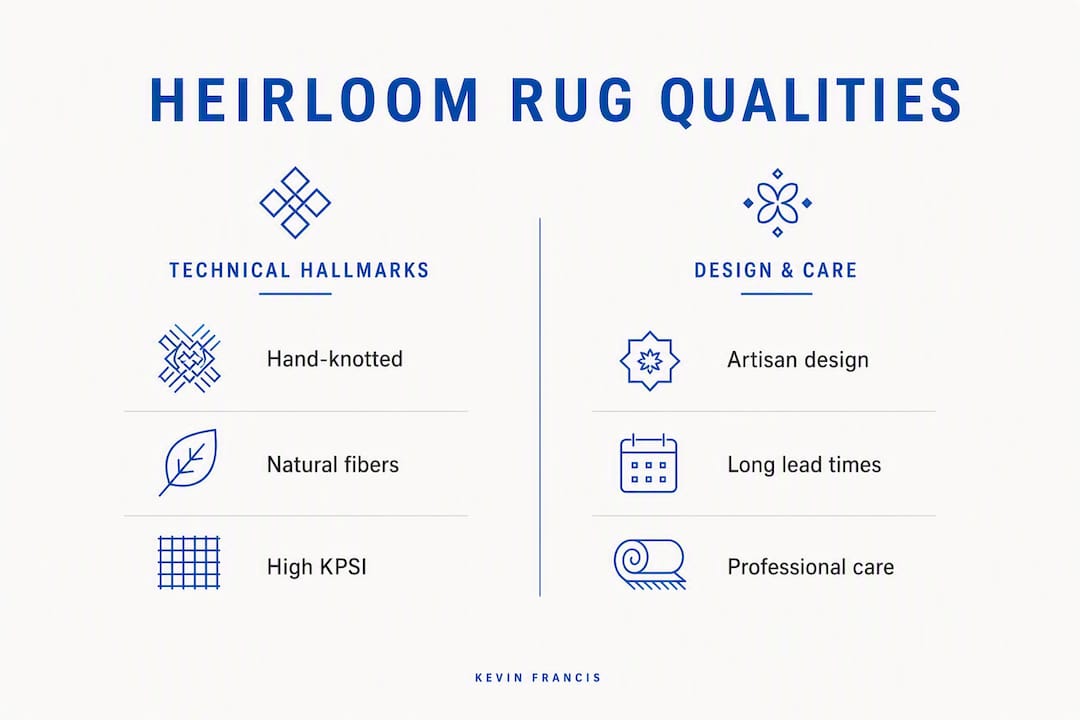
Three hallmarks identify a genuinely heirloom-quality piece at a glance:
- Construction: Hand-knotted, handwoven, or Tibetan-knotted structure with a verifiable knot count and a foundation that can be repaired by a skilled weaver decades from now.
- Materials: Premium natural fibers — Chokla, New Zealand Merino, or Afghan Ghazni wool; silk accents; cotton or wool foundations — sourced for tensile strength and long-term luster.
- Finishing: A multi-step finishing sequence (pile shearing, selvedge binding, washing, blocking) that locks in dimensional stability and sets the pile height permanently.
A reputable atelier will document all three, offer a repair policy, and quote a lead time measured in months rather than days.
Table of Contents
- What technical hallmarks actually define heirloom quality?
- How are heirloom rugs made, from design to delivery?
- How do heirloom rugs age, and why is that a feature?
- How should you care for an heirloom rug over decades?
- What should you ask before buying or commissioning one?
- Why do bespoke heirloom rugs belong in high-end residential interiors?
- What does a real atelier commission look like?
- Key Takeaways
- The case for making heirloom your default standard
- Commission a handmade heirloom rug from Kevin Francis Design
- Useful sources and further reading
- FAQ
What technical hallmarks actually define heirloom quality?
Hand-knotted construction is the most reliable single signal of heirloom intent. Each knot is tied individually around the warp threads, creating a structure that can be unwoven and rewoven at any point in the rug’s life. Handwoven flatweaves and Tibetan-knotted pieces share this repairability, though their pile character differs. High-end hand-tufted rugs occupy a middle ground: the tufting gun speeds production, but the latex backing used to secure the pile cannot be rewoven, which limits long-term conservation options.
Knot density, measured in KPSI (knots per square inch), determines how much pattern detail the weave can hold and how the surface wears under foot traffic. A higher KPSI allows finer motifs and a denser, more resilient pile. The density range appropriate for a given piece depends on the design’s complexity and the pile height specified.
- Wool grade: Producers select Chokla, New Zealand Merino, or Afghan Ghazni wool for premium pieces because each balances softness with tensile strength. Poor-quality wool pills and loses luster relatively quickly.
- Silk accents: Used selectively in highlights, silk catches light differently from wool, adding visual depth without compromising structural integrity.
- Foundation: A strong cotton or wool warp-and-weft foundation is what allows structural repairs; a weak foundation makes reweaving impossible.
- Selvedges and fringe: Finished selvedges should feel firm and lie flat. Fringe that is sewn on rather than woven as an extension of the warp is a clear sign of machine or low-quality production.
Pro Tip: Turn the rug over. On a genuine hand-knotted piece, the back shows individual knot nodes in a pattern that mirrors the front design. A machine-made rug has a uniform, grid-like backing with no visible knot variation. The fringe on a handmade rug emerges directly from the warp threads — it is not attached.
How are heirloom rugs made, from design to delivery?
The production sequence at a serious atelier follows a logical arc, and understanding it helps you ask the right questions when commissioning.
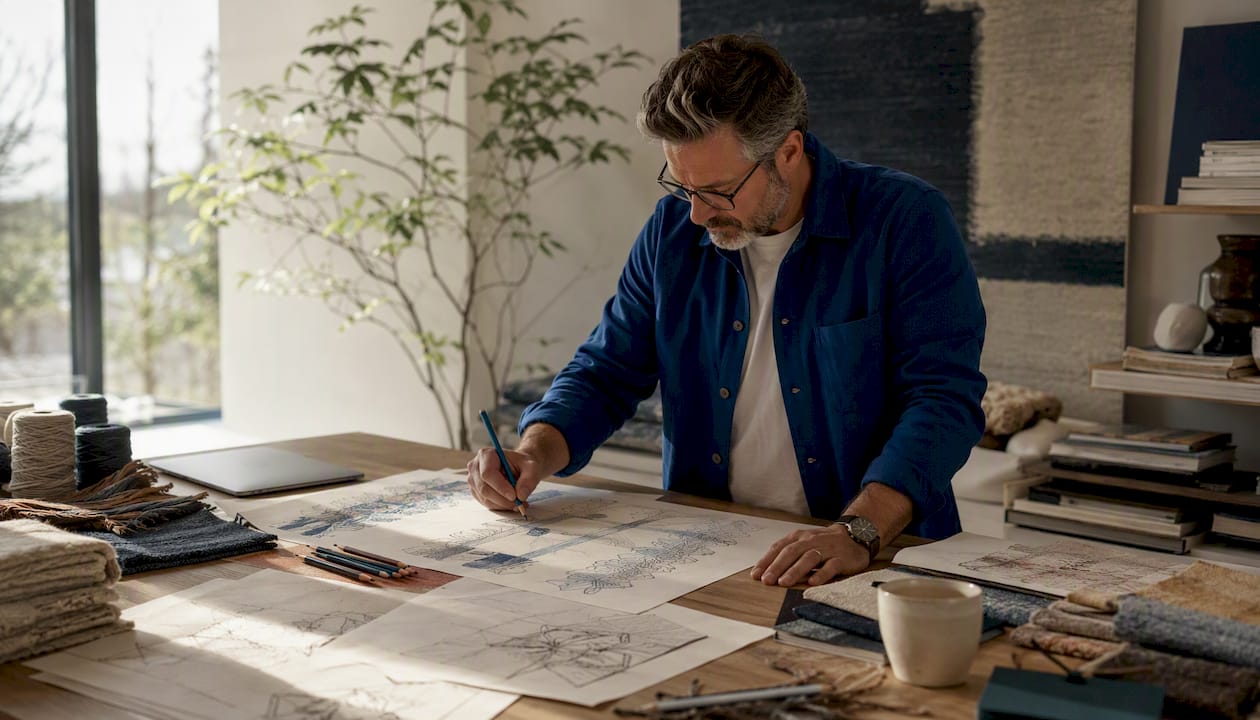
- Design and naksha: The pattern is translated into a naksha, a knot-by-knot color map that the weaver reads row by row. This is the blueprint that makes complex geometric or figurative designs reproducible.
- Warping: Cotton or wool warp threads are stretched vertically on the loom, establishing the rug’s length and the foundation for every knot.
- Knotting: Weavers tie individual knots — Persian (Senneh), Turkish (Ghiordes), or Tibetan — around pairs of warp threads, cutting the yarn to set pile height. This is the stage that consumes most of the production time.
- Weft packing: After each row of knots, one or more weft threads are passed horizontally and beaten down to lock the knots in place and build structural density.
- Off-loom finishing: After weaving, up to 18 manual finishing steps may be required. Finishing alone can take 2–4 weeks when done entirely by hand, and includes pile shearing to set consistent height, edge binding, washing, and blocking to correct dimensions.
For a bespoke 8×10 hand-knotted wool rug at a fine atelier, expect a production timeline measured in several months from design approval to shipment, depending on KPSI and pile complexity. Rushed finishing is the most common quality failure: skipping pile shearing or selvedge binding causes dimensional distortions that cannot be corrected after the fact.
When comparing methods, hand-knotted and handwoven rugs offer the fullest repairability and the most authentic aging character. High-end hand-tufted pieces can achieve beautiful surface results but require more careful conservation planning given their latex backing.
How do heirloom rugs age, and why is that a feature?
Natural fibers mellow with use in a way that synthetic materials simply cannot replicate. Wool softens slightly underfoot, colors deepen and harmonize, and the pile develops a gentle sheen that reads as warmth rather than wear. This is patina, and for a well-made piece, it is the point.
Abrash, the subtle color variation that appears in hand-spun yarns, becomes more pronounced and more beautiful over decades. What looks like slight inconsistency in a new rug reads as extraordinary depth after twenty years of proper use.
A few practices accelerate graceful aging; others create damage that mimics it poorly:
- Rotate the rug every 12–18 months to distribute foot traffic and light exposure evenly.
- Avoid harsh chemical cleaners, which strip natural lanolin from wool and accelerate fiber breakdown.
- Allow the pile to breathe — avoid rubber-backed pads that trap moisture and cause mildew.
- Expect and welcome abrash as a sign of hand-spun yarn, not a defect.
Handmade rugs age differently from machine-made pieces precisely because their natural fibers and hand-tied structure respond to use as a living material rather than a static product.
How should you care for an heirloom rug over decades?
Preservation at the atelier level is less complicated than most homeowners expect, but it does require consistency.
- Vacuum weekly using a suction-only attachment or a low-power setting — never a beater bar, which stresses the pile and loosens knots over time.
- Rotate every 12–18 months to prevent uneven fading and wear patterns.
- Spot-clean immediately with cold water and a clean white cloth; blot, never rub.
- Schedule a professional deep clean every three to five years with a specialist who understands hand-knotted construction and natural dyes.
- Address structural repairs early — a loose fringe or a small area of pile loss is a minor reweaving job when caught promptly; left unattended, it becomes a structural failure.
For conservation, require your atelier or repair specialist to offer reweaving, fringe restoration, selvedge rebinding, and backing stabilization. These are the four structural services that determine whether a rug survives another generation.
Pro Tip: Choose a rug pad made from natural felt or a felt-and-rubber combination rather than solid rubber. Natural felt allows airflow beneath the pile, prevents moisture accumulation, and cushions the foundation without the dimensional creep that solid rubber causes over years of use. For protecting luxury rugs in high-traffic areas, pad choice is as consequential as cleaning frequency.
What should you ask before buying or commissioning one?
The designer’s checklist for qualifying an heirloom-quality rug comes down to documentation and transparency. Provenance and a documented repair policy are the two trust signals that protect your investment most directly.
Specification checklist:
- Fiber composition and yarn origin (country, breed, grade)
- Knot type (Persian, Turkish, Tibetan) and KPSI range
- Dye type (vegetable, chrome, synthetic) and colorfastness documentation
- Finishing steps completed and by whom
- Documented repair policy and named conservation partner
- Atelier provenance: workshop location, artisan profiles, production photos
| Tier | Typical price range (8×10) | Lead time |
|---|---|---|
| Studio workshop | $3,000 | 3–5 months |
| Fine workshop | $8,000 | 5–8 months |
| Bespoke atelier | — | 8 months |
Ranges are indicative; actual pricing depends on KPSI, fiber grade, and design complexity.
Questions to ask on enquiry:
- Can you share workshop photos and artisan profiles for this commission?
- What wool origin and grade will be used, and can I see a yarn sample?
- What finishing steps are included, and how long does finishing take?
- What are your contract terms, deposit structure, and staged approval milestones?
- How is the rug shipped, and what insurance covers it in transit?
For custom sizing, confirm whether the change affects KPSI, pile direction, or border proportions — these are the three variables most likely to shift pricing and timeline. Request a design proof, in-progress knotting photos at the halfway point, and a pre-shipment inspection image of the back.
Why do bespoke heirloom rugs belong in high-end residential interiors?
A hand-knotted rug is one of the few furnishing elements that increases in visual and material value as the rest of the room evolves around it. Furniture changes, paint colors shift, and lighting gets updated — but a well-chosen heirloom rug anchors the space through every iteration.
- Durability: Natural wool and silk resist compression and fiber breakdown far longer than synthetic pile; a properly maintained hand-knotted rug can outlast multiple furniture cycles.
- Design specificity: Bespoke scale, custom color calibration, and original motifs mean the rug was made for that room, not adapted to it.
- Repairability: Unlike mass-market rugs, which are replaced when damaged, heirloom pieces can be rewoven, rebound, and restored — making them a genuinely long-term investment.
- Staging and resale: In luxury real estate, a statement handmade rug reads as a design credential. It signals that the space was considered, not assembled.
Artisan rugs differ from mass-produced alternatives in every dimension that matters for a long-term interior: material resilience, visual depth, and the capacity to be repaired rather than discarded.
What does a real atelier commission look like?
The Lotto Hand-Knotted Wool Area Rug from Kevin Francis Design illustrates what atelier-level specification looks like in practice: hand-knotted construction, premium wool pile, and a geometric pattern derived from historical Turkish weaving traditions. It is the kind of piece that arrives with a documented production story and ages into a room rather than out of it.
When commissioning any hand-knotted piece, request the following from your atelier:
- Raw fiber origin documentation (country, breed, grade)
- Hand-spun yarn evidence (abrash variation visible in sample skeins)
- In-progress knotting photos at 25% and 50% completion
- Finishing-stage images showing pile shearing and selvedge binding
- Back-of-rug photograph showing individual knot nodes
- Selvedge detail closeup confirming structural binding
Photo-request template for your order file:
- Raw fiber/yarn sample with origin label
- Loom setup photo showing warp threading
- In-progress knotting photo (pile side and back side)
- Post-shearing pile closeup showing consistent height
- Finished back photograph showing full knot pattern
- Selvedge and fringe detail confirming woven (not sewn) construction
- Blocking/washing confirmation image
This documentation becomes part of the rug’s provenance record and supports any future conservation or insurance valuation. Interior designers working within a designer trade program will recognize this kind of staged documentation as standard practice for high-value commissions across all categories of bespoke furnishing.
Key Takeaways
A genuinely heirloom-quality rug is defined by hand-knotted or equivalent artisan construction, premium natural fibers, and a multi-step finishing sequence — not by age or antique status.
| Point | Details |
|---|---|
| Heirloom means new and handmade | An heirloom rug is a new, artisan-crafted piece built for generational use, not an antique defined by age. |
| Finishing quality determines longevity | Up to 18 manual finishing steps and 2–4 weeks of hand finishing separate a rug that lasts generations from one that warps within years. |
| Wool origin is a material signal | Chokla, New Zealand Merino, or Afghan Ghazni wool resists pilling and luster loss; poor wool fails within 3–5 years. |
| Documentation protects your investment | Always require fiber origin, workshop photos, KPSI specification, and a documented repair policy before purchase. |
| Kevin Francis Design | Offers hand-knotted wool rugs with atelier provenance and custom sizing, including the Lotto Hand-Knotted Wool Area Rug. |
The case for making heirloom your default standard
There is a tendency in luxury interiors to treat the rug as the last decision, chosen to complement everything else already in place. That instinct produces competent rooms. It rarely produces memorable ones.
The pieces that define a space over decades are almost always the ones that were specified first and specified with intention. A hand-knotted rug made from Ghazni wool with a custom color palette calibrated to the architecture of a specific room is not a background element. It is the room’s foundation, literally and visually. Everything placed on top of it borrows from its character.
What I find most compelling about the heirloom standard is not the durability argument, though that case is real and well-documented. It is the idea that a rug made this way carries the evidence of its own making. The abrash in the pile, the slight variation in the selvedge, the way the color deepens near the border where the weaver’s tension shifted slightly — these are not imperfections. They are the record of a human being working at the highest level of their craft. No machine produces that. No shortcut preserves it.
Specify accordingly.
Commission a handmade heirloom rug from Kevin Francis Design
Kevin Francis Design brings the full atelier commissioning experience to designers and homeowners who want a rug made for a specific room, not adapted to it. The process begins with a design brief and color consultation, moves through sample approvals and staged production photography, and concludes with delivery and a conservation pledge that covers the piece’s long-term care.
Typical lead times run several months depending on construction complexity and pile density. A deposit structure with milestone approvals keeps the commission transparent at every stage, and each rug arrives with complete atelier documentation: fiber origin, production photos, finishing confirmation, and repair policy.
Browse the Lotto Hand-Knotted Wool Area Rug as a starting point, or contact the studio directly to discuss a bespoke commission tailored to your project’s exact scale, palette, and motif.
Useful sources and further reading
A note on scope: this guide defines “heirloom” as new, handmade, and intended for long-term use. It does not address antique or vintage rugs, which are age-classified categories with different valuation frameworks.
- Antique vs Vintage vs Old — RugIndustry Glossary: Authoritative glossary entry defining age-based rug classifications; useful for understanding what this guide explicitly does not cover.
FAQ
What is an heirloom-quality rug, exactly?
An heirloom-quality rug is a new, handmade piece built for generational use through hand-knotted or equivalent artisan construction, premium natural fibers, and rigorous finishing. It is defined by craft and material integrity, not age.
How do you identify a genuine hand-knotted rug?
Turn the rug over: a hand-knotted piece shows individual knot nodes on the back that mirror the front design, and the fringe emerges directly from the warp threads rather than being sewn on.
How long does a bespoke heirloom rug take to make?
A typical bespoke 8×10 hand-knotted wool rug takes several months from design approval to delivery, with up to 2–4 weeks of manual finishing steps alone.
How often should an heirloom rug be professionally cleaned?
A professional deep clean with a specialist in hand-knotted construction and natural dyes is recommended every three to five years, with structural repairs addressed as soon as any pile loss or fringe damage appears.
Does Kevin Francis Design offer custom sizing for heirloom rugs?
Yes. Kevin Francis Design offers custom sizing and bespoke commissions, including the Lotto Hand-Knotted Wool Area Rug, with atelier documentation and a conservation pledge delivered with each piece.
Recommended
- What Makes a Rug Truly Handmade: A Collector’s Guide – Kevin Francis Design
- Buying Hand-Tufted Area Rugs: A Rug Maker’s Complete Guide – Kevin Francis Design
- Artisan vs. Mass-Produced Rugs: How They Really Differ – Kevin Francis Design
- How Rug Craftsmanship Reflects Cultural Heritage – Kevin Francis Design


