


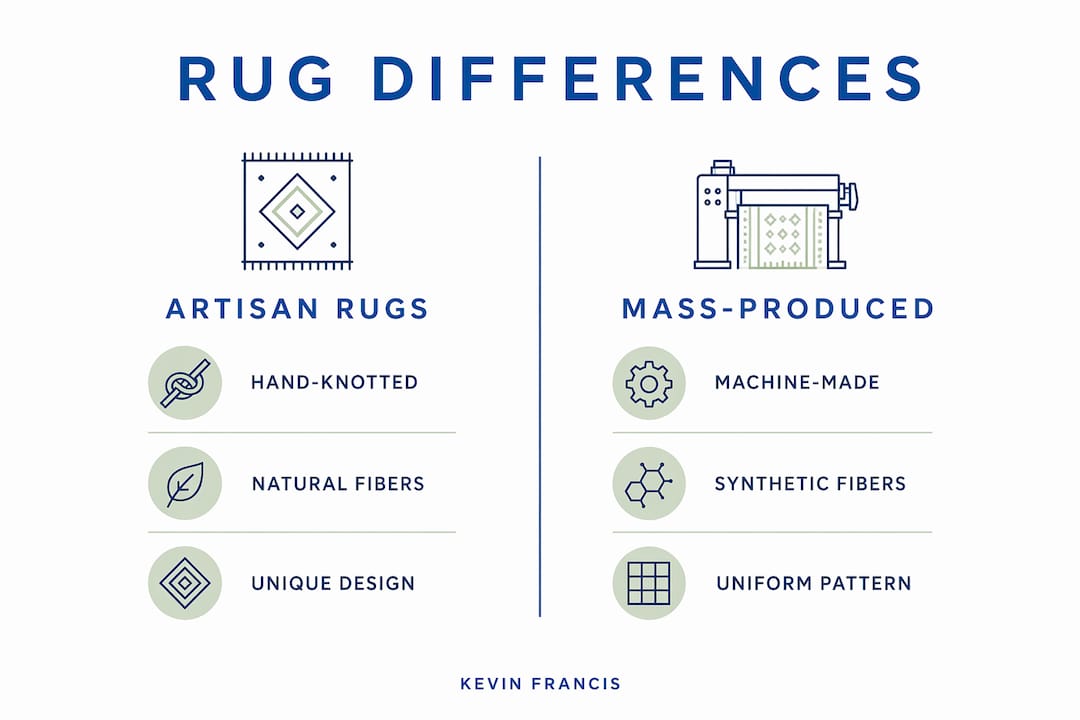
Artisan rugs differ from mass-produced rugs in five fundamental ways: construction method (hand-knotted, hand-tufted, or hand-loomed versus power-loomed), fiber choice (natural wool, silk, and cotton versus synthetic polypropylene and polyester), longevity (decades to generational versus a few years of useful life), design character (one-of-a-kind or limited-run versus identical repeating patterns), and long-term value (appreciating heirlooms versus depreciating commodities).
Here is how each dimension plays out in practice:
- Construction: Artisan rugs are built knot by knot or loop by loop by hand; machine-made rugs are woven by power looms at industrial speed with no individual human touch per thread.
- Materials: Handmade pieces typically use natural fibers — wool, silk, cotton, jute — while mass-produced rugs lean on polypropylene, nylon, or polyester.
- Lifespan: A well-made hand-knotted wool rug can last for many decades; a machine-made synthetic rug typically shows significant wear within a shorter period.
- Design: Every artisan rug carries slight, unrepeatable variations in color and pattern; factory rugs reproduce the same design identically across thousands of units.
- Price and value: Artisan rugs cost more upfront but often hold or increase in resale value; mass-produced rugs depreciate quickly.
Pro Tip: The fastest physical check is also the most reliable — flip the rug over and look at the back. A genuine handmade piece shows the pattern and individual knots mirrored on the reverse; a machine-made rug has a uniform, grid-like backing with a sewn-on fringe.
Table of Contents
- What “artisan/handmade” and “machine-made” actually mean
- How artisan and mass-produced rugs are constructed — and why it matters
- Natural fibers vs. synthetics: what your rug is actually made of
- How artisan rugs age versus mass-produced rugs
- Why artisan rugs offer design you cannot replicate at scale
- Price and value: when the artisan premium is genuinely justified
- Environmental and ethical considerations
- How to tell if a rug is genuinely handmade
- Care, cleaning, and repair: how maintenance differs
- When to choose an artisan rug and when mass-produced makes sense
- What specialists say about wool performance and rug inspection
- Key Takeaways
- Why craftsmanship has always been the starting point
- Artisan rugs from Kevin Francis Design
- FAQ
What “artisan/handmade” and “machine-made” actually mean
These terms get used loosely in retail, so precision matters before we go further.
Artisan / handmade constructions:
- Hand-knotted: Individual knots (Persian/Senneh or Turkish/Ghiordes) are tied by hand around warp threads, row by row. The most labor-intensive and durable method. Typical materials: wool, silk, or a blend.
- Hand-tufted: A tufting gun punches yarn through a canvas backing; a secondary latex-and-cloth backing is glued on to hold the tufts. Faster than hand-knotting, lower cost, but structurally weaker. Typical materials: wool, acrylic, or blends.
- Hand-loomed / flat-woven: Weft threads are woven over and under warp threads on a loom operated by hand (kilims and dhurries fall here). No pile; reversible; durable for flat-weave use. Typical materials: wool, cotton, jute.
Machine-made / mass-produced constructions:
- Power-loomed: Computer-controlled looms produce pile or flat-weave rugs at high speed. Patterns are perfectly uniform; backing is typically latex or synthetic mesh. Typical materials: polypropylene, polyester, nylon, or wool blends.
- Machine-tufted: Similar to hand-tufted but the tufting gun is automated. Often sold under the “hand-tufted look” label.
Where hand-tufted sits: Hand-tufted rugs occupy a middle ground. The yarn is placed by a human operator, so they carry some artisan character, but the glued canvas backing and the absence of individual knots put them structurally closer to machine-made than to hand-knotted. Understanding this distinction is central to the hand-knotted vs. hand-tufted comparison that so many buyers find confusing.
How artisan and mass-produced rugs are constructed — and why it matters
The construction process is where the differences in rug manufacturing become most tangible, and where the gap in long-term performance originates.
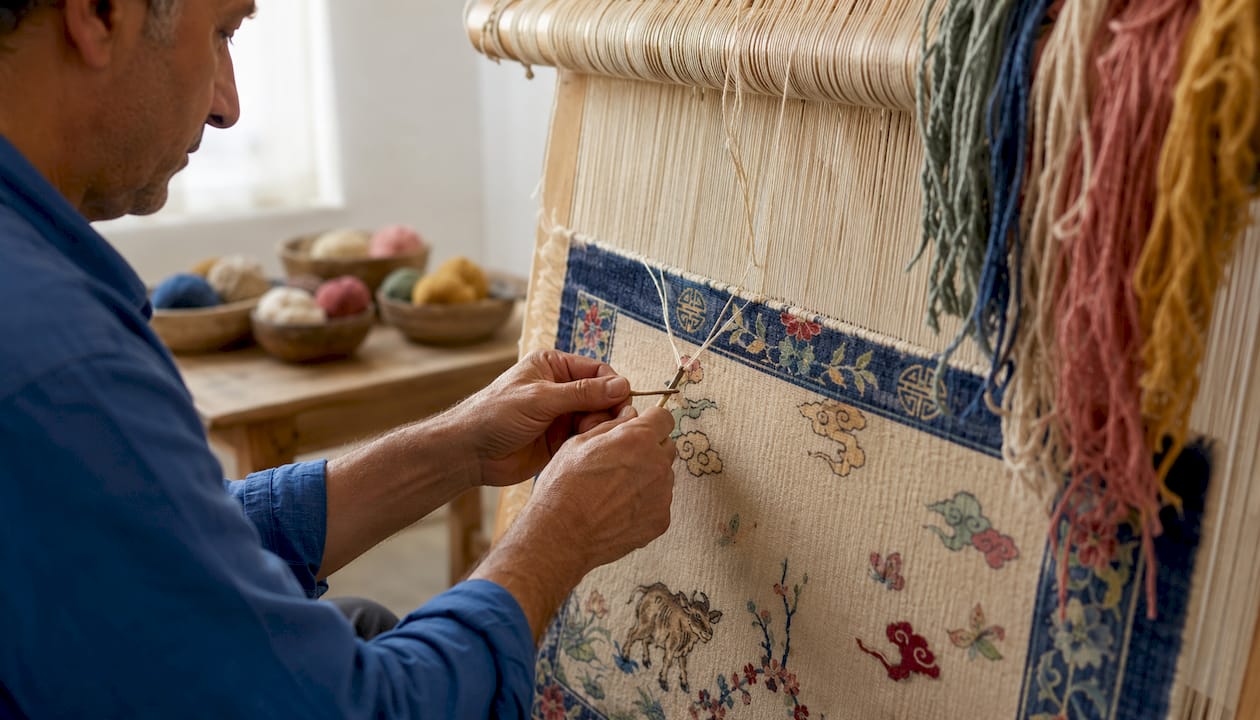
Hand-knotted rugs are built entirely from individual knots tied around pairs of warp threads. A skilled weaver ties each knot by hand, cuts the yarn, and advances to the next pair. A large hand-knotted rug — say, a 9×12 — can contain anywhere from one million to over ten million knots depending on the design’s complexity and the weaver’s knot density. That density, measured in knots per square inch (KPSI), is one of the most reliable indicators of quality: a fine Persian city rug might achieve 300–500 KPSI, while a tribal piece might sit at 40–80 KPSI. Neither is inferior; they serve different aesthetic and structural purposes.
Hand-tufted rugs skip the individual knotting step. A tufting gun drives loops of yarn through a stretched canvas, and a latex adhesive backing locks them in place. The result looks similar to a hand-knotted pile from above, but the back tells a different story: a flat canvas sheet rather than a field of visible knots. Tufted rugs’ glued canvas backing can break down over time, and immersion cleaning accelerates that failure — a critical care distinction covered later.
Power-loomed rugs are woven by computer-controlled machinery that replicates patterns with mechanical precision. The backing is uniform, the fringe is sewn on separately (or heat-bonded), and the pile height is perfectly consistent across the entire surface. That uniformity is a tell, not a virtue.
Flip any rug you are considering and study the back for 30 seconds. On a hand-knotted piece, you will see the actual pattern rendered in individual knots — slightly irregular, full of life. On a machine-made rug, you will see a grid so uniform it looks printed. The fringe on a handmade rug grows from the warp threads themselves; on a factory rug, it is stitched or glued on as an afterthought.
Repairability is the practical consequence of construction. A hand-knotted rug can be rewoven, re-piled, and restored knot by knot. A machine-made rug, once the pile crushes or the backing separates, is essentially unrepairable in any meaningful sense.
Pro Tip: When evaluating knot density in-store, fold a small section of the rug back on itself and count the knot rows visible along the fold per linear inch. More rows per inch generally signals finer construction and longer pile life.
Natural fibers vs. synthetics: what your rug is actually made of
Material choice shapes how a rug feels underfoot, how it ages, and how it performs under real household conditions.
| Fiber | Type | Resilience | Stain resistance | Feel | Best use |
|---|---|---|---|---|---|
| Wool | Natural | Excellent | Good (lanolin) | Warm, springy | Living rooms, bedrooms |
| Silk | Natural | Moderate | Low | Lustrous, delicate | Low-traffic, display |
| Cotton | Natural | Moderate | Fair | Soft, flat | Casual rooms, layering |
| Jute / sisal | Natural | Good | Poor (absorbs liquid) | Textured, earthy | Dry rooms, layering |
| Polypropylene | Synthetic | Low–moderate | Excellent | Flat, plastic-feel | Outdoor, high-spill |
| Polyester | Synthetic | Low | Good | Soft but crushes | Budget interiors |
| Nylon | Synthetic | Good | Good | Resilient | High-traffic budget |
Wool is widely regarded as the premier rug fiber for durability, soil resistance, and long-term beauty. Its natural lanolin content repels water and dirt, and its crimp structure gives pile a springy recovery that synthetics cannot replicate. For high-traffic rooms, wool’s combination of resilience and cleanability makes it the most practical natural choice.
Statistic callout: Wool fibers can bend thousands of times without breaking, a level of elasticity that lets pile spring back from crushing far better than most synthetic alternatives. For a homeowner, this translates directly to a rug that looks fresh after years of foot traffic rather than flat and lifeless.
Silk is the luxury outlier: its sheen is unmatched, but it is fragile under foot traffic and sensitive to moisture. Silk rugs belong in low-traffic spaces where their painterly luminosity can be appreciated without the punishment of daily wear.
Synthetic fibers — polypropylene especially — resist staining and moisture brilliantly, which is why they dominate outdoor and budget indoor categories. The tradeoff is pile crush: once a synthetic pile flattens, it rarely recovers. Blended constructions (wool warp with a synthetic weft, or wool pile over a cotton foundation) exist to balance cost against performance, and they can be a sensible middle ground for buyers who want natural-fiber character without full artisan pricing.
How artisan rugs age versus mass-produced rugs
A hand-knotted wool rug does not simply last longer — it ages differently, in ways that can actually increase its appeal and value.
The mechanisms behind that longevity are structural. Each knot is an independent unit; if one row wears, the surrounding structure remains intact and a skilled restorer can reweave the damaged section. Wool’s elasticity (those thousands of bend cycles without fiber breakage) means pile recovers from compression rather than collapsing permanently. Natural dyes, used in many traditional artisan rugs, tend to mellow and deepen over decades rather than bleach out unevenly.
Typical lifespan expectations:
- Hand-knotted wool rugs have a very long lifespan with proper care, often lasting many decades; antique examples can last even longer.
- Hand-tufted rugs typically show wear and degradation over a couple of decades as their backing deteriorates.
- Power-loomed synthetic rugs tend to have shorter lifespans under normal household use.
Machine-made rugs show their age through pile crush, fringe fraying, and color fading — all of which happen uniformly across the surface, leaving no graceful middle stage. An artisan rug, by contrast, develops what collectors call a patina: a softening of color and a slight sheen that signals age and use rather than neglect. Persian and Turkish rugs from the early 20th century routinely sell at auction for multiples of their original price precisely because that patina is desirable.
Statistic callout: Wool’s extraordinary fiber elasticity — the ability to bend many thousands of times without breaking — is the physical reason a hand-knotted wool rug can absorb decades of foot traffic and still look alive. A synthetic pile fiber simply does not have that recovery capacity.
Why artisan rugs offer design you cannot replicate at scale
Every hand-knotted or hand-loomed rug is, in a meaningful sense, a unique object. That is not marketing language; it is a structural consequence of how these pieces are made.
Dye lots in natural fiber dyeing are never perfectly reproducible. A weaver working with plant-based or mineral dyes mixes batches that vary slightly from one commission to the next, and even within a single rug, subtle tonal shifts can appear where one dye lot ends and another begins. These variations, called abrash, are considered marks of authenticity rather than flaws. They give the surface a living, painterly quality that no power loom can manufacture.
Bespoke commissions take this further. A buyer can work with an artisan studio to specify pattern, palette, pile height, and dimensions — producing a piece that exists nowhere else in the world. Kevin Francis Design’s approach to custom work, for instance, allows clients to translate a personal motif or architectural reference into a hand-knotted floor piece with a level of specificity that factory production simply cannot accommodate.
What to ask a seller about design authenticity:
- Are the dyes natural or synthetic? Natural dyes produce abrash; synthetic dyes are more uniform.
- Is this piece from a single dye lot, or were multiple lots used? If multiple, where do the transitions fall?
- Is the pattern hand-drawn on the warp before weaving, or transferred from a digital template?
- For custom work: can you see the cartoon (the full-scale design drawing) before production begins?
Pro Tip: Slight color variation across a rug’s field is a positive sign, not a defect. If a seller describes a rug as “perfectly uniform in color throughout,” that is a stronger indicator of machine production than of quality.
Price and value: when the artisan premium is genuinely justified
The price gap between artisan and mass-produced rugs can feel stark — sometimes by a factor of ten or more for comparable dimensions. Understanding what drives that gap makes the decision much clearer.
Primary price drivers for artisan rugs:
- Labor and time: A hand-knotted 9×12 rug can take one weaver six months to two years to complete, depending on KPSI and complexity.
- Material quality: Fine New Zealand wool, hand-spun Tibetan wool, or mulberry silk cost significantly more than polypropylene.
- Design complexity: More colors, finer patterns, and bespoke commissions all increase weaving time and therefore cost.
- Provenance: Rugs from established weaving regions (Tabriz, Oushak, Tibetan highlands) carry a premium tied to tradition, skill concentration, and collector demand.
- Repairability and resale: A hand-knotted rug can be restored and resold; a machine-made rug cannot.
Break-even thinking: A quality hand-knotted wool rug priced at $3,000 that lasts 60 years costs roughly $50 per year. A machine-made synthetic at $300 that needs replacing every seven years costs about $43 per year — nearly the same annual cost, with none of the resale value, none of the patina, and none of the heirloom potential.
When the artisan premium is worth it:
- Formal living rooms, dining rooms, and primary bedrooms where the rug is a design anchor
- Spaces where the piece will be seen and appreciated daily
- Buyers who want a rug that can be passed down or sold
- Anyone prioritizing natural materials and ethical production
When mass-produced is a reasonable choice:
- Children’s playrooms and pet areas where spills and damage are frequent
- Rental properties or temporary living situations
- Outdoor spaces where UV and moisture exposure will degrade any fiber
- Budget-constrained buyers who need floor coverage now and can upgrade later
Environmental and ethical considerations
The sustainability story of artisan rugs is not simply about natural fibers — it is about the entire lifecycle of the object.
Natural wool, cotton, and jute are renewable and biodegradable. Synthetic fibers like polypropylene are petroleum derivatives that do not biodegrade and shed microplastics during washing. The dyeing process matters too: natural plant and mineral dyes have a far lower chemical load than the synthetic azo dyes used in most mass production, though natural dyeing is more resource-intensive in water use.
The longer a rug lasts, the lower its environmental cost per year of use. A hand-knotted wool rug that serves a household for 60 years represents a fraction of the resource consumption of six successive machine-made replacements over the same period. Repairability compounds this advantage: a restored rug is not a discarded one.
Labor conditions are a genuine concern in artisan rug production. Organizations like GoodWeave certify that rugs are produced without child labor and under fair working conditions. The U.S. Green Building Council also recognizes rug producers working toward sustainable practices.
Verification tips when sustainability matters to you:
- Ask for GoodWeave certification or equivalent third-party labor verification.
- Request fiber sourcing information: where was the wool shorn, and how was it processed?
- Ask whether dyes are natural or low-impact synthetic; request a dye safety data sheet if available.
- Look for craftsmanship-focused producers who document their supply chain.
Pro Tip: A seller who cannot tell you where the fiber was sourced or who produced the rug is a seller who has not asked those questions themselves. Transparency about provenance is one of the clearest signals of genuine artisan production.
How to tell if a rug is genuinely handmade
This checklist works in-store or when evaluating seller photographs. Go through it in order — the first two steps alone will resolve most cases.
Step-by-step inspection:
- Flip the rug. The back is the most reliable tell. A hand-knotted rug shows the pattern mirrored in individual, slightly irregular knots. A machine-made rug has a uniform, grid-like backing that looks almost printed.
- Check the fringe. On a genuine hand-knotted or hand-loomed rug, the fringe is an extension of the warp threads — it grows from the rug’s foundation. On a machine-made rug, the fringe is sewn or glued on separately. Pull gently: a sewn fringe will feel attached at a seam; an integral fringe will feel continuous with the body.
- Look for slight irregularities. Perfectly uniform pile height, perfectly straight edges, and perfectly consistent color across the entire field are signs of machine production. Slight variations in pile, a gently undulating edge, or subtle color shifts (abrash) indicate hand work.
- Estimate knot density. Fold a corner back and count knot rows per inch along the fold. Finer rugs will show more rows; coarser tribal pieces fewer. Either can be hand-knotted — the point is whether individual knots are visible at all.
- Examine the edge finishing. Hand-knotted rugs typically have hand-stitched or hand-overcast edges (selvedge). Machine-made rugs often have serged or heat-bonded edges.
- Check for a secondary backing. A canvas or jute cloth glued to the underside indicates a hand-tufted construction, not hand-knotted. This is not a flaw, but it is a structural distinction worth knowing.
- Read the label. Look for “hand-knotted,” “hand-loomed,” or “hand-tufted” — not just “handmade,” which is a looser term. Country of origin can also be informative: rugs from Iran, Turkey, India, Nepal, and Morocco are more likely to be genuinely hand-produced.
For online shopping — what to request from sellers:
- A close-up photograph of the back of the rug
- A close-up of the fringe attachment point
- An image of the edge finishing (selvedge)
- A certificate of origin or weaver documentation if available
Kevin Francis Design’s craftsmanship identification guide walks through these visual checks with supporting photography, which is particularly useful when shopping remotely.
Pro Tip: Ask the seller directly: “Can you show me a photograph of the back of this rug?” A confident artisan seller will have that image ready or will take one immediately. Hesitation or redirection is itself informative.
Care, cleaning, and repair: how maintenance differs
Artisan and mass-produced rugs require meaningfully different care approaches, and the wrong method on the wrong rug can cause irreversible damage.
Routine maintenance for artisan rugs:
- Vacuum on low suction, without a beater bar, in the direction of the pile. Avoid vacuuming the fringe directly.
- Rotate the rug 180 degrees every 6–12 months to distribute wear evenly.
- Use a quality rug pad: it prevents slipping, reduces pile compression, and protects the foundation from floor abrasion.
- Blot spills immediately with a clean white cloth; never rub. For wool, cold water and mild soap are safe for most fresh stains.
When professional cleaning is required:
- For hand-knotted wool rugs: professional wash every 3–5 years, depending on traffic. A specialist rug cleaner will wash the piece flat, control water temperature, and dry it properly to prevent dye bleed.
- For hand-tufted rugs: surface cleaning is generally safer than full immersion. The latex backing in tufted rugs can degrade with wet cleaning, causing the secondary backing to separate and the pile to shed. Ask a professional cleaner specifically about tufted construction before proceeding.
- For machine-made synthetics: most can tolerate more aggressive cleaning, including steam, though always check the manufacturer’s label.
Kevin Francis Design’s care guide for handmade rugs covers dye stability, vacuuming technique, and professional cleaning frequency in practical detail.
Red flags to avoid:
- Full immersion cleaning on rugs with unstable natural dyes (colors will bleed)
- Household steam cleaners on hand-knotted wool (heat and pressure damage the pile)
- Harsh detergents or enzyme-based cleaners on natural fibers (they strip lanolin and weaken the fiber)
- Leaving a wet rug rolled up (mold and mildew develop within hours)
Pro Tip: Before any cleaning, test a small, hidden corner with your chosen method and let it dry fully. Natural dye instability is not always visible until the rug is wet.
When to choose an artisan rug and when mass-produced makes sense
The right choice depends on how you use the space, what you want the rug to do, and how long you plan to keep it.
Quick use-case guide:
- Formal living room or dining room: Artisan rug. The piece will be seen daily, should anchor the room’s design, and will benefit from the longevity and patina that only handmade construction delivers.
- Primary bedroom: Artisan rug, particularly hand-knotted wool. Low traffic, high visibility, and the tactile pleasure of natural fiber underfoot each morning.
- Children’s playroom or pet area: Mass-produced synthetic. Spills, stains, and rough use will degrade any rug; a replaceable polypropylene piece makes practical sense here.
- Outdoor space or covered patio: Machine-made synthetic designed for outdoor use. No natural fiber belongs in direct sun and moisture exposure.
- Rental property or temporary space: Mass-produced. The investment calculus does not favor artisan pricing when the rug may be left behind or damaged by tenants.
- Entryway or mudroom: A flat-woven artisan piece (kilim or dhurrie) or a durable machine-made option, depending on budget and aesthetic priority.
Decision flow:
- Will this rug be a long-term design investment, or functional floor coverage? Long-term investment points toward artisan; functional coverage toward mass-produced.
- Is the fiber’s natural feel and aging quality important to you? Yes points toward wool or silk; no opens the door to synthetics.
- Are you willing to maintain it professionally every few years? Yes supports artisan; no favors a lower-maintenance machine-made piece.
- Do you want something unique, or is a consistent repeating pattern acceptable? Unique points firmly toward artisan.
Blended options — a wool pile on a machine-woven cotton foundation, for example — can offer a middle path. They carry more natural-fiber character than full synthetics and more durability than pure hand-tufted constructions, at a price point below fully hand-knotted work.
What specialists say about wool performance and rug inspection
Two expert signals stand above the rest when evaluating rug quality: wool’s physical resilience and the back-of-rug inspection technique. Both are grounded in material science and practical observation rather than marketing.
Statistic callout: Industry experts consistently cite wool’s fiber elasticity as its defining performance advantage. Wool fibers can bend many thousands of times without breaking — a property rooted in the fiber’s natural crimp and lanolin content. For a rug owner, this means a wool pile that springs back after years of foot traffic rather than compressing into a flat, lifeless mat.
The back-of-rug inspection is the single most reliable non-destructive test available to a buyer. As rug cleaning specialists note, a hand-knotted rug shows a clear, mirrored pattern of individual knots on its reverse, while a machine-made rug presents a uniform grid. This test takes under a minute and requires no tools.
Quick authority checklist for buyers:
- Knot density (KPSI): Ask the seller or count yourself. Higher KPSI generally indicates finer construction and longer pile life.
- Provenance documentation: A certificate of origin, weaver’s mark, or gallery provenance record adds both authenticity and resale value.
- Repair history: For antique or vintage pieces, documented repairs by a skilled restorer are a positive signal, not a negative one. They show the rug has been cared for and can be maintained.
- Industry signals: Look for references to the Carpet and Rug Institute standards or Woolmark certification when evaluating fiber claims.
Key Takeaways
Artisan rugs outperform mass-produced alternatives in construction integrity, natural-fiber resilience, design uniqueness, and long-term value — making the premium justified for any space where the rug is meant to last and matter.
| Point | Details |
|---|---|
| Flip the rug first | The back reveals individual knots and an integral fringe on genuine handmade pieces; machine-made rugs show a uniform grid and a sewn-on fringe. |
| Prioritize wool for longevity | Wool fibers bend many thousands of times without breaking, giving hand-knotted pile a recovery capacity synthetics cannot match. |
| Weigh lifetime cost, not sticker price | A hand-knotted rug lasting 60+ years can cost the same per year as a mass-produced replacement cycle, with resale value added. |
| Ask about knot count and provenance | KPSI, certificate of origin, and weaver documentation are the three most reliable quality signals beyond visual inspection. |
| Kevin Francis Design for artisan examples | The brand’s hand-knotted collections, including the Talisman and Lotto rugs, illustrate the construction, material, and design qualities covered in this guide. |
Why craftsmanship has always been the starting point
There is a tendency in home decor conversations to treat the choice between handmade and machine-made as purely a budget question — as though the only thing separating a hand-knotted wool rug from a polypropylene power-loom piece is the price tag. That framing misses something important.
A machine-made rug is a product. A hand-knotted rug is a record of time, skill, and material judgment made by a human being working at the pace of craft rather than the pace of industry. The slight irregularities in the pile, the subtle abrash in the dye, the fringe that grows from the warp rather than being stitched on afterward — these are not imperfections. They are the evidence of a process that cannot be automated without losing what makes the object worth having.
What I find most compelling, working with hand-knotted and hand-tufted constructions, is how the material itself participates in the design. Wool takes dye differently than synthetic fiber. It holds light differently. It ages into something richer rather than something worn. When we talk about a rug lasting generations, we are really talking about a material and a construction method that were chosen with that outcome in mind from the start.
The practical guidance in this article — the inspection checklist, the fiber comparisons, the care protocols — exists to help you recognize that quality when you encounter it, and to protect it once you own it. The difference between artisan and mass-produced is not subtle once you know where to look.
Artisan rugs from Kevin Francis Design
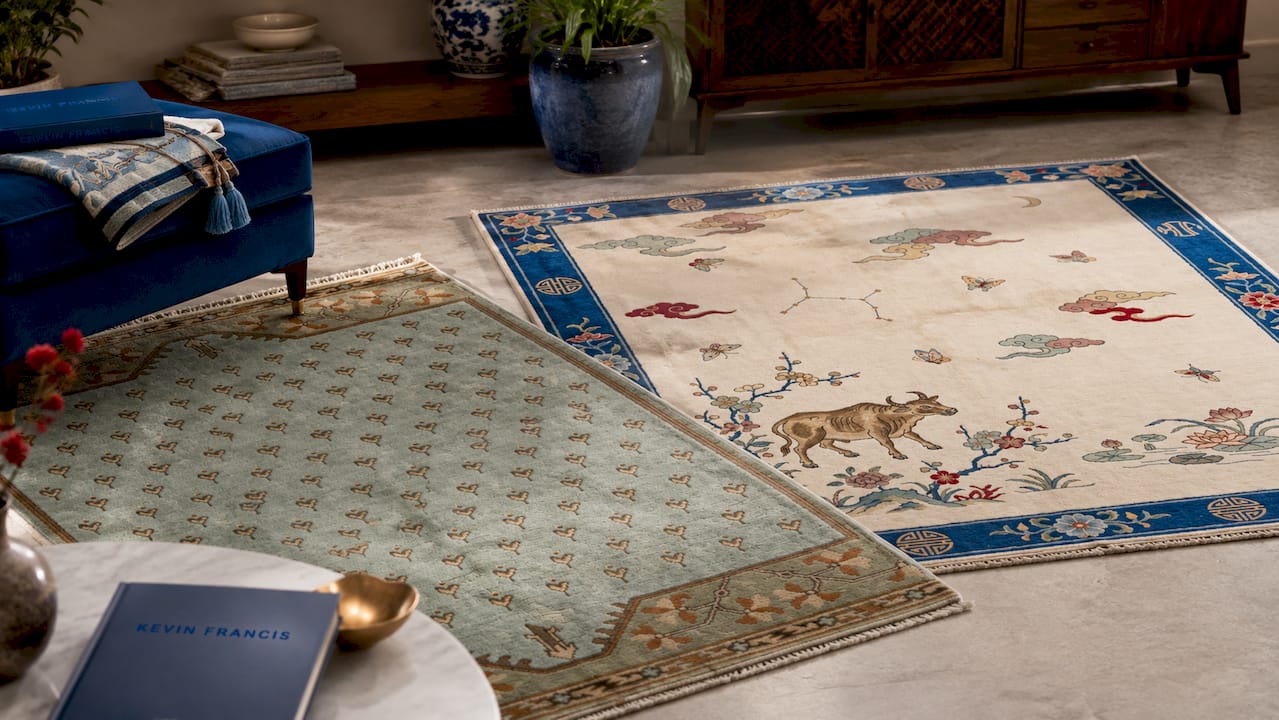
For readers who want to see these construction and material principles expressed in finished pieces, Kevin Francis Design offers a curated collection of hand-knotted artisan rugs built for both beauty and longevity. The Talisman Rug is a personalized, hand-knotted Art Deco piece available in custom dimensions and colorways — a direct example of the bespoke commission process described throughout this guide. The Lotto Hand-Knotted Wool Area Rug demonstrates the Turkish hand-knotted tradition in a luxury wool construction suited to formal living spaces.
Both pieces are available with custom sizing and design consultation. To explore the full collection or discuss a bespoke commission, visit Kevin Francis Design and request a custom consultation directly.
FAQ
How do you tell if a Persian rug is handmade?
Flip the rug and examine the back: a genuine hand-knotted Persian rug shows the pattern mirrored in individual, slightly irregular knots, and the fringe extends directly from the warp threads rather than being sewn on. Rug cleaning specialists confirm this back-inspection method is the most reliable non-destructive test available.
What is the highest quality rug material?
Wool is widely considered the premier rug fiber for durability, resilience, and long-term beauty, with silk offering unmatched luster for low-traffic display pieces. Wool’s natural lanolin and crimp structure give it a soil resistance and pile-recovery capacity that synthetic fibers cannot replicate.
What is the 18-inch rule for rugs?
The 18-inch rule is a placement guideline recommending approximately 18 inches of exposed floor between the rug’s edge and the surrounding walls, creating a proportional visual frame. It is a flexible starting point rather than a fixed requirement, and smaller rooms can scale it down to 8–12 inches.
What country makes the highest quality rugs?
Iran (Persia), Turkey, and Nepal are consistently recognized for producing the finest hand-knotted rugs, each with distinct weaving traditions, knot types, and material standards. Indian and Moroccan artisan production also reaches exceptional quality levels, particularly for wool and flat-woven constructions.
How long does a hand-knotted rug last compared to a machine-made one?
A well-maintained hand-knotted wool rug typically lasts many decades, with antique examples lasting even longer; a machine-made synthetic rug typically shows significant wear within a shorter period. The difference comes down to construction integrity, fiber resilience, and repairability.
Recommended
- Hand-Knotted vs Hand-Tufted Rugs: A Maker’s Comparison – Kevin Francis Design
- Handmade Rugs vs Machine-Made: Benefits Worth Knowing – Kevin Francis Design
- What Makes a Rug Truly Handmade: A Collector’s Guide – Kevin Francis Design
- Hand-Knotted vs Hand-Tufted vs Machine-Made Rugs Compared – Kevin Francis Design


