


Quality handmade rug craftsmanship is defined by three physical realities: visible knot nodes on the reverse side, structurally integral fringe, and natural fiber that springs back under pressure. These are not aesthetic preferences. They are construction facts that separate a genuine hand-knotted piece from a machine-made or hand-tufted imitation. Identifying quality handmade rug craftsmanship rewards you with a piece that deepens in character over decades, not one that flattens and fades within years. This guide walks you through every practical test and evaluation criterion worth knowing, from knot density ranges to dye authenticity, so you can assess any rug with confidence.
What physical features immediately reveal handmade rug craftsmanship?
The back of a rug tells the truth the front is designed to conceal. On a genuine hand-knotted piece, individual knots are clearly visible, tied around warp threads, and the pattern on the reverse mirrors the front with slight softness. A machine-made rug, by contrast, shows a uniform mechanical grid or a fabric and latex backing that hides its construction entirely. Flip the rug over before you do anything else.
Once you have examined the back, work through these physical checks in order:
- The fringe test. The fringe on a genuine hand-knotted rug is the warp thread itself, extending naturally from the body of the weave. Run your fingers to where the fringe meets the rug. If you feel a seam, stitching, or a line of glue, the fringe was attached after the fact. That is a definitive sign of machine or imitation production.
- The fold test. Fold a corner of the rug back on itself. A hand-knotted rug folds cleanly and the knots remain visible at the crease. A machine-made rug resists or reveals a stiff latex layer beneath.
- The pile inspection. Press your thumb firmly into the pile and release. Quality natural fibers rebound quickly, almost like compressed wool remembering its shape. Low-grade fibers or synthetic blends remain compressed, which signals poor construction.
- The abrash check. Look across the field of the rug at a low angle. Subtle shifts in color tone, known as abrash, are caused by hand-dyeing wool in small batches where dye concentration varies slightly. Abrash authenticates the hand-dyeing process and is entirely absent from machine-made rugs, which achieve perfect, flat color uniformity.
- The irregularity scan. Slight unevenness in knot size, minor pattern drift, and small color distribution variations are not flaws. Minor irregularities confirm human involvement in a way no machine can replicate. Perfect symmetry across every inch of a rug is, counterintuitively, a warning sign.
Pro Tip: Bring a small flashlight when evaluating a rug in a showroom. Raking light across the pile surface reveals pile direction, abrash, and any repairs or reweaving that flat overhead lighting conceals.
How do you measure and interpret knot density in rug quality?
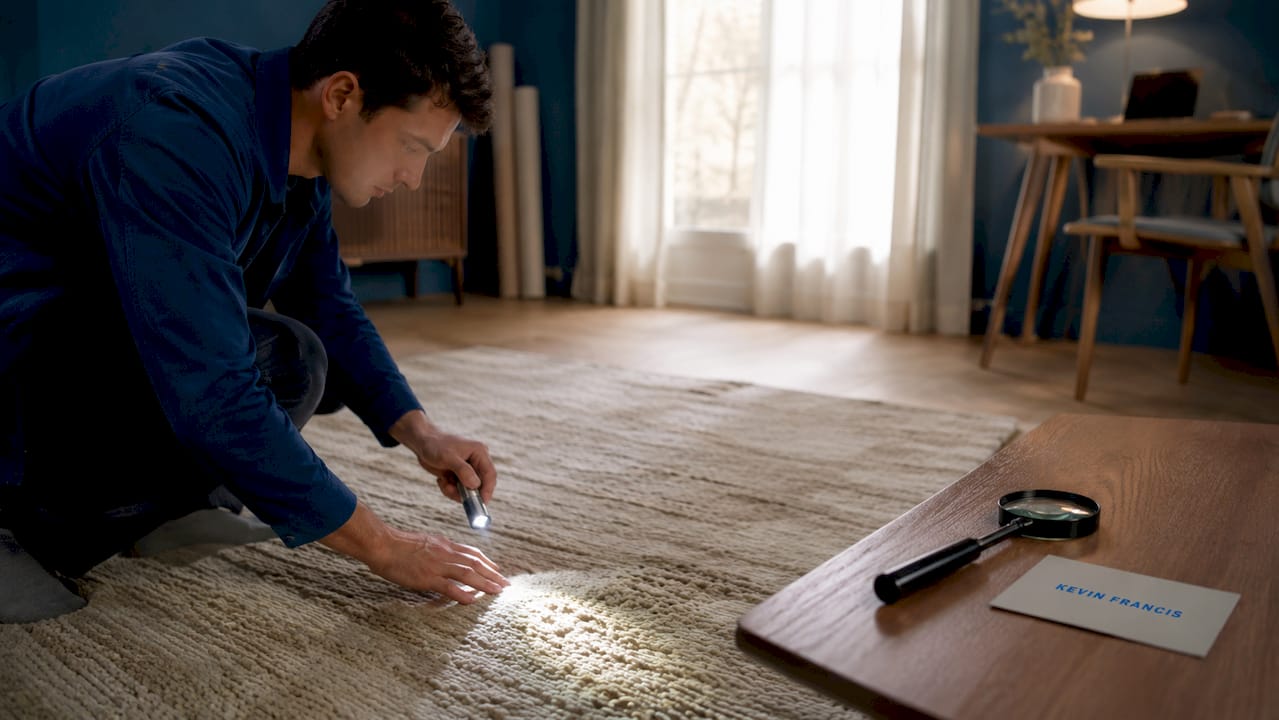
Knot density, expressed as knots per square inch (KPSI), is the most cited technical metric in handmade rug assessment. To measure it, turn the rug over and use a magnifying glass to count the individual knot nodes across one inch horizontally, then one inch vertically. Multiply those two numbers together. That product is your KPSI figure.
The ranges below reflect what those numbers mean in practice:
| KPSI Range | Rug Type | What It Indicates |
|---|---|---|
| 40–80 KPSI | Basic hand-knotted | Coarser pile, simpler geometric patterns |
| 100–200 KPSI | Quality wool rugs | Good detail, curvilinear designs possible |
| 300–500 KPSI | Fine wool or wool-silk blend | High detail, intricate medallion work |
| 600+ KPSI | Fine silk rugs | Exceptional detail, portrait-level imagery |
These KPSI ranges define detail and effort across the full spectrum of hand-knotted production. A 600 KPSI silk rug from Qom, Iran, can render facial features with near-photographic clarity. A 60 KPSI tribal rug from the Caucasus carries its own bold, geometric authority.
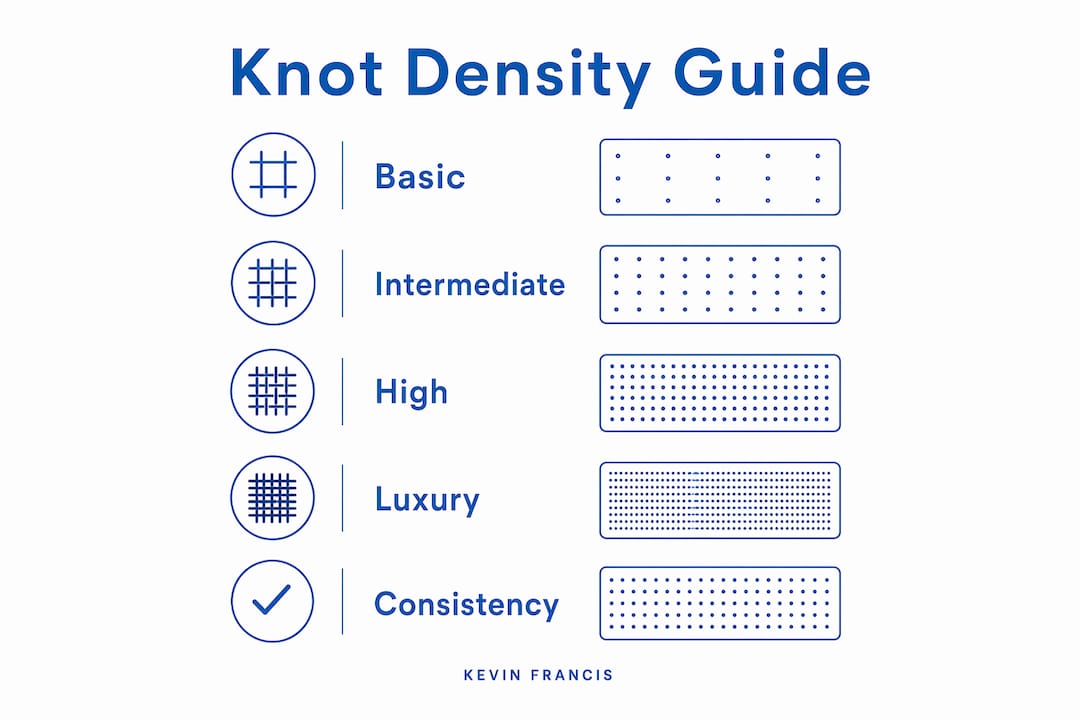
What matters beyond the raw number is consistency. Measuring knots under magnification and finding balanced, evenly spaced nodes across the entire surface indicates a skilled weaver working at a steady tension. Irregular spacing, where some areas are tight and others loose, points to inconsistent technique regardless of the average KPSI.
Knot type also carries geographic meaning. Symmetric knots, also called Turkish or Ghiordes knots, wrap fully around two warp threads and are common in Anatolian and Caucasian rugs. Asymmetric knots, known as Persian or Senneh knots, wrap around one warp thread and loop under the adjacent one, allowing finer detail and higher density. Neither is superior in absolute terms. Both are signs of authentic hand-knotting when executed with care.
KPSI alone does not determine quality. A densely knotted rug woven from low-grade wool or synthetic fiber will still underperform a moderately dense rug made from hand-spun, lanolin-rich Tibetan highland wool. Knot count is one chapter of the story, not the whole narrative.
How can you distinguish handmade rugs from machine-made imitations?
The market contains three categories that buyers frequently confuse: hand-knotted, hand-tufted, and machine-made. Understanding the construction differences between them is the foundation of any honest handmade rug quality assessment.
Machine-made rugs have perfectly uniform knots and a backing of fabric or latex glue that conceals the weave structure entirely. The pattern repeat is mechanically precise. There is no variation in pile height, no abrash, and no structural fringe. These rugs are not without value as decorative objects, but they are not handmade.
Hand-tufted rugs occupy a middle ground that confuses many buyers. A tufting gun punches yarn through a canvas backing, and a secondary fabric layer is then glued over the back to hide the loops. The result can look convincingly artisanal from the front. Turn it over and you will find a flat, fabric-covered back with no visible knots and often a faint chemical smell from the adhesive. The fringe, if present, is sewn on separately.
Pro Tip: Press your nose gently to the back of any rug you are considering. A sharp chemical or latex smell almost always indicates a glued backing, which is the signature of hand-tufted or machine-made construction. A genuine hand-knotted wool rug smells faintly lanolin-rich or neutral.
Genuine hand-knotted rugs, whether made through traditional Persian knotting, Tibetan knotting techniques, or handweaving, share one structural truth: the knots are visible, countable, and tied directly to the foundation. Consulting resources like building an artisan rug collection can help you develop a practiced eye for these distinctions within a residential context.
Price and documentation add a final layer of verification. Authentic hand-knotted rugs from established weaving regions carry certificates of origin, weaver provenance, and fiber composition details. A seller who cannot or will not provide this documentation is telling you something important about the product.
How do fibers, dyes, and finishing affect rug quality?
Material choices determine how a rug ages, not just how it looks at purchase. The three primary natural fibers in quality handmade rugs each carry distinct characteristics:
- Wool is the most common and forgiving fiber. Hand-spun wool from highland breeds like Tibetan or New Zealand Corriedale retains natural lanolin, which gives it a soft luster, natural stain resistance, and the pile resilience described earlier. Commercially spun wool, processed with harsh chemicals, loses much of this character.
- Silk produces the finest pile and the highest KPSI potential. It reflects light differently at different angles, creating the characteristic sheen that shifts as you move around the rug. Silk is more delicate than wool and requires careful placement away from heavy foot traffic.
- Cotton is most often used for the warp and weft foundation rather than the pile. A cotton foundation gives the rug dimensional stability and lies flat. Some flat-weave kilims use cotton pile, which produces a matte, graphic surface quite different from wool’s warmth.
A deeper look at luxury area rug fibers reveals how fiber origin and processing method affect both feel and longevity in ways that fiber type alone does not capture.
Dye quality is equally telling. Natural dyes derived from plants, insects, and minerals produce the gentle color depth and abrash that collectors prize. Synthetic dyes, introduced in the late 19th century, produce brighter and more uniform color but can fade unevenly under UV exposure. A simple colorfastness test involves pressing a damp white cloth firmly onto the pile. Significant color transfer indicates poor dye fixation.
Finishing details complete the picture. Run your hand along the selvedge, the woven edge binding that runs the length of the rug. A tightly wrapped, even selvedge indicates careful finishing. A loose, fraying, or machine-stitched selvedge suggests shortcuts. Quality fibers rebound quickly under thumb pressure, and pile that remains compressed or sheds excessively beyond the initial break-in period signals fiber quality problems that no amount of pattern beauty can compensate for.
Key takeaways
Genuine hand-knotted rug quality is confirmed by visible knots on the reverse, integral fringe, natural fiber resilience, and authentic dye variation, not by price or appearance alone.
| Point | Details |
|---|---|
| Check the back first | Visible, slightly irregular knot nodes tied to warp threads confirm hand-knotted construction. |
| Use the fringe test | Integral fringe that is part of the warp structure is the single most definitive authenticity indicator. |
| Interpret KPSI in context | Knot density ranges from 40 to 600+ KPSI; consistency and fiber quality matter as much as the number. |
| Smell and feel the backing | A chemical odor and fabric-covered back reveal hand-tufted or machine-made construction immediately. |
| Value abrash and irregularity | Subtle color variation and minor pattern drift are marks of authentic hand-dyeing and human craft. |
Why I trust touch over numbers when evaluating a rug
There is a tendency among new collectors to lead with KPSI as though it were a credit score. I understand the appeal. Numbers feel objective. But texture and fiber response tell you more about a rug’s future than any count you can make on the back.
I have handled 40 KPSI tribal pieces from Afghanistan that will outlast their owners and 200 KPSI rugs woven from chemically processed wool that felt brittle within a decade. The difference was entirely in the fiber. When I press my palm into a rug and feel that immediate, elastic rebound, I know the wool was treated with respect from the sheep to the loom.
The other thing I have learned is that seller transparency reflects quality confidence. A weaver or dealer who knows their product will tell you the region of origin, the fiber source, the dye method, and the approximate age of the piece without hesitation. Vagueness about provenance is almost always a sign that the product cannot bear scrutiny.
I also want to gently push back on the idea that imperfection is a problem. The slight wobble in a border line, the almost-imperceptible color shift across a field, the fringe that is not perfectly even: these are the signatures of a human being who spent months at a loom. Authentic craftsmanship embraces minor variation as proof of its own origin. A rug that looks too perfect almost certainly is.
The artisan’s hand is not a flaw in the work. It is the work.
— Kevin O’Gara
Discover artisan rugs crafted with genuine integrity
At Kevin Francis Design, every rug in our collection is selected and created with the evaluation criteria above as the baseline, not the ceiling. We work with hand-knotting, hand-tufting, and Tibetan knotting techniques, and we document fiber origin, dye method, and construction detail for every piece. If you have spent time learning to read the back of a rug, you will find that our pieces reward that attention. Explore our artisan rug collections and discover pieces where the craftsmanship speaks for itself, from the selvedge to the fringe, from the first touch to the last.
FAQ
What is the fastest way to tell if a rug is hand-knotted?
Turn the rug over and examine the back. A hand-knotted rug displays individual knot nodes tied around warp threads, with the pattern visible in soft relief on the reverse side.
What KPSI is considered high quality for a wool rug?
A quality wool rug typically falls in the 100 to 200 KPSI range, which supports detailed curvilinear patterns. Fine silk rugs reach 600 KPSI and above for portrait-level imagery.
Is abrash a defect in a handmade rug?
Abrash is not a defect. It is a natural result of hand-dyeing wool in small batches and is widely recognized as a mark of authentic, traditional dye practice in hand-knotted rugs.
How do I tell a hand-tufted rug apart from a hand-knotted one?
Flip the rug over. A hand-tufted rug has a flat fabric backing glued over the construction to hide the tufting loops, and often carries a faint chemical smell. A hand-knotted rug shows visible, countable knots with no secondary backing layer.
Does a higher price guarantee a handmade rug is authentic?
Price alone does not confirm authenticity. Genuine quality requires documentation of fiber origin, dye method, and weaving provenance. A seller who provides this information openly is far more reliable than one who relies on price as the only signal of quality.
Recommended
- Building an Artisan Rug Collection for Your Home – Kevin Francis Design
- Types of Luxury Area Rug Fibers: A Decorator’s Guide – Kevin Francis Design
- How Bespoke Rugs Reflect Your Identity and Style – Kevin Francis Design
- Professional Rug Appraisal for Luxury Pieces: A Collector’s Guide – Kevin Francis Design


