


Professional rug appraisal is defined as a formal, documented evaluation of a luxury textile’s authenticity, physical condition, and current market value, conducted by a credentialed specialist whose findings are accepted by insurers, estate attorneys, and the IRS. For collectors of Persian, Oriental, silk, and antique rugs, this process is not optional. It is the foundation of responsible ownership. Providers such as ABC Decorative Rugs and Expert Appraisal Company offer USPAP-compliant written appraisals for insurance scheduling, estate tax filings, and charitable donation documentation. Verbal assessments exist as a lighter alternative, but they carry no legal weight. Understanding which format you need, and who is qualified to deliver it, protects both the financial and artistic legacy of your collection.
What types of rug appraisals exist and which fits your luxury pieces?
Rug appraisals fall into two broad categories: informal value assessments and formal written appraisals. The distinction matters enormously in practice. A verbal value assessment is an informal, ballpark opinion delivered without documentation, typically starting at $25 at providers like Renaissance Rug Cleaning. It is useful for a quick sense of a rug’s worth before a sale, but it cannot be submitted to an insurer, probate court, or the IRS.
A formal written appraisal is a signed, dated document that includes full methodology, physical examination findings, market analysis, and a concluded value. Formal appraisals start at $250 at Renaissance Rug Cleaning, while ABC Decorative Rugs offers flat-rate pricing of approximately $150 per rug with discounts for multiple pieces and a turnaround of 7 to 10 business days. That pricing gap reflects the depth of work involved, not just the paperwork.
Within formal written appraisals, three specialized types serve distinct legal and financial purposes:
- Insurance scheduling appraisal: Establishes replacement value so your insurer can schedule the rug as a separate item on your policy. Most homeowner policies cap rug coverage at $2,500, while comparable Persian rugs can carry replacement values up to $22,000. A written appraisal closes that gap.
- Estate tax appraisal: Required when an estate exceeds the federal exemption threshold. The IRS mandates a USPAP-compliant written appraisal to establish fair market value for Form 706 filings, and the report must be prepared to withstand direct IRS scrutiny.
- Charitable donation appraisal: Triggered when donating a rug valued over $5,000 to a qualifying institution. The IRS requires the appraisal to be completed no earlier than 60 days before the donation and no later than the tax return due date, with the appraiser’s signature on Form 8283.
| Appraisal type | Primary purpose | Delivery format | Typical cost |
|---|---|---|---|
| Verbal assessment | Quick sale or curiosity | Oral opinion | From $25 |
| Written appraisal (insurance) | Policy scheduling, replacement value | Signed written report | $150 to $250+ |
| Estate tax appraisal | Form 706, fair market value | USPAP-compliant report | Varies by complexity |
| Charitable donation appraisal | IRS Form 8283, deduction support | Signed, dated written report | Varies by complexity |
Pro Tip: Request a written appraisal even when your insurer does not immediately require one. Documenting replacement value now prevents underinsurance disputes after a loss.
How to select a qualified appraiser for luxury rugs
The IRS defines a Qualified Appraiser as someone with verifiable education and experience specific to the property type, recognized professional credentials, and no conflict of interest with the piece being appraised. That definition is the baseline. For luxury rugs, the bar should be higher still.
Look for appraisers who hold credentials from recognized bodies such as the International Society of Appraisers, specifically the Certified Appraiser of Personal Property (CAPP) designation, or equivalent standing from the American Society of Appraisers. These credentials require demonstrated competency, ongoing education, and adherence to USPAP standards. Membership alone is not sufficient; ask whether the appraiser has direct experience with the specific textile category your collection represents, whether Persian court carpets, Tibetan knotted wool, or mid-century European tapestries.
When evaluating a potential appraiser, work through these questions before committing:
- Are you a Qualified Appraiser as defined by the IRS, and can you provide documentation of your credentials?
- Have you appraised rugs of this origin, period, and construction technique before?
- Do you follow USPAP standards, and will your report include a signed statement of compliance?
- Do you have any financial interest in the sale or purchase of this rug?
- Can you provide a sample report so I can review your methodology and documentation depth?
- What is your turnaround time, and does your fee structure change for collections of multiple pieces?
Impartiality is non-negotiable. An appraiser who also deals in rugs of the same type creates a conflict of interest that can invalidate the appraisal for IRS or legal purposes. When building an artisan rug collection, separating the roles of dealer, advisor, and appraiser from the outset protects every valuation you commission.
Pro Tip: Ask for references from estate attorneys or insurance adjusters who have accepted the appraiser’s reports. Professional acceptance is the truest measure of an appraiser’s credibility.
What does the professional rug appraisal process actually involve?
The appraisal process for luxury pieces follows a structured sequence that transforms physical observation into a legally defensible document. Understanding each stage helps you prepare your collection and set realistic expectations for timing and cost.
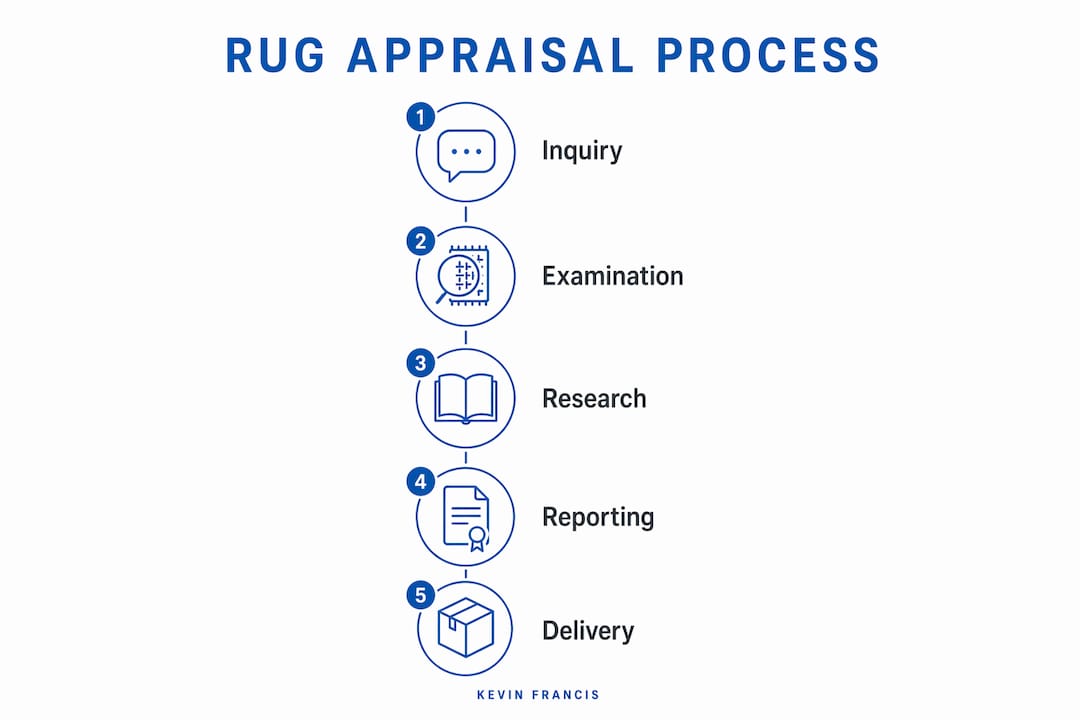
Initial inquiry and logistics
Contact the appraiser to discuss the rug’s origin, approximate age, and intended use for the appraisal. Most appraisers offer drop-off, pick-up, or in-home examination for large or particularly fragile pieces. For antique silk rugs or oversized room-size carpets, in-home appraisal is often the most practical and safest option.
Physical examination
The appraiser conducts a detailed inspection of both the face and the back of the rug. ABC Decorative Rugs details a process that includes a fiber burn test to confirm material composition, knot count under a loupe to establish construction quality, and condition mapping to identify wear, repairs, or restoration work. High-resolution photography documents the rug’s current state and supports the written report. Understanding luxury rug fiber types beforehand helps you follow the appraiser’s findings with confidence.

Provenance research and market analysis
The appraiser researches the rug’s origin, age, and weaving tradition, drawing on auction records, dealer databases, and comparable sales to anchor the valuation in current market data. This stage is where expertise in specific textile traditions, such as Safavid Persian weaving or Tibetan Buddhist iconography, becomes decisive. A generalist appraiser may miss attribution details that significantly affect value.
Delivery of the written report
The completed appraisal is a 3 to 5 page report containing the appraiser’s signature, the date of examination, physical findings, market commentary, and a concluded value stated for the specific intended use. The report should clearly distinguish between replacement value (for insurance) and fair market value (for estate or donation purposes), since these figures can differ substantially for the same piece.
| Appraisal stage | What happens | Approximate timeline |
|---|---|---|
| Initial inquiry | Scope, logistics, fee agreement | 1 to 2 days |
| Physical examination | Fiber test, knot count, condition mapping, photography | Half day to full day |
| Research and analysis | Provenance, comparable sales, market commentary | 3 to 5 business days |
| Report drafting and delivery | Signed, dated written report | 7 to 10 business days total |
Common mistakes that undermine luxury rug appraisals
Collectors who treat appraisal as a formality rather than a compliance process expose their collections to significant financial and legal risk. The most costly errors are predictable and avoidable.
- Relying on verbal assessments for formal purposes. A verbal opinion from even the most respected dealer carries no weight with an insurer, probate court, or the IRS. If you need documentation, you need a written appraisal.
- Missing IRS timing windows for charitable donations. The IRS requires donation appraisals to be completed no earlier than 60 days before the donation date and no later than the tax return due date. Missing either boundary can disqualify the deduction entirely, even when the valuation itself is accurate.
- Using an appraiser who does not meet the IRS Qualified Appraiser standard. Appraisal timing and credentials must both be correct. A perfectly timed report from an unqualified appraiser is worthless for tax purposes.
- Confusing replacement value with fair market value. Replacement value reflects the cost to purchase a comparable rug at retail today. Fair market value reflects what a willing buyer would pay a willing seller in an open market. Insurance scheduling requires replacement value; estate and donation appraisals require fair market value. Using the wrong standard produces a report that will be challenged.
- Failing to re-appraise after significant market changes or restoration work. Rug markets shift, and restoration can either increase or decrease value depending on how it was executed. A re-appraisal every five years, or immediately after any material change to the piece, keeps your documentation current and your coverage accurate.
Appraisal logistics are compliance work. A technically accurate valuation attached to the wrong timing, the wrong credential, or the wrong value standard will not protect your collection when it matters most.
Key takeaways
Professional rug appraisal for luxury pieces requires the right appraiser credential, the correct value standard, and strict adherence to IRS timing rules to produce documentation that holds up under legal, insurance, or tax scrutiny.
| Point | Details |
|---|---|
| Written appraisals are non-negotiable | Verbal assessments carry no legal or insurance weight for luxury collections. |
| Match the value standard to the purpose | Use replacement value for insurance and fair market value for estate or donation appraisals. |
| IRS timing rules are strict | Donation appraisals must fall within a precise window tied to the donation date and tax return deadline. |
| Credentials determine acceptance | Only IRS-defined Qualified Appraisers with USPAP compliance produce reports that withstand scrutiny. |
| Re-appraise regularly | Every five years, or after restoration or significant market shifts, keeps your documentation accurate. |
Why I believe most collectors wait too long to get a proper appraisal
I have watched collectors spend years acquiring extraordinary pieces, only to discover that their documentation is either missing or legally insufficient at exactly the wrong moment. An estate settlement, an insurance claim after a flood, a planned gift to a museum: these are the situations where a verbal opinion from a trusted dealer simply does not hold. The absence of a proper written appraisal does not just create paperwork problems. It creates genuine financial loss.
The collectors I respect most treat appraisal as part of the acquisition process, not an afterthought. When you bring a significant piece into your collection, the appraisal should follow within weeks, not years. For charitable giving, the IRS timing rules mean that planning ahead is not a luxury. It is a requirement. I have seen deductions disallowed not because the valuation was wrong, but because the appraiser’s credentials were not properly documented or the report arrived one day outside the allowable window.
My honest advice is this: choose an appraiser the way you choose a conservator. Look for someone who communicates their methodology clearly, who has direct experience with your specific textile tradition, and who has a track record of reports accepted by insurers and estate attorneys. The relationship is worth cultivating over time. An appraiser who knows your collection can respond quickly when circumstances demand it, and that speed can be the difference between a protected asset and an unrecoverable loss.
— Kevin O’Gara
How Kevin Francis Design supports your collection and appraisal journey
At Kevin Francis Design, we understand that every handmade rug in a serious collection carries both artistic and financial significance. Our handmade luxury rugs are crafted with documented materials, construction techniques, and provenance narratives that make the appraisal process more straightforward from the start. When you acquire a piece through us, you receive the kind of detailed origin and craftsmanship documentation that qualified appraisers rely on to establish accurate valuations for insurance, estate, and charitable purposes.

Whether you are building a new collection or seeking guidance on protecting pieces you already own, we are glad to connect you with the resources and expertise that serious collectors need. Reach out to Kevin Francis Design to explore our current collection and discuss how we support the full lifecycle of luxury rug ownership.
FAQ
What is a USPAP-compliant rug appraisal?
A USPAP-compliant appraisal follows the Uniform Standards of Professional Appraisal Practice, the nationally recognized ethical and performance standards for appraisers in the United States. Compliance is required for appraisals used in IRS filings, insurance claims, and probate proceedings.
How much does a professional rug appraisal cost?
Written appraisals typically range from $150 to $250 per rug, with discounts available for multiple pieces. Verbal assessments are significantly less expensive but carry no legal or insurance weight.
How often should I re-appraise my luxury rugs?
Re-appraise every five years or immediately after any restoration, significant market shift, or change in intended use. Outdated appraisals can result in underinsurance or rejected tax documentation.
What is the difference between replacement value and fair market value?
Replacement value is the cost to purchase a comparable rug at retail today and is used for insurance scheduling. Fair market value reflects what a willing buyer would pay a willing seller in an open market and is required for estate tax and charitable donation appraisals.
Can I use any appraiser for an IRS charitable donation deduction?
No. The IRS requires a Qualified Appraiser with verifiable credentials, specific experience with the property type, and no conflict of interest. The appraisal must also fall within a strict timing window relative to the donation date and tax return deadline.


