


Bespoke wallpaper design is the practice of creating fully custom wallcoverings precisely tailored to your wall’s exact dimensions, lighting conditions, and personal aesthetic. Unlike standard off-the-roll options, custom wallpaper design treats each wall as a singular canvas, requiring collaboration between the homeowner, a skilled designer or artisan, and specialist printers or craftspeople. The bespoke wallpaper process spans multiple stages, from site analysis and measurement through design development, material selection, production, and professional installation. Understanding what each phase demands helps you avoid costly errors, make confident material choices, and arrive at a finished room that feels genuinely, unmistakably yours.
What does bespoke wallpaper design involve, step by step?
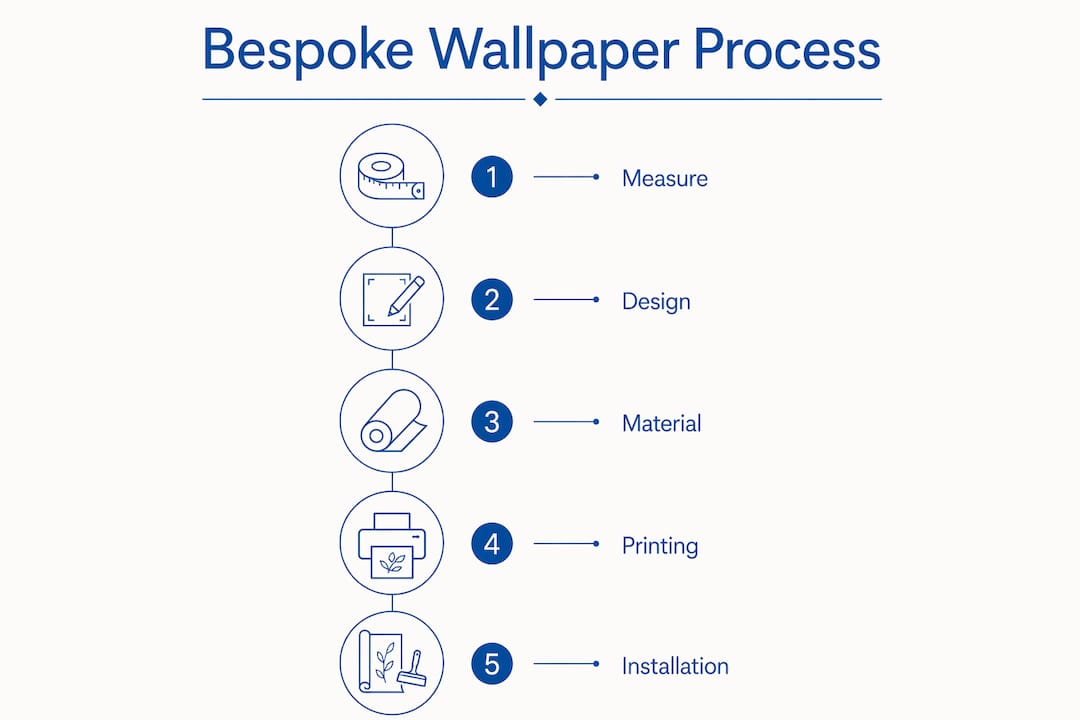
The bespoke wallpaper process is a structured sequence of decisions and actions, each one building on the last. Skipping or rushing any stage tends to surface as a visible flaw in the finished wall, so understanding the full arc matters before you begin.
-
Site and lighting analysis. A designer visits the space to assess natural light, architectural features such as alcoves or chimney breasts, and the room’s existing color palette. Light dramatically shifts how pigments read on a wall, and a design that looks luminous in a north-facing room can feel flat in a sun-drenched conservatory. This site analysis stage is where the creative brief truly begins to take shape.
-
Precise measurement. Every wall is measured at multiple points, because walls are rarely perfectly square. Height and width are recorded at the top, middle, and base of each surface. A standard 4-inch trim allowance is added to each side to accommodate minor variations during hanging. Doors and windows are not subtracted from the total, because panels must be printed as continuous sheets and trimmed on-site.
-
Design development and client collaboration. The designer produces initial sketches or digital mood boards, then refines them through a series of color proofs and client reviews. This iterative process can take several rounds, particularly when personal motifs, original artwork, or travel photography are being incorporated into the pattern.
-
Material selection. Substrate choice happens in parallel with design development, because the material affects how colors print and how the finished surface feels. Non-woven bases, grasscloth, silk, and cork each carry color differently and suit different rooms and lifestyles.
-
Production: printing or handcrafting. Digital printing requires source files at 150 to 300 DPI at full print size for sharp, gallery-quality results. Artisanal methods such as hand-block printing take considerably longer but yield textures and tonal variations that no digital press can replicate.
-
Professional installation. Panels arrive pre-trimmed to equal widths and are hung using the paste-the-wall method, which keeps the paper dimensionally stable. Vertical smoothing is the industry standard during hanging, because horizontal smoothing stretches the paper and creates fine white seam lines as it dries.
Pro Tip: Ask your designer for a physical color proof on your chosen substrate before approving production. Screen colors and printed colors diverge more than most people expect, and a proof costs far less than a reprint.
What materials and printing techniques are used in bespoke wallpaper?
The substrate you choose shapes the entire character of the finished wall. Bespoke wallpaper materials range from practical and durable to frankly luxurious, and each carries its own installation requirements and visual personality.
| Material | Character and best use |
|---|---|
| Heavyweight non-woven | Dimensionally stable, tear-resistant, suits high-traffic rooms and complex murals |
| Grasscloth | Natural woven texture, warm and organic, best for low-humidity spaces |
| Silk | Luminous sheen, painterly depth of color, suited to formal rooms and feature walls |
| Cork | Tactile, sound-absorbing, adds warmth and a sculptural quality to contemporary interiors |
| Peel-and-stick vinyl | Renter-friendly, repositionable, lower cost, less premium finish |
Digital printing dominates the bespoke market today because it handles photographic imagery, gradient washes, and fine detail with precision. For sharp results, source file resolution must reach at least 150 to 300 DPI at the intended print size. That standard rules out most smartphone photographs taken at standard settings, which is worth knowing before you fall in love with a holiday snapshot as your mural concept.
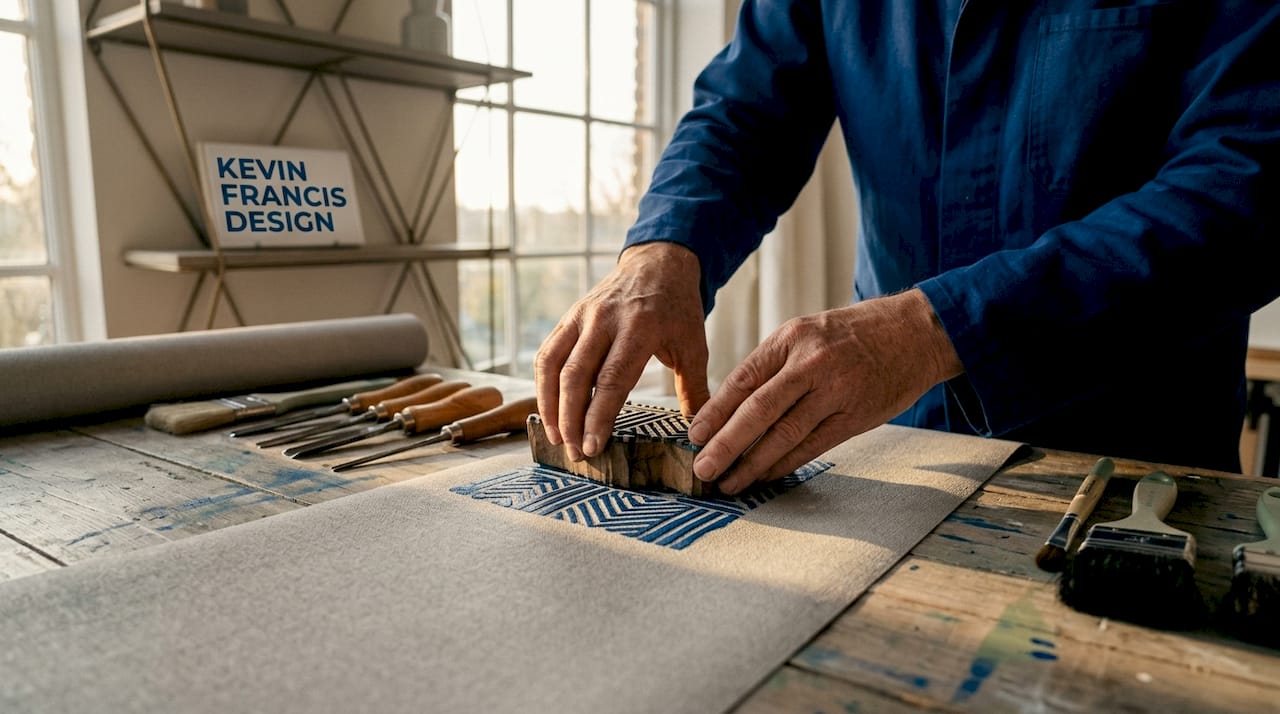
Hand-block printing occupies a different world entirely. Traditional artisans carve designs using only two chisels and apply rabbit-skin glue distemper paints that produce tonal variations and surface texture impossible to achieve digitally. A single roll can take days to produce, and no two panels are identical. That variation is precisely the point: it is the visual equivalent of a brushstroke rather than a pixel.
Bespoke wallpaper materials, including non-woven, cork, and silk substrates, offer durability and a premium finish that mass-market papers simply cannot match. This distinction matters most in rooms where the wall is the statement, not merely the backdrop.
Pro Tip: For bathrooms and kitchens, specify a vinyl-coated or moisture-resistant non-woven substrate. Even the most beautiful grasscloth will buckle and discolor in a humid environment within a year.
How to measure your walls correctly for a perfect fit
Measurement is where the most expensive mistakes in custom wallpaper design happen, and they happen quietly. A 2-inch error in a single dimension can force a full reprint because bespoke wallpaper is printed exactly to the ordered size and is non-returnable. The financial consequence of getting this wrong is real: professional installation alone can reach $1,500 per room, and material costs frequently exceed $10 per square foot.
Follow these measurement principles without exception:
- Measure height at three points. Take readings at the left edge, center, and right edge of each wall. Use the largest figure as your working height.
- Measure width at three points. Repeat at the top, middle, and base of the wall. Again, use the largest reading.
- Add a 4-inch trim allowance to each side. This gives the installer room to align the pattern and trim cleanly at the ceiling, baseboard, and corners.
- Do not subtract doors or windows. Panels must run as continuous vertical sheets. The installer trims around openings on-site.
- Account for pattern repeat. Patterns with a large vertical repeat require additional paper so that each panel begins at the same point in the design. A 24-inch repeat on a 9-foot wall can add 20 percent or more to your total square footage requirement.
- Re-measure before you order. Measure twice on separate days, ideally with a second person confirming each reading.
The consequences of skipping these steps extend beyond cost. Because bespoke wallpaper is produced as a single print run, reprinting means a delay of weeks, not days. If you are working toward a renovation deadline or a specific event, that delay can cascade through the entire project schedule.
What design customization options are available for bespoke wallpaper?
The creative range of custom wallpaper design is genuinely broad, and it has expanded considerably as digital printing technology has matured. These are the customization directions that produce the most striking and cohesive results:
- Color matching to paint palettes. Bespoke wallpaper can be color-matched to specific paint brands, allowing you to build a fully color-drenched room where walls, trim, and soft furnishings share a single tonal story. This approach, favored by designers working in maximalist or jewel-box interiors, creates a sense of enveloping warmth that no standard wallpaper can achieve.
- Personal motifs and original artwork. Botanical illustrations from a grandmother’s sketchbook, architectural drawings of a beloved building, or a child’s painting scaled to mural size: all of these translate beautifully into bespoke wallcoverings. The design becomes a piece of personal narrative rather than a decorative product.
- Travel and landscape photography. A panoramic photograph of a coastline, a forest canopy, or a city skyline can be printed across an entire wall as a photomural. The key is sourcing or commissioning a high-resolution image that meets the DPI threshold for the intended print size.
- Layered pattern mixing. Today’s bespoke wallpaper design increasingly favors multiple patterns in one room, provided there is a dominant lead pattern that anchors the composition. A large-scale botanical on the main wall paired with a smaller geometric on a recessed alcove creates visual rhythm without chaos.
- Functional feature panels. For walls that incorporate televisions or cabinetry, specialized hardware and skilled joinery are required alongside the wallpaper installation to achieve a result that is both beautiful and fully operational.
The advantages of custom wallpaper in this creative dimension are difficult to overstate. You are not choosing from a catalog; you are authoring the room.
Key takeaways
Bespoke wallpaper design requires precise measurement, collaborative design development, careful material selection, and professional installation to produce a flawless, one-of-a-kind result.
| Point | Details |
|---|---|
| Measurement precision is non-negotiable | A 2-inch error forces a costly full reprint; always add a 4-inch trim allowance per side. |
| Material choice shapes the entire result | Substrates from non-woven to silk affect color depth, durability, and installation method. |
| Production method defines character | Digital printing suits photographic detail; hand-block printing yields texture no press can replicate. |
| Design collaboration takes multiple rounds | Color proofs and iterative client reviews are standard, not optional, in the bespoke process. |
| Pattern mixing requires a dominant anchor | Layering multiple wallpapers works beautifully when one pattern clearly leads the composition. |
Why bespoke wallpaper is worth every step of the process
I have worked with handmade and artisan surfaces long enough to know that the rooms people remember are almost never the ones with the most expensive furniture. They are the rooms where the walls themselves feel considered. Bespoke wallpaper is one of the few decisions in interior design that touches every surface simultaneously, and that scale of impact is something no rug, lamp, or piece of art can replicate on its own.
What I find homeowners consistently underestimate is the value of the design development stage. Many clients arrive wanting to skip straight to production, and I understand the impulse. But the iterative rounds of proofs and revisions are where a good idea becomes a great one. A color that reads perfectly on screen can feel cold or muddy on a non-woven substrate in afternoon light. Catching that in a proof costs almost nothing. Catching it after installation costs everything.
My honest advice: treat the measurement stage with the same seriousness you would give a structural decision. I have seen beautiful, expensive designs ruined by a single transposed number. Hire a professional to measure, or at minimum have two people verify every reading independently. The bespoke wallpaper process rewards patience and precision in equal measure, and the finished result, a wall that exists nowhere else in the world, is worth every careful step.
— Kevin
Bring the same artistry to every surface in your home
At Kevinfrancisdesign, we believe that a truly considered interior extends from the walls to the floor beneath your feet. Our collection of handmade luxury rugs is crafted with the same devotion to precision, material quality, and original design that defines the finest bespoke wallpaper commissions. Each piece is handwoven, hand-tufted, or knotted using Tibetan techniques, drawing on motifs rooted in art, architecture, and Kevin Francis O’Gara’s own creative vision. If you are investing in a custom wallcovering that tells your story, we invite you to explore how a bespoke rug can complete that narrative with equal warmth and artistry.
FAQ
What is bespoke wallpaper, exactly?
Bespoke wallpaper is a fully custom wallcovering designed and produced to fit your specific wall dimensions, color palette, and aesthetic preferences. Unlike standard rolls, it is printed or handcrafted as a single commission and is not available off the shelf.
How long does the bespoke wallpaper process take?
The full process, from initial consultation through design development, production, and installation, typically takes six to twelve weeks. Hand-block printed commissions can take longer, depending on the complexity of the design and the artisan’s schedule.
What resolution do images need to be for custom wallpaper printing?
Source files for digital wallpaper printing require at least 150 to 300 DPI at the intended full print size. Images below this threshold will appear blurry or pixelated when printed at mural scale.
Why should I not subtract doors and windows from my measurements?
Bespoke wallpaper panels are printed as continuous vertical sheets and trimmed on-site by the installer. Subtracting openings from your order leaves you short of material, and because the paper is printed to a single specification, there is no way to reorder a partial panel.
Can bespoke wallpaper be removed without damaging the wall?
Non-woven bespoke wallpapers are generally strippable and can be removed cleanly from properly prepared walls. Peel-and-stick options offer the easiest removal, while paste-hung silk or grasscloth substrates require more care and may need professional removal to avoid surface damage.


