


Artisan weaving traditions worldwide organize into three identifiable layers: core weave-structure families (plain, twill, tapestry, pile, ikat, soumak, and more), loom families (backstrap, warp-weighted, floor, tapestry), and regionally distinct repertoires that give each tradition its visual and cultural signature. This guide covers all three layers, with a comparison table of weave structures, a region-by-region survey of twelve traditions, two in-depth technique case studies (ikat and the backstrap loom), a fiber and motif reference, and practical resources for learning more.
What you will find here:
- Core weave structures and how to recognize them on sight
- Major loom types and the constraints they impose
- Eight representative regional traditions with signature motifs and social functions
- Two technique case studies: ikat resist-dyeing and backstrap loom weaving
- Fiber, dye, and motif reference with cultural symbolism
- Museums, workshops, and books for deeper study
- A designer’s checklist for reading handwoven rugs
- Glossary of essential terms
Three authoritative anchors frame this survey: UNESCO’s intangible cultural heritage program, which has recognized dozens of weaving practices as living traditions; the George Washington University Museum’s textile collections, which provide concise regional reference summaries; and Kevin Francis Design, which publishes this guide as part of its commitment to connecting contemporary rug design with the craft histories that inspire it.
Key Takeaways
Artisan weaving traditions worldwide share a three-layer structure: core weave families define the cloth’s architecture, loom type determines its physical constraints, and regional repertoires give each tradition its distinctive visual and cultural signature.
| Point | Details |
|---|---|
| Three-layer taxonomy | Every artisan weaving tradition can be read through its weave structure, loom type, and regional motif vocabulary. |
| Ikat’s defining challenge | Resist-dyeing yarns before weaving produces feathered edges; double ikat requires simultaneous warp and weft alignment, making it among the most labor-intensive textiles to produce. |
| Backstrap loom constraints | Body-tension looms limit cloth width to the weaver’s arm span and produce measurable variation in width along a panel, a key authenticity marker. |
| Motifs encode meaning | Andean cosmological registers, Kente color semantics, and Persian garden layouts are precise symbolic vocabularies, not decorative choices. |
| Kevin Francis Design | The Lotto, Cairene, and Selendi hand-knotted wool rugs translate traditional knotted-pile techniques into contemporary, responsibly sourced pieces for residential and design use. |
Table of Contents
- What makes a practice an artisan weaving tradition?
- How do the core weave structures differ from one another?
- What loom types shape the textiles they produce?
- Which regional traditions best represent weaving styles around the world?
- Ikat and the backstrap loom: two technique case studies
- Fibers, dyes, and the meanings woven into cloth
- How can you study, learn, or authenticate weaving traditions?
- Reading handwoven rugs: what designers look for
- How globalization is reshaping traditional artisan weaving
- What do weaving patterns actually mean across cultures?
- Why these traditions matter to makers, designers, and cultural memory
- Kevin Francis Design: handwoven rugs rooted in global craft traditions
- Sources
- FAQ
What makes a practice an artisan weaving tradition?
Not every cloth woven by hand qualifies as an artisan weaving tradition in the scholarly sense. Four attributes define the category: intergenerational transmission (skills passed from elder to apprentice within a community), locally sourced or regionally specific materials and dyes, loom or tool specificity that shapes the cloth’s structure and dimensions, and a social or ceremonial role that gives the textile meaning beyond its function as fabric.
A brief timeline situates the major developments:
- Ancient twining (pre-loom): Warp and weft twining predate loom-woven textiles in the archaeological record; comparative ethnographic research documents independent occurrences across the Pacific and North America, confirming twining as humanity’s earliest structured textile technique.
- Fixed-frame and warp-weighted looms (c. 5000–3000 BCE): Vertical warp-weighted looms appear in Neolithic Europe and the ancient Near East, enabling wider cloth and more consistent tension than hand-held twining.
- Multi-shaft and drawlooms (c. 500 BCE onward): Multiple heddles allow twill and complex pattern repeats; the drawloom, developed in Asia, enables intricate supplementary-weft brocades and damasks.
- Tablet (card) weaving: Evolved from twining as an efficient way to produce narrow, pattern-rich bands; the same comparative research cited above shows it arose independently in multiple regions.
- Jacquard mechanism (1804) and modern adaptations: The Jacquard loom automates drawloom patterning with punched cards, later influencing digital weaving software, though hand-operated versions remain central to many artisan traditions.
Glossary of essential terms
Warp: The set of threads held under tension on the loom, running lengthwise through the cloth. Weft: The thread passed over and under the warp threads, running crosswise. Warp-faced: A structure in which warp threads cover the weft almost entirely, producing a dense, ridged surface (common in Andean belts and bands). Weft-faced: A structure in which weft threads cover the warp, typical of tapestry and kilim weaving. Tapestry: A weft-faced weave in which different colored wefts are used to build pictorial or geometric designs, with wefts not running selvedge to selvedge. Pile: Loops or cut ends of yarn that stand above the ground weave, forming the soft surface of knotted rugs. Ikat: A resist-dyeing technique applied to yarns before weaving, producing characteristic blurred or “feathered” edges in the finished pattern. Soumak: A wrapping technique in which weft threads wrap around warp threads to create a textured, slightly ridged surface; used in Caucasian and Middle Eastern flatweaves. Tablet weaving: A technique using small cards or tablets with holes through which warp threads pass; rotating the tablets creates complex braided or warp-faced patterns in narrow bands.
How do the core weave structures differ from one another?
Understanding the types of artisan weaving traditions worldwide starts with recognizing the structural families that underlie every handmade textile. Each structure has a distinct formation method, a visual signature you can read on the cloth’s surface or back, and a geographic distribution shaped by loom technology and cultural preference.
Primary weave structure families
Plain (tabby) weave is the simplest interlacement: each weft thread passes over one warp thread, then under the next, alternating with every row. The result is a balanced, grid-like surface. It appears in everything from West African cotton cloth to Japanese ramie and forms the base structure for many embellished textiles.
Twill weave shifts the interlacement point by one warp thread with each row, producing diagonal lines on the surface. The angle and direction of those diagonals vary, giving twills their characteristic herringbone, chevron, or diamond patterns. Scottish tartan and many South Asian dress fabrics use twill as their foundation.
Satin and sateen extend the float length so that warp threads (satin) or weft threads (sateen) dominate the surface, creating a smooth, lustrous face. Silk satins from China and Central Asia exemplify this structure at its most refined.
Tapestry (weft-faced) builds imagery by using discontinuous wefts of different colors, each turned back at the boundary of a color area rather than running across the full width. Navajo blankets, Peruvian cumbi, and Aubusson tapestries all use this structure. The back of a tapestry reveals the color boundaries clearly.
Warp-faced compound weaves pack warp threads so densely that the weft becomes invisible; pattern is created by bringing different colored warps to the surface. Andean warp-faced textiles, including the belts and carrying cloths of the Quechua and Aymara peoples, are among the most technically complex examples.
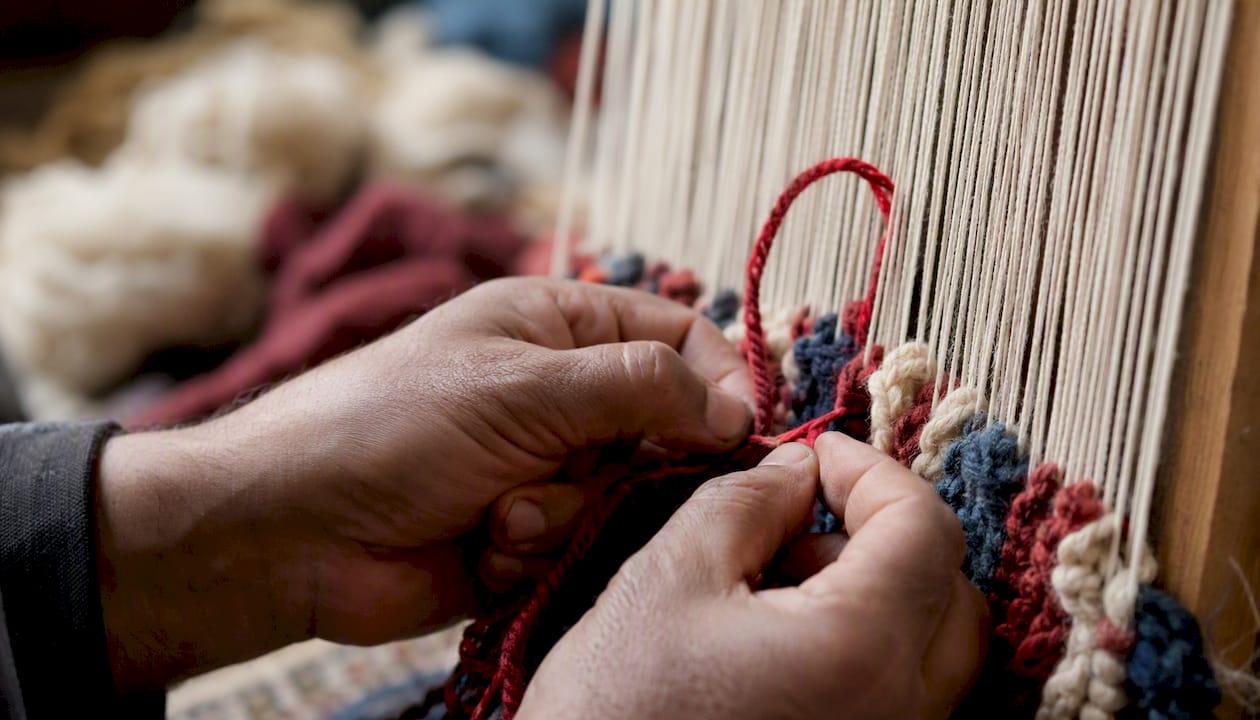
Pile (knotted) rugs add a third element: individual yarn knots tied around pairs of warp threads, then cut to form the pile surface. Knot density, measured in knots per square inch, determines the fineness of detail achievable. Persian, Turkish, and Tibetan knotted rugs each use distinct knot types (Persian/Senneh, Turkish/Ghiordes, Tibetan).
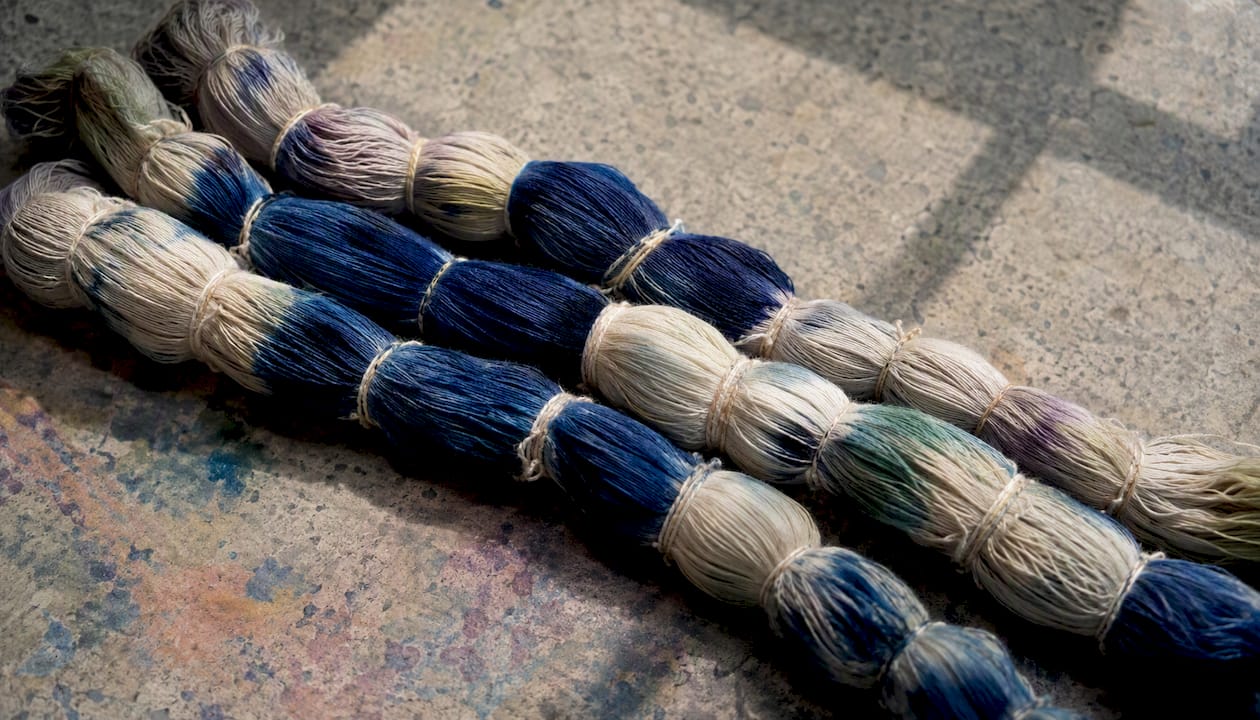
Ikat is a resist-dyeing technique applied to warp threads, weft threads, or both before weaving. Bundles of threads are bound tightly, dyed, re-bound, and re-dyed to build up a pattern; when woven, slight misregistration between bound sections creates the characteristic feathered blur that collectors recognize immediately.
Brocade and supplementary-weft techniques add pattern threads over a plain or twill ground without those threads forming part of the cloth’s structural interlacement. Indian Jamdani muslin, Chinese silk brocades, and Guatemalan huipil embroidery all use supplementary wefts to float pattern across the surface.
Soumak and twining wrap weft threads around warp threads rather than simply passing through the shed. Soumak produces a herringbone-like surface texture and is common in Caucasian and Kurdish flatweaves. Twining, the oldest of all these techniques, interlocks two or more weft threads around each warp.
Tablet (card) weaving uses small perforated cards threaded with warp yarns; rotating the cards in sequence creates complex warp-faced bands used for belts, straps, and decorative borders across Viking Scandinavia, the Andes, and Central Asia.
| Weave structure | Visual signature | Common regions | Typical products |
|---|---|---|---|
| Plain / tabby | Even grid, balanced face and back | West Africa, South Asia, Pacific | Dress cloth, base fabric |
| Twill | Diagonal lines, herringbone, chevron | Europe, South Asia, East Asia | Suiting, tartan, dress fabric |
| Tapestry (weft-faced) | Color boundaries visible on back; no continuous weft | Andes, North America, Middle East | Blankets, wall hangings, rugs |
| Warp-faced compound | Dense warp surface, invisible weft | Andes, Central Asia | Belts, carrying cloths, bands |
| Pile / knotted | Soft cut surface; knot rows visible on back | Central Asia, Middle East, South Asia | Knotted rugs, prayer mats |
| Ikat | Feathered / blurred color edges | South Asia, Southeast Asia, Central Asia, Andes | Dress cloth, ceremonial fabric |
| Brocade / supplementary weft | Floating pattern threads on one face | South Asia, East Asia, Central America | Sarees, huipil, court robes |
| Soumak / twining | Ridged herringbone texture; structured back | Caucasus, Middle East, Pacific | Flatweave rugs, bags, borders |
| Tablet / card weaving | Narrow warp-faced band, complex repeat | Scandinavia, Andes, Central Asia | Belts, straps, trim bands |
What loom types shape the textiles they produce?
The loom is not merely a tool; it is a set of constraints that determines cloth width, pattern complexity, portability, and production speed. Understanding loom families is one of the most direct routes into understanding why regional traditions look the way they do.
-
Backstrap (body-tension) loom: One end of the warp beam attaches to a fixed point (a tree, post, or wall); the other attaches to a strap around the weaver’s lower back. Leaning back increases tension; leaning forward relaxes it. This body-mediated tension makes every panel slightly unique and limits cloth width to roughly the weaver’s arm span. Backstrap looms are portable, require minimal materials to construct, and are central to Andean, Mesoamerican, and Southeast Asian traditions.
-
Warp-weighted loom: Weights hang from the lower ends of warp threads to maintain tension on a vertical frame. Common in Neolithic Europe and still used in parts of Scandinavia and Greece, this loom produces cloth from the top down and naturally favors twill structures.
-
Fixed-frame vertical loom (tapestry loom): A rigid frame holds the warp under even tension. High-warp (haute-lisse) looms position the warp vertically so the weaver works facing the back of the cloth; low-warp (basse-lisse) looms position the warp horizontally. Both are used for tapestry and kilim production across the Middle East, North Africa, and Europe.
-
Treadle / floor loom: Foot pedals (treadles) operate heddles that lift warp threads, freeing both hands for the shuttle. Floor looms can be wide, fast, and equipped with multiple shafts for complex pattern repeats. They underpin most professional handloom traditions in South Asia, Scandinavia, and West Africa.
-
Simple frame loom: A basic rectangular frame used for kilims, small rugs, and sampler weaving. Width is fixed by the frame; pattern is built entirely through weft color changes. Accessible and widely used in educational and community settings.
Tool glossary
Beater (reed): A comb-like frame that pushes each weft row firmly against the previous one, controlling cloth density. Heddle: A frame or set of loops through which warp threads pass; lifting a heddle opens a “shed” through which the shuttle passes. Shuttle: A boat-shaped carrier that holds the weft bobbin and passes through the shed. Bobbin: A small spool wound with weft yarn, held inside the shuttle. Tablet (card): A small perforated card used in tablet weaving to control warp thread rotation and pattern.
Portable looms favor garments, narrow panels, and textiles that travel with their makers. Fixed-frame looms favor larger rugs, repeat-pattern cloth, and production contexts where the loom stays in one place. That practical distinction maps almost perfectly onto the cultural uses of each tradition: Andean weavers carry backstrap looms to the fields; Persian carpet workshops anchor floor looms in dedicated rooms where a single rug may take months to complete.
Which regional traditions best represent weaving styles around the world?
A mapping study of weaving techniques finds the highest density and variety of traditions clustered around the Tropic of Cancer, a band that encompasses the Middle East, South Asia, Southeast Asia, and parts of Central America. That concentration reflects both climate (fiber-growing conditions) and the historical movement of loom technology along trade routes. What follows is a region-by-region survey of representative traditions.
Andean South America
The Quechua and Aymara peoples of Peru, Bolivia, and Ecuador have produced warp-faced textiles for at least 3,000 years. Their finest cloth, called cumbi, was woven from vicuña fiber on backstrap looms and reserved for Inca royalty and religious ceremony. Contemporary Andean weavers still use backstrap looms to produce chuspas (coca pouches), fajas (belts), and carrying cloths (awayos) with cosmological registers: stepped diamonds represent mountains, zigzags represent water, and paired figures encode reciprocal social relationships.
- Loom type: Backstrap
- Signature: Dense warp-faced surface; stepped geometric motifs in natural camelid fiber colors
- Social function: Ceremonial exchange, status marker, everyday use
Central Asia (Uzbekistan, Tajikistan, Turkmenistan)
Central Asian ikat (atlas and adras) is among the most visually arresting textile art in the world: silk or silk-cotton warps are resist-dyed in multiple color sequences before weaving, producing swirling, flame-like patterns with that characteristic feathered edge. Turkmen tribal weavers also produce knotted pile rugs with dense geometric guls (medallion motifs) in madder red and ivory, woven on horizontal ground looms. UNESCO has recognized several Central Asian textile traditions as intangible cultural heritage.
- Loom type: Horizontal pit loom (ikat cloth); horizontal ground loom (pile rugs)
- Signature: Flame-patterned ikat; geometric gul medallions in pile rugs
- Social function: Status, bridal trousseau, trade
South Asia (India)
India’s handloom traditions span the full range of weave structures. The Venkatagiri tradition of Andhra Pradesh produces delicate cotton and silk sarees with zari (gold-wrapped thread) borders and Jamdani supplementary-weft motifs; research on Venkatagiri handloom documents both the technical refinement of the craft and the pressures it faces from powerloom competition and rising raw-material costs. Patola double-ikat from Gujarat, Banarasi brocade from Varanasi, and Kanchipuram silk from Tamil Nadu each represent distinct regional technique families within a single country.
- Loom type: Pit loom (most traditions); backstrap variants in tribal areas
- Signature: Zari borders, supplementary-weft motifs, double-ikat registration
- Social function: Ceremonial dress, bridal gift, status
Southeast Asia
The Kanekes (Baduy) weavers of West Java, Indonesia, offer one of the most documented examples of a tradition governed by community law. Their tinunan panels are woven on backstrap looms from handspun cotton dyed with plant-based dyes; community rules (pikukuh) prescribe every material choice and limit outside contact, producing cloth that is simultaneously a textile and a social document. Panels typically run about three meters in length. Across the region, Philippine piña cloth (woven from pineapple fiber) and Thai silk ikat (mudmee) represent the breadth of Southeast Asian artisan textile crafts.
- Loom type: Backstrap (Baduy, Philippine, many hill-tribe traditions); floor loom (Thai silk)
- Signature: Narrow panels; plant-dyed cotton; strict material rules in some communities
- Social function: Ceremonial, identity, community regulation
West Africa (Kente and related traditions)
Kente cloth from the Asante and Ewe peoples of Ghana is woven in narrow strips (roughly four inches wide) on horizontal treadle looms, then sewn together into larger garments. Each color and pattern combination carries specific meaning: gold signifies royalty and wealth; blue represents love and harmony; the Sika Futuro pattern (gold dust) is reserved for chiefs. Kente was historically a royal prerogative; today it marks graduation, celebration, and cultural pride across the African diaspora.
Alongside Kente, Malian bogolanfini (mud cloth) uses a completely different technique: cotton cloth is painted with fermented mud in geometric patterns, then treated with plant-based mordants to fix the color. The result is a matte, earthy textile whose symbols encode proverbs and social status.
- Loom type: Narrow-band horizontal treadle loom (Kente); hand-painted on plain-weave ground (mud cloth)
- Signature: Narrow strip construction; color-coded symbolic vocabulary
- Social function: Royal regalia, ceremonial dress, cultural identity
Middle East and Persian carpet traditions
Persian knotted carpets represent perhaps the most technically demanding of all pile-weaving traditions. Weavers tie individual knots (Persian/Senneh or Turkish/Ghiordes) around pairs of warp threads, cut the pile, and beat it down with a heavy comb; knot density in fine Isfahan or Tabriz carpets can reach several hundred knots per square inch. Medallion compositions, arabesque scrollwork, and garden (chahar bagh) layouts encode cosmological and paradisiacal imagery. The kilim flatweave tradition, practiced across Turkey, Iran, and the Caucasus, uses weft-faced tapestry structure to produce reversible geometric textiles without pile.
- Loom type: Vertical fixed-frame loom
- Signature: High knot density; medallion and arabesque motifs; reversible kilim flatweave
- Social function: Status, prayer, trade, interior decoration
North America: Navajo and Indigenous textile traditions
Navajo weaving developed from an earlier Pueblo tradition and reached its most celebrated form in the Classic Period (c. 1650–1865), when weavers produced chiefs’ blankets in bold horizontal stripe compositions using raveled bayeta (Spanish red wool) alongside handspun wool. Navajo weavers work on upright vertical looms, weaving weft-faced tapestry from the bottom up. The Transitional and Rug periods introduced pictorial elements, sand-painting-inspired designs, and the “Two Grey Hills” and “Teec Nos Pos” regional styles that collectors recognize today.
Pro Tip: When examining a Navajo textile, look at the selvedge cords. Authentic hand-woven pieces have continuous, hand-twisted selvedge cords that are integral to the cloth; machine-made imitations typically have sewn-on or glued edges.
- Loom type: Upright vertical frame loom
- Signature: Bold geometric tapestry; continuous selvedge cords; natural and raveled wool
- Social function: Trade, status, ceremonial use
Scandinavia and the Baltic
Scandinavian rölakan (Swedish tapestry) and ryijy (Finnish pile rug) traditions both use upright looms and natural wool. Ryijy rugs have a long pile that originally served as bedding and boat covers; their bold, often abstract floral and geometric designs became a canvas for folk art expression. Baltic tablet-woven bands (jostas) use the card-weaving technique to produce intricate warp-faced patterns used as dress trim and ceremonial belts.
- Loom type: Upright frame loom; tablet weaving cards
- Signature: Long pile (ryijy); complex warp-faced bands (jostas)
- Social function: Domestic warmth, ceremonial dress, folk art
Southwest China: bamboo weaving
In Sansui, Guizhou Province, artisans use 17 documented bamboo species for different weaving products, from fine baskets to architectural panels. The dyeing process is notably labor-intensive: one documented workflow involves 12 hours of boiling followed by 48 hours buried in soil to fix natural colors, a fixation method that distinguishes traditional natural-dye stability from faster industrial approaches.
- Loom type: Hand-plaiting and simple frame
- Signature: Species-specific material choice; extended natural-dye fixation
- Social function: Domestic use, trade, architectural application
Ikat and the backstrap loom: two technique case studies
Case study 1: Ikat resist-dyeing
Ikat is one of the most technically demanding of all traditional weaving techniques, and one of the most widely distributed. The same resist-dye principle appears in India, Indonesia, Central Asia, and Latin America, yet each tradition produces a visually distinct result.
How warp ikat is made:
- Wind the warp threads onto a frame to the finished cloth length.
- Calculate the pattern repeat and mark binding points on the warp bundle.
- Bind the warp tightly at each marked section with resist material (palm leaf, rubber, or plastic in contemporary practice) to prevent dye penetration.
- Immerse the bound warp in the first dye bath; remove and dry.
- Re-bind some sections, unbind others, and dye again in a second color. Repeat for each color in the design.
- Remove all bindings; mount the dyed warp on the loom.
- Weave with a plain or complementary weft. The slight misalignment between bound sections during weaving produces the feathered blur that is ikat’s defining visual signature.
Weft ikat applies the same resist-dyeing process to the weft threads rather than the warp. Double ikat (found in Patola cloth from Gujarat and Geringsing from Bali) dyes both warp and weft in registration, requiring extraordinary precision to align the two sets of patterned threads during weaving.
- Registration challenge: Even a millimeter of misalignment between dyed sections creates visible blur. In double ikat, both warp and weft must align simultaneously, which is why Patola and Geringsing are among the most time-consuming textiles in the world to produce.
- Regional signatures: Uzbek atlas ikat uses silk warps with bold, swirling color fields; Orissan bandha ikat from India uses cotton with fine geometric registers; Indonesian endek from Bali uses weft ikat on a silk or cotton ground.
Conservation and ethical collecting: When acquiring ikat textiles, request documentation of origin and weaver community. Authentic pieces often show slight irregularities in the feathered edges that machine-printed “ikat-look” fabrics cannot replicate. Avoid purchasing sacred or ceremonial textiles removed from their community context.
Case study 2: The backstrap loom
The backstrap loom’s genius is its simplicity: two sticks, a strap, and the weaver’s own body provide all the tension the cloth needs. That simplicity also defines its limits.
How backstrap weaving works:
- Wind the warp threads between two beams to the desired cloth length.
- Attach the far beam to a fixed point; loop the near beam’s strap around the weaver’s lower back.
- Insert heddles (loops of cord or a heddle rod) to separate alternating warp threads, creating the shed.
- Pass the weft through the shed; beat it down with a flat stick or comb.
- Rotate the heddle to open the counter-shed; pass the weft back.
- Adjust body position continuously to maintain even tension.
The Kanekes (Baduy) weavers of West Java produce tinunan panels roughly three meters long on backstrap looms, working under community rules that prescribe handspun cotton and plant dyes. The cloth’s narrow width, typically 30–40 centimeters, reflects the physical constraint of the weaver’s arm span. Andean backstrap weavers work with similar width constraints but often join multiple panels to create wider garments.
Why tension variability matters: Because tension is regulated by the weaver’s posture, slight variations in lean angle produce measurable differences in cloth width and handle along the length of a single panel. Scholars and collectors use this variability as one marker of authentic hand-weaving; machine-woven cloth maintains perfectly uniform width.
Pro Tip: When assessing a backstrap-woven textile for authenticity, measure the cloth width at several points along its length. A variation of a few millimeters is normal and expected; perfectly uniform width across the full length suggests mechanical production.
Fibers, dyes, and the meanings woven into cloth
Main fiber families
Wool from sheep and camelids (alpaca, vicuña, llama) dominates rug-making traditions across Central Asia, the Middle East, and the Andes. Camelid fibers are particularly prized for their fineness and natural luster; vicuña, the finest, was historically restricted to Inca royalty.
Silk enables the finest weave counts and the most luminous surfaces. Chinese, Central Asian, and Indian silk traditions each developed distinct dyeing and weaving methods suited to silk’s long, smooth filaments.
Cotton is the dominant fiber in South Asian, Southeast Asian, and West African handloom traditions. Its absorbency makes it ideal for natural dyeing, and its relative affordability allowed handloom cotton cloth to serve everyday as well as ceremonial purposes.
Plant bast fibers (flax, hemp, nettle, and muka flax in the Pacific) produce linen-like cloths with a characteristic cool hand. Ramie is widely used in East and Southeast Asia.
Bamboo in Southwest China represents a distinct category: the culm is split into fine strips and woven or plaited rather than spun into yarn. Ethnobotanical field research in Sansui documents 17 bamboo species used locally, each selected for specific product types based on flexibility, strength, and surface texture.
Natural dye practices
Natural dyes require mordanting (fixing the dye to the fiber) and often involve multi-step processes that industrial production cannot economically replicate. Indigo, one of the most widely used natural dyes across cultures, requires a fermentation vat and multiple dip-and-oxidize cycles to build depth of color. Madder root produces the warm reds characteristic of Persian and Central Asian pile rugs. Plant bark, leaves, and berries provide regional color palettes that are literally rooted in local ecology.
The extended fixation steps documented in Southwest China’s bamboo-dyeing tradition, including 12 hours of boiling and 48 hours buried in soil, illustrate how natural-dye stability depends on time and process rather than chemistry shortcuts. Sustainable sourcing of natural dyes is increasingly a marker of quality in contemporary artisan textiles; you can read more about eco-friendly material choices and their role in responsible interior design.
| Fiber | Typical products | Typical regions | Conservation note |
|---|---|---|---|
| Wool (sheep) | Knotted rugs, tapestry, twill cloth | Middle East, Central Asia, Europe | Dry clean or gentle hand wash; avoid prolonged moisture |
| Camelid (alpaca, vicuña) | Warp-faced cloth, fine shawls | Andes | Handle gently; store folded, not rolled, to avoid crease set |
| Silk | Ikat, brocade, satin | Central Asia, South Asia, East Asia | Dry clean only; avoid direct sunlight to prevent dye fade |
| Cotton | Sarees, Kente strips, Baduy panels | South Asia, West Africa, Southeast Asia | Hand wash in cool water; air dry flat |
| Plant bast (flax, hemp, nettle) | Linen cloth, utilitarian weaves | Europe, Pacific, East Asia | Machine wash on gentle cycle; iron damp |
| Bamboo strips | Baskets, panels, architectural weaving | Southwest China, Southeast Asia | Keep dry; treat with natural oil to prevent splitting |
Motif meanings: symbols woven into cloth
Motifs in handwoven textiles are rarely decorative in origin. They encode cosmology, social status, clan identity, and agricultural knowledge.
- Stepped diamonds and zigzags (Andes): Represent mountains (apu) and water, the two forces that govern Andean agricultural life. The number of steps in a diamond can indicate the weaver’s community of origin.
- Gul medallions (Turkmen rugs): Each tribal group uses a distinct gul form as a clan identifier; the pattern functions like a heraldic device, readable to other tribal members.
- Kente color semantics (Asante/Ewe): Gold (sika) signals royalty and wealth; green (ahodwo) signals growth and renewal; black (tuntum) signals maturity and spiritual energy. Specific named patterns are associated with proverbs and historical events.
- Arabesque and medallion (Persian carpets): The central medallion (toranj) represents the sun or the vault of heaven; the surrounding field of arabesques encodes the garden of paradise (chahar bagh), a cosmological image of order and abundance.
- Selimiye and elibelinde (Turkish kilims): The elibelinde (hands-on-hips) motif represents the mother goddess and fertility; its angular, double-axe form recurs across Anatolian flatweaves spanning thousands of years.
How can you study, learn, or authenticate weaving traditions?
Museums and collections
The George Washington University Museum’s textile collections offer concise regional summaries and visual reference material accessible to students and researchers. The Metropolitan Museum of Art in New York holds one of the most comprehensive collections of global textiles, with particular depth in Persian carpets, Andean cloth, and Asian silks; their online collection database allows object-level research with provenance notes. The Textile Museum in Washington, D.C., specializes in handwoven textiles from across the world and offers study-room access for researchers. University collections at institutions such as the Rhode Island School of Design (RISD) Museum and the Cooper Hewitt, Smithsonian Design Museum provide hands-on access to historic pieces.
When visiting a museum to research a specific textile, ask the curator three questions: What is the documented provenance? Has the fiber been analyzed? And are there comparable pieces in the collection for structural comparison?
Workshops and courses
- Local weaving guilds: The Handweavers Guild of America maintains a directory of local chapters offering workshops in floor-loom, tapestry, and tablet weaving across the United States.
- University textile programs: RISD, Cranbrook Academy of Art, and the University of the Arts in Philadelphia offer graduate and continuing-education courses in fiber arts and textile history.
- Community cooperative workshops: Organizations such as Weave a Real Peace (WARP) connect learners with artisan cooperatives in Latin America, West Africa, and South Asia for ethical, community-based learning experiences.
- Online courses: Craftsy (now Bluprint) and Skillshare offer introductory weaving courses; for more advanced technique study, the Ashford Wheels & Looms YouTube channel and the Tapestry Weaving Study Group provide structured video instruction.
- Ethnographic field study: For serious researchers, fieldwork through university anthropology departments or organizations like the Textile Society of America provides access to living traditions and community weavers.
Authentication checklist
Before purchasing a handwoven textile represented as an artisan piece, work through these steps:
- Fiber test: Burn a small thread from an inconspicuous area. Wool and silk smell of burning hair and form a crushable ash; cotton and plant fibers smell of burning paper; synthetics melt and form a hard bead.
- Weave structure inspection: Turn the textile over. A hand-knotted rug shows individual knot rows on the back; a machine-made rug shows a uniform, molded backing. A hand-woven tapestry shows color boundaries and weft tails on the back.
- Selvedge and finish clues: Hand-woven selvedges are slightly irregular; machine-woven selvedges are perfectly uniform. Look for hand-twisted selvedge cords on Navajo pieces and hand-knotted fringe on Persian rugs.
- Dye bleed test: Dampen a white cloth and press it against the textile. Some natural dye bleed is normal in older pieces; heavy, uniform bleed suggests synthetic overdyeing.
- Provenance documentation: Request any available documentation: purchase receipts, gallery certificates, auction records, or collector notes. The longer and more specific the chain of custody, the more confident you can be about origin.
Reading handwoven rugs: what designers look for
Understanding how a rug was made is the first step toward understanding what it is worth, how it will age, and how it will perform in an interior. The construction signals that matter most are visible without any specialist equipment.
Construction indicators:
- Knot type and density: Turn the rug over and examine the back. Persian (Senneh) knots are asymmetric, tied around one warp thread and looped under the adjacent one; Turkish (Ghiordes) knots are symmetric, wrapping around both warp threads. Knot density, counted per square inch on the back, correlates directly with the fineness of detail in the pile surface. A Tibetan-knotted rug uses a distinctive rod-knotting method that produces a characteristically dense, even pile.
- Warp and weft counts: In flatweaves, count the warp and weft threads per inch at the edge. Higher counts indicate finer yarn and more labor-intensive production.
- Edge finishing: Hand-knotted fringe is an extension of the warp threads; sewn-on fringe is a later addition and a quality indicator to note. Overcasting on the sides should be hand-stitched in wool, not machine-serged.
- Back structure: A single-weave rug has one layer of warp and weft; a double-weave rug has two, producing a thicker, more durable structure. The back of a quality hand-knotted rug should show the knot pattern clearly, with no latex or adhesive coating.
How artisan methods affect durability and patina:
Natural dyes develop a patina over time as the outer dye layer wears away to reveal slightly different tones beneath, a process collectors call “abrash.” Synthetic dyes tend to fade uniformly and can look flat after years of use. Wool pile from hand-spun yarn has a slightly irregular diameter that catches light differently across the surface, giving the rug a painterly, living quality that machine-spun pile cannot replicate. You can read more about how handwoven rugs develop unique character over decades of use.
Pro Tip: To assess age and authenticity without destructive testing, examine the wear pattern. Genuine antique rugs wear unevenly: high-traffic paths show pile compression and slight color shift, while protected areas under furniture retain the original pile height. Artificially aged rugs show uniform surface distressing with no logical wear pattern.
- Check motif alignment: hand-drawn cartoons produce slight asymmetries that are a mark of authenticity, not a flaw.
- Look for localized repairs: old repairs in period-appropriate wool are a positive provenance signal; modern repairs in synthetic yarn suggest the piece has been commercially restored.
- Smell the back: genuine aged wool has a faint lanolin and dust scent; chemical treatments for artificial aging often leave a faint solvent odor.
The craftsmanship behind a handwoven rug is inseparable from its cultural meaning, and reading that craftsmanship accurately is what separates a considered acquisition from a decorative purchase.
How globalization is reshaping traditional artisan weaving
The pressures on living weaving traditions are real and well-documented. The Venkatagiri handloom tradition in Andhra Pradesh faces labor shortages, rising raw-material costs, and direct competition from powerlooms that can produce similar-looking cloth at a fraction of the cost; research on the tradition argues that survival depends on combining preservation with modernization through digital marketing, cooperative development, and design collaboration with contemporary designers.
That pattern repeats across traditions. Kente weavers in Ghana now sell through Instagram and Etsy alongside traditional market stalls. Navajo weavers have established formal certification programs to distinguish authentic hand-woven pieces from imported imitations. Central Asian ikat workshops in Uzbekistan have attracted international design collaborations that bring new color palettes and market access while raising questions about cultural ownership and authenticity.
The most sustainable path, as the Venkatagiri research suggests, is neither pure preservation nor wholesale modernization. Cooperatives that give weavers collective bargaining power, design partnerships that respect the weaver’s authorship, and digital platforms that connect buyers directly with makers all represent practical interventions. The mapping study of global weaving techniques frames knowledge exchange itself as a strategy against craft extinction: when weavers from different traditions share technical knowledge, both traditions gain resilience.
For collectors and designers, the most meaningful response to globalization is buying with knowledge. Understanding the weave structure, the loom type, and the regional tradition behind a textile is not just intellectual enrichment; it is the foundation of ethical acquisition. A buyer who can read a rug’s back, identify its knot type, and ask informed questions about provenance is a buyer who supports the tradition rather than the imitation.
What do weaving patterns actually mean across cultures?
The symbolic vocabulary of handwoven textiles is one of the richest and least-read archives of human thought. Motifs that appear purely decorative to an outside eye carry precise meaning within their originating communities.
In Andean weaving, the textile surface is divided into registers that map cosmological space. The upper register (hanan pacha) represents the celestial world; the lower (ukhu pacha) represents the interior earth; the middle (kay pacha) is the human world. A weaver encoding these registers into a carrying cloth is not decorating fabric; she is making a cosmological statement about her community’s place in the universe.
Kente cloth’s color and pattern vocabulary is similarly precise. The Adweneasa pattern, one of the most complex Kente designs, is reserved for royalty and major ceremonies; its name translates roughly as “my skill is exhausted,” a reference to the technical difficulty of its production. Wearing it outside its sanctioned context is a social transgression, not merely a fashion choice.
In Persian carpet design, the garden layout (chahar bagh, meaning “four gardens”) divides the field into quadrants by a central pool or fountain, encoding the Quranic description of paradise. The motif traveled from Persia into Mughal Indian carpet design and from there into European decorative arts, where it was often reproduced without its original meaning. That loss of meaning in translation is one of the central concerns of contemporary textile scholarship.
Turkish kilim motifs carry a layered vocabulary that spans pre-Islamic, Islamic, and folk traditions. The ram’s horn (koçboynuzu) motif signals masculinity, heroism, and power; the running water (su) motif encodes life and fertility. These symbols were not invented by individual weavers but inherited from a community visual language, modified slightly by each generation.
The narrative-driven approach to textile collections that contemporary designers increasingly favor draws directly on this tradition of encoded meaning, treating the textile surface as a site of storytelling rather than mere decoration.
Why these traditions matter to makers, designers, and cultural memory
Every handwoven textile carries within it a record of decisions: which fiber, which loom, which motif, which color. Those decisions were not made in isolation. They were shaped by climate, trade, ceremony, and the accumulated knowledge of generations of weavers who refined their practice in response to the world around them.
What moves me most, working with these traditions through Kevin Francis Design, is the way artisan weaving resists the erasure of time. A Navajo chief’s blanket from the 1850s still speaks its visual language clearly to anyone who takes the time to learn it. A Baduy tinunan panel woven under community rules that have not changed in centuries carries the weight of that continuity in every thread. These are not relics; they are living arguments for the value of slowness, specificity, and skill.
Ethical sourcing matters here in a way that goes beyond supply-chain compliance. When we commission or purchase handwoven textiles, we are participating in a relationship with a community of makers. That relationship is most honest when it is transparent: when the buyer knows what they are buying, the weaver is credited and compensated fairly, and the cultural context of the textile is respected rather than stripped away for decorative convenience.
Kevin Francis Design: handwoven rugs rooted in global craft traditions
The hand-knotted rugs in Kevin Francis Design’s collection draw directly from the weaving traditions surveyed in this guide. The Lotto Hand-Knotted Wool Area Rug takes its name and geometric vocabulary from the Turkish carpet tradition, rendered in contemporary colorways that work in modern interiors. The Cairene Hand-Knotted Wool Area Rug references the refined medallion compositions of Egyptian and Ottoman court weaving. The Selendi Hand-Knotted Wool Area Rug draws on the bold, architecturally scaled motifs of Anatolian village weaving.
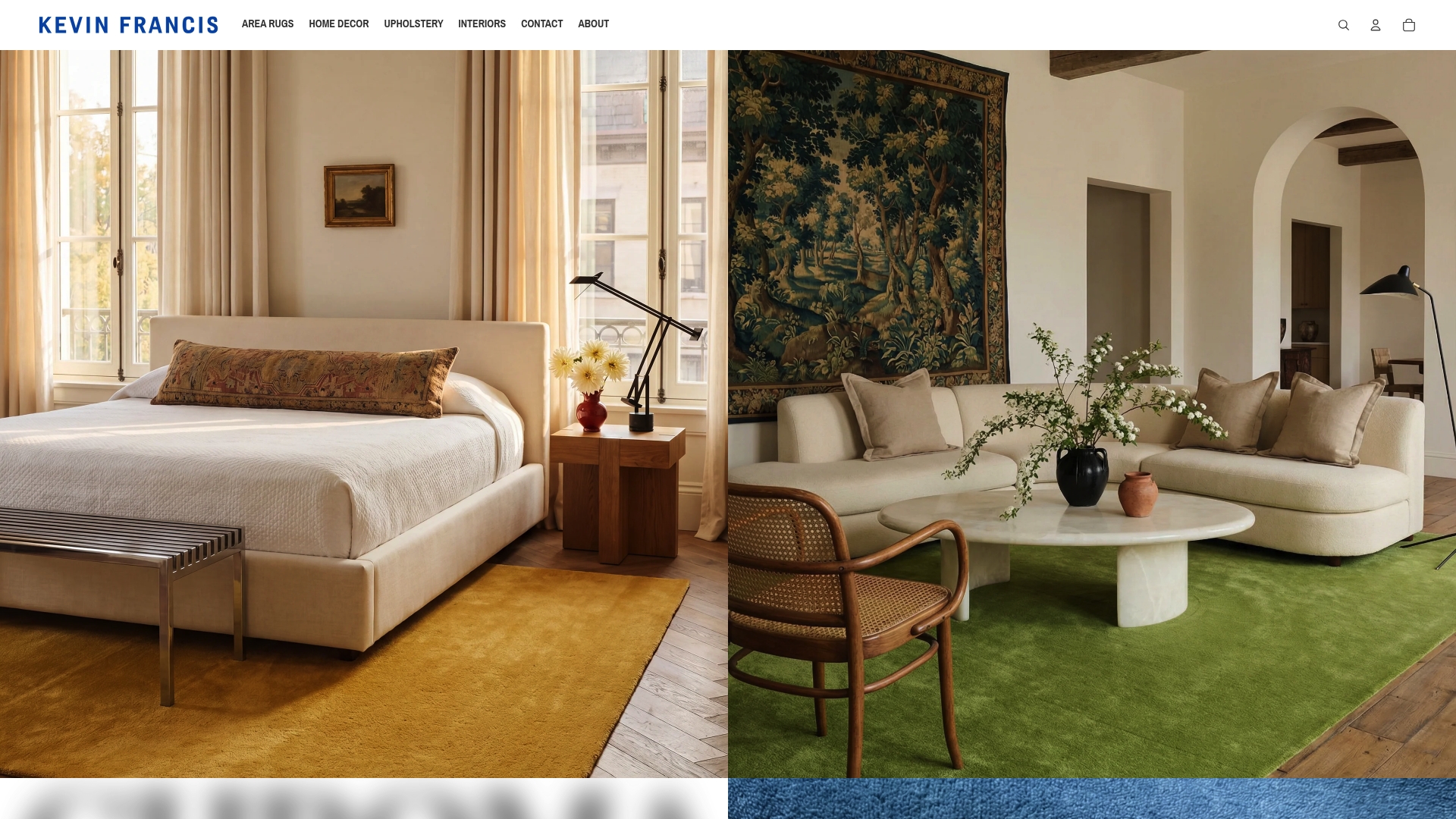
These are contemporary pieces made for gallery, installation, and residential use, not ethnographic or sacred textiles. Each is produced using responsible sourcing practices, with natural wool pile and construction methods that honor the knotted-pile tradition. Custom sizing and colorway options are available for interior designers and collectors seeking a bespoke piece. To discuss a commission or explore the full collection, visit Kevin Francis Design.
Three weaving traditions, from our own workshops

Mamluk, Hand-Knotted
Turkish-pattern hand-knotting in New Zealand wool, tied knot by knot in India. The most labor-intensive construction we make.
From $1,010
See sizes →

Color Study, Handwoven Flatweave
A kilim-style flatweave, woven on a loom rather than knotted, in a Bauhaus color study. The oldest technique on this page.
From $600
See sizes →

Panthera, Looped Pile
A hand-looped construction with a spotted leopard pattern, in a performance fiber that takes a mudroom or a kitchen.
From $770
See sizes →
Every rug in the collection names its construction on the product page, so you know whether you are buying knotted, tufted, looped or woven before you order.
Sources
These sources support the claims and regional examples throughout this guide and are recommended for deeper study:
- Bamboos for weaving and relevant traditional knowledge in Sansui, Southwest China | Journal of Ethnobiology and Ethnomedicine
- Warp and weft twining and tablet weaving around the Pacific — roundtable/ethnographic paper
- Mapping Shared Threads: Knowledge Exchange as a Strategy against Craft Extinction
- Venkatagiri Handloom Weaving: Traditions, Techniques and Contemporary Challenges
- The Kanekes Weavers of West Java and Their Cloth – RŪPAHAUS
- Textile Traditions — George Washington University Museum
FAQ
What are the main types of artisan weaving traditions worldwide?
Artisan weaving traditions worldwide organize into three layers: core weave structures (plain, twill, tapestry, pile, ikat, soumak, brocade, and tablet weaving), loom families (backstrap, warp-weighted, floor, and tapestry looms), and regionally distinct repertoires such as Navajo tapestry, Persian knotted carpets, Andean warp-faced textiles, and West African Kente.
What country is most widely recognized for weaving?
No single country holds that distinction, but Iran (Persia), India, and China each have documented weaving histories spanning several thousand years, with particularly deep traditions in knotted pile rugs (Iran), silk brocade and ikat (India and China), and handloom cotton cloth (India). UNESCO has recognized weaving traditions from dozens of countries as intangible cultural heritage.
What are the four main types of weaving techniques?
The four foundational weave structures are plain (tabby), twill, satin/sateen, and tapestry (weft-faced). All other structures, including pile knotting, ikat, brocade, soumak, and tablet weaving, build on or combine these four foundations.
How do you tell if a rug is genuinely hand-knotted?
Turn the rug over: a hand-knotted rug shows individual knot rows clearly on the back, with the pile yarn visible as tied loops around the warp threads. Machine-made rugs have a uniform molded or latex-coated backing with no visible knot structure. Selvedge cords on authentic hand-knotted pieces are hand-twisted and integral to the warp; sewn-on or glued edges indicate machine production.
What does the Bible say about weaving?
The Hebrew Bible references weaving in several contexts, most notably in Exodus 35–39, where skilled weavers produce the curtains, priestly garments, and textiles for the Tabernacle using linen, wool, and blue, purple, and scarlet dyed threads. The passages describe both the technical skill required and the sacred function of the textiles, reflecting the ancient Near Eastern understanding of weaving as a craft with both practical and ceremonial dimensions.
Recommended
- How Rug Craftsmanship Reflects Cultural Heritage – Kevin Francis Design
- Why Handwoven Rugs Develop Unique Character Over Time – Kevin Francis Design
- Types of Handwoven Rug Techniques: A Designer’s Guide – Kevin Francis Design
- Narrative-Driven Home Textile Collections: 6 Archetypes – Kevin Francis Design


