


Rug craftsmanship is a living cultural text: motifs, materials, and techniques encode a community’s environment, history, and values in ways that written records rarely capture. Scholars applying Roland Barthes’ visual semiotics to textiles have shown that decorative elements carry layered cultural meanings that ordinary viewers easily overlook. UNESCO’s Intangible Cultural Heritage program treats these traditions as fragile archives worth protecting. At Kevin Francis Design, we read every handmade rug as a document — one that rewards close attention.
The primary mechanisms through which rugs encode heritage:
- Motifs (floral, geometric, cosmological) that map belief systems and local ecology
- Color and dye choices that signal trade access, local flora, and ritual meaning
- Knotting technique and pile structure that index region, labor systems, and function
- Material selection that reflects pastoral life, climate, and available resources
- Asymmetry and repair that can record trauma, postmemory, and the passage of time
Table of Contents
- How do motifs, colors, and techniques function as cultural sign systems?
- Four regional traditions that show distinct cultural logics
- How is rug knowledge passed down, and what does that reveal?
- How to read a rug: a practical interpretation checklist
- Why does this matter now? Contemporary significance of textile heritage
- What Kevin O’Gara observes about handmade rugs and cultural craft signals
- Key Takeaways
- Why a craft-centered reading changes everything
- Useful sources and further reading
- Handmade rugs with a story worth living with
- FAQ
How do motifs, colors, and techniques function as cultural sign systems?
Motifs and materials act as signs; their presence, omission, or treatment carries cultural messages. Roland Barthes’ framework of visual semiotics, applied to textiles, reveals that a rug’s surface operates on at least two levels: the literal image and the cultural discourse it encodes. A pomegranate is not merely decorative — it is a fertility symbol with roots in pre-Islamic ritual. A geometric maze is not abstract play — it may be a protective labyrinth design intended to confuse malevolent spirits.
Research confirms that motif systems encode environmental conditions and philosophical worldviews simultaneously, making a single rug a compressed record of its maker’s world.
| Motif Category | Typical Meaning | Cultural Trigger |
|---|---|---|
| Floral / botanical | Fertility, paradise, abundance | Local ecology, trade in dye plants |
| Geometric / protective | Warding off evil, cosmic order | Nomadic spiritualism, ritual practice |
| Cosmological / celestial | Belief systems, divine hierarchy | Religious tradition, oral mythology |
| Animalistic | Power, landscape, clan identity | Pastoral life, hunting culture |
Dye palettes carry their own grammar. Natural indigo points to trade networks; madder red signals local root cultivation; saffron yellow places a weaver in specific highland ecologies. Technique, too, is a social index: asymmetrical Persian knotting versus symmetrical Turkish knotting signals not just geography but labor organization and the gender dynamics of the workshop.
Four regional traditions that show distinct cultural logics
Each weaving tradition encodes a different cultural logic, shaped by geography, history, and social structure.
| Tradition | Signature Motifs | Technique | Social Role |
|---|---|---|---|
| Qashqai kilim | Nature scenes, nomadic animals | Flatweave, natural dyes | Portable identity marker for nomadic clans |
| Pirot kilim | Geometric abstraction, protective symbols | Flatweave, wool on wool | Household dowry, community status |
| Ingushetiya felt/wool | Asymmetric ornaments, postmemory forms | Collaborative felting, wool | Communal grief and resilience archive |
| Navajo weaving | Geometric bands, spiritual cosmology | Tapestry weave, handspun wool | Ceremonial, clan identity, trade |
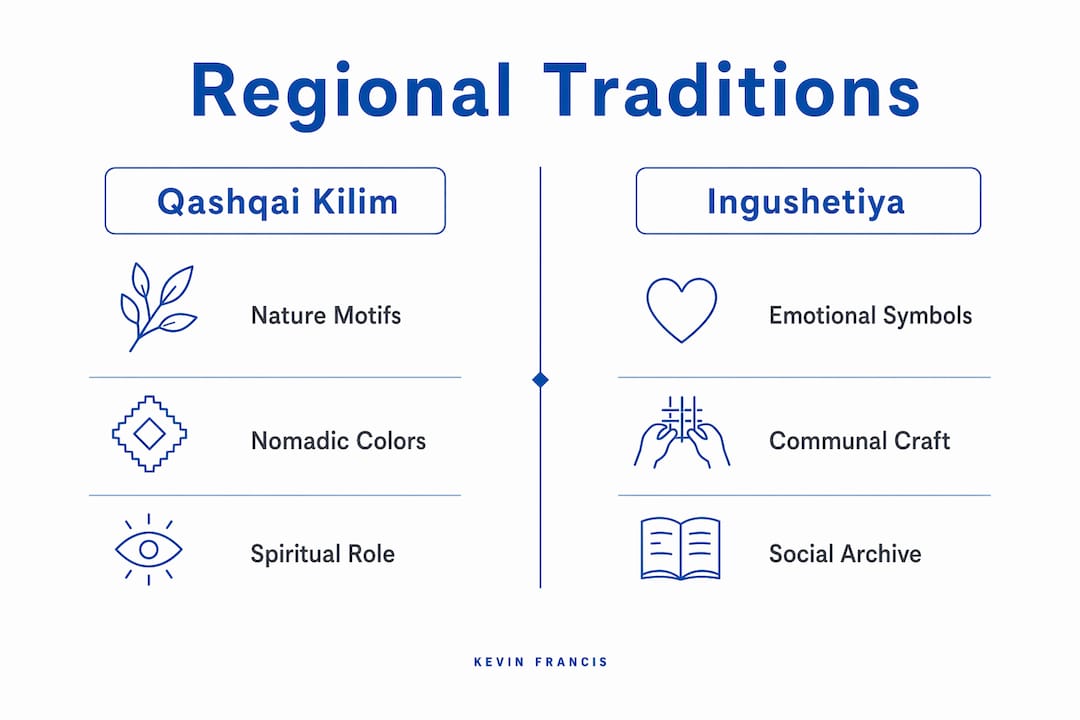
Qashqai kilims from southwestern Iran distill nomadic spiritualism into color and form. Their motifs reflect the Zagros Mountains’ flora and fauna, functioning as portable maps of a pastoral world. Pirot kilims from Serbia favor tight geometric abstraction; their protective symbols were woven into dowry pieces that marked a bride’s family status and her community’s aesthetic values.
The Ingushetiya tradition in Russia’s North Caucasus offers one of the most poignant examples of weaving as emotional archive. Ethnographic fieldwork documented by National Geographic found that asymmetrical ornaments appear during epidemics, wars, and crises — deliberate departures from symmetry that map collective grief onto the textile surface.
Navajo weaving in the American Southwest encodes cosmological order through geometric banding and color sequences tied to ceremony and clan. The tradition survived forced assimilation policies precisely because its knowledge lived in hands and memory rather than manuscripts.
How is rug knowledge passed down, and what does that reveal?
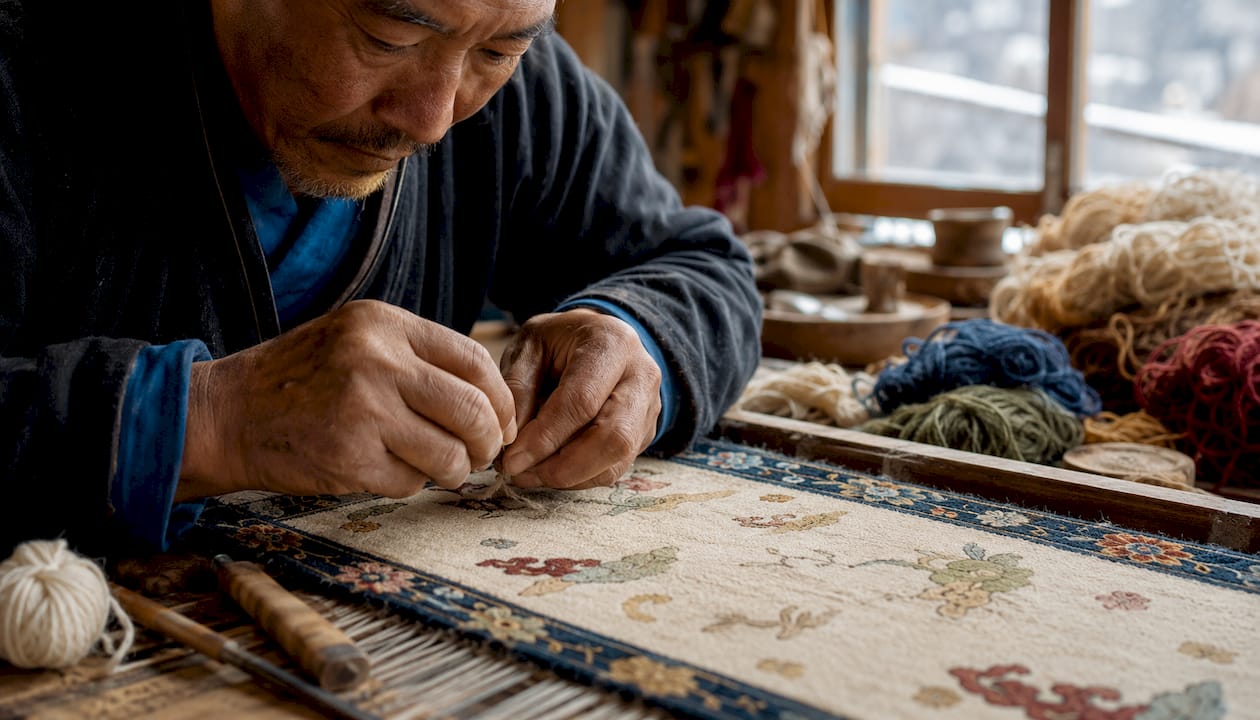
The loom is a social archive. Rug knowledge is transmitted primarily through apprenticeship and communal practice, which means the craft carries not just patterns but the relationships, songs, and stories that surround their making. UNESCO’s documentation of Li textile techniques shows that patterns can record history, belief, and legend where written language is absent — and that this knowledge is acutely vulnerable when practitioner numbers decline.
Women have historically been the primary keepers of most flatweave and pile traditions, processing raw wool, managing dye baths, and holding pattern knowledge across generations. Kurdish carpet traditions trace this role to mountainous pastoral life, where women wove family heirlooms from raw fleece to finished piece. Yet gender roles vary: Ghanaian kente weaving is historically male-dominated, with women contributing through yarn procurement and marketing rather than the loom itself.
Transmission is rarely verbal instruction alone. In Ingushetiya, communal production — multi-person, multi-day projects accompanied by songs and gathered family — is itself the medium of knowledge transfer. The asymmetric motifs woven during times of crisis encode postmemory: grief and resilience made visible in wool.
Pro Tip: When speaking with a maker or seller about a rug’s provenance, ask “Who taught you this pattern?” rather than “Where is it from?” The answer often reveals the transmission chain and whether the motif carries living meaning or has been reproduced commercially.
How to read a rug: a practical interpretation checklist
You can begin interpreting any rug by working through six diagnostic questions, whether you are standing in a museum gallery, a market, or your own living room.
- Identify the motif category. Is it floral, geometric, cosmological, or animalistic? Each category points toward a different cultural register and likely geographic origin.
- Examine the knotting or weave structure. Asymmetrical knotting suggests Persian or Kurdish traditions; symmetrical knotting points to Anatolian or Caucasian origins; flatweave (kilim) signals nomadic or highland production. A guide to identifying handmade craftsmanship can help you distinguish hand-tied knots from machine-made approximations.
- Assess the dye palette. Soft, slightly uneven color suggests natural dyes and older production; harsh, perfectly uniform color suggests synthetic dyes introduced after the mid-19th century.
- Look for asymmetry and repairs. Intentional asymmetry can signal postmemory or ritual intent. Repairs, especially in contrasting wool, are often signs of a rug valued enough to preserve across generations.
- Search for inscriptions or maker marks. Many Kerman and Caucasian rugs carry a weaver’s signature or the name of the patron. Their presence usually indicates a commissioned, high-status piece.
- Ask provenance questions. “Who learned this pattern, and from whom?” “Was this made for a specific occasion?” “What does this motif mean in your tradition?” These questions open the cultural text rather than closing it with a price tag.
Why does this matter now? Contemporary significance of textile heritage
Contemporary design and heritage policy increasingly treat rugs as resources for sustainable creative innovation rather than static artifacts. Researchers Youngim Seo and Hyewon Park argue in their 2025 study that traditional textiles should be re-evaluated as “social texts” that encode community values and offer genuine foundations for ethical, culturally grounded design. That reframing has real stakes: UNESCO’s urgent-safeguarding lists document traditions where practitioner communities have shrunk to the point of near-extinction, making each surviving piece a primary source with no backup copy.
For interior designers and collectors, this research shifts the question from “Does it look good?” to “What is it saying, and to whom?” A rug chosen for its motif symbolism and regional identity brings a layer of meaning into a room that no machine-made reproduction can replicate. Ethical sourcing, fair compensation for makers, and honest representation of a rug’s origins are not peripheral concerns — they are the conditions under which living traditions survive.
What Kevin O’Gara observes about handmade rugs and cultural craft signals
Handwork leaves traces that function as both authenticity markers and memory. At Kevin Francis Design, Kevin O’Gara approaches each piece with the understanding that a handmade rug’s surface is never static: it shifts with use, light, and time in ways that reveal the decisions made at the loom.
Two specific observations from practice: first, Tibetan knotting, used in several Kevin Francis Design pieces, produces a particularly expressive pile that develops a painterly patina over time, the colors shifting in a wash of warmth that machine-cut pile cannot replicate. Second, repairs in heritage rugs deserve respect rather than concealment. A rewoven section in slightly different wool is a record of the rug’s life — who owned it, how it was used, and how much it was valued. The Lotto Hand-Knotted Wool Area Rug and the Dede Hand-Knotted Wool Area Rug both carry this quality of honest, aging craft.
For collectors: store heritage rugs away from prolonged direct sunlight, rotate them annually to even the wear, and when a repair is needed, seek a conservator who matches the original fiber and dye rather than one who erases the evidence of use.
Key Takeaways
Rug craftsmanship reflects cultural heritage through semiotic systems of motif, color, technique, and asymmetry that encode a community’s environment, beliefs, and social memory.
| Point | Details |
|---|---|
| Rugs as cultural texts | Motifs, dyes, and knotting techniques each carry layered meanings that map environment, belief, and social role. |
| Regional case studies | Qashqai, Pirot, Ingushetiya, and Navajo traditions each encode distinct cultural logics through signature motifs and techniques. |
| Transmission and postmemory | Craft knowledge passes through communal practice and apprenticeship; asymmetry can intentionally encode grief or trauma. |
| How to read a rug | Six diagnostic steps — motif category, knot type, dye palette, asymmetry, inscriptions, and provenance questions — open the cultural text. |
| Kevin Francis Design | Hand-knotted pieces age with a patina that reveals the weaver’s hand, making craftsmanship itself a form of cultural memory. |
Why a craft-centered reading changes everything
We tend to look at rugs and see decoration. What the scholarship asks us to do — and what years of working closely with handmade textiles has reinforced for me — is look again, more slowly. The motifs are not ornament. The asymmetry is not error. The worn patch near the threshold is not damage. Each of these is a sentence in a language that took generations to develop, and that language is worth learning to read. Engaging with a rug as a cultural text is an act of respect toward the maker, the community, and the long chain of transmission that brought the object into existence. It also makes the rug more beautiful, not less.
Useful sources and further reading
- Examining the Cultural and Ideological Implications of the Visual Elements of the Sheikh Safi Tomb Carpet Using Roland Barthes’ Visual Semiotics Approach — Primary source for applying Barthes’ visual semiotics to historic carpet imagery; essential for understanding layered sign systems in rug design.
- The Cultural Value of Traditional Textiles: Cases from the UNESCO List of Intangible Cultural Heritage in Need of Urgent Safeguarding — Seo & Park (2025); argues for re-evaluating textiles as social texts and a basis for sustainable creative innovation.
- Traditional Li textile techniques: spinning, dyeing, weaving and embroidering — UNESCO ICH — UNESCO documentation of a gendered, endangered transmission tradition; illustrates preservation stakes.
- Memories are crafted in wool in this tiny Russian republic — National Geographic — Field reporting on Ingushetiya’s postmemory weaving practices and asymmetry as communal grief.
- Visual and cultural analysis of rug motifs as semiotic systems — Comparative analysis of Qashqai and Pirot kilim motif systems as environmental and spiritual encodings.
- Armenian rugs of resilience — Documents talismanic and ritual functions of protective motifs in Armenian carpet traditions.
- Kurdish Carpets: Threads Weaving the Memory of Kurdistan — Traces Kurdish carpet traditions as unwritten family and migration records, with women central to production.
- Anthropological Study of Kerman Carpet Symbols, Shapes and Designs — Ethnographic fieldwork connecting Kerman carpet motifs to regional belief, climate, and social life.
- How designer rugs tell creative stories at home — Kevin Francis Design — Connects cultural storytelling through rugs to contemporary interior narratives.
- Why handwoven rugs develop unique character over time — Kevin Francis Design — Explains how handwoven construction and aging create patina and authentic character over decades.
Handmade rugs with a story worth living with
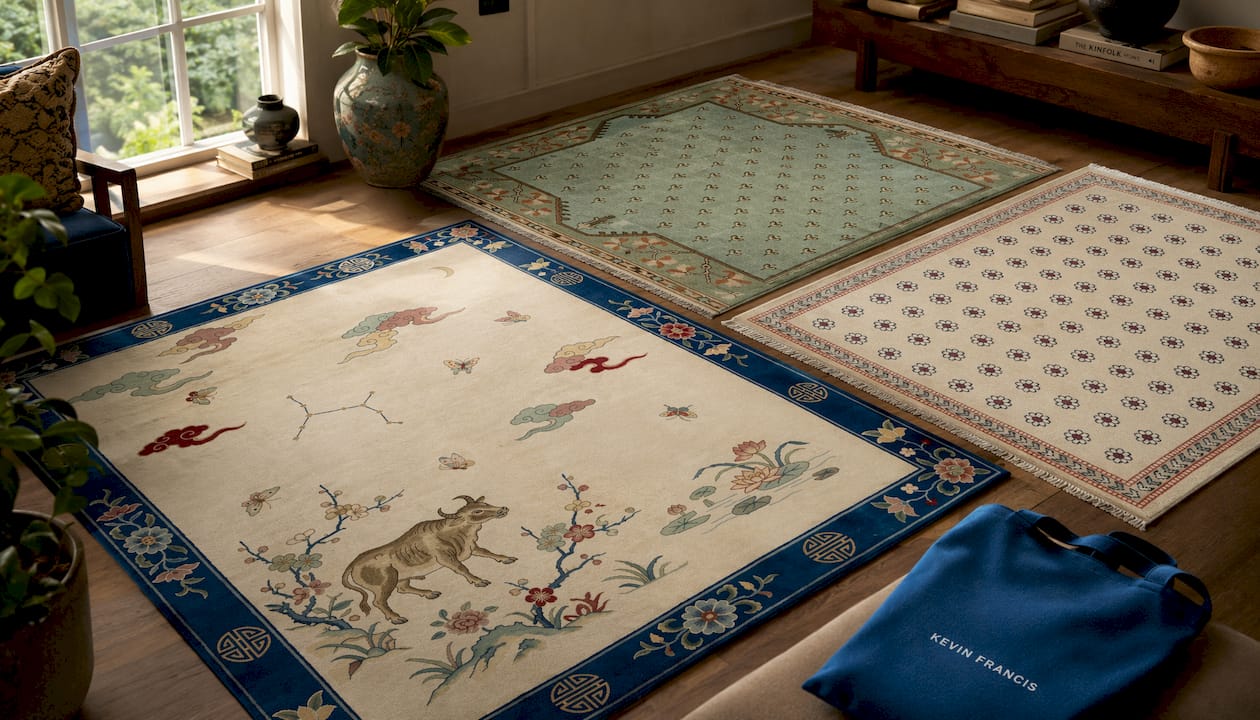
For readers who have spent time learning to read a rug as a cultural text, the next step is finding pieces where that depth of craft is genuinely present. Kevin Francis Design offers a curated collection of hand-knotted area rugs made using Tibetan knotting, handweaving, and hand-tufting techniques — each piece designed to carry the kind of character that only honest handwork produces. The Talisman Rug reinterprets Chinese Art Deco symbolism through a personalized, hand-knotted format, bringing talismanic motif tradition into a contemporary interior. Every piece in the collection is chosen because it ages with integrity, its surface shifting over years into something richer than it began. Browse the full collection at Kevin Francis Design and find the piece whose story belongs in your home.
FAQ
What makes a rug a cultural artifact rather than just decor?
A rug becomes a cultural artifact when its motifs, materials, and techniques encode specific community values, beliefs, or historical events — functioning as a visual language rather than pure ornament.
How can you tell if a rug’s motifs carry symbolic meaning?
Look at the motif category: geometric forms often carry protective or cosmological meaning, while floral patterns frequently signal fertility or paradise imagery. Asking the maker or a specialist about the motif’s name and origin usually confirms its intended meaning.
What is postmemory weaving, and where does it appear?
Postmemory weaving refers to the practice of encoding collective trauma or grief into a textile’s structure, often through deliberate asymmetry. The Ingushetiya tradition in Russia’s North Caucasus is a documented example, where asymmetrical ornaments appear in pieces made during wars and epidemics.
How does rug craftsmanship reflect cultural heritage in contemporary design?
Researchers Seo and Park (2025) argue that traditional textiles function as social texts, and contemporary designers increasingly draw on this heritage for ethical, culturally grounded creative work rather than treating historic motifs as purely decorative resources.
What should I look for when buying a handmade heritage rug?
Examine knot structure, dye palette, and any asymmetry or repairs — then ask who taught the maker the pattern. These details together reveal whether a piece carries living cultural meaning or has been commercially reproduced without its original context.


