


A truly handmade rug is defined by the individual hand-knotting or hand-weaving of its pile surface around warp threads on a loom, without any machine-inserted fibers. This construction method is what separates a genuine artisan textile from the many convincing imitations on the market today. Understanding what makes a rug truly handmade gives you the knowledge to invest wisely, decorate with intention, and own something that carries the quiet dignity of human skill. At Kevin Francis Design, we believe that distinction matters deeply.
What makes a rug truly handmade: construction at its core
The most important factor defining a truly handmade rug is its pile construction method. A hand-knotted rug is built by tying each knot individually around warp threads stretched on a loom. The weaver works row by row, knot by knot, building the pile from the foundation up. No machine inserts the fibers. Every loop, every cut, every pass of the weft thread is a deliberate human act.
This process is also called hand-knotting in the trade, and it is the gold standard for what defines a handmade rug. Related techniques include hand-weaving, where the weaver interlaces warp and weft threads to create flat-woven structures like kilims. Both methods require artisan involvement at every stage, and both produce textiles with a structural integrity that machines simply cannot replicate.
Natural fibers are the material foundation of this craft. Wool, silk, and cotton are the most common choices. Wool provides resilience and warmth. Silk adds luminosity and fine detail. Cotton offers a stable, even base for the warp structure. The combination of skilled hands and quality natural fibers is what gives a truly handmade rug its character, its longevity, and its soul.
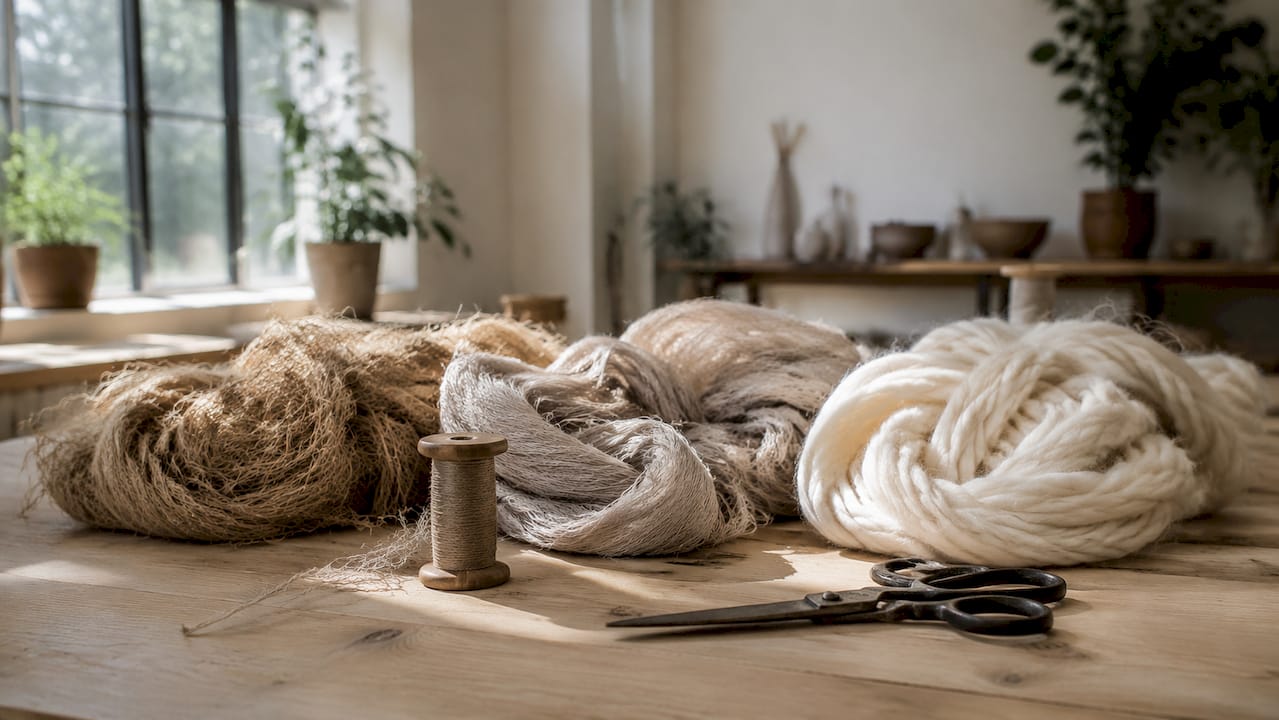
A hand-knotted rug takes months to years to complete. That time investment is not inefficiency. It is the source of the rug’s value.
How do hand-knotted, hand-tufted, and machine-made rugs differ?
The differences between construction methods are structural, not cosmetic. Understanding them protects you from paying hand-knotted prices for a tufted or machine-made product.
| Construction method | How the pile is formed | Backing | Typical lifespan |
|---|---|---|---|
| Hand-knotted | Each knot tied by hand around warp threads | Natural warp and weft, no adhesive | 50–100 years or more |
| Hand-tufted | Yarn punched into backing with a tufting gun | Latex glue and secondary backing | 7–15 years |
| Hand-woven (kilim) | Warp and weft interlaced by hand | No pile, flat structure | Decades with care |
| Machine-made | Computer-programmed power loom | Synthetic backing, sewn fringes | 5–20 years |
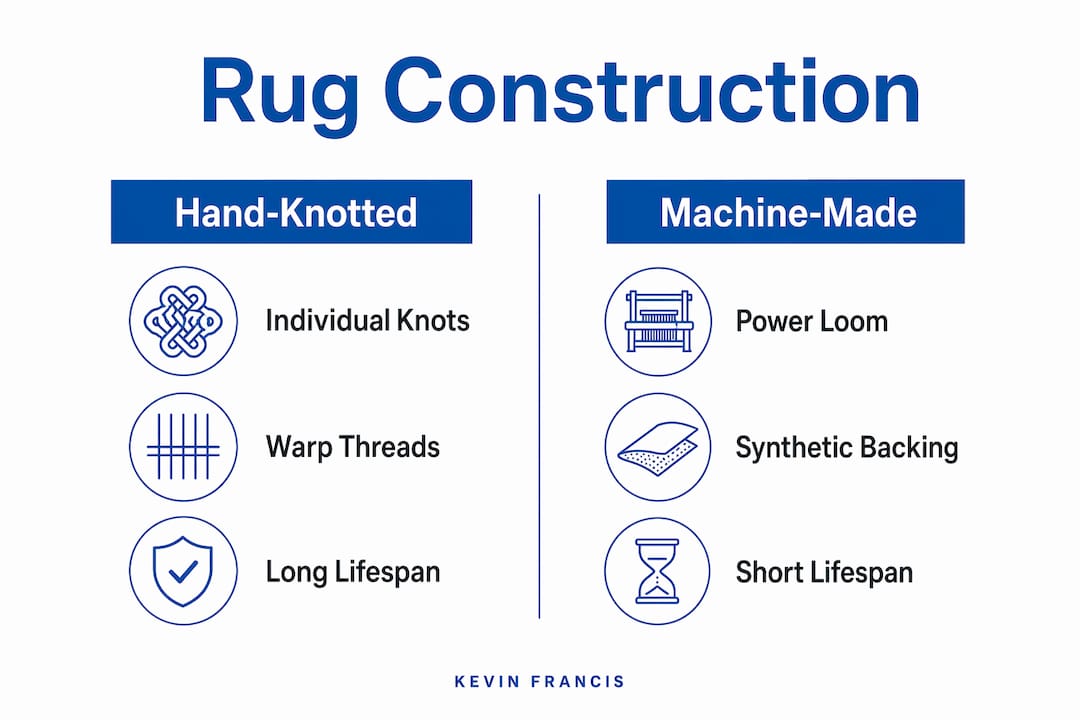
Hand-tufted rugs are the category most often confused with truly handmade rugs. Tufting involves punching yarn into a stretched backing cloth with a tufting gun, then sealing the back with latex glue and a secondary fabric layer. Artisans do operate the tufting gun by hand, which is why these rugs are marketed as handmade. But the pile is glued, not knotted. That distinction changes everything about durability and structure.
Machine-made rugs are produced by computer-programmed power looms that work at speeds no human can match. The result is a perfectly uniform pattern, a mechanically finished back, and fringes that are sewn on rather than formed by the warp threads themselves. Uniformity is the machine’s signature.
Hand-woven rugs, by contrast, carry the artisan’s signature in every slight variation of tension and color. The irregularities in knots and weave patterns are proof of human involvement, not flaws to be corrected.
Pro Tip: Flip any rug you are considering and examine the back. A hand-knotted rug shows individual knot nodes in a slightly irregular pattern. A machine-made rug looks almost photographically perfect on the reverse. A tufted rug shows a flat, glued surface with a secondary fabric layer.
How to identify handmade rugs by their physical features
Knowing the features of authentic handmade rugs turns you from a passive buyer into a confident one. These are the characteristics that reveal a rug’s true origin.
- The back tells the truth. On a hand-knotted rug, the back mirrors the front pattern in knot nodes. Each node is slightly irregular in size and spacing. On a machine-made rug, the back is perfectly even and often has a canvas or synthetic layer glued to it.
- Fringes are structural, not decorative. On a truly handmade rug, the fringe is formed by the warp threads themselves, extending naturally from the body of the rug. On a machine-made rug, fringes are sewn or glued on as a finishing touch.
- Color variation is a sign of hand-dyeing. Handmade rugs often show subtle shifts in color across the field, a quality called abrash. This happens because artisans dye wool in batches, and natural dye lots vary slightly. Machines produce perfectly consistent color from edge to edge.
- Pile irregularities confirm hand-shearing. After knotting, artisans shear the pile to an even height by hand. The result is a surface with very slight texture variation. Machine-cut pile is uniform to a fraction of a millimeter.
- Knot density indicates design complexity. Knot density is an important quality indicator, but it is not the sole measure of value. A coarser tribal rug with 40 knots per square inch can be more valuable than a finely knotted rug with poor fiber quality. Density tells you about design resolution, not about craftsmanship alone.
Authentic handmade rugs also develop a patina over time. The colors soften and deepen with age and foot traffic, growing more beautiful rather than worn out. This aging quality is one of the most compelling features of authentic handmade rugs, and it is something no machine-made textile can replicate.
Pro Tip: Request high-resolution images of the rug’s back before purchasing online. A reputable seller will always provide them. If the back looks too perfect, trust that instinct.
Why fiber choice and artisan skill shape a rug’s value
The fiber a rug is made from and the skill of the artisan who makes it are inseparable from its long-term value. These two factors determine how a rug ages, how it holds color, and how it feels underfoot for decades.
Wool quality varies significantly by geography. High-altitude wool from regions like the Ghazni highlands of Afghanistan produces longer, stronger fibers with higher lanolin content. That lanolin acts as a natural protectant, resisting crushing and color fading over time. Lowland wool tends to have shorter, softer fibers that wear more quickly. The difference shows up clearly after ten or twenty years of use.
Silk is used in the finest handmade rugs for its luminosity and its ability to hold extremely fine detail. A silk rug catches light differently at every angle, creating a wash of color and movement across the surface. Cotton is most often used for the warp and weft foundation, providing dimensional stability without adding bulk to the pile.
Artisan skill shapes the rug in ways that go beyond the knot count. Consider these qualities that only an expert hand can produce:
- Design fidelity. A skilled weaver translates a complex pattern cartoon into knotted form with precision, maintaining proportions across a large field.
- Carving and shearing. After knotting, artisans carve around motifs to create a sculptural, three-dimensional surface. This technique requires a steady hand and years of practice.
- Selvedge finishing. The edges of a hand-knotted rug are wrapped by hand, creating a durable border that resists unraveling. Machine-made edges are serged or glued.
- Color graduation. Expert dyers and weavers work together to create subtle color transitions that give a rug depth and visual warmth.
You can explore the full range of handwoven rug techniques to understand how each method shapes the final result.
Practical tips for buying and caring for authentic handmade rugs
Purchasing a truly handmade rug is an investment. These steps protect that investment from the moment you begin your search.
- Inspect the back in person or via detailed images. The reverse of a hand-knotted rug is your most reliable indicator. Look for individual knot nodes, slight irregularities, and warp threads forming the fringe.
- Ask for provenance and artisan credentials. Reputable sellers can tell you the region of origin, the weaving tradition, and often the workshop or cooperative that produced the rug. Vague answers are a warning sign.
- Assess fiber type with a simple touch test. Wool feels warm and slightly waxy. Silk is cool and has a distinctive sheen. Synthetic fibers feel uniformly soft and lack the subtle texture of natural materials.
- Consider professional appraisal for significant purchases. For rugs above a certain price point, an independent appraiser with textile expertise can confirm authenticity, fiber content, and approximate age.
- Avoid common misidentification traps. A hand-tufted rug may carry a “handmade” label because artisans operate the tufting gun. A tufted rug’s pile is glued, not knotted, and its lifespan of roughly 7–15 years reflects that structural difference.
- Care for natural fibers with appropriate methods. Rotate the rug every six to twelve months to distribute foot traffic evenly. Vacuum with a low-suction setting, avoiding the fringe. For deep cleaning, use a specialist in hand-knotted textiles, not a standard carpet cleaner.
- Use a quality rug pad. A natural fiber or felt pad protects the rug’s foundation from friction and extends its life significantly.
For a deeper look at what separates a quality piece from an ordinary one, the luxury rug identification guide at Kevin Francis Design is a thorough resource.
Key takeaways
A truly handmade rug is defined by hand-knotted or hand-woven pile construction, natural fiber quality, and artisan skill, all of which produce a textile that machines cannot replicate.
| Point | Details |
|---|---|
| Construction method is the defining factor | Only hand-knotted or hand-woven pile construction qualifies as truly handmade. |
| Tufted rugs differ structurally | Hand-tufted rugs use glued pile and last 7–15 years, far less than hand-knotted rugs. |
| Irregularities confirm authenticity | Slight variations in knot nodes, color, and pile height are signs of genuine artisan work. |
| Fiber origin shapes longevity | High-altitude wool from regions like Ghazni, Afghanistan produces stronger, longer-lasting pile. |
| Knot density is one factor, not the only one | Fiber quality and artisan skill matter as much as knots per square inch when assessing value. |
What I’ve learned from years of working with handmade rugs
The market is full of rugs that look handmade but are not. That gap between appearance and reality is where most buyers get hurt, and it is the thing I find myself explaining most often.
The most common misconception I encounter is that “handmade” simply means a person was involved in the process. By that logic, a factory worker pressing a button on a power loom is making a handmade rug. The word needs a stricter definition, and that definition lives in the construction. If the pile is not knotted by hand around the warp threads, the rug is not truly handmade in the traditional sense, regardless of what the label says.
What I find genuinely moving about hand-knotted rugs is that they carry time inside them. A rug that took two years to complete holds two years of a weaver’s attention, skill, and intention. That is not a romantic abstraction. It shows up in the way the rug ages, the way it holds color, and the way it feels different from anything a machine produces. Owning one of these pieces is a form of connection to a tradition that stretches back centuries.
The balance between tradition and design innovation is something we think about constantly at Kevin Francis Design. Our collections draw on classical knotting and weaving traditions while expressing a distinctly contemporary design vision. That combination is only possible because the foundation is authentic. You can see how artisan rug craftsmanship informs every piece we create.
My honest advice: buy the best construction you can afford, prioritize fiber quality over pattern novelty, and never let a label substitute for your own inspection of the back.
— Kevin O’Gara
Handmade rugs worth owning, from Kevin Francis Design
Kevin Francis Design offers a curated selection of rugs built on the construction principles this article describes.

The Lotto Hand-Knotted Wool Rug is hand-knotted in the Turkish tradition using high-quality wool, with every knot tied individually around the warp threads. The pattern draws on classical geometric motifs reinterpreted through a contemporary design lens. For those drawn to hand-tufted construction, the Anatolia Hand-Tufted Rug offers artisan craftsmanship at an accessible scale, with the maze pattern that has become a signature of Kevin Francis Design’s collections. Both pieces reflect the authenticity criteria this article outlines, and our team is available to guide you toward the right choice for your space.
FAQ
What is the difference between hand-knotted and hand-tufted rugs?
A hand-knotted rug has each knot tied individually around warp threads by an artisan, creating a durable, long-lasting structure. A hand-tufted rug has its pile punched into a backing with a tufting gun and secured with latex glue, giving it a lifespan of roughly 7–15 years compared to 50–100 years for a well-made hand-knotted rug.
How can you tell if a rug is truly handmade?
Flip the rug and examine the back. A hand-knotted rug shows individual knot nodes in a slightly irregular pattern that mirrors the front design. Machine-made rugs have a mechanically perfect back, and tufted rugs show a flat, glued surface covered by a secondary fabric layer.
Are irregularities in a handmade rug a defect?
Irregularities in knot spacing, color, and pile height are signs of authentic artisan work, not defects. Perfect uniformity across a rug’s surface and back is the signature of machine production, not handcraft.
Does knot density determine a handmade rug’s quality?
Knot density indicates design resolution and complexity, but it is not the sole quality measure. Fiber quality, artisan skill, and regional weaving tradition all contribute equally to a rug’s value and longevity.
How should I care for a hand-knotted rug?
Rotate the rug every six to twelve months to distribute wear evenly, vacuum with low suction while avoiding the fringe, and use a specialist in hand-knotted textiles for deep cleaning. A natural fiber or felt rug pad placed underneath extends the life of the foundation significantly.


