


Handwoven rug techniques define the artistry, texture, and longevity of every rug you bring into a space. The term “handwoven” is a broad construction category that covers several distinct methods, from hand-knotted pile rugs tied knot by knot on a vertical loom to flatweaves like kilims and dhurries woven without any pile at all. Understanding the types of handwoven rug techniques matters because each method produces a different visual character, a different lifespan, and a different maintenance reality. Whether you are furnishing a formal living room or a well-loved hallway, the construction method is the single most important factor to understand before you buy.
1. What are the types of handwoven rug techniques?
The major rug weaving methods recognized by the industry are hand-knotted, hand-tufted, flatweave, hand-hooked, and hand-braided. Each is a genuinely different process, not a variation on the same theme. As one dealer’s guide notes, “handwoven” is often used in marketing as an umbrella term that can include flatweave types like kilims and dhurries, which have a completely different production method from hand-knotted rugs despite similar artisanal branding. That distinction matters enormously when you are comparing price points and expected lifespans. The sections below break each method down with the specificity a serious design decision deserves.
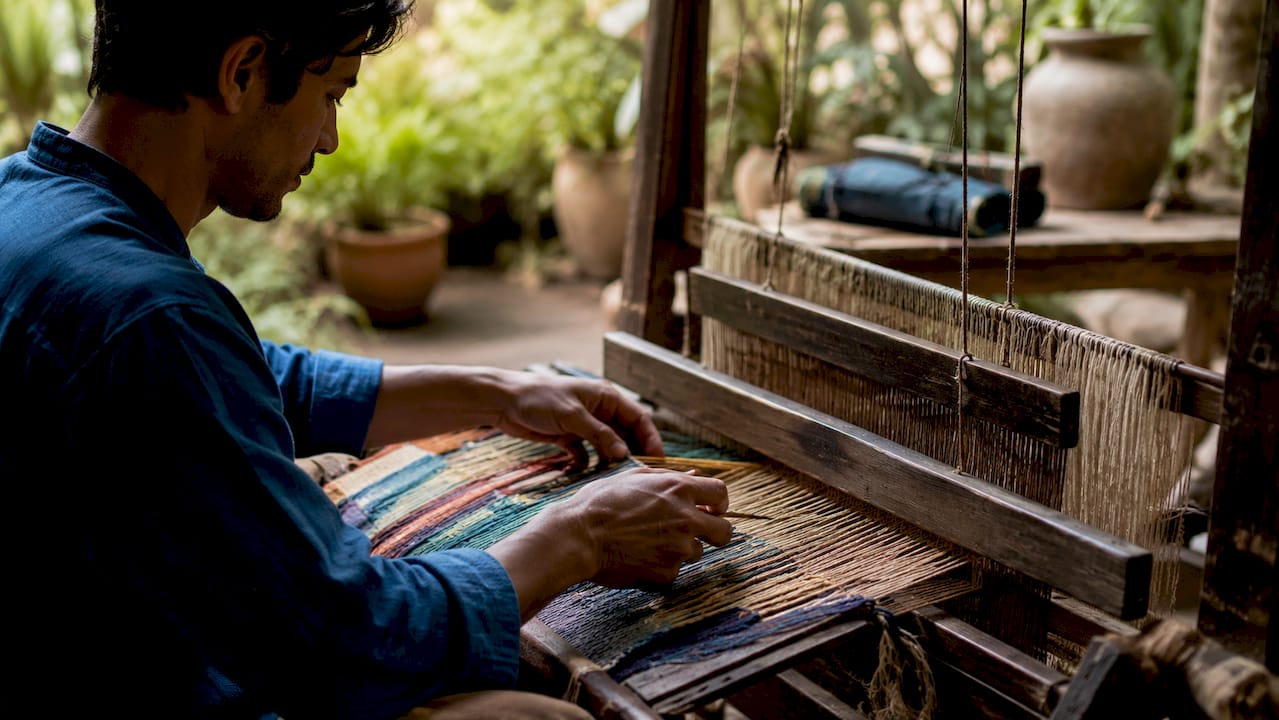
2. Hand-knotted rugs: the gold standard of artisan weaving
Hand-knotted rugs are the most labor-intensive of all traditional rug techniques. Each knot is tied individually onto a warp thread on a vertical loom, then the pile is cut to create an even surface. A single 9-by-12 rug can contain millions of knots and take a team of weavers months or even years to complete.
The two dominant knot types are the Persian knot (also called the Senneh knot) and the Turkish knot (the Ghiordes knot). The Persian knot wraps asymmetrically around one warp thread, allowing for finer detail and higher knot counts per square inch. The Turkish knot wraps symmetrically around two warp threads, producing a sturdier pile suited to bolder geometric patterns. Regions including Persia, Turkey, India, and Tibet each developed their own knotting traditions, which is why a Tabriz carpet looks nothing like a Tibetan piece despite both being hand-knotted. You can explore how Tibetan knotting techniques translate into modern interiors for a closer look at that regional tradition.
The reward for all that labor is extraordinary longevity. Hand-knotted rugs last 50 to 100 or more years, and antique Persian examples still look beautiful after a century. That lifespan makes them genuine heirloom investments, not just floor coverings.
- Authentication tip: Flip the rug over. Authentic hand-knotted rugs show individual, slightly irregular knots on the underside and natural warp-thread fringes. No glued backing. No canvas.
- Knot density: Measured in knots per square inch (KPSI). Higher KPSI generally means finer detail and greater value.
- Best for: Formal living rooms, dining rooms, and any space where you want a rug to outlast the furniture around it.
Pro Tip: When shopping for hand-knotted rugs, ask for the KPSI count. A rug with 100 KPSI is a solid everyday piece; 300 KPSI and above signals fine art-level craftsmanship.
3. Hand-tufted rugs: plush appeal with a shorter timeline
Hand-tufted rugs are made by punching yarn through a stretched canvas backing using a handheld tufting gun. The loops are then cut or left intact to form the pile, and a secondary backing is glued on to hold everything in place. A skilled artisan can finish a 9-by-12 rug in 2–3 days, which explains why hand-tufted rugs are far more affordable than hand-knotted ones.
The trade-off is lifespan. Because the pile is secured by latex glue rather than structural knots, the backing deteriorates over time. Most hand-tufted rugs last 7–15 years before the backing begins to separate or shed. That is not a flaw so much as a design reality to plan around.
“Consumers often confuse hand-tufted rugs as accelerated hand-knotted versions, but these are fundamentally different techniques with distinct lifespans and maintenance needs.”
- Feel: Plush, soft underfoot, and often thicker than hand-knotted rugs at the same price point.
- Maintenance: Vacuum regularly, but avoid steam cleaning, which can weaken the latex backing.
- Identification: The underside shows a smooth canvas or felt backing, not individual knots.
- Best for: Bedrooms, reading nooks, and spaces where tactile softness matters more than multi-decade longevity.
Hand-tufted rugs are a perfectly respectable choice when you understand what you are buying. The problem arises when retailers market them as equivalent to hand-knotted rugs. Knowing the difference protects your investment and your expectations.
4. Flatweave rug styles: kilims, dhurries, and woven traditions
Flatweave rugs are constructed by interlacing warp and weft threads without any pile. The result is a thin, reversible textile with a graphic, almost painterly surface. Kilims and dhurries are the two most recognized flatweave styles, and they differ in origin, material, and character.
Kilims originate from Central Asia, Persia, and Anatolia. Their defining feature is the slit-weave technique, which creates small vertical gaps between color blocks wherever two colors meet. Those slits are a hallmark of authentic handwoven kilims and produce the sharp geometric motifs the style is known for. Machine-made imitations lack this structural detail entirely.
Dhurries come primarily from India and are traditionally woven from cotton, though wool and silk versions exist. They are softer and more flexible than kilims, fully reversible, and often washable, which makes them a practical choice for family spaces.
| Feature | Kilim | Dhurrie |
|---|---|---|
| Origin | Central Asia, Persia, Turkey | India |
| Primary material | Wool | Cotton or wool |
| Construction detail | Slit-weave gaps | Tight interlaced weave |
| Reversible | Yes | Yes |
| Best setting | Living rooms, entryways | Casual rooms, outdoor-adjacent spaces |
Flatweave rugs are easier to maintain than pile rugs because dirt does not embed deeply without a pile to trap it. They are lightweight, breathable, and well-suited to high-traffic residential areas where a thick pile rug would wear unevenly.
Pro Tip: To confirm a kilim is authentic, look for those characteristic slit gaps along color boundaries. If the pattern looks perfectly uniform with no structural gaps, it was likely machine-made.
5. Hand-hooked and hand-braided rugs: texture as artistry
Hand-hooked and hand-braided rugs occupy a different creative space from knotted and flatwoven pieces. Both methods are rooted in folk craft traditions, and both produce surfaces with a warmth and tactile richness that more formal techniques rarely match.
Hand-hooked rugs are made by pulling loops of yarn or fabric strips through a woven foundation using a hook tool. The loops can be left intact for a rounded, cushioned surface or cut to create a velvety pile. The design possibilities are wide. Artists use hand-hooking to create pictorial rugs with landscapes, florals, and figurative motifs that read almost like paintings on the floor.
Hand-braided rugs are made by plaiting yarns into long cords, which are then coiled and stitched together. The result is a dense, durable surface with a satisfying geometric rhythm. Oval and round braided rugs are the most traditional forms, though rectangular versions are common today.
- Hand-hooked: Suited to bohemian, eclectic, and cottage interiors. Works beautifully as a statement piece in a reading room or sunroom.
- Hand-braided: Naturally durable and well-suited to casual dining areas, mudrooms, and layered rug arrangements.
- Care: Both styles benefit from regular rotation to distribute foot traffic evenly. Spot-clean with mild soap and water.
- Artistic value: Hand-hooked rugs in particular are increasingly collected as textile art, with some contemporary makers producing limited-edition pieces that command gallery prices.
6. Comparing handwoven rug techniques: which is right for your space?
Choosing among different rug weaving styles comes down to three factors: how long you need the rug to last, what visual character you want it to bring, and how much maintenance you are willing to give it.
| Technique | Lifespan | Texture | Price range | Best room |
|---|---|---|---|---|
| Hand-knotted | 50–100+ years | Dense, rich pile | High | Living room, dining room |
| Hand-tufted | 7–15 years | Plush, soft | Mid | Bedroom, lounge |
| Flatweave (kilim/dhurrie) | 20–40 years | Flat, graphic | Low to mid | Entryway, kitchen, high-traffic |
| Hand-hooked | 15–25 years | Looped or cut pile | Mid | Study, sunroom |
| Hand-braided | 20–30 years | Dense, textured | Low to mid | Casual dining, mudroom |
Machine-made rugs offer uniform precision and lower prices, but they lack the organic texture variation and structural durability of any handmade method. If you are building a collection meant to grow in value and character over time, handmade construction is the only path worth considering. Learning to identify quality craftsmanship before you buy will save you from costly misidentifications.
The most reliable authentication method for hand-knotted rugs remains the back of the rug. Individual knots visible on the underside, natural fringes that are extensions of the warp threads, and slight irregularities in the pile are all signs of genuine hand-knotted construction. A smooth, glued canvas backing signals hand-tufted or machine-made construction regardless of what the label says.
Key takeaways
The construction method of a handwoven rug determines its texture, lifespan, and artistic character more than any other single factor.
| Point | Details |
|---|---|
| Hand-knotted rugs last longest | Expect 50–100+ years; individual knots on the back confirm authenticity. |
| Hand-tufted rugs offer plush value | Lifespan of 7–15 years; ideal for bedrooms where softness matters most. |
| Flatweaves suit high-traffic spaces | Kilims and dhurries are reversible, easy to clean, and graphically bold. |
| “Handwoven” is a marketing umbrella | The term covers multiple distinct techniques; always ask about construction method. |
| Texture signals technique | Flip any rug over to read its construction before committing to a purchase. |
Craft over label: what I’ve learned choosing rugs for real interiors
I have spent years working with artisan weavers and placing rugs in rooms that need to perform as well as they inspire. The single most useful shift I made was to stop reading labels and start reading the back of the rug. Marketing language in this category is genuinely unreliable. A rug described as “handcrafted” or “artisan-made” might be hand-tufted, hand-knotted, or hand-finished on a machine-made base. Those are three very different objects with three very different futures.
My honest preference for formal spaces is always hand-knotted. The density of the pile, the way light moves across it differently from every angle, the knowledge that it will outlast the sofa beside it by decades. That is not nostalgia. It is structural reality. For a client who wants warmth in a bedroom without the investment of a knotted piece, a well-made hand-tufted rug is a perfectly sound choice, provided they understand the 10-year horizon. Where I see the most regret is when someone pays hand-knotted prices for a hand-tufted rug because the retailer was vague about construction.
Flatweaves are chronically underestimated. A fine kilim in a dining room or entryway brings graphic energy and handles daily life with remarkable grace. I have placed kilims in spaces where a pile rug would have looked wrong and felt impractical, and they have transformed those rooms. If you are building an artisan rug collection, I would encourage you to include at least one flatweave. The contrast it creates alongside a knotted piece is genuinely beautiful.
— Kevin O’Gara
Discover handcrafted rugs by Kevin Francis Design
At Kevin Francis Design, every rug in our collection is chosen for the integrity of its construction and the depth of its artistry. Our hand-knotted wool pieces represent the pinnacle of traditional rug weaving methods, each one a considered investment in beauty and longevity. The Lotto Hand-Knotted Wool Area Rug is a particularly compelling example, drawing on Turkish knotting traditions to produce a surface rich with pattern and warmth. We also offer custom design services for clients who want a piece built around a specific room, palette, or vision. Explore our full collection of handmade luxury rugs and find the technique, scale, and character that belongs in your home.
FAQ
What is the most durable handwoven rug technique?
Hand-knotted rugs are the most durable, with a lifespan of 50 to 100 or more years. Individual knots tied onto warp threads create a structurally sound pile that does not rely on glue or backing to hold its shape.
How do I tell a hand-knotted rug from a hand-tufted one?
Flip the rug over. Hand-knotted rugs show individual, slightly irregular knots on the underside and natural warp-thread fringes. Hand-tufted rugs have a smooth canvas or felt backing secured with latex glue.
Are kilims considered handwoven rugs?
Yes. Kilims are authentic handwoven rugs constructed using a slit-weave technique that interlaces warp and weft threads without any pile. The small vertical gaps along color boundaries are a hallmark of genuine kilim construction.
What does “handwoven” actually mean on a rug label?
“Handwoven” is a broad marketing term that technically refers to flatweave construction but is often applied loosely to hand-tufted and even hand-finished machine-made rugs. Always ask the retailer to specify the exact construction method before purchasing.
Which rug weaving method works best for high-traffic areas?
Flatweave rugs, particularly kilims and dhurries, perform best in high-traffic areas. Their pileless construction means dirt does not embed deeply, they are lightweight and reversible, and they hold their appearance well under daily use.


