


Rug pile height — the industry term for the length of a rug’s fibers measured from the backing to the tip — is the single specification that most directly shapes how a rug feels underfoot, how long it lasts, and how easy it is to maintain. For most living spaces, a medium pile of 1/4" to 1/2" (roughly 6–12 mm) strikes the best balance between comfort and practicality. Low pile under 1/4" (under 6 mm) suits high-traffic areas, pets, and dining rooms; high pile above 1/2" (over 12 mm) belongs in bedrooms and quiet sitting rooms where softness is the priority.
Quick numeric reference for shopping:
- Low pile: under 1/4" (under 6 mm) — durable, easy to clean, pattern-precise
- Medium pile: 1/4"–1/2" (6–12 mm) — versatile, comfortable, most living rooms
- High/plush pile: 1/2"–3/4" (12–19 mm) — soft, cozy, low-traffic spaces
- Shag: over 3/4" (over 19 mm) — maximum texture, minimal traffic only
Pro Tip: When shopping in-store, press your thumb firmly into the pile and release. If the fibers spring back quickly and cleanly, the pile density is good. Slow recovery often signals lower fiber quality regardless of height.
Key Takeaways
The right rug pile height depends on room use, traffic level, and the construction quality beneath the fibers.
| Point | Details |
|---|---|
| Low pile for high-traffic zones | Under 1/4" (under 6 mm) handles hallways, dining rooms, and kitchens without matting or trapping debris. |
| Medium pile for most living rooms | 1/4"–1/2" (6–12 mm) balances comfort and durability for the widest range of household uses. |
| High pile belongs in low-traffic spaces | Reserve 1/2"–3/4" (12–19 mm) for bedrooms and quiet rooms where softness outweighs maintenance demands. |
| Always check door clearance first | A standard interior door needs roughly 1/2" of floor clearance; pile height plus backing can exceed this. |
| Kevin Francis Design for custom pile | Hand-knotted wool rugs with sample swatches available, so you verify pile height and feel before committing. |
Table of Contents
- What does rug pile height actually measure?
- Pile height ranges: a practical reference chart
- How pile construction shapes the way a rug wears
- How pile height affects durability, comfort, and daily life
- Which pile height works best in each room?
- How to measure pile height accurately
- Cleaning and care by pile height
- Your pile-height buying checklist
- How to spot quality pile and construction
- Does pile height affect allergies?
- Environmental considerations in pile height and material choice
- How pile height and rug backing work together
- The trade-off no one talks about honestly
- Handmade rugs with the pile height your room deserves
- Sources
- FAQ
What does rug pile height actually measure?
Rug pile height is the length of the rug fibers measured from the backing or foundation up to the tips of the strands. That single measurement tells you how tall the surface texture stands, but it says nothing about how densely those fibers are packed. Pile density — the number of tufts or knots per square inch — is a separate specification, and a rug can have a tall pile with loose density or a short pile with extraordinary tightness.
A few distinctions worth keeping clear:
- Pile height measures fiber length, tip to backing.
- Pile density (or pile weight) measures how closely the fibers are packed.
- Backing type affects how the pile sits: a firm latex or cotton secondary backing holds tufts upright, while a loose woven backing allows more flex and movement.
- Fiber type interacts with height: wool holds its shape at most heights, while some synthetics compress more quickly at taller lengths.
When you read a product spec sheet, look for the pile height listed in inches or millimeters. If only one measurement appears and it seems unusually large, it may include the backing thickness. True pile height is measured from the foundation weave to the fiber tip only.
Pile height ranges: a practical reference chart
The rug industry glossary defines very short pile as under 5 mm, medium pile as approximately 5–10 mm, and long pile as 10 mm and above. Retailers tend to use slightly different shorthand, with One Kings Lane placing low pile below 1/4", medium between 1/4" and 1/2", and plush/high between 1/2" and 3/4", with shags exceeding 3/4". The table below reconciles both systems.
| Label | Inches | Millimeters | Best uses | Quick pros/cons |
|---|---|---|---|---|
| Low | Under 1/4" | Under 6 mm | Hallways, kitchens, dining rooms, offices | Easy to vacuum, durable, precise patterns; less cushion underfoot |
| Medium | 1/4"–1/2" | 6–12 mm | Living rooms, family rooms, most bedrooms | Balanced comfort and durability; suits most fiber types |
| High/Plush | 1/2"–3/4" | 12–19 mm | Master bedrooms, quiet sitting rooms | Luxuriously soft; harder to vacuum, traps more debris |
| Shag | Over 3/4" | Over 19 mm | Accent areas, nurseries, reading nooks | Maximum texture and warmth; requires dedicated maintenance |
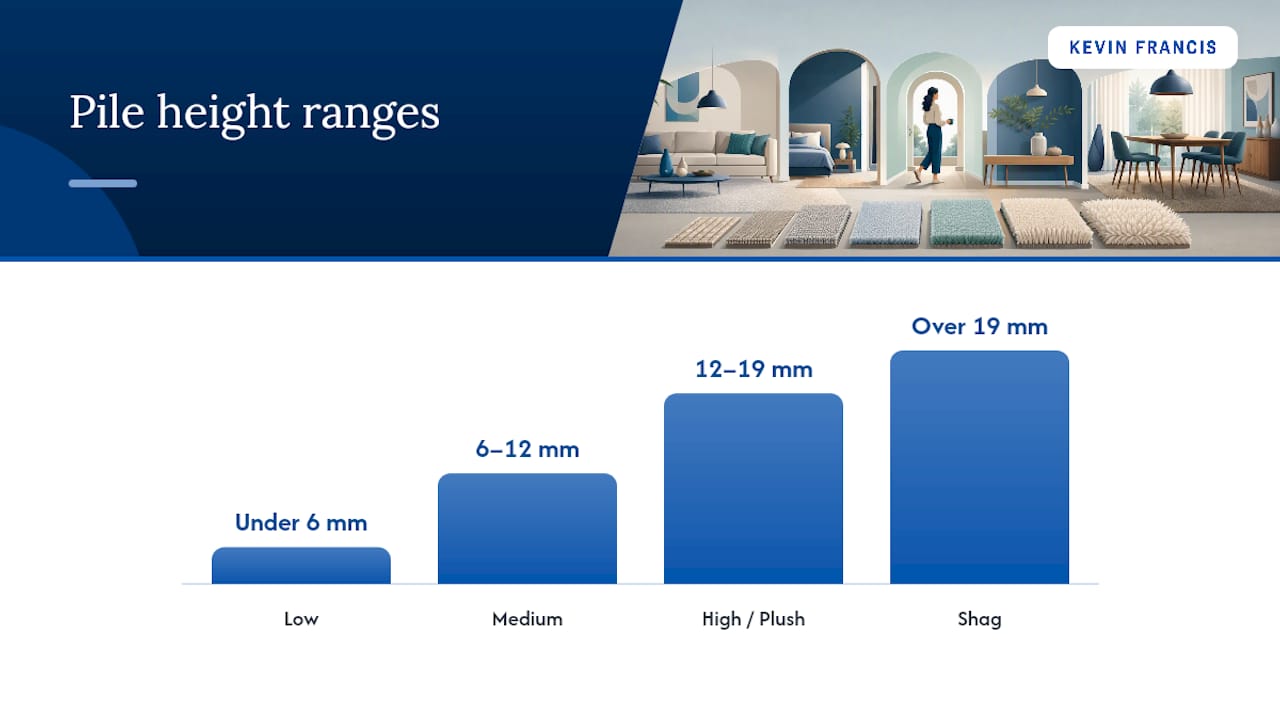
One note on vendor labeling: retail pile categories are not standardized across brands. A rug sold as “medium” by one manufacturer may measure closer to high by another’s scale. Always check the actual millimeter or inch figure in the product specification rather than relying on the category label alone.
For U.S. shoppers reading international specs: 1 inch equals 25.4 mm, so a 10 mm pile converts to roughly 3/8", sitting comfortably in the medium range.
How pile construction shapes the way a rug wears
Pile height and pile construction work together. The same height can feel and perform very differently depending on how the fibers are formed.
- Cut pile: fibers are sheared at the top, creating a smooth, velvety surface. The most common construction; suits most rooms and holds color well.
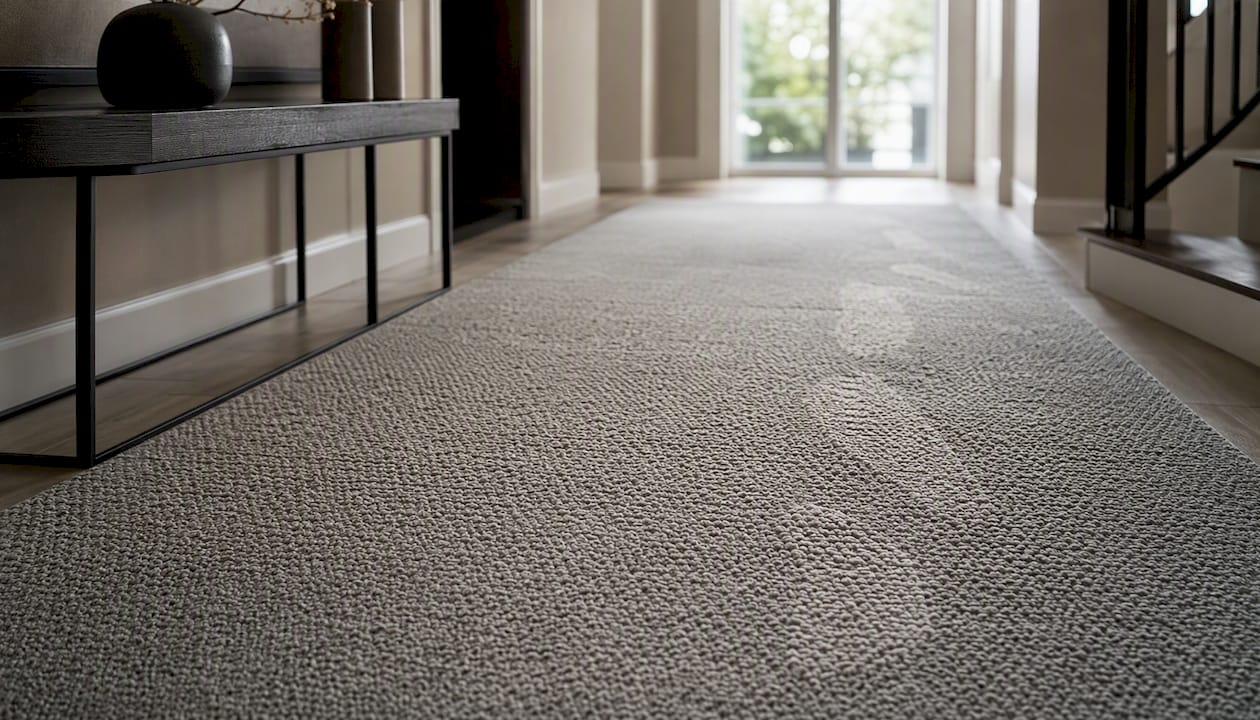
- Loop pile (Berber-style): fibers form continuous loops anchored at both ends. Extremely durable and resistant to crushing; less soft underfoot but excellent for high-traffic areas.
- Cut-and-loop: combines both techniques to create textured, sculptural patterns. The variation in height creates visual interest but can make vacuuming slightly more involved.
- Shag/high-low: long, loosely twisted or cut fibers at varying heights. Dramatic texture and warmth; requires the most maintenance of any construction.
- Textured/twisted pile: tightly twisted cut fibers that resist matting. A practical choice for family rooms where both comfort and durability matter.
Short pile allows finer pattern detail because each knot or tuft is compact and tightly placed. This is why many hand-knotted Persian and city-style pieces use very short pile under 5 mm for precise geometric or floral motifs. A shag pile, by contrast, softens or entirely obscures fine pattern work.
Pro Tip: For hallways and entries, choose loop pile or a low-cut construction. These resist the crushing that comes from concentrated foot traffic far better than plush cut pile, which can develop visible wear paths within months in a busy corridor.
How pile height affects durability, comfort, and daily life
The height of a rug’s pile touches nearly every aspect of living with it, from how it sounds in a room to whether your door will close properly.
- Durability: low pile compresses less and recovers more reliably under furniture and foot traffic. High pile, particularly in synthetic fibers, can mat and flatten permanently in high-use zones.
- Comfort and softness: taller fibers create more cushion underfoot. A plush bedroom rug at 1/2"–3/4" feels genuinely different from a flat-woven runner in a hallway.
- Stain visibility: lower pile tends to show spills more immediately, which is actually an advantage — you catch them before they set. High pile can absorb a spill deeper into the fiber before it becomes visible.
- Acoustics: thicker pile absorbs more sound. A high-pile rug in a hard-floored living room noticeably reduces echo and ambient noise, a quality worth considering in open-plan spaces.
- Insulation: taller fibers trap more air, adding a modest layer of thermal insulation between a cold floor and the room.
- Door clearance: this is the most commonly overlooked practical issue. A standard interior door needs roughly 1/2" of clearance at the floor. Any rug with a pile height approaching or exceeding that threshold, plus backing thickness, can prevent the door from swinging freely. Measure the gap under your door before purchasing.
Pro Tip: A quality rug pad, cut roughly 1" smaller than the rug on all sides, stabilizes the piece, reduces abrasion to the pile tips, and adds a layer of cushion that lets you choose a slightly lower pile without sacrificing underfoot comfort. Choose a pad material compatible with your floor type — rubber grips hard floors well, while felt works better on carpet.
For non-slip safety, particularly under high-pile rugs on hard floors, a dedicated anti-slip rug underlay prevents movement and reduces edge wear over time.
Which pile height works best in each room?
Room use, traffic level, and the presence of pets or children should drive pile selection as much as aesthetics. The 18-inch rule from Houzz — leaving roughly 18 inches of bare floor between rug edge and walls — is a useful proportion guide, though designers treat it as a flexible starting point rather than a fixed law.
For high-traffic areas like hallways and entries, low pile under 1/4" is the clear choice. It withstands concentrated foot traffic, vacuums easily, and won’t catch on furniture legs or door sweeps.
Living room: medium pile (1/4"–1/2") suits most living rooms, offering enough softness for bare feet while remaining practical for regular vacuuming. For luxury living room rugs, a hand-knotted wool piece at medium pile delivers both visual depth and long-term resilience. Common sizes — 8x10 or 9x12 — work well with standard furniture arrangements; tape out the dimensions on the floor before committing.
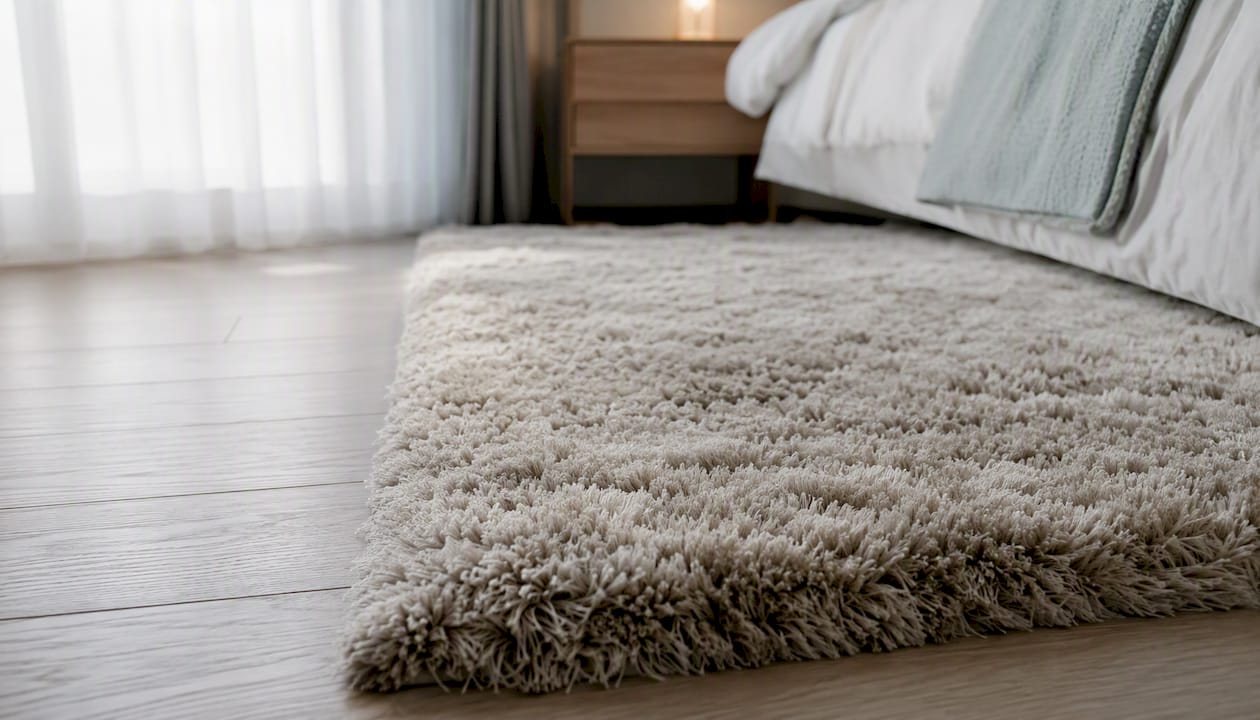
Bedroom: high pile or plush (1/2"–3/4") is ideal, particularly beside and at the foot of the bed where bare feet land first thing in the morning. Extend the rug 18–24 inches beyond the bed sides for a cohesive, enveloping feel.
Dining room: low pile only. Chair legs drag repeatedly across the surface, and food debris needs to be vacuumed cleanly. Extend the rug at least 24 inches beyond the table edges so chairs remain on the rug when pulled out.
Kitchen: flat-weave or very low pile. Spills are frequent, and a low-profile surface cleans far more easily. Avoid high pile entirely near cooking areas.
Nursery/children’s room: medium-to-high pile for softness and cushioning, but choose a fiber that cleans easily — wool or a quality synthetic rather than silk. A rug pad is non-negotiable for safety.
Home office: low-to-medium pile. Chair casters roll smoothly over low pile; high pile resists caster movement and accelerates wear in the rolling path.
Covered porch or outdoor space: flat-weave or very low pile in a weather-resistant fiber. Pile height matters less here than fiber durability and drainage.
How to measure pile height accurately
Measuring pile height takes less than two minutes and removes all guesswork from the specification sheet.
- Gather your tools. A small steel ruler or a digital caliper works best. A depth gauge gives the most precise reading but is rarely necessary for consumer purchases.
- Lay the rug flat on a hard surface. Avoid measuring on carpet, which compresses the backing and skews the result.
- Part the fibers at a single point to expose the backing clearly. Press the ruler straight down through the pile until it touches the backing weave.
- Read the measurement from the backing surface to the top of the fiber tips, not the top of the ruler. Record in both inches and millimeters.
- Take three readings at different points across the rug — center, edge, and a midpoint — and average them. Pile height can vary slightly across a handmade piece.
- Note the backing type (latex, cotton, jute) and whether the pile is cut or looped, as both affect how the measurement translates to feel.
Pro Tip: When you can only inspect a rug visually in-store, hold the edge up to the light and look at the pile profile from the side. This gives a surprisingly accurate sense of height and density without any tools.
Retail pile labels vary between sellers, so always check the actual measurement in inches or millimeters and, when possible, request a sample to verify feel and pile appearance in your room’s light.
Cleaning and care by pile height
The right maintenance approach depends almost entirely on pile height and fiber type. Getting this wrong shortens a rug’s life considerably.
Low pile (under 1/4"):
- Vacuum weekly with a standard upright or canister vacuum; beater bars are generally safe at low settings.
- Spot-clean spills immediately with a clean cloth and mild detergent; low pile releases moisture more easily than high pile.
- Professional cleaning every 12–18 months for wool; every 18–24 months for quality synthetics.
Medium pile (1/4"–1/2"):
- Vacuum weekly; reduce beater bar pressure or use a suction-only pass for wool and natural fibers.
- Rotate the rug every six months to distribute wear evenly.
- Wool at this height benefits from professional cleaning annually in high-use rooms.
High pile and shag (above 1/2"):
- Turn off the rotating beater bar entirely, or use a canister vacuum with a soft brush attachment. Beater bars can pull and tear long fibers, causing irreversible damage.
- Shake smaller pieces outdoors periodically to dislodge debris that vacuuming misses.
- Professional cleaning every 12 months; silk-blend high-pile pieces should be cleaned by a specialist.
Pro Tip: For any pile height, a quality rug pad reduces the abrasion that occurs when the backing grinds against the floor during foot traffic. This single addition can meaningfully extend a rug’s life, particularly for hand-knotted and hand-tufted pieces where replacing worn fibers is costly.
Your pile-height buying checklist
Before you purchase, work through these questions and record the answers:
- What room and what traffic level? (high, moderate, low)
- Are pets or children present?
- What is the door clearance measurement at the entry point?
- What pile height and construction does the product specification state (in inches or mm)?
- What backing material is listed, and is it compatible with your floor type?
- Is a rug pad included, or will you source one separately?
- Has the fiber been treated for stain resistance?
- Can you request a physical sample to check pile feel and color in your room’s light?
When speaking with a retailer or installer, a simple three-line script covers the essentials: “What is the exact pile height in millimeters? What backing material does this rug use? And what pad do you recommend for this pile height on my floor type?” Any hesitation on the first question is a red flag. A reputable seller knows their specifications.
Watch for these warning signs: pile height listed only as “low/medium/high” with no numeric value, missing or vague backing information, and pad recommendations that don’t account for your floor surface.
How to spot quality pile and construction
The difference between a rug that ages beautifully and one that deteriorates within two years often comes down to details visible in a careful in-person inspection.
- Turn the rug over. A quality hand-knotted piece shows individual knots clearly on the reverse; a tufted rug shows a latex or fabric backing that holds the tufts in place. Neither is inherently inferior, but you should know which you are buying.
- Check the edge finishing. Serged, whipped, or hand-sewn edges signal care in construction. Glued or heat-bonded edges on a premium-priced piece are a concern.
- Examine knot or tuft consistency. Run your hand across the pile in multiple directions. Uneven height or loose tufts that pull free with light tension indicate quality control issues.
- Assess backing firmness. A stable, firm backing holds pile upright and prevents the rug from bunching. A flimsy backing, regardless of pile height, leads to premature wear.
- Look at pattern clarity. Short pile preserves fine motifs; if a detailed geometric pattern looks blurred or indistinct, the pile may be too long for the design’s knot density.
- Feel the fiber. Wool should feel slightly waxy and resilient; it springs back after compression. Synthetic fibers that feel brittle or overly soft often signal lower-grade material.
Pro Tip: For luxury hand-knotted rugs, construction signals — backing quality, knot density, and edge finishing — matter more to long-term durability than modest differences in pile height. A tightly knotted piece at medium pile will outlast a loosely constructed shag by decades.
Does pile height affect allergies?
Pile height has a real, practical relationship with allergen accumulation. Taller, denser pile creates more surface area and more depth for dust, pet dander, and pollen to settle into. Low pile is considerably easier to vacuum thoroughly, removing allergens more completely with each pass.
For allergy-sensitive households, low pile under 1/4" on a firm backing is the most manageable choice. The fibers are short enough that a standard vacuum with good suction reaches the backing surface, where most fine particulates settle. High pile and shag constructions trap debris deeper, and even thorough vacuuming may not extract everything without a specialist cleaning.
Wool, interestingly, has a natural lanolin coating that can resist some dust mite colonization compared to certain synthetic fibers, though no fiber type eliminates the need for regular cleaning. Frequent vacuuming and annual professional cleaning matter more than fiber type alone for allergy management.
Environmental considerations in pile height and material choice
Pile height directly affects how much raw material a rug requires. A shag rug uses substantially more fiber per square foot than a flat-weave or low-pile piece of the same dimensions. For buyers with sustainability in mind, this is worth factoring into the decision alongside aesthetics.
Wool remains one of the more environmentally considered fiber choices: it is renewable, biodegradable, and naturally durable, meaning a well-made wool rug at any pile height tends to outlast synthetic alternatives significantly. A rug that lasts 20 years has a far lower environmental footprint than one replaced every five, regardless of its pile height.
For hand-knotted pieces using natural dyes and traditional techniques, the craftsmanship itself is a form of sustainability. The labor-intensive process produces fewer pieces, each made to last, rather than the volume-driven output of machine-tufted production.
How pile height and rug backing work together
Backing and pile height are interdependent. A tall, heavy pile needs a firm, stable backing to stay upright and prevent the rug from buckling or shifting. A thin or loosely woven backing under a high-pile rug creates instability that accelerates wear at the base of the fibers, where they attach to the foundation.
For hand-knotted rugs, the foundation weave itself serves as the backing, and its tightness directly determines how well the pile holds over time. For tufted rugs, the secondary backing — typically latex or a woven fabric — is applied after tufting and is the primary structural support. A quality secondary backing should feel firm and even, with no soft spots or delamination at the edges.
Rug pad selection interacts with this system. A pad that is roughly 1 inch smaller than the rug on all sides remains invisible while providing stability and shock absorption that reduces abrasion to pile tips. Choosing the wrong pad material — a thick foam pad under a heavy hand-knotted piece, for example — can actually cause the rug to bunch rather than lie flat.
The trade-off no one talks about honestly
There is a persistent assumption in home decor that higher pile equals higher quality. It does not. The most enduring, technically accomplished rugs in the world — antique Persian city rugs, fine Tibetan knotted pieces, classical Turkish kilims — are often remarkably low in pile height. Their value lies in knot density, dye quality, and the precision of the pattern, none of which require tall fibers.
High pile is a legitimate aesthetic choice. The softness of a plush bedroom rug is a genuine pleasure, and there are rooms where that warmth and texture are exactly right. But choosing high pile because it “feels more luxurious” in a high-traffic living room is a decision you will likely regret within two years, when the pile has matted in the main walking path and the rug looks tired.
The more useful question is not “how tall should the pile be?” but “what does this room actually need?” A dining room needs a surface that survives chair drag and food spills. A bedroom needs something that feels extraordinary underfoot at 6 AM. A hallway needs a rug that still looks composed after ten thousand footsteps. Pile height is the specification that answers all three questions differently, and getting it right is simply a matter of being honest about how the room is used.
Request samples. Measure the pile in your hand. Place the sample on the floor in the actual room, in the actual light, before you commit.
Handmade rugs with the pile height your room deserves
At Kevin Francis Design, every rug begins with a specific vision for how it will live in a room. Our handmade wool pieces are crafted using hand-knotting and Tibetan knotting techniques that allow precise control over pile height and density, so the finished rug performs as beautifully as it looks.
The Lotto Hand-Knotted Wool Area Rug is a strong example: a medium-pile, hand-knotted wool piece where the pile height is calibrated to preserve the clarity of its geometric pattern while remaining practical for living room use. Custom sizing is available, and we offer sample swatches so you can verify pile feel and color in your own space before ordering. Browse the collection or reach out to discuss pile preferences, custom dimensions, and the right construction for your room.
Three pile heights from our own workshop

Color Study Flatweave (no pile)
Handwoven wool with no pile at all. The one for a dining room, a hall, or under a desk chair.
From $600
See sizes →

Mamluk Hand-Knotted (low pile)
Hand-knotted New Zealand wool at about 1/4 inch. Dense, crisp pattern, easy to vacuum, built for a living room that gets used.
From $1,010
See sizes →

Theseus Maze (medium pile)
Hand-tufted wool at roughly 1/2 inch. Soft underfoot for a bedroom or family room, with the maze pattern that hides the traffic.
From $920
See sizes →
All three are made in New Zealand wool and available in nine sizes; if the room is between sizes, the custom sizing option on every product page covers it.
Sources
- Pile - Rug Glossary
- Rug Pile Heights & What They Mean
- Rug Guide: The 5 Things to Know About Rug Pile – One Kings Lane
- 11 Area Rug Rules and How to Break Them
- How to Choose the Right Rug Size for Every Room
FAQ
What is considered a low pile for a rug?
Low pile is generally defined as fibers under 1/4" (under 6 mm) in height. These rugs are durable, easy to vacuum, and well-suited to high-traffic areas, dining rooms, and homes with pets.
What is considered a high pile rug?
A high or plush pile rug measures between 1/2" and 3/4" (12–19 mm); shag rugs exceed 3/4". Both are best reserved for low-traffic spaces like bedrooms, where softness is the priority over durability.
How do you determine carpet pile height?
Lay the rug flat on a hard surface, part the fibers to expose the backing, and measure from the backing to the fiber tips with a ruler or caliper. Take readings at three points and average them for accuracy.
What is the 18-inch rule for rugs?
The 18-inch rule recommends leaving roughly 18 inches of bare floor between the rug edge and the walls to create visual proportion. In smaller rooms, 8–12 inches is acceptable; designers treat the guideline as a flexible starting point rather than a fixed requirement.


