


Bespoke furnishings outperform off-the-shelf pieces because they deliver superior materials, precise fit, and lifecycle value that mass-produced alternatives simply cannot replicate. A hand-knotted wool rug made to your exact dimensions, a cabinet jointed in solid hardwood, a textile dyed with traditional techniques — each of these ages with grace rather than deteriorating into something you feel compelled to replace.
- Material quality: Artisan-grade fibers, solid timber, and vegetable-tanned leathers perform and age differently than their mass-market counterparts.
- Tailored fit: Custom proportions resolve awkward layouts and eliminate the “dead air” that standard sizes leave behind.
- Repairability: Bespoke pieces can be refinished, re-knotted, or reupholstered; most flat-pack or particleboard furniture cannot be meaningfully repaired.
- Total cost of ownership: When amortized over decades, the annualized cost of a bespoke piece is frequently lower than repeatedly replacing cheaper alternatives.
The honest caveat: bespoke takes time and costs more upfront. Lead times typically run 12 or more weeks for fully bespoke commissioned work, 4–8 weeks for customized retail options, and immediate availability for ready-made pieces. If your timeline is tight or your budget is fixed, that matters. The rest of this guide helps you decide when the investment is worth it — and how to commission with confidence.
Table of Contents
- What does “bespoke” actually mean in practical design terms?
- Why materials and craftsmanship create a measurable difference
- How bespoke amortizes over time: durability and total cost of ownership
- How perfect fit transforms a room’s proportion and flow
- How commissioning works: stages, lead times, and what to expect
- When off-the-shelf is the smarter choice
- Craft in practice: a Kevin Francis Design textile commission
- The questions to ask before you commission any bespoke piece
- Key Takeaways
- The case for craft that most guides miss
- Kevin Francis Design: handmade rugs and textiles built to last
- Further reading and authoritative sources
- FAQ
What does “bespoke” actually mean in practical design terms?
The word bespoke comes from the tailoring trade, where a garment was said to have been “bespoken” for a specific client. In furnishings, it means a piece commissioned from scratch to a client’s exact specifications: dimensions, materials, finish, and construction method are all determined before a single cut is made.
That is meaningfully different from what most retail stores call “customizable.” There is a practical spectrum worth understanding:
Ready-made pieces arrive in fixed sizes and standard finishes. You choose from what exists. A sofa in three widths, a rug in four colorways — the manufacturer’s decisions govern your room.
Customizable retail sits in the middle. You select a frame, a fabric, perhaps a leg finish. The underlying construction and proportions remain standardized; you are personalizing within a template.
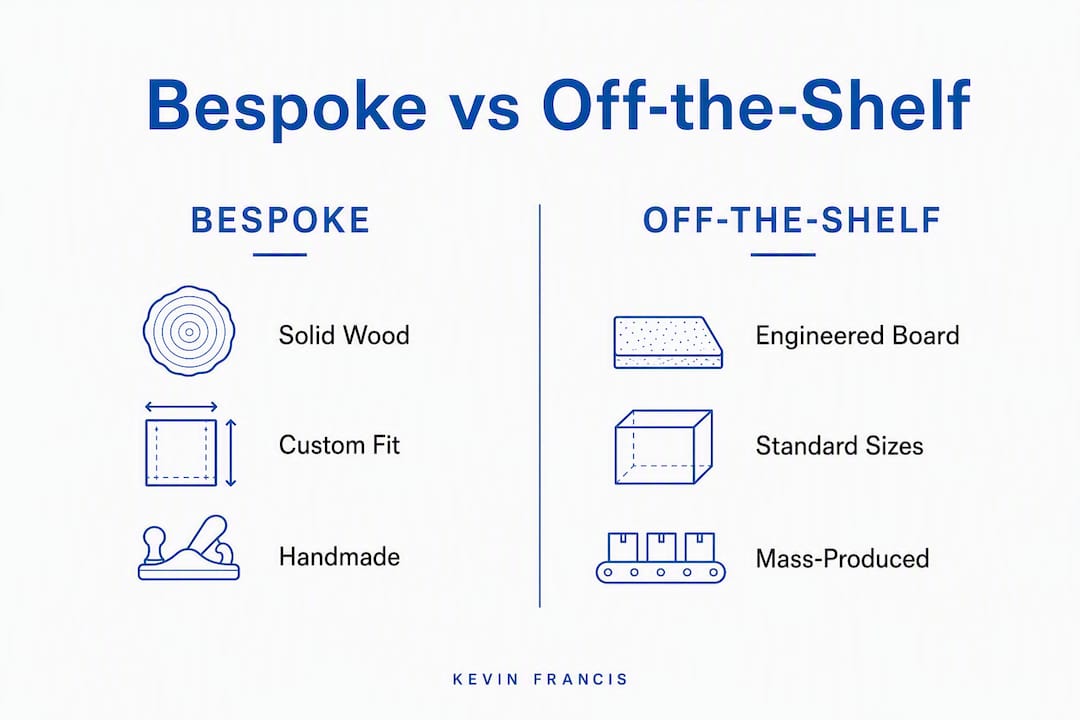
Fully bespoke means the maker starts from your brief. Dimensions, fiber selection, knot density, joinery method, hardware specification — everything is resolved around your space and your aesthetic. A custom-sized wool rug made to fit a specific alcove, or a built-in banquette designed around a bay window, are genuinely bespoke. No template governs the outcome.
Understanding this spectrum prevents a common mistake: paying a premium for “customizable” retail while expecting bespoke results.
Why materials and craftsmanship create a measurable difference
The performance gap between bespoke and mass-produced furnishings begins at the material selection stage, long before any construction starts.
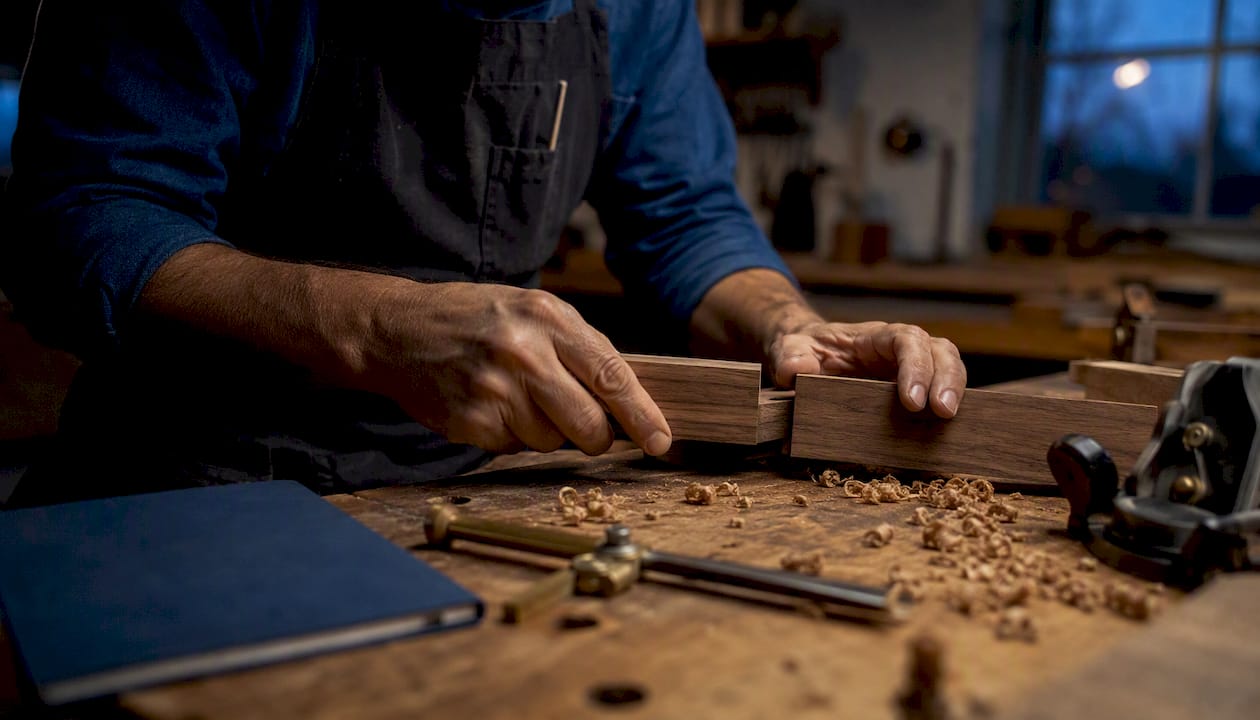
1. Solid-wood joinery versus engineered board
Solid hardwood furniture — mortise-and-tenon joints, hand-cut dovetails, wooden pegs rather than metal staples — flexes slightly with seasonal humidity changes without failing. Particleboard and MDF swell, delaminate, and crack. Custom solid-wood pieces typically cost 1.5–3 times their mass-produced equivalents upfront, yet commonly deliver 20–50 years of use with maintenance, compared to 5–15 years for particleboard in active family settings.
2. Hand-knotting and hand-tufting in textiles
In hand-knotted rugs, each knot is tied individually around the warp threads, creating a pile that can be repaired knot by knot. Hand-tufting uses a tufting gun to push yarn through a backing canvas, which is faster but still far more durable than machine-loomed construction. Tibetan knotting, a technique practiced at Kevin Francis Design, produces a characteristically dense, lustrous pile with a softness that machine production cannot replicate at any price point.
3. Natural fibers versus synthetic alternatives
Wool, linen, and vegetable-tanned leather develop a patina over time rather than degrading. Wool in particular is naturally flame-resistant, moisture-wicking, and resilient under foot traffic. Artisan fabrics woven with traditional dyeing techniques age with depth and character; synthetic pile flattens and fades.
4. The intentional beauty of handmade variation
One of the most misunderstood qualities in artisan textiles is the slight irregularity of weave and thread tension. These are not flaws. Handmade textiles exhibit variations that contribute to perceived depth and authenticity — the “collected” quality that luxury interiors prize and that machine production cannot manufacture. Every handcrafted piece carries a subtle uniqueness, a quiet signature of the hands that made it.
5. Hardware and finishing details
Bespoke cabinetry and upholstered pieces use solid-brass or forged-iron hardware, hand-applied finishes, and double-stitched seams. These details are invisible until something fails — and with quality hardware, failure is rare. Mass-market zinc-alloy pulls and staple-gun upholstery tell a different story within a few years of daily use.
Statistic callout: Solid hardwood furniture commonly delivers significantly longer use with proper maintenance, compared to much shorter lifespans for particleboard and MDF equivalents. That lifespan difference is the foundation of every cost-of-ownership argument for bespoke.
How bespoke amortizes over time: durability and total cost of ownership
The financial case for bespoke furnishings rests on a single concept: amortized efficiency. A higher upfront investment spread across decades produces a lower annualized cost than a cheaper piece replaced every few years.
| Dimension | Bespoke / Artisan | Mass-Market Ready-Made |
|---|---|---|
| Typical upfront cost | 1.5–3× mass-market equivalent | Baseline |
| Expected useful life | 20–50+ years (with maintenance) | 5–15 years |
| Repairability | Refinishable, re-knotted, reupholstered | Effectively disposable |
| End-of-life value | Resalable; some pieces appreciate | Near-zero resale |
| Environmental impact | Lower through local sourcing, small batches | Higher through overproduction and landfill |
Consider a concrete scenario. A hand-knotted wool rug purchased for $4,000 and maintained for 40 years costs $100 per year. A machine-made synthetic rug at $800, replaced every seven years, costs roughly $114 per year — and generates six disposal cycles. The bespoke piece wins on both cost and conscience.
Repairability is the mechanism that makes this math work. Artisan pieces can be refinished, re-bound, or re-glued; mass-market particleboard furniture requires full replacement when a joint fails or a surface delaminates. For rugs specifically, re-knotting a worn section, re-binding a fraying edge, or washing and re-blocking a hand-knotted pile are all standard conservation procedures.
Maintenance guidance that protects your investment:
- Rotate rugs every 6–12 months to distribute foot traffic evenly.
- Use a rug pad to reduce pile compression and protect the backing.
- Refinish solid-wood surfaces every 5–10 years depending on use.
- Check upholstery seams and frame joints annually; address small failures before they compound.
Choosing handmade and locally produced bespoke items also reduces overproduction and typically lowers the carbon footprint relative to overseas mass manufacturing. Fewer pieces produced, fewer pieces discarded — the environmental arithmetic is straightforward.
Statistic callout: Made-to-measure bespoke solutions can increase usable floor space or storage noticeably compared to standard-sized pieces in the same footprint. — providing a spatial dividend that compounds the financial one.
How perfect fit transforms a room’s proportion and flow
Scale is the most underestimated variable in interior design. A sofa that is four inches too short for a wall, a rug that floats in the center of a room without anchoring the seating group, a bookcase that stops eight inches below a ceiling — each of these creates a visual restlessness that no amount of styling can fully resolve.
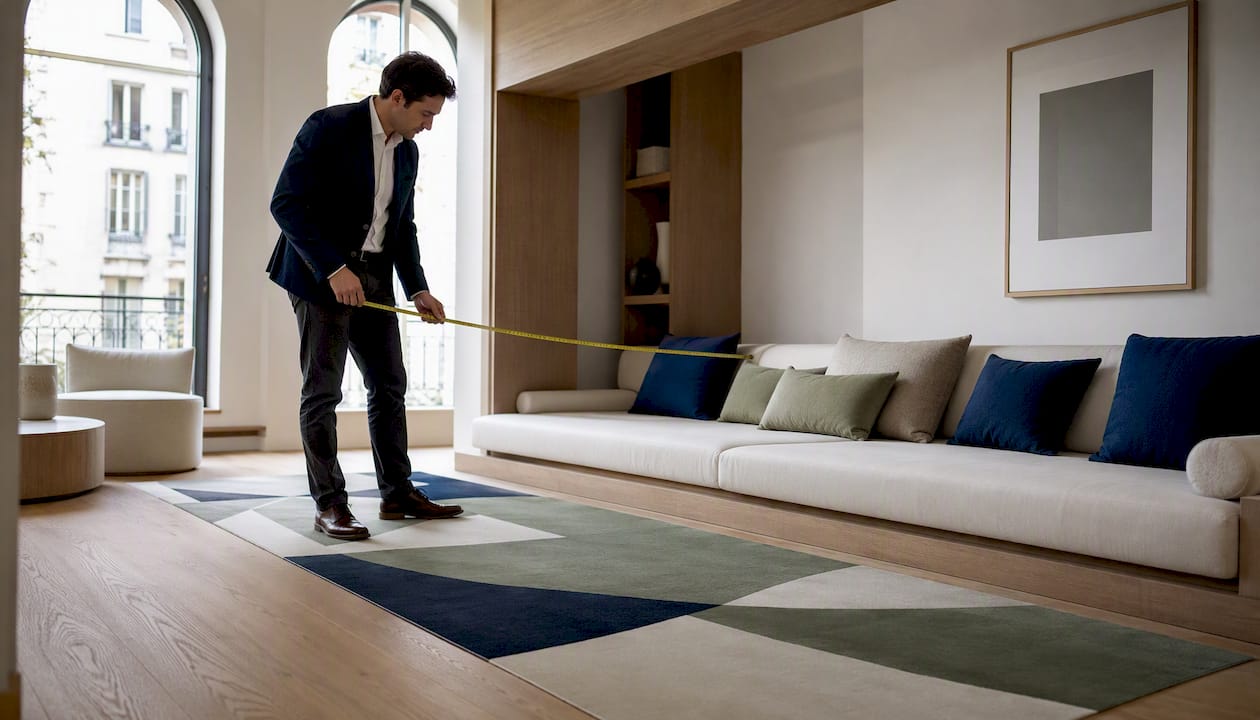
Bespoke pieces act as architectural interventions, purpose-built to reconcile a room’s proportions and improve visual weight in ways that standard dimensions cannot. Designers treat certain bespoke elements as core structure rather than decoration — the rug that defines the conversation zone, the built-in that frames the fireplace wall, the window seat that transforms a bay from dead space into a destination.
Before and after, in practice:
- A narrow hallway fitted with a runner cut to the exact corridor width reads as intentional and generous; a standard 2’6" runner centered in a 3’2" passage looks like an afterthought.
- A living room with a 9’4" × 13’6" footprint cannot be served by a standard 9’ × 12’ rug without leaving an uneven border. A custom-cut piece grounds the space completely.
- A dining nook with a curved wall becomes a jewel-box corner when a banquette is built to follow the arc; a rectangular sofa simply fights the architecture.
Practical proportion guidelines for custom pieces:
- In a seating group, the rug should extend at least 18 inches beyond the front legs of all sofas and chairs.
- For dining, allow the rug to extend 24–30 inches beyond the table edge on all sides so chairs remain on the rug when pulled out.
- Built-ins that run floor to ceiling (or within 6 inches of it) read as architectural rather than furniture — a distinction worth the extra cost in rooms with high ceilings.
Pro Tip: When a room has a non-standard architectural feature — a sloped ceiling, a curved wall, a deep bay window — commission the anchor piece as bespoke before purchasing anything else. The custom element sets the proportional logic for every subsequent decision, and retrofitting later costs more than getting it right the first time.
For more on spatial optimization in unique floor plans, the principles of custom fit apply across every room type.
How commissioning works: stages, lead times, and what to expect
Understanding the commissioning process removes the anxiety that keeps many homeowners from pursuing bespoke work. The timeline is longer than retail, but each stage has a clear purpose.
| Stage | What happens | Typical duration |
|---|---|---|
| Consultation | Brief, site visit or measurements shared, material discussion | 1–2 weeks |
| Design and sampling | Drawings, material samples, colorway options presented | 2–4 weeks |
| Client approval | Revisions, final sign-off on spec | 1–2 weeks |
| Production | Handmaking, weaving, or construction | 12+ weeks (bespoke); 4–8 weeks (customized) |
| Finishing and QC | Final inspection, binding, hardware fitting | 1–2 weeks |
| Delivery and installation | Shipping, fitting, final adjustments | 1–2 weeks |
Fully bespoke commissions typically require 12 or more weeks from brief to installation. Customized retail options (where you select within a template) run 4–8 weeks. Ready-made pieces are available immediately.
Planning checklist before you commission:
- Confirm your site measurements, including ceiling height and any architectural irregularities.
- Set a realistic budget that includes delivery, installation, and any site preparation.
- Decide on fiber, finish, or material preferences before the first consultation — samples help.
- Identify your installation access constraints (stairwells, elevator dimensions, doorway widths).
- Build in a buffer of 2–3 weeks beyond the quoted lead time for any project with a hard deadline.
For a detailed walkthrough of the design process, this guide to custom furniture design covers measurement and brief preparation in practical depth.
When off-the-shelf is the smarter choice
Bespoke is not always the right answer. There are genuine scenarios where ready-made furnishings serve better — and acknowledging them is part of making good design decisions.
Choose ready-made when:
- The space is temporary (a rental, a staging project, a transitional home).
- Standard dimensions happen to fit your room without compromise.
- The piece is purely functional with no visual prominence (a utility shelf in a closet, a guest room desk).
- Budget constraints are real and non-negotiable — a well-chosen ready-made piece is always better than a poorly specified bespoke one.
How to make better ready-made choices:
- Upgrade hardware immediately. Replacing zinc pulls with solid brass on a ready-made cabinet costs little and reads as intentional quality.
- Add a custom cushion or slipcover to a standard sofa frame. The upholstery does most of the visual work.
- Layer a bespoke rug over a standard piece to anchor the room and shift the perceived quality of everything around it.
The most practical framework for balancing budget and impact is the 70/30 rule: allocate roughly 70% of a room’s anchor pieces to bespoke or custom commissions, and use high-quality ready-made accents for the remaining 30%. This preserves architectural integrity without requiring every item to be commissioned from scratch. The bespoke pieces carry the room; the retail pieces support them.
Craft in practice: a Kevin Francis Design textile commission
The most persuasive argument for bespoke is not abstract — it lives in the specifics of a real project.
A client approached Kevin Francis Design with a living room measuring 14’3" × 18’9", anchored by a low-slung mid-century sofa grouping and floored in pale white oak. The brief called for warmth without weight, pattern without busyness, and a piece that would hold its quality through a decade of family use.
The chosen approach: a hand-knotted wool rug in a geometric field pattern, sized to 13’6" × 18’ to allow an even 4.5-inch border of oak on all sides. Fiber selection was New Zealand wool for its natural resilience and the way it holds vegetable-based dyes without the flatness of synthetic alternatives. Knot density was specified at 80 knots per square inch — dense enough for crisp pattern definition, open enough to preserve the soft, slightly textured hand that distinguishes artisan work from machine production.
The installation resolved a proportion problem the client had struggled with for two years: a standard 9’ × 12’ rug had left the room feeling unmoored, the seating group floating rather than settled. The custom piece anchored the conversation zone completely, and the border of pale oak became a deliberate frame rather than an accident of sizing.
Material spec in brief: 100% New Zealand wool pile, cotton warp and weft, hand-knotted using Tibetan knotting technique, pile height approximately 0.4 inches, natural and low-VOC dyes. Expected useful life with standard maintenance: 40–60 years. Repairable by any skilled rug conservator.
For more on how artisan rugs differ from mass-produced alternatives, the construction differences translate directly into the longevity outcomes described here.
The questions to ask before you commission any bespoke piece
A confident commissioning decision starts with the right questions. This checklist applies whether you are sourcing a rug, a sofa, cabinetry, or any other made-to-measure piece.
- What materials are used, and where do they come from? Ask for a full material spec: fiber type, origin, dyeing process, hardware grade. Vague answers (“premium materials,” “quality fabrics”) are a red flag.
- What is the construction method? Hand-knotted, hand-tufted, solid-wood joinery, or engineered board — the method determines repairability and lifespan.
- Can I see a sample before production begins? Any reputable maker will provide a physical sample of the material, finish, or colorway. Declining this request is a warning sign.
- What is the repair and warranty policy? Ask specifically: “If the frame splits in year three, what happens?” A maker confident in their work will answer this directly.
- Can you share references or portfolio examples from similar projects? Completed work in comparable spaces tells you more than any showroom sample.
- What is the realistic lead time, and what causes delays? An honest answer includes contingencies. An unrealistically short lead time for fully bespoke work should prompt skepticism.
- How do I care for this piece to protect the warranty? Maintenance guidance is a sign of a maker who expects the piece to last.
Red flags to watch for:
- Specifications described in marketing language rather than technical terms.
- Reluctance to share references or completed project photography.
- Lead times that seem implausibly short for the complexity described.
- No written warranty or repair policy.
When commissioning a bespoke rug for a hotel or high-traffic space, the same questions apply with even greater rigor — durability specifications and maintenance protocols become contractual rather than advisory.
Key Takeaways
Bespoke furnishings outperform off-the-shelf alternatives on materials, fit, repairability, and total cost of ownership — the upfront premium is real, but the annualized cost over decades is frequently lower.
| Point | Details |
|---|---|
| Lifespan advantage | Solid hardwood and hand-knotted textiles last 20–50+ years; mass-market particleboard typically lasts 5–15 years. |
| Spatial dividend | Made-to-measure pieces can increase usable floor space or storage by 20–40% compared to standard sizes. |
| Cost-of-ownership logic | Amortized over decades, bespoke pieces often cost less per year than repeatedly replacing cheaper alternatives. |
| Hybrid strategy | The 70/30 rule — 70% bespoke anchors, 30% quality ready-made accents — balances impact and budget effectively. |
| Kevin Francis Design | Offers hand-knotted and hand-tufted wool rugs in custom sizes, with Tibetan knotting techniques and natural fibers built for 40–60 years of use. |
The case for craft that most guides miss
There is a conversation happening in luxury interiors that rarely surfaces in buying guides: the difference between a room that feels designed and one that feels assembled. It is not about budget. It is about whether the pieces in a space were made for that space, or whether the space was arranged around whatever was available.
The conventional wisdom says bespoke is a luxury for the few. I think that framing misses the point entirely. The real luxury is not the price tag — it is the absence of compromise. When a rug is cut to the exact dimensions of a room, when a cabinet is built to meet a ceiling rather than fall short of it, the room stops apologizing for itself. It simply works.
What I find most undervalued in the bespoke conversation is repairability. We have become so accustomed to disposable furnishings that the idea of repairing a piece rather than replacing it feels almost radical. But a hand-knotted rug that can be re-knotted, a solid-wood frame that can be re-glued and refinished, a piece of upholstery that can be re-covered — these are not nostalgic indulgences. They are the most rational long-term design decisions available.
The 70/30 rule is the most practical piece of advice I can offer anyone navigating this decision. You do not need to commission everything. Commission the pieces that define the room’s architecture — the rug, the built-in, the statement textile — and let quality ready-made pieces support them. That is how you build a room that holds its integrity for decades rather than seasons.
Kevin Francis Design: handmade rugs and textiles built to last
When the anchor piece in your room needs to carry the weight of the whole design, the construction behind it matters more than any styling decision you will make.
Kevin Francis Design creates handmade artisan rugs in custom sizes, using hand-knotting, hand-tufting, and Tibetan knotting techniques with natural wool fibers and low-VOC dyes. Each piece is made to your exact dimensions and brief — not adapted from a standard template. The result is a textile that fits your space precisely, ages with character, and can be conserved rather than replaced.
A starting point worth exploring: the Lotto Hand-Knotted Wool Area Rug, a hand-knotted piece in 100% wool that illustrates the construction quality and design depth the studio brings to every commission. Custom sizing is available, and the studio welcomes requests for samples and material specifications before any commitment is made. To discuss a commission or request a quote, visit Kevin Francis Design and start the conversation.
Further reading and authoritative sources
These sources informed the research and reasoning throughout this article. Each is worth reading in full if you are deepening your understanding of bespoke furnishings, craft techniques, or lifecycle cost analysis.
- Standard, Customized or Bespoke: Choosing the Right Furniture Solution — CBM Living’s breakdown of lead times and decision criteria across the three procurement tiers; useful for project planning.
- Custom vs. Off-the-Shelf: Why Bespoke Wins in Luxury Homes — Covers bespoke as architectural intervention and the sustainability case for local, small-batch production.
- Handmade vs. Machine-Made Home Décor — Svarna’s explanation of why handmade textile variations are a quality asset, not a defect.
- Handmade vs. Machine-Made: Repairability and Lifecycle — Etaliya’s practical comparison of artisan repairability versus mass-market disposability.
- Ready-Made vs. Custom Furniture — Kavela’s cost-per-year framework for understanding amortized efficiency in bespoke purchases.
- Custom Home Furniture vs. Mass-Produced: 7 Procurement Questions — Practical procurement guidance including cost multiples and lifespan benchmarks for solid wood versus engineered board.
- Bespoke Furniture vs. Mass-Produced: Real-Life Value — The 20–40% spatial gain data and a grounded cost comparison from a practitioner perspective.
- Why Artisan Fabrics Appeal to Modern Buyers — ProTextile’s overview of artisan fabric pricing, aging characteristics, and dyeing techniques.
- Custom vs. Retail Furniture for a Luxury Home — The source for the 70/30 rule and its application in luxury residential procurement.
- Artisan vs. Mass-Produced Rugs: How They Really Differ — Kevin Francis Design’s own comparison of construction methods, materials, and longevity in artisan versus factory-made rugs.
- Why Handwoven Rugs Develop Unique Character Over Time — Kevin Francis Design’s exploration of patina, aging, and the long-term aesthetic dividend of handwoven textiles.
FAQ
What is the difference between off-the-shelf and bespoke furniture?
Off-the-shelf furniture is mass-produced in standard sizes and fixed finishes; you choose from what exists. Bespoke furniture is commissioned to your exact dimensions, materials, and brief — every specification is determined by your space and needs before production begins.
Is bespoke furniture good quality?
Yes, when sourced from a skilled maker. Bespoke pieces use higher-grade materials — solid hardwood, natural wool, hand-applied finishes — and construction methods such as hand-knotting or mortise-and-tenon joinery that are not economically viable in mass production. Solid hardwood furniture commonly lasts 20–50 years with maintenance.
Is bespoke decor worth the investment?
For anchor pieces that define a room’s architecture, yes. The upfront cost is higher, but the annualized cost over decades is frequently lower than replacing mass-market alternatives every 5–15 years. Repairability and resale value add further to the long-term case.
What are the benefits of custom furniture?
The core benefits are precise fit for your space, superior materials and construction, repairability, and a lower total cost of ownership over time. Custom sizing can also increase usable floor space or storage by 20–40% compared to standard-sized pieces in the same footprint.
Fully bespoke pieces typically require 12 or more weeks from brief to installation. Customized retail options require 4–8 weeks. Building a 2–3 week buffer into any project with a hard deadline is advisable.
Recommended
- Why Customization Defines the Ultra-Luxury Experience – Kevin Francis Design
- How to Design Custom Furniture That Fits Your Space and Style – Kevin Francis Design
- Why Custom Rugs Suit Unique Spaces in Your Home – Kevin Francis Design
- How Bespoke Rugs Reflect Your Identity and Style – Kevin Francis Design


