


Custom rugs are precisely tailored floor coverings designed to fit the exact dimensions, shapes, and design requirements of any room. Standard rugs simply cannot address the full range of spatial challenges that homeowners and interior decorators face, from angled walls to open-plan layouts where furniture groupings demand something beyond a rectangle. The industry term for this category is “bespoke rugs,” and the practice combines artisan craftsmanship with modern digital customization to produce pieces that function as both flooring and fine art. Brands like Stark Carpet and studios like Tutuland Studio have made this process more accessible than ever, and understanding why custom rugs suit unique spaces starts with recognizing what off-the-shelf options consistently fail to deliver.
How do custom rugs solve the challenges of irregular, unique spaces?
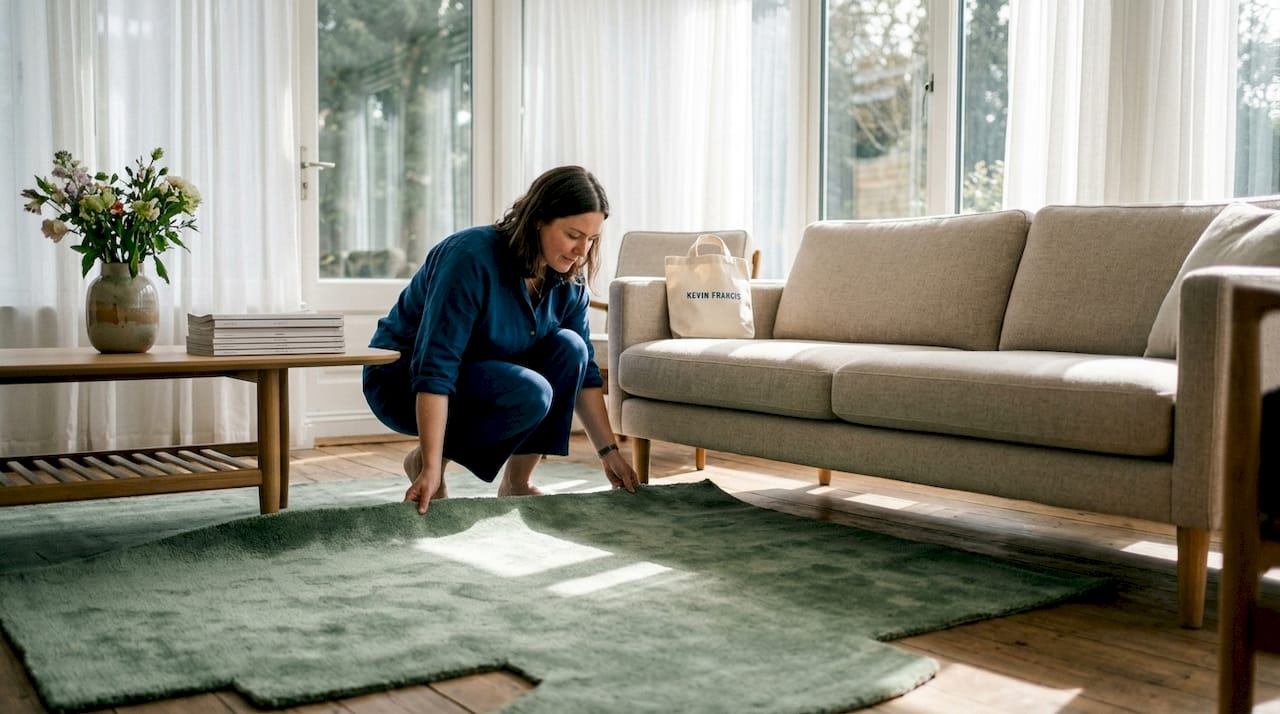
Standard rug sizes fail irregular or uniquely shaped rooms, leaving awkward gaps at the edges or overhanging furniture legs in ways that look unfinished. This is the core problem that bespoke rugs exist to solve. A wrap-around living room, a stair landing with a curved banister, or a reading nook tucked beneath a sloped ceiling all demand dimensions that no manufacturer stocks on a shelf.
The spatial challenges that defeat ready-made rugs include:
- Odd dimensions: Rooms with non-standard proportions where a 5x8 or 8x10 rug leaves either too much bare floor or crowds the furniture.
- Angled walls and built-ins: Alcoves, bay windows, and built-in cabinetry create footprints that rectangles cannot fill cleanly.
- Open floor plans: Large, flowing spaces need rugs that define zones without creating visual interruptions.
- Stair landings and hallways: Narrow, elongated, or L-shaped passages require custom cuts to look intentional rather than improvised.
Custom sizing also solves the furniture-grounding problem. A rug that is precisely sized allows all front legs of a sofa and chairs to rest on the rug at the same depth, creating a unified seating island. That visual grounding is what separates a room that feels designed from one that feels assembled.
| Challenge | Standard rug | Custom rug |
|---|---|---|
| Irregular room shape | Leaves gaps or overhangs | Cut to exact footprint |
| Furniture grounding | Approximate fit | Precise leg placement |
| Stair landings | Wrong size or shape | Tailored to tread and landing |
| Open-plan zone definition | Rigid rectangle | Any shape, any scale |
| Angled walls or alcoves | Cannot accommodate | Shaped to architecture |
What aesthetic and design advantages do bespoke rugs offer?
Custom rugs act as intentional, functional artwork that give you complete control over color saturation, scale, and pattern placement. That level of control is what separates a room with a rug from a room built around one. When you can specify the exact depth of a terracotta tone or the precise repeat of a geometric motif, every other element in the room responds to it rather than competing with it.
The design advantages extend well beyond color:
- Pattern placement: You decide where a central medallion sits relative to your furniture, not where the manufacturer’s repeat happens to fall.
- Scale control: A pattern that reads beautifully at 9x12 can feel lost at 5x8. Custom sizing preserves the designer’s intended visual weight.
- Material and texture: Wool, silk, cotton, and blended fibers each carry different light and underfoot feel. Artisan techniques like hand-tufting, handweaving, and Tibetan knotting add tactile richness that machine-made rugs cannot replicate.
- Colorway harmony: You can pull a specific hue directly from your upholstery fabric or a piece of wall art, creating a wash of color and movement that ties the room together.
Bespoke rugs also carry narrative weight. A rug designed around a family crest, a beloved landscape, or an abstract motif drawn from a collector’s art holdings tells a story that a catalog piece never could. At Kevin Francis Design, this storytelling approach is central to the creative philosophy, with collections drawing on modernist art movements and architectural forms to produce pieces that feel genuinely singular.
Pro Tip: When selecting a colorway for a custom rug, pull three colors from your room’s existing palette rather than introducing new ones. Use the rug to deepen the richest tone, soften the lightest, and echo the mid-tone. This creates cohesion without monotony. Kevin Francis Design’s custom colorway guide walks through this process in practical detail.
How does the custom rug creation process work?
Custom rug ordering follows three core steps: shape selection, size determination, and design upload, followed by digital proof approval before production begins. That structure removes much of the guesswork and makes the process feel closer to commissioning a piece of art than placing a furniture order.
Here is how the process typically unfolds:
- Measure your space accurately. Use a steel tape measure, not a fabric one, and measure the room’s footprint as well as the furniture grouping you want the rug to anchor. Note any angled walls or architectural features that affect the shape.
- Choose your shape. Rectangles are most common, but circles, runners, and custom abstract cuts are all achievable. Match the shape to your architecture, not just your furniture.
- Select your material and construction method. Handmade options like hand-tufting or Tibetan knotting add depth and longevity. Digital-native methods offer faster turnaround for simpler designs.
- Upload your design and approve a digital proof. Reputable studios provide a rendered proof before production. Review it carefully for color accuracy and pattern scale.
- Confirm production timeline. Handmade custom rugs can have turnaround times as short as 5–10 business days after design approval, which is faster than traditional hand-knotted imports. More complex artisan pieces take longer, so confirm timelines upfront.
For care and maintenance, wool and natural fiber rugs benefit from regular rotation to even out wear and periodic professional cleaning. Avoid steam cleaning on hand-knotted pieces, as it can loosen the foundation fibers. A quality rug pad protects both the rug and your floor, and it prevents the shifting that makes even a perfectly sized rug look careless.
Pro Tip: Before submitting your design file, convert all colors to CMYK and confirm the resolution is at least 150 DPI at the final rug size. Low-resolution files produce blurry pattern edges, which no amount of craftsmanship can correct. Kevin Francis Design’s custom rug brief guide covers file preparation in full.
Why choose custom rugs over ready-made options?
Ready-made rugs come in limited standard sizes and shapes that consistently fail large living rooms, irregular layouts, and staircases. The limitation is not just aesthetic. A rug that does not fit a space correctly creates visual tension that no amount of styling can resolve.
The case for custom rugs over ready-made alternatives rests on several concrete advantages:
- Fit: A bespoke rug fills your exact footprint. No gaps, no overhangs, no compromises.
- Longevity: Custom rugs allow finely tuned material choices that enhance durability and lifespan, delivering better long-term value than standard options.
- Floor protection: Custom rugs protect high-traffic areas by covering entryways and busy zones precisely, preserving the flooring underneath.
- Acoustic comfort: A well-fitted rug absorbs sound more effectively than a smaller one, which matters in open-plan spaces with hard floors.
- Ethical sourcing: Many artisan custom rug makers work with sustainably sourced wool and natural dyes, giving you a product with a traceable supply chain.
| Factor | Ready-made rug | Custom rug |
|---|---|---|
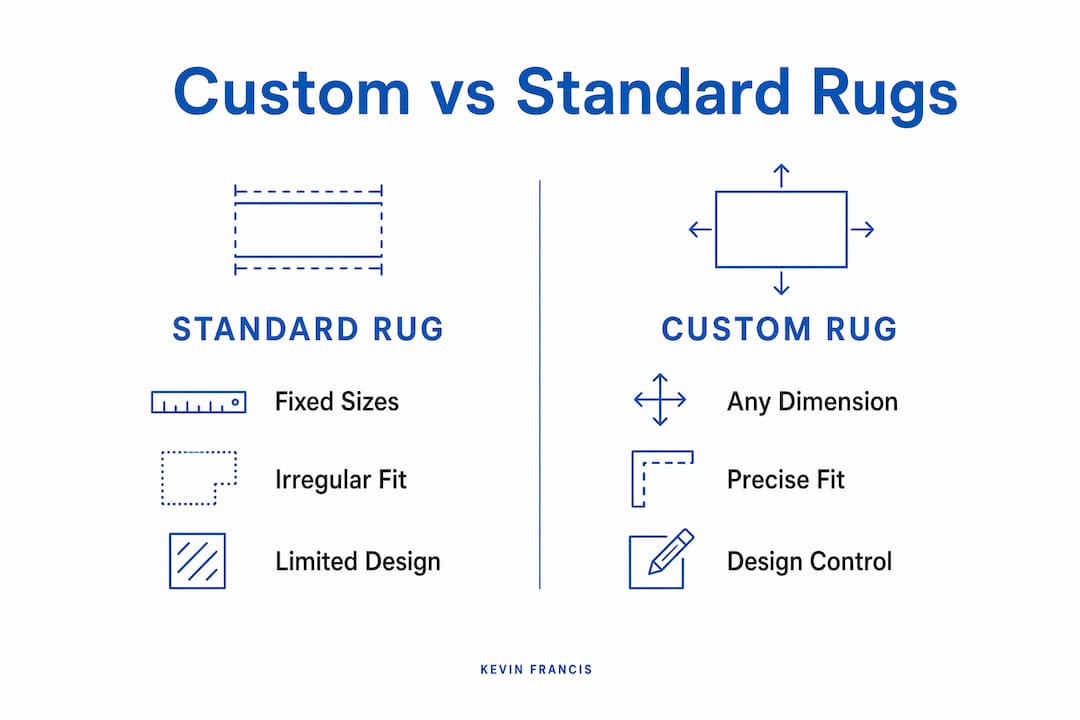
| Size options | Fixed standard sizes | Any dimension |
| Shape options | Rectangle, oval, round | Any shape |
| Design control | Catalog selection | Full creative control |
| Material choice | Limited | Broad, including artisan fibers |
| Lifespan | Moderate | Extended with quality materials |
| Floor protection | Approximate coverage | Precise, tailored coverage |
The best time to invest in a custom rug is when you are working with an irregular space, commissioning a room from scratch, or when a ready-made option has failed you twice already. Building an artisan rug collection for your home is a long-term investment in both beauty and function, and it rewards careful planning.
Key Takeaways
Custom rugs suit unique spaces because they deliver precise fit, full design control, and artisan quality that ready-made options structurally cannot match.
| Point | Details |
|---|---|
| Fit solves spatial problems | Custom sizing eliminates gaps, overhangs, and awkward furniture placement in irregular rooms. |
| Design control elevates rooms | Specifying color, pattern scale, and material creates cohesion that catalog rugs cannot achieve. |
| Artisan techniques add lasting value | Hand-tufting, handweaving, and Tibetan knotting produce durability and texture beyond machine-made alternatives. |
| The process is accessible | Shape selection, size input, and digital proofing make ordering a custom rug straightforward for homeowners. |
| Long-term investment pays off | Custom rugs protect floors, absorb sound, and outlast standard options when quality materials are chosen. |
What I have learned from years of designing for unusual spaces
The most common mistake I see homeowners make is treating the rug as the last decision in a room. They choose the sofa, the paint, the lighting, and then look for a rug that fits what is left. That sequence almost always produces a compromise. The rug should be one of the first decisions, not the last, because it sets the tonal and spatial foundation for everything above it.
I have worked on rooms where the architecture was genuinely difficult: a sunroom with five different wall angles, a loft with a structural column sitting exactly where a standard rug would center itself, a dining room with a curved bay that made every rectangular option look wrong. In each case, a bespoke rug was not a luxury. It was the only solution that actually worked.
What surprises clients most is how a correctly fitted rug changes the perceived size of a room. A rug that reaches to within 18 inches of each wall in a bedroom makes the room feel larger, not smaller. A rug that is too small does the opposite. That spatial psychology is something you feel before you can articulate it, and it is one of the most powerful tools in a decorator’s hands.
The trend I find most encouraging right now is the convergence of digital customization with genuine artisan craftsmanship. Studios like Tutuland Studio are proving that bespoke rugs reflecting personal identity do not require a six-month wait or a five-figure budget. That accessibility is changing what homeowners expect from their floors, and rightly so.
My one caution: do not let digital convenience tempt you into skipping the material conversation. The fiber, the pile height, the knot density. These are the decisions that determine whether a rug looks beautiful for two years or twenty.
— Kevin O’Gara
Artisan craftsmanship for spaces that deserve more
The Lotto Hand-Knotted Wool Area Rug from Kevin Francis Design is built for rooms that refuse to be ordinary. Each piece is hand-knotted using luxury wool, producing a depth of texture and color that rewards close attention as much as it commands a room from the doorway.
The Lotto rug works across a wide range of layouts, from formal living rooms to open-plan spaces where a strong visual anchor is needed. Its construction reflects the same philosophy that runs through every Kevin Francis Design piece: that a rug is not background furniture but a considered work of craft. For rooms where cultural expression and artistic intention meet, pairing artisan rugs with culturally resonant wall art creates an interior that feels genuinely personal. Explore the Lotto Hand-Knotted Wool Area Rug and reach out to the Kevin Francis Design team for guidance on custom sizing and colorway options.
FAQ
What makes a rug “custom” versus standard?
A custom rug is made to your exact specifications for size, shape, color, and pattern, rather than selected from a fixed catalog. Bespoke rugs are the industry term for this category of made-to-measure floor coverings.
How long does it take to receive a custom rug?
Handmade custom rugs can be produced in as little as 5–10 business days after design approval, though complex artisan pieces with hand-knotting or intricate patterns take longer.
Are custom rugs worth the investment for a single room?
Custom rugs deliver superior fit, longer lifespan through quality material selection, and precise floor protection, making them a strong investment for any room where a standard size consistently falls short.
Can I order a custom rug in a non-rectangular shape?
Yes. Circles, runners, L-shapes, and abstract cuts are all achievable with most custom rug studios, making bespoke options the right choice for architecturally complex spaces.
How do I prepare my space before ordering a custom rug?
Measure the room footprint and your furniture grouping separately using a steel tape measure, note any angled walls or built-ins, and confirm the shape you need before submitting a design file.


