


Customization is the defining feature of ultra-luxury interiors because it converts objects into authored, non-interchangeable artifacts that carry identity, provenance, and emotional meaning no catalog piece can replicate. The one-line verdict: if a room could belong to anyone, it belongs to no one. What follows is a guide to understanding why bespoke personalization sits at the heart of truly elevated living, how to commission it with confidence, and what to look for when evaluating an atelier’s craft.
McKinsey’s retail and luxury research consistently places personalization among the top drivers of satisfaction and long-term loyalty for affluent clients, and the direction of travel in 2026 is unmistakable: relevance and authorship have overtaken visible branding as the primary signals of taste.
Table of Contents
- What does true personalization mean in an ultra-luxury interior?
- How does customization create real value — emotionally, aesthetically, and functionally?
- What craftsmanship and materials actually define bespoke ultra-luxury work?
- How does commissioning a bespoke piece actually work?
- Art-inspired customization: what it looks like in practice
- How do you evaluate a bespoke luxury maker before you commit?
- Why will customization define ultra-luxury through 2026 and beyond?
- Kevin Francis Design: art-led bespoke rugs with atelier transparency
- Key Takeaways
- A note on authorship and why it matters most
- Useful sources and further reading
- FAQ
What does true personalization mean in an ultra-luxury interior?
Ultra-luxury personalization is not a monogram on a pillow or a color choice from a swatch book. It is co-creation: a process in which the client’s identity, habits, and aesthetic sensibility shape an object from a blank sheet rather than a pre-set menu.
HospitalityNet’s analysis of ultra-luxury service draws a sharp line here: true ultra-luxury removes uniformity and replaces it with intent-driven outcomes that cannot be exchanged for mass alternatives. The same principle applies to interiors. A bespoke textile is not a better version of a retail rug; it is a categorically different object, one that carries the client’s palette, scale preferences, and narrative.
Architectural Digest’s design psychology reinforces this: modern luxury staging focuses on nuanced storytelling and emotional fit, deliberately leaving space for the homeowner’s personal objects to carry a room’s emotional weight. Restraint, in this reading, is not minimalism for its own sake; it is the conscious creation of narrative space.
Practical markers of genuine personalization in a room include:
- Proportioning tailored to the room’s specific dimensions, not a standard size
- Textile narratives that echo a private collection’s palette or a personal artistic reference
- Bespoke finishes that cannot be sourced from any supplier catalog
- Scale choices that anchor the room’s focal plane rather than fill it generically
Pro Tip: Ask the atelier for production photographs taken during your piece’s creation. A maker who cannot show you your own object being made is not making it for you.
How does customization create real value — emotionally, aesthetically, and functionally?
Customization raises value along three distinct axes: emotional resonance, aesthetic coherence, and functional longevity. Each matters, and together they justify the premium that bespoke work commands.
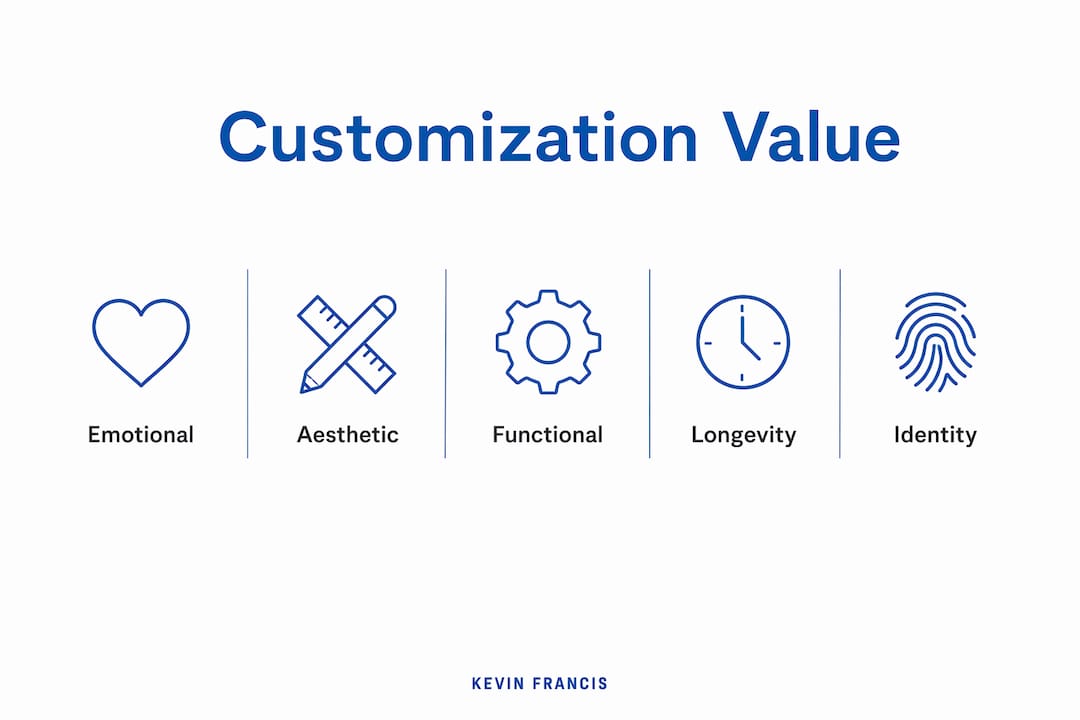
Emotionally, Katharine Pooley’s design guidance links personalization directly to two cognitive responses: identity (“This is who I am”) and belonging (“This was made for me”). A room that triggers both simultaneously is one a client will never want to leave, and never want to replicate elsewhere. Research on home personalization and psychological well-being confirms that personalizing one’s space has a direct positive impact on satisfaction with the home and with life in general.
Aesthetically, bespoke objects create narrative coherence. A hand-knotted rug commissioned to echo the warm ochres and deep indigos of a client’s art collection does not merely complement the room; it anchors it, giving every other element a tonal reference point. That is the jewel-box effect at its most deliberate.
Functionally, tailored scale and material selection extend longevity. A rug sized precisely for a room’s traffic patterns, woven from fibers chosen for that specific use, will outlast a standard piece by years, sometimes decades.
“Personalization is the psychological marker of luxury because it signals identity and belonging rather than status through logos.” — Katharine Pooley, design psychology
What craftsmanship and materials actually define bespoke ultra-luxury work?
Materials and hand techniques are the primary deliverables of bespoke craft. They carry provenance, durability, and authorship in ways that machine production simply cannot.
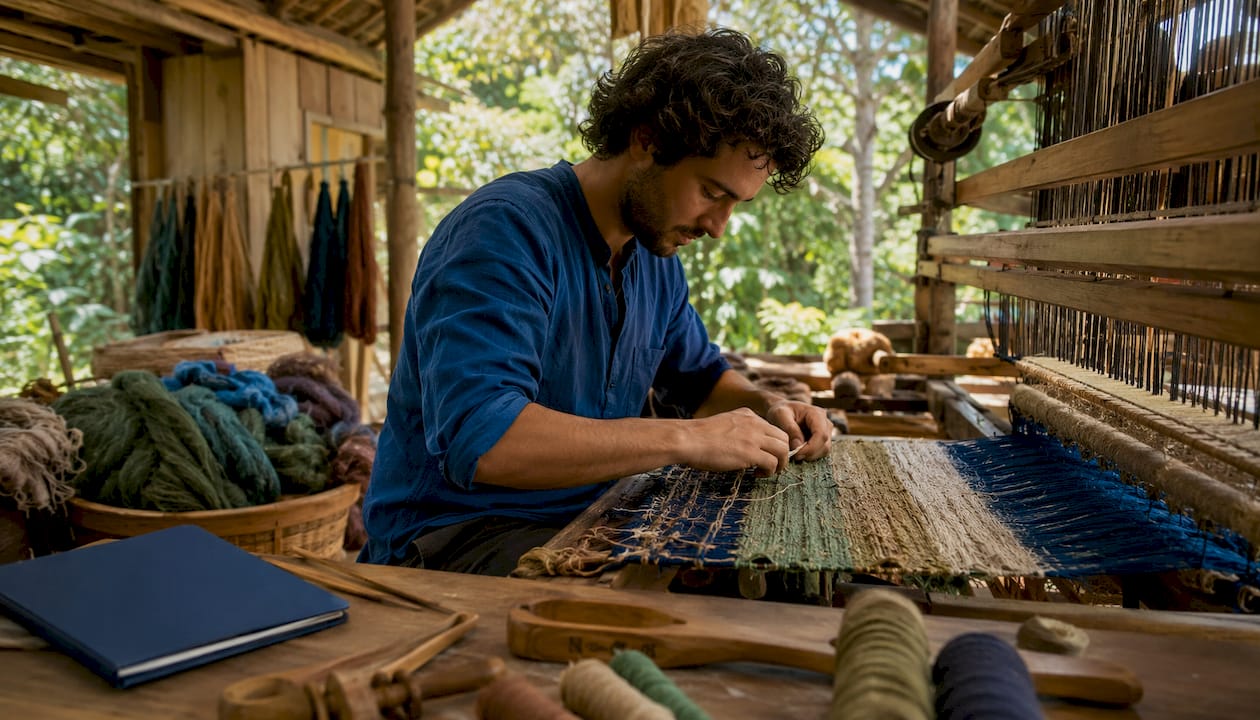
At Kevin Francis Design, three techniques define the atelier’s approach. Handweaving produces a textile surface with natural variation in tension and texture, giving each piece a living quality that shifts subtly with light. Hand-tufting allows precise placement of pile density, creating relief and shadow that a flat-woven piece cannot achieve. Tibetan knotting, the most labor-intensive of the three, yields knot densities that translate directly into tactile richness and structural longevity; a well-executed Tibetan-knotted rug is a multigenerational object.
Material provenance matters equally. Natural fibers, traceable dye sources, and transparent supplier relationships are the foundation of a credible atelier. When a maker can name the wool’s origin, describe the dye process, and show you the workshop where your piece was produced, you are dealing with genuine craft rather than assembled components.
Proof signals to request: production photographs at each stage, sample approvals before full production begins, and a plain-language explanation of knot density or stitch count for the specific technique used.
How does commissioning a bespoke piece actually work?
Commissioning is a structured creative collaboration. Expect five phases: discovery, concept, sampling, production, and handover, each with a client sign-off before the next begins.
- Discovery call — share your brief: room dimensions, palette references, artistic inspirations, and functional requirements.
- Concept presentation — the atelier returns with sketches, palette proposals, and material recommendations.
- Sample approval — physical swatches or prototype sections are produced and reviewed; this is where color and texture are confirmed.
- Production — full-scale fabrication begins only after written sign-off on the approved sample.
- Delivery and installation — the finished piece is delivered with documentation of provenance and care.
| Phase | Typical duration (small piece) | Typical duration (large commission) |
|---|---|---|
| Discovery to concept | 1–2 weeks | 2–4 weeks |
| Sample production | 2–4 weeks | 4 weeks |
| Full production | 6 weeks | 12 weeks |
| Delivery | 1–2 weeks | 2–4 weeks |
Cost factors include exclusivity guarantees (a global one-of-one clause), fiber and dye sourcing, artisan labor hours, and shipping or installation logistics. Exclusivity clauses on high-stakes commissions commonly add 30%–100% to the base price, a premium that clients in this market accept readily when the guarantee is genuine.
Key cost factors at a glance:
- One-of-one exclusivity guarantee (global or regional, often adding 30%–100% to pricing)
- Natural fiber and traceable dye sourcing
- Artisan labor (knot density, technique complexity)
- Shipping, customs, and white-glove installation
- Legal documentation of copyright and exclusivity
Pro Tip: Request that exclusivity language be written into the commission contract before sampling begins, not after. Securing design rights at the outset protects both parties and removes ambiguity about reproduction.
Art-inspired customization: what it looks like in practice
Art-inspired briefs convert artistic vocabulary — palette, gesture, negative space — into tactile, functional objects that carry the same emotional charge as the works that inspired them.
Consider a living room anchored by a modernist-inspired hand-knotted rug: geometric forms drawn from a client’s Bauhaus print collection, rendered in a warm stone and charcoal palette that pulls the room’s focal plane downward and inward. The rug does not illustrate the art; it translates its grammar into a different medium. Every piece of furniture placed above it reads differently as a result.
A second example: a textile commissioned to echo a private collection’s palette of dusty rose, aged gold, and deep forest green. The hand-tufted surface carries those colors in varying pile heights, so the piece shifts from warm to cool depending on the angle of light, much as a painting does across a day.
When vetting an atelier, request three types of images: a close-up of the weave or knot structure, an in-situ photograph of a comparable finished piece, and a prototype swatch from your specific colorway. These three together tell you everything about execution quality.
How do you evaluate a bespoke luxury maker before you commit?
Ask targeted operational and craft questions that reveal provenance and process transparency before any deposit changes hands.
Questions to raise on a first call:
- Can you share production photographs from a comparable recent commission?
- Where are your fibers and dyes sourced, and can you provide supplier documentation?
- What is your sample policy, and is the sample cost credited toward the commission?
- How do you structure exclusivity guarantees, and are they written into the contract?
- Can you provide two or three client references from commissions of similar scale?
Trust signals to expect from a credible atelier:
- Documented fiber and dye provenance with named suppliers
- A written sample-approval stage before full production
- Signed one-of-one exclusivity clauses available on request
- A visible atelier workflow: photographs, video, or in-person visits
- Client references willing to speak to timeline and quality
Red flags worth noting: evasive answers about where materials originate, no sample policy, timelines that shift without explanation, and reluctance to provide references or production photographs. Any one of these warrants caution; more than one is a clear signal to look elsewhere. For a broader view of personalizing your home with confidence, Kevin Francis Design’s design guides offer practical starting points.
Why will customization define ultra-luxury through 2026 and beyond?
Personalization is the central competitive axis for ultra-luxury because it creates unreplicable cultural and emotional capital. No two clients share the same identity, and no mass-produced object can carry a specific person’s story.
The Successful Founder’s 2026 analysis describes this moment as a shift from surface-level customization to predictive, identity-driven design: ateliers that combine advanced material knowledge with deep client relationship management are pulling ahead decisively. The convergence of CRM tools, advanced natural materials, and a consumer preference for relevance over brand signage is reshaping what “luxury” means at the top of the market.
The authorship model is the clearest expression of this shift. Leading ultra-luxury ateliers now invite clients into a blank-sheet creative process, making co-authorship the primary value rather than the object alone. Bespoke commissions are increasingly structured as multigenerational assets, with exclusivity clauses and provenance documentation that give the piece a traceable history. That history is itself part of the value.
Kevin Francis Design: art-led bespoke rugs with atelier transparency
For collectors who want a bespoke textile that carries genuine artistic authorship, Kevin Francis Design offers something distinct from a standard custom-order service: a co-creative process rooted in art-inspired design, hand technique, and full atelier transparency.
The process begins with a discovery consultation, moves through palette and concept development, and includes physical sample approvals before a single knot of the final piece is tied. Every commission carries an exclusivity guarantee, and provenance documentation accompanies each finished work. The Lotto Hand-Knotted Wool Area Rug illustrates the atelier’s approach: a hand-knotted wool piece whose geometric precision and material depth reflect Kevin O’Gara’s art-led design philosophy. For those considering a luxury glass interior door as part of a broader bespoke interior, the same principle applies: every element should carry authorship, not just category quality.
To begin a bespoke commission or view the full portfolio, contact Kevin Francis Design directly through the website.
Key Takeaways
Customization defines the ultra-luxury experience because it transforms objects into authored, identity-bearing artifacts that carry provenance, emotional resonance, and unrepeatable scarcity.
| Point | Details |
|---|---|
| Authorship over ownership | Ultra-luxury clients co-create pieces from a blank sheet; the object carries their creative fingerprint. |
| Emotional and functional value | Personalization triggers identity and belonging, while tailored scale and materials extend longevity. |
| Exclusivity adds measurable premium | One-of-one exclusivity clauses commonly add 30%–100% to commission pricing. |
| Verify craft before committing | Request production photos, supplier documentation, and written sample-approval terms before any deposit. |
| Kevin Francis Design | Offers art-inspired bespoke rugs with discovery consultation, sample approvals, and guaranteed exclusivity. |
A note on authorship and why it matters most
There is a version of “bespoke” that is really just a longer menu. More color choices, a name embroidered in a corner, a slightly adjusted dimension. That is not what we mean when we talk about authorship.
True authorship in a bespoke interior object means the maker began with your story, not their catalog. It means the palette came from a painting you love, the scale was drawn from the specific geometry of your room, and the technique was chosen because it would produce the precise tactile quality you described in a brief. The finished piece cannot exist without you.
For collectors building interiors that will outlast trends and carry meaning across generations, that distinction is the only one that matters. What ultra-luxury interior design means in 2026 has shifted decisively toward this model, and the ateliers worth working with are the ones who understood it before it became a trend. We encourage you to request a consultation, ask the hard questions, and commission only from makers who can show you your object being made.
Useful sources and further reading
- The New Luxury: Ultra-Personalisation in 2026 — The Successful Founder
- Authorship > Ownership — InnovateDisruptorDie
- The Psychology of Luxury Interior Design — Architectural Digest
- The Psychology of Luxury Interiors — Katharine Pooley
- Luxury vs. Ultra-Luxury Hospitality — HospitalityNet
- The Future of Bespoke Pricing — PLTFRM
- McKinsey Retail and Luxury Insights
- Kevin Francis Design — Bespoke Rugs and Textiles
When vetting any atelier, request three specific documents: a fiber and dye provenance sheet, a production photograph log from a comparable commission, and a sample of the exclusivity clause language used in their standard contract. These three items tell you more than any portfolio image.
FAQ
What makes ultra-luxury customization different from standard custom orders?
Ultra-luxury customization is co-creation from a blank sheet, not a selection from a pre-set menu. The client’s identity, palette, and brief shape the object before any design decisions are made.
How long does a bespoke rug commission typically take?
A small bespoke piece typically takes around 10 weeks from discovery to delivery; a large commission can take 20 weeks or more, depending on technique complexity and client sign-off timing.
Why do exclusivity clauses add so much to the price?
Exclusivity guarantees ensure the design will never be reproduced for another client, making the piece a genuinely unrepeatable artifact. That scarcity carries real market value and commonly adds 30%–100% to the base commission price.
What trust signals should I look for when choosing a bespoke atelier?
Look for documented material provenance, a written sample-approval stage, signed one-of-one exclusivity clauses, and client references from comparable commissions. Production photographs taken during your specific piece’s fabrication are the strongest single signal of genuine craft.
Does Kevin Francis Design offer bespoke commissions?
Yes. Kevin Francis Design works with clients through a structured discovery-to-handover process that includes palette development, physical sample approvals, and guaranteed exclusivity documentation for every commission.
Recommended
- What Does Ultra-Luxury Interior Mean in 2026? – Kevin Francis Design
- How to Wow Your Guests with Luxurious Living Room Details – Kevin Francis Design
- Luxury Resort Interior Design: A Professional Approach – Kevin Francis Design
- 7 Interior Design Secrets to Make Your Home Feel High-End & Luxurious – Kevin Francis Design


