

The luxury goods authentication process for handmade rugs and artisan textiles is the verification of three things at once: provenance (the documented chain of custody), construction (materials, dyes, and knotting method), and condition (assessed through an independent report or lab testing when the stakes justify it). Before you commission full authentication, run a quick triage:
- Flip the rug. A hand-knotted piece shows individual knots on the back; a hand-tufted one hides behind glued canvas.
- Check the fringe. It should extend from the warp threads, not be sewn or glued on afterward.
- Request paperwork. Ask for the invoice, any auction lot history, and labels sewn to the back.
- Ask for a condition report. This documents knot density, materials, and repairs in writing.
- Request lab testing for high-value pieces. Fiber and dye analysis settle disputes paperwork cannot.
Key Takeaways
Authenticating a handmade rug or artisan textile requires verifying construction by hand, confirming provenance through paperwork, and commissioning lab testing when the piece’s value demands it.
| Point | Details |
|---|---|
| Flip and fringe test first | Check the back for visible knots and confirm fringe extends from the warp before anything else. |
| Demand paperwork | Request invoices, auction lot numbers, and labels, then cross-check dates and details. |
| Hire independent conservators | Use accredited conservators or auction specialists for condition reports, never the selling dealer. |
| Reserve lab testing for high stakes | Commission fiber or dye analysis for disputed provenance or high-value pieces. |
| Watch for vague labeling | Terms like “hand-woven” can legally mislead; insist on precise construction language. |
| Choose provenance-first sourcing | Kevin Francis Design builds documentation and appraisal access into every custom commission. |
Table of Contents
- Why Authentication Matters for Handmade Rugs and Textiles
- Step 1: Inspect the Knots, Fringe, and Weave Yourself
- Step 2: Gather and Verify Provenance Paperwork
- Who Prepares a Trustworthy Condition Report?
- When Do You Need Fiber or Dye Testing?
- How Chain of Custody Protects Your Investment
- What Marketing Language Should Make You Pause?
- How Do You Commission an Authentication?
- How Kevin Francis Design Approaches Provenance
- Let Kevin Francis Design Handle the Verification for You
- Sources
- FAQ
Why Authentication Matters for Handmade Rugs and Textiles
A documented chain of custody does more than satisfy curiosity. It directly shapes resale value and protects the cultural integrity of work made by named weavers and regional workshops. For interior designers specifying six-figure pieces into a client’s home, or hospitality buyers outfitting a boutique hotel lobby, unverifiable provenance is a liability that surfaces later, usually during insurance claims or resale negotiations.
- Provenance anchors resale price and buyer confidence for years after purchase.
- Ethical sourcing keeps credit and compensation with the artisans who actually made the piece.
- Condition reports and lab results are frequently required by insurers before they will underwrite high-value textiles.
Pro Tip: Ask for provenance documentation before you fall in love with a piece, not after. Sellers with nothing to hide rarely hesitate to produce paperwork on request.
Step 1: Inspect the Knots, Fringe, and Weave Yourself
Before any lab gets involved, your own eyes and hands do most of the work. The flip test remains the fastest, most reliable check: a hand-knotted rug reveals the pattern and individual knots on its reverse, while a hand-tufted rug hides that structure behind a layer of glued canvas, and a machine-made rug shows a perfectly uniform grid.
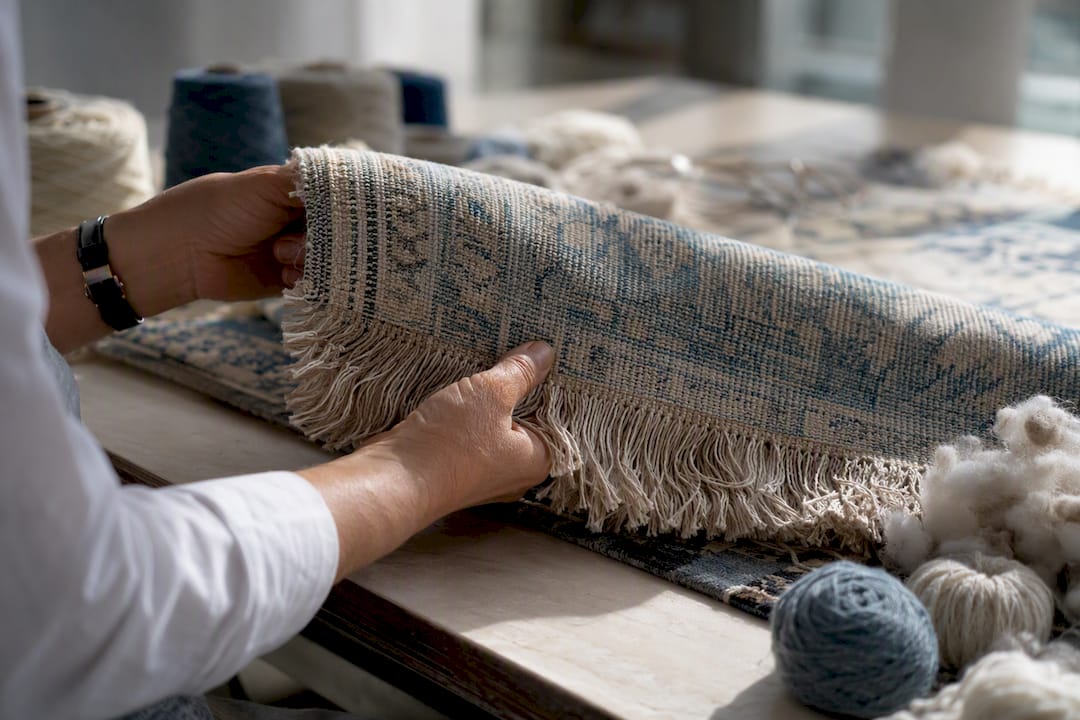
Fringe tells its own story. On an authentic piece, the fringe is a structural extension of the warp threads, not a decorative add-on. Sewn-on or glued fringe is one of the clearest tells of a machine-made piece dressed up to look artisanal.
Knot type matters too. Persian, or asymmetrical, knots allow finer detail per square inch; Turkish, or symmetrical, knots produce a slightly bolder but more durable structure. Neither is “better,” but the count and consistency across the field tell you how much time and skill went into the piece.
Slight color variation across a field, known as abrash, is not a flaw. It is a signature of hand-dyeing, and its presence is one of the more reliable positive indicators of genuine handwork.
Pro Tip: When requesting photos from a dealer, ask specifically for close-ups of the back, both selvedges, the fringe attachment point, and a coin or ruler for scale. A dealer’s willingness to send all four tells you almost as much as the images themselves.
Step 2: Gather and Verify Provenance Paperwork
Once construction checks out, paperwork closes the loop. Receipts, auction records, gallery labels, and certificates together build a verifiable chain of custody, and that chain is what protects both authenticity and market value down the line.
Request these documents before finalizing any purchase:
- Original invoice or bill of sale, with a legible date and seller signature.
- Auction lot numbers, if the piece passed through a sale, so you can cross-check the auction house’s own database.
- Prior sale records or gallery labels sewn to the back.
- Export or import paperwork, when a piece has crossed borders.
Cross-reference dates across documents. A rug supposedly acquired in one decade should not appear in a photo with a later manufacturing detail. Ask sellers directly: “Can you show me the auction lot this piece sold under?” or “Who prepared the last condition report, and when?” Vague or evasive answers to specific, verifiable questions are the biggest red flag in this entire process. Our own rug provenance documentation guide breaks down what a complete paper trail should look like before you sign off.
Who Prepares a Trustworthy Condition Report?
A condition report should come from an accredited textile conservator, an auction-house specialist, or a museum conservator, not the selling dealer. Auction-house condition reports set the standard: they list exact dimensions, materials, knot density, any repairs or restoration, and photographic documentation of the verso and selvedges.
Look for these credibility markers in an appraiser:
- Formal accreditation or membership with a recognized textile or appraisal association.
- Prior affiliation with an auction house or museum textile department.
- Published scholarship or catalog contributions on rug or textile history.
A condition report worth trusting reads like a technical dossier, not a sales sheet. If it praises the rug more than it measures it, find a different conservator.
Our guide to professional rug appraisal for luxury pieces walks through how to find and brief one.
When Do You Need Fiber or Dye Testing?
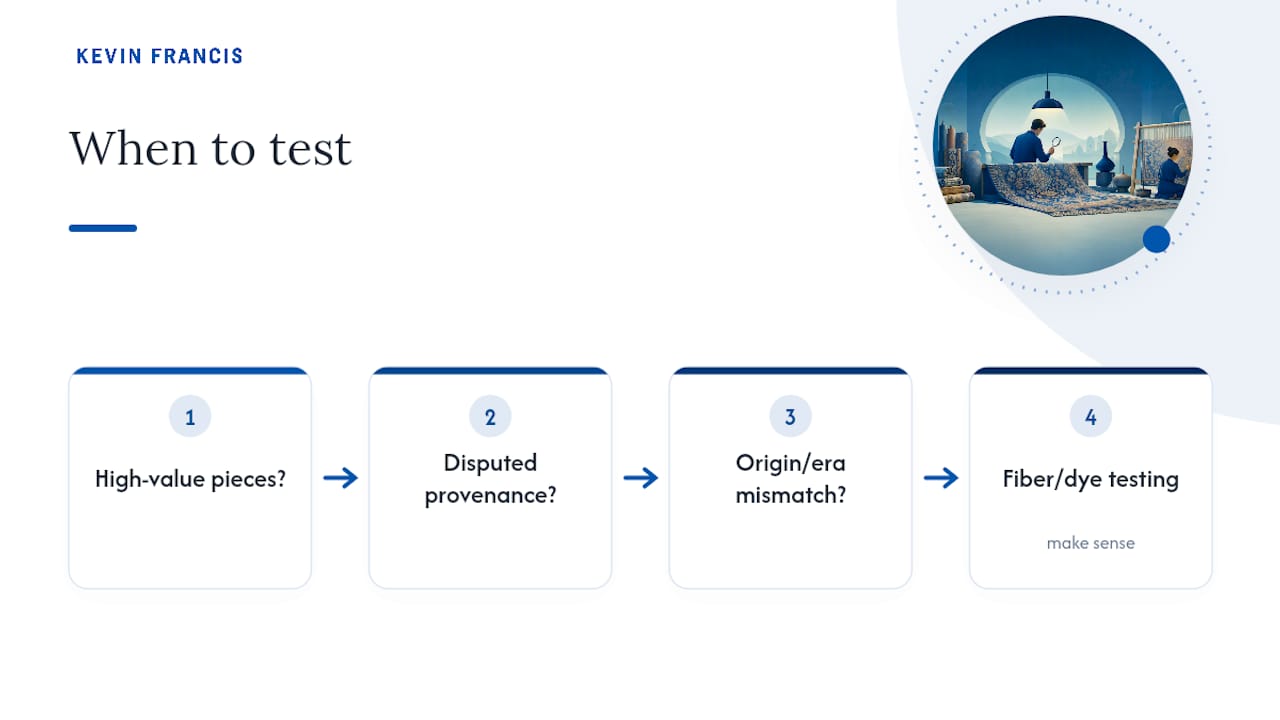
Visual inspection and paperwork resolve most cases. High-value pieces, disputed provenance, or materials that seem anachronistic for the claimed origin call for lab work. Fiber microscopy confirms wool, silk, or cotton content at a cellular level. Raman spectroscopy or HPLC identify whether a dye is natural or synthetic, which matters enormously for dating a piece, since certain synthetic dyes did not exist before specific decades. XRF or FTIR analysis can flag chemical signatures inconsistent with a claimed region or era. Radiocarbon dating is reserved for the highest-stakes authentications, usually antique pieces with six-figure valuations.
- Fiber microscopy: confirms material composition.
- Raman/HPLC dye analysis: distinguishes natural from synthetic dyes and helps date the piece.
- XRF/FTIR: flags chemical inconsistencies with claimed origin.
Portable spectrometers and AI image-matching tools have become practical in-situ aids for specialists working directly in a client’s home or a hotel’s storage facility, cutting down on the need to ship a piece off-site for preliminary screening.
How Chain of Custody Protects Your Investment
A complete chain of custody includes invoices, prior ownership photos, transport records, and conservation invoices, layered on top of the condition report and paperwork you already gathered. Documented ownership history strongly influences legal clarity and resale value, which is exactly why serious collectors treat the paper trail as part of the asset itself.
- Photograph the piece from every angle immediately after purchase.
- Register it with your insurer using the condition report as baseline documentation.
- Archive every receipt, appraisal, and conservation invoice in one file, digital or physical.
Pro Tip: Update your chain-of-custody file after every cleaning or repair, not just at purchase. A rug with a gap in its conservation history is harder to insure and harder to resell.
What Marketing Language Should Make You Pause?
Sellers sometimes rely on technically-true-but-misleading phrasing. The term “hand-woven” can legally apply to a rug that only involved a human at a minor finishing step, even if the bulk of the piece was machine-made. “Persian-style” often describes a design pattern, not an origin claim.
Watch for these practical red flags:
- No photos of the back, selvedges, or fringe attachment.
- Fringe that is obviously sewn or glued rather than woven through.
- Colors that look perfectly, suspiciously uniform across the entire field.
- A price far below what comparable documented pieces command, with no explanation.
Insist on precise construction language: hand-knotted, hand-tufted, or machine-made. Anything vaguer than that is worth a direct follow-up question before you proceed.
Our comparison of hand-knotted, hand-tufted, and machine-made construction covers the terminology sellers most often blur.
How Do You Commission an Authentication?
Vetting the right authenticator matters as much as the testing itself. Look for credentials from a recognized textile or appraisal body, prior published work, trade association membership, and a willingness to show sample reports from past clients.
Before hiring, ask:
- What is your typical turnaround time for a condition report versus a full technical dossier?
- Do you require a physical sample, and is testing nondestructive?
- What does the final written deliverable include, and can I share it with insurers or future buyers?
Costs and timelines vary by scope. A standard condition report typically turns around faster and costs less than fiber microscopy or dye analysis, and a full technical dossier combining several tests takes the longest and costs the most. Budget accordingly if you’re procuring for a hospitality project on a deadline, since lab queues can extend timelines beyond a designer’s install date if testing is requested at the last minute. For teams sourcing across multiple vendors, the trade program resources at One Day Doors & Closets offer useful context on structuring vendor relationships for procurement at scale.
How Kevin Francis Design Approaches Provenance
We build provenance verification into procurement from the first client conversation, not as an afterthought once a piece is chosen. That means requesting full verso imagery from artisan partners before a piece ships, commissioning condition reports for hospitality projects where insurers require them, and bringing in accredited labs whenever a client’s collection warrants it.
Provenance is part of the craftsmanship story. A rug’s origin and construction deserve the same scrutiny as its color and pattern.
- Full verso and selvedge imagery requested as standard practice for custom commissions.
- Condition reporting arranged for hospitality and high-value residential projects.
- Independent, accredited labs engaged when a client requests scientific verification.
A Note From Kevin O’Gara
Designers live in the tension between what looks right in a room and what holds up under scrutiny. My priority is always durability and provenance working together, never one sacrificed for the other. A beautiful rug with no paper trail is still a risk, and I’d rather slow a project down by a week than install something we can’t stand behind later.
Let Kevin Francis Design Handle the Verification for You
Kevin Francis Design gives procurement teams and homeowners something most rug sources cannot: full provenance documentation built into the commissioning process from day one, rather than assembled after the fact under pressure from an insurer or a resale buyer.
When you work with us on a custom piece, we handle document requests, arrange condition reporting, and coordinate independent appraisals where a project calls for one, so you are never left chasing paperwork months after installation. Our Lotto Hand-Knotted Wool Area Rug illustrates the standard we hold every commission to: fully hand-knotted construction, documented materials, and verso imagery available on request. If you’re specifying a piece for a client project or your own home, request provenance documentation or a consultation before you finalize your order.
Sources
For readers who want to go deeper on any single step, these resources cover the technical detail this guide only summarizes:
- Hand-Knotted vs Hand-Tufted vs Machine-Made Rugs: A Dealer’s Honest Guide to What You’re Actually Buying | RugIndustry
- How to Tell a Handmade Rug from a Machine-Made Rug – Floorspace
- Provenance Papers Explained: Understanding Rug Origin Documentation - Decadent Interiors
Cross-check any auction lot number against the auction house’s own public database before relying on it as proof of provenance.
FAQ
What Is the Luxury Goods Authentication Process for a Rug?
It is the combined verification of provenance documentation, hand construction, and condition, often supported by an independent appraisal or lab testing for high-value pieces.
How Can I Tell if a Rug Is Hand-Knotted or Hand-Tufted?
Flip it over: a hand-knotted rug shows individual knots and the pattern on the back, while a hand-tufted rug hides that structure behind glued canvas.
What Documents Should I Request Before Buying a High-Value Rug?
Ask for the original invoice, any auction lot history, labels sewn to the back, and export paperwork if the piece crossed borders.
When Is Scientific Testing Worth the Cost?
Fiber and dye testing make sense for high-value pieces, disputed provenance, or materials that seem inconsistent with the claimed origin or era.
Does Kevin Francis Design Provide Provenance Documentation?
Yes. Kevin Francis Design builds verso imagery, condition reporting, and access to independent appraisals into custom commissions and hospitality procurement projects.


