


A signature designer rug is defined as a handcrafted textile bearing the authenticated mark of its maker, functioning as a signed original rather than a decorative reproduction. The term “signature rug” borrows its meaning directly from fine art: just as a painting gains provenance from the artist’s signature, a designer area rug gains authenticity and value from a woven or inscribed mark identifying its creator, workshop, or artistic lineage. Understanding what is a signature designer rug means recognizing that you are looking at a certified original, not simply a luxury floor covering. Kevin Francis Design builds every collection around this principle, treating each rug as a piece of art that carries a story from the loom to your floor.
What does a signature on a designer rug mean?
A rug signature is a woven or inscribed mark that identifies the artisan, workshop, or region responsible for the piece. It functions as provenance, authenticity, and artistry marker all in one. Without it, a rug is simply a beautiful object. With it, the rug becomes a traceable original.
Signatures appear in several forms across traditional and contemporary rugs:
- Cartouche: A small, framed panel woven into the border or medallion, most common in Persian rugs. Traditional cartouches contain Farsi script naming the weaver or city of origin.
- Woven inscription: Text integrated directly into the field or border, sometimes including a date or dedication.
- Commission mark: A special notation indicating the rug was made for a specific patron, adding rarity and historical weight.
- Designer label: In modern collections, a woven or attached label bearing the designer’s name, studio, or collection title.
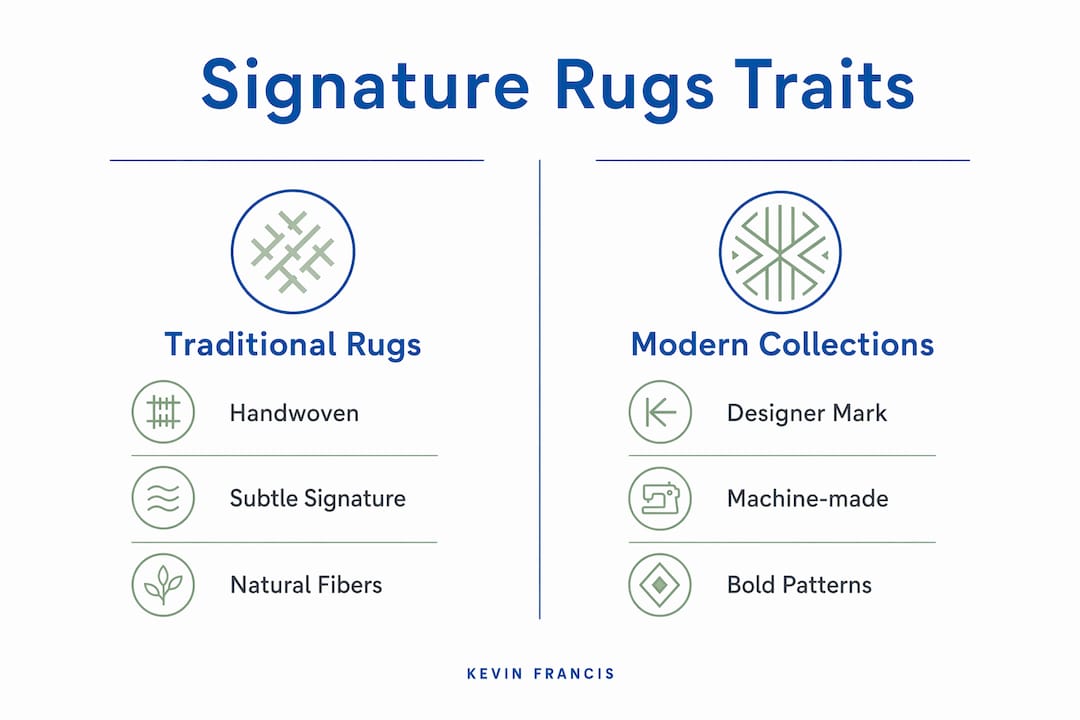
Traditional signed rugs, particularly Persian examples, carry names, dates, or dedications as premium commission marks. These details transform a rug from a commodity into a collectible. Modern designer signature collections work differently. A signature cartouche in a contemporary context represents a branded limited edition rather than a personal weaver’s mark. Both carry value, but for different reasons: one signals heritage, the other signals artistic vision and controlled production.
Signatures on traditional rugs are intentionally subtle. They blend within the design rather than announce themselves, telling a quiet story of heritage and craftsmanship to those who know where to look.
Pro Tip: When examining a rug for a signature, check the lower border first. Persian and Turkish weavers most commonly placed their marks there, often in a small rectangular panel that mirrors the rug’s color palette.
What are the key characteristics of signature designer rugs?
Signature designer rugs share a set of defining qualities that separate them from mass-produced alternatives. These qualities appear in the materials, the construction method, and the finish.
Materials
Natural fibers define the foundation of any genuine luxury rug. Wool, silk, and cotton each bring distinct properties:
| Fiber | Quality | Best Use |
|---|---|---|
| Wool | Durable, resilient, naturally stain-resistant | Living rooms, dining areas, high-traffic spaces |
| Silk | Luminous sheen, fine detail, soft texture | Bedrooms, low-traffic display areas |
| Cotton | Crisp foundation, holds dye well | Flatweave rugs, rug backing |
Luxury designer rugs use natural fibers such as wool, silk, and cotton for superior texture and durability. Natural fibers age gracefully, developing a patina that synthetic materials cannot replicate. Hand-spun silk, in particular, adds a tactile, luminous quality that shifts with the light, giving the rug a living, painterly presence.
Construction and craftsmanship
The weaving method determines both the rug’s visual precision and its longevity. Hand-knotting, hand-tufting, and Tibetan knotting each produce distinct results. Hand-knotting is the most labor-intensive and produces the highest knot density, which translates directly to sharper pattern definition and greater durability. Kevin Francis Design uses hand-knotting as the foundation for its most refined collections, including pieces inspired by Ottoman and Anatolian traditions.
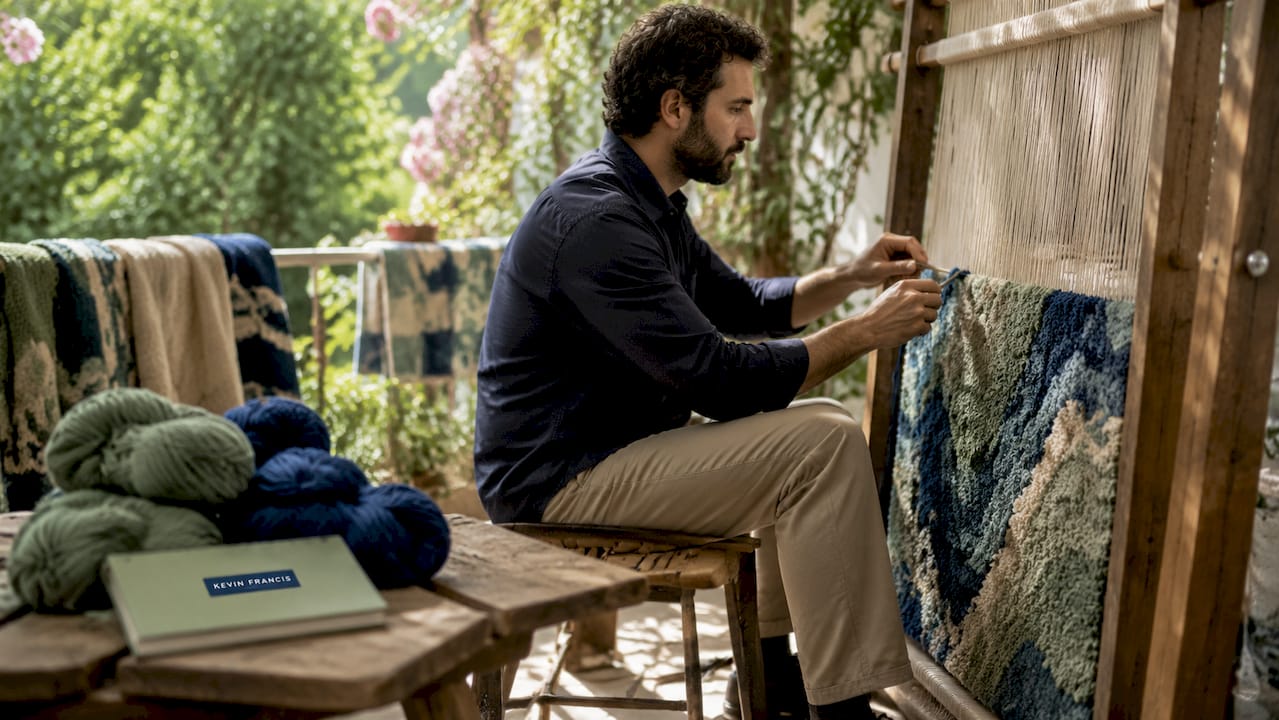
Pile height is another defining characteristic. High-pile rugs suit low-traffic areas where softness is the priority. Low-pile rugs perform better in dining rooms and hallways where chairs, foot traffic, and cleaning frequency demand a tighter, more resilient surface.
Color and dye quality
Natural dyes and colorfast synthetic dyes both appear in quality designer rugs, but the finest pieces favor natural or carefully controlled vegetable dyes. These dyes mellow rather than fade, producing a wash of color that deepens over decades. Synthetic dyes in lower-quality rugs tend to bleed or shift unevenly with age.
Pro Tip: To test dye quality on a rug you are considering, press a damp white cloth firmly against the pile for ten seconds. No color transfer indicates stable, well-fixed dye.
How do signature designer rugs differ from other luxury rugs?
The distinction between a rug with a woven signature and a rug marketed as a “signature collection” matters enormously for buyers who care about provenance and value.
A traditional signed rug, such as a signed Persian piece, is an investment-grade asset comparable to blue-chip art. Its signature reveals the weaver’s name, city of origin, production date, and sometimes the patron for whom it was made. Rarity, age, and verifiable provenance drive its value. Collectors and auction houses treat these rugs as they would paintings by named artists.
A modern designer “signature collection” operates on a different logic. Here, the designer’s name or studio mark signals artistic direction, controlled production, and aesthetic consistency rather than a single artisan’s hand. The value comes from the designer’s reputation, the quality of materials, and the originality of the pattern. Kevin Francis Design’s collections, for example, draw on specific art historical references and original geometric concepts, giving each piece a traceable creative identity even within a curated series.
The table below clarifies the key distinctions:
| Feature | Traditional signed rug | Modern signature collection |
|---|---|---|
| Signature type | Woven cartouche, Farsi script | Designer label, studio mark |
| Value driver | Provenance, age, rarity | Artistic vision, material quality |
| Production | Single workshop or master weaver | Curated series, controlled edition |
| Collector appeal | Antique market, auction houses | Interior design, luxury retail |
| Handmade status | Always handmade | Typically handmade; verify before buying |
Machine-made rugs marketed as “designer” do exist, and they represent a meaningful gap in quality. A genuine signature designer rug is always handcrafted. The signatures and stamps on authentic pieces function as provenance identifiers, indicating artisan, workshop, region, production date, and authenticity. Machine-made pieces carry none of that traceability.
How to choose and style signature designer rugs in upscale interiors
Selecting the right luxury rug for a space requires attention to scale, material, placement, and the room’s function. These four considerations, applied in order, prevent the most common and costly mistakes.
-
Determine the correct size first. Proper rug sizing places furniture legs fully or at least partially on the rug, with only 9–15 inches of visible floor around the perimeter in luxury spaces. A rug that is too small disconnects the furniture grouping and breaks the room’s visual harmony. Measure the seating area, not just the room, before ordering.
-
Match the fiber to the room’s function. Wool suits living rooms and dining areas where durability matters. Silk belongs in bedrooms or formal sitting rooms where foot traffic is light and the rug’s luminous surface can be appreciated without wear. Cotton flatweaves work well in kitchens and casual spaces.
-
Consider pile height relative to traffic. High-pile rugs create a jewel-box effect in low-traffic rooms, drawing the eye downward with depth and texture. Low-pile rugs maintain their appearance longer under chairs, dining tables, and entryways.
-
Use the rug to anchor the room. Interior designers consistently recommend treating the rug as the room’s foundational design piece, selecting it before finalizing upholstery and drapery colors. The rug’s palette sets the room’s emotional register.
-
Decide between custom and ready-made. Custom signature rugs allow you to specify exact dimensions, colorways, and pile height for a space. Ready-made signature collections offer faster delivery and a curated aesthetic that has already been resolved by the designer. For rooms with unusual proportions or highly specific design briefs, custom is the stronger choice. Kevin Francis Design offers both paths, with bespoke options available alongside its named collections.
For guidance on how scale affects the entire room, the principles that apply to wallpaper scale for residential spaces translate directly to rug selection: proportion relative to the wall or floor plane determines whether a pattern reads as bold or busy.
Pro Tip: Place your rug before arranging furniture. Laying the rug first lets you see how its pattern and color interact with the floor and light, which is far easier than moving sofas after the fact.
Key takeaways
A signature designer rug is the most direct way to bring certified artisanship, traceable provenance, and lasting material quality into a luxury interior.
| Point | Details |
|---|---|
| Signature as provenance | A woven mark identifies the artisan, workshop, or designer, confirming authenticity and origin. |
| Natural fibers define quality | Wool, silk, and cotton deliver durability, texture, and aging that synthetic materials cannot match. |
| Size before everything else | Correct rug sizing anchors furniture and maintains visual cohesion; too small breaks the room. |
| Traditional vs. modern signatures | Traditional cartouches signal heritage; modern designer marks signal artistic vision and controlled production. |
| Handmade status is non-negotiable | A genuine signature designer rug is always handcrafted; machine-made pieces carry no comparable provenance. |
Why I think most people underestimate what a signature rug actually does
People tend to focus on pattern and color when they choose a rug, which makes sense. Those are the things you see first. What they miss is the quieter work the rug does once it is in the room.
A signed rug carries a story that changes how you experience the space. When I know a rug was woven by a specific workshop, using hand-spun wool and natural dyes, following a pattern that traces back to a particular artistic tradition, the room feels different. Not louder. Richer. There is a depth to it that a machine-made piece simply cannot produce, no matter how beautiful the pattern looks in a photograph.
The craftsmanship question is where I see the sharpest divide between buyers who are satisfied and those who are not. Buyers who prioritize price per square foot almost always end up replacing their rug within a decade. Buyers who invest in a quality luxury rug with verified materials and construction tend to keep it for life. The economics actually favor the better piece.
My strongest advice is to resist trend-driven choices. A signature rug built on a timeless geometric or classical motif will outlast every furniture refresh you make around it. It becomes the room’s constant, the thing everything else is measured against. That is the real value of a signed original.
— Kevin O’Gara
Kevin Francis Design’s signature rug collections
Kevin Francis Design brings the tradition of signed artisanship into contemporary interiors through collections that are handmade, named, and built to last.
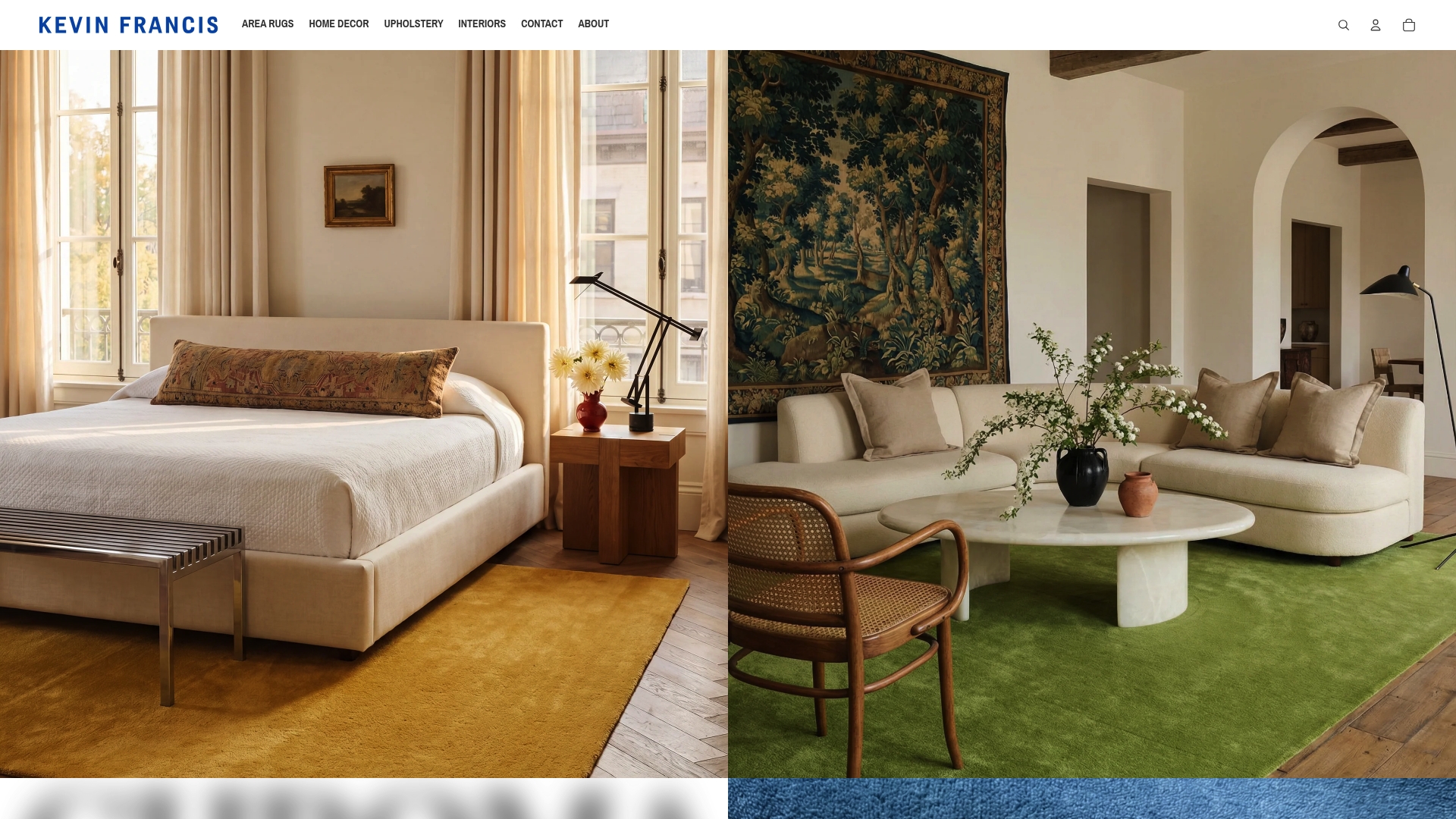
The Lotto Hand-Knotted Wool Area Rug draws on Ottoman geometric traditions, hand-knotted in premium wool with the precision and density that defines investment-grade craftsmanship. The Cairene and Selendi collections extend that same commitment to named, traceable design across different pattern vocabularies. Each piece is available in custom dimensions and colorways for rooms that require a bespoke solution. Visit Kevin Francis Design to view the full collection and request a custom consultation.
FAQ
What is the signature rug definition in simple terms?
A signature designer rug is a handcrafted rug bearing the authenticated mark of its maker, confirming its origin, artisan identity, and authenticity. It functions as a signed original, much like a signed painting.
How do I identify a genuine signature on a rug?
Look for a small woven cartouche or inscription in the border, often in the lower panel. Traditional Persian and Turkish rugs place the weaver’s name or workshop mark there, sometimes with a date or city of origin.
Are signature designer rugs worth the investment?
A signed, handmade rug in natural fibers holds and often increases its value over time, making it comparable to other investment-grade decorative art. Machine-made alternatives do not carry the same provenance or longevity.
What materials should I look for in a luxury area rug?
Wool, silk, and cotton are the defining fibers of genuine luxury rugs. Wool offers durability and resilience; silk adds luminosity and fine detail; cotton provides a crisp, stable foundation for flatweave constructions.
How do I choose the right size for a designer rug?
Place at least the front legs of all major furniture pieces on the rug, leaving no more than 9–15 inches of exposed floor around the perimeter. A rug that is too small visually disconnects the furniture and weakens the room’s design.


