

Provenance value is the measurable and emotional premium that comes from knowing exactly who made an object, where, how, and for whom — a verifiable chain of origin that transforms a beautiful piece into an investable, insurable, and story-rich asset. For luxury homeowners and interior designers, understanding provenance value in luxury goods means the difference between acquiring something lovely and acquiring something lasting. The trust signals that anchor this value include a signed certificate of authenticity (COA), original sales records or auction catalogue entries, and maker attribution from studios like Kevin Francis Design, where every commission carries documented craft history.
- Provenance value = verifiable origin + maker story + chain of custody
- COA and signed invoices confirm who made the piece and when
- Auction or sales records establish market history and realized price
- Production photos provide visual proof of the handmaking process
- Kevin Francis Design delivers a provenance packet with every bespoke commission
Table of Contents
- Why does provenance matter in luxury interiors?
- How is provenance actually documented?
- How can you verify provenance before buying?
- Your pre-purchase checklist: what to ask and request
- How does provenance affect price, insurance, and resale?
- A real-world example: the Lotto Hand-Knotted Wool Area Rug
- How to preserve provenance over a lifetime
- Key Takeaways
- Why provenance is the most underestimated design decision
- Provenance-backed artisan decor from Kevin Francis Design
- Further reading and authoritative sources
- FAQ
Why does provenance matter in luxury interiors?
Luxury buying has shifted decisively from conspicuous brand signals toward intentional, maker-driven value — and provenance is now often what justifies the premium. A room furnished with documented artisan pieces carries a narrative that no catalog-sourced interior can replicate. Designers who specify with provenance in mind give their clients something genuinely rare: confidence.
Financially, provenance supports higher insurance declared values, cleaner resale transactions, and stronger positions in asset-backed lending conversations. Undocumented objects sell at a discount on the secondary market because buyers absorb the risk of unknown origin. Documented ones change hands faster and at better prices.
There is also an ethical dimension. Handcrafted objects age with patina rather than wearing out, and their provenance often includes traceable sourcing of materials and fair compensation for makers. For designers committed to sustainability, provenance documentation is the evidence that backs those claims. Craft evidence — the slight asymmetry of a hand-knotted pile, the subtle variation in a woven border — reassures buyers that something was made slowly and thoughtfully, by a human being who cared.
Pro Tip: When specifying artisan pieces for a client, ask for provenance documentation at the proposal stage, not after purchase. Embedding it in the brief signals to makers that you expect professional-grade records, and it protects your client’s investment from day one.
How is provenance actually documented?
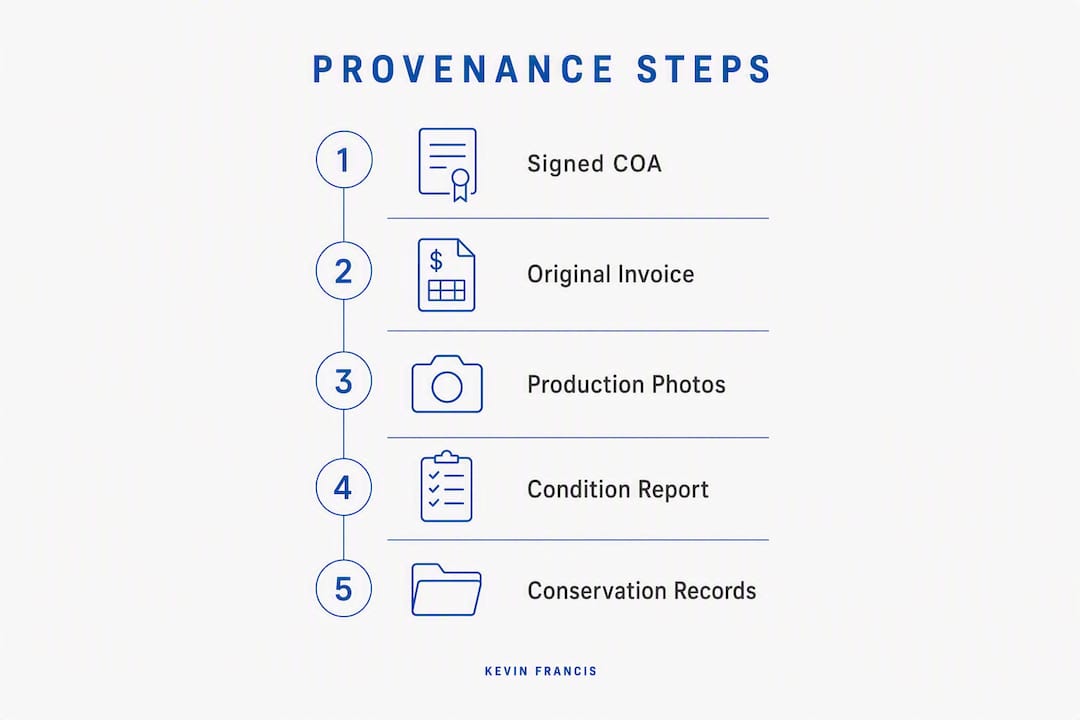
The strongest provenance files combine several layers of evidence, each proving something different about the object’s origin and history.
| Document | What it proves | Why it matters for valuation or resale |
|---|---|---|
| Signed COA | Maker identity and date of completion | Primary authentication; required by most insurers and appraisers |
| Original invoice | Purchase price, buyer, and seller | Establishes market value at time of sale |
| Production photos | Process evidence and workshop attribution | Visual proof of handmaking; hard to falsify |
| Condition report | State of the object at a specific date | Baseline for insurance and future appraisal |
| Exhibition or sales history | Public record of ownership and display | Adds cultural weight and market credibility |
| Conservation or lab notes | Material composition and repair history | Supports authenticity claims for rare materials |
Named workshops and production photos are stronger evidence than vague origin statements. For high-value textiles, isotopic or spectrometric testing can link fibers to a specific geographic source, making origin claims essentially impossible to falsify. This level of scientific authentication is increasingly available and worth commissioning when a piece carries significant value or when doubt exists about material sourcing.
You can explore Kevin Francis Design’s full approach in the luxury rug provenance documentation guide, which walks through each document type in detail.
How can you verify provenance before buying?
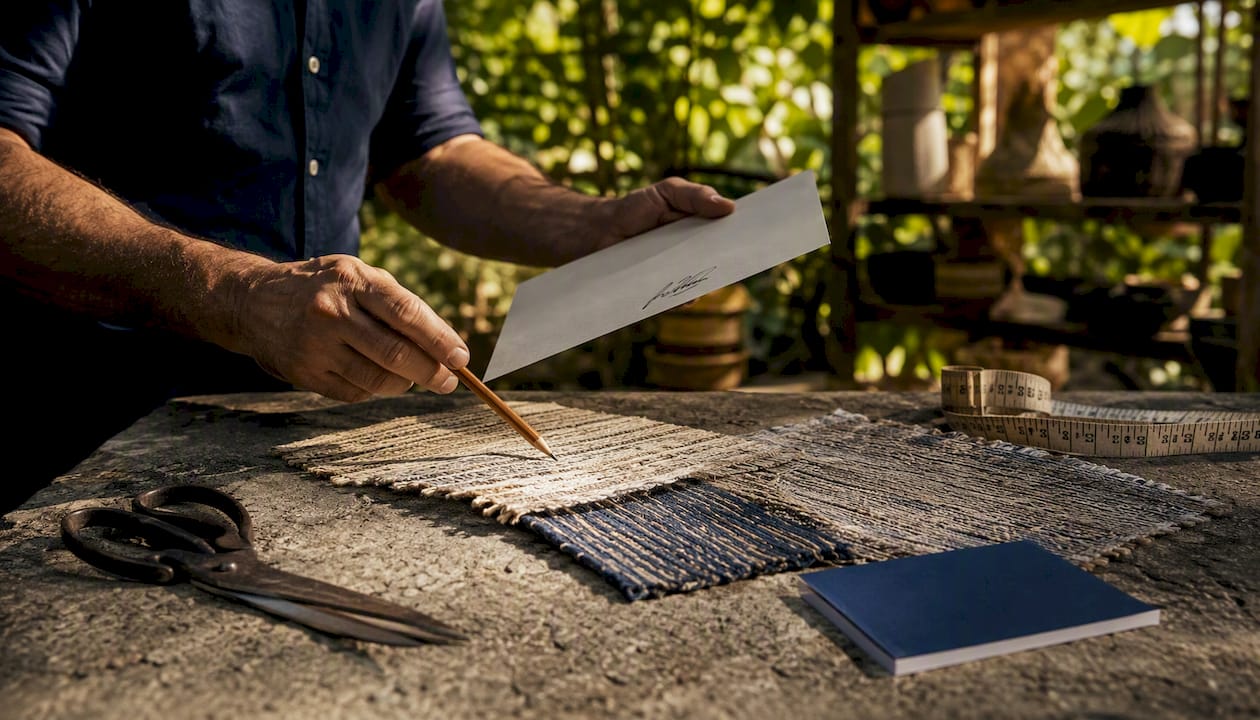
Direct verification starts with the maker. Ask for workshop contact details, process images with visible date stamps, and a signed COA on studio letterhead. Request the original invoice and confirm the maker’s name appears on both documents consistently. For bespoke commissions, a truly handmade piece will show subtle variation across its surface — slight irregularities in pile height, minor color shifts in hand-dyed wool — that factory production cannot replicate.
Third-party verification adds another layer of confidence. An independent appraiser’s condition report, cross-referenced against auction catalogues or maker registries, confirms that the documentation package is internally consistent. For pieces with significant value, scientific testing of fibers or pigments provides the highest level of certainty.
Red flags to watch for:
- Identical “handmade” multiples with no surface variation
- Vague origin statements (“made in Asia,” no workshop name)
- Missing serial data, lot numbers, or maker signatures
- Seller reluctance to provide process photos or maker contact
- Unrealistically fast production timelines for complex techniques
Pro Tip: Deliberate imperfection is a collector’s best friend. Slight asymmetry, weave irregularities, and glaze pooling are proof of a human hand. If every unit looks pixel-perfect, it almost certainly left a factory, not a workshop.
Your pre-purchase checklist: what to ask and request
Before committing to any significant artisan piece, send the seller or maker a short written request. The response — and its speed — tells you nearly everything.
Documents to request:
- Signed COA on maker or studio letterhead
- Production photos with visible date stamps
- Maker biography or workshop attribution
- Original invoice showing price, date, buyer, and seller
- Condition report from an independent specialist
- Any conservation notes or lab testing results
Questions to ask directly:
- Who made this piece, and can I contact them or their studio?
- Where and when was it made, and how long did production take?
- Can you provide process images showing the work in progress?
- Who owned this piece before me, and do you have records of prior sales?
- Is there a signed COA, and does it include material specifications?
Keep original packaging, tissue wrapping, and any branded boxes. Original packaging and purchase documentation contribute materially to an item’s valuation and can affect resale or loan-to-value calculations. A provenance file that includes the original box is meaningfully stronger than one without it. For designers, cohesive provenance-led interiors extend this thinking to every material choice in a room, not just the statement pieces.
How does provenance affect price, insurance, and resale?
Pricing for artisan luxury decor reflects several provenance-linked factors: maker reputation, documented production method, exhibition or sales history, completeness of the documentation package, and rarity of the technique. A hand-knotted wool rug with a full provenance file commands a different conversation than an identical-looking piece with no paperwork.
For insurance, provenance documentation supports a higher declared replacement value. Insurers and lenders rely on condition reports and appraisals that reference the provenance packet; without it, they default to conservative market estimates. Asset-backed lenders use the same logic: a documented piece has a clearer loan-to-value basis.
On the secondary market, documented provenance shortens buyer due diligence. A collector who can verify origin, ownership history, and condition in one organized file is far more likely to pay a strong price quickly. Undocumented objects attract lower offers because the buyer prices in the uncertainty. The artisanal materials market has grown to reflect this: buyers increasingly treat provenance as the asset, not just the object.
A real-world example: the Lotto Hand-Knotted Wool Area Rug
The Lotto Hand-Knotted Wool Area Rug from Kevin Francis Design illustrates what a complete provenance bundle looks like in practice. When a client commissions or purchases this rug, the documentation package includes:
- Signed COA on Kevin Francis Design letterhead, naming the designer and production technique
- Production photos showing the hand-knotting process at the workshop level
- Original invoice with date, buyer details, and material specifications (wool pile, Tibetan knotting method)
- Condition report completed at time of delivery, noting pile depth and color consistency
- Storage and packaging records including original wrapping materials
Each document serves a specific purpose. The COA anchors the insurance appraisal. The production photos make the handmade origin essentially irrefutable. The condition report establishes a baseline for any future claim or resale conversation. Together, they convert a beautiful object into a documented asset.
Pro Tip: Assemble all provenance documents into a single labeled folder — physical and digital — at the moment of purchase. Scan originals immediately and store digital copies in at least two locations. A provenance packet assembled years after purchase is far weaker than one created on day one.
How to preserve provenance over a lifetime
Provenance is only as strong as the records that survive. A few consistent habits protect it across decades and ownership transfers.
- Digitize immediately. Scan all original documents at high resolution the day they arrive. Store copies in cloud backup (Google Drive, Dropbox, or a dedicated archival service) and on a local hard drive.
- Keep original packaging. Boxes, tissue, and branded wrapping are part of the provenance file. Store them flat in a dry, temperature-stable environment.
- Log every repair or conservation. Any cleaning, re-stretching, or restoration should be documented with the conservator’s name, date, and method. Add these notes to the provenance file.
- Commission a condition report at transfer. Whenever a piece changes hands — sale, gift, estate — commission a fresh condition report. This closes one chapter of ownership and opens the next with a clean record.
- Update ownership records. A simple signed letter noting the new owner’s name and the transfer date, attached to the original COA, maintains the chain of custody cleanly.
For handwoven pieces that develop character over time, periodic condition assessments also serve a preservation function, catching early signs of wear before they become irreversible.
Key Takeaways
Provenance value in luxury goods is the verifiable record of origin, maker, and ownership that converts a beautiful object into a documented, insurable, and resalable asset.
| Point | Details |
|---|---|
| Always secure a signed COA | A COA on maker letterhead is the primary document insurers and appraisers require. |
| Production photos are irreplaceable | Visual process evidence makes handmade origin essentially impossible to falsify. |
| Original packaging adds value | Keeping original boxes and wrapping materially strengthens resale and lender valuations. |
| Red flags signal risk | Identical multiples, vague origins, and missing paperwork are reasons to walk away. |
| Kevin Francis Design delivers full documentation | Every bespoke commission includes a provenance packet: COA, production photos, invoice, and condition report. |
Why provenance is the most underestimated design decision
Most conversations about luxury interiors focus on aesthetics: color, scale, material, light. Provenance rarely enters the brief until something goes wrong — an insurance claim, a resale, an estate valuation. That is exactly backwards.
The designers and collectors who treat provenance as a design criterion from the start end up with interiors that hold their value, their story, and their integrity across generations. A room where every significant piece has a documented maker, a clear origin, and a file of evidence is not just beautiful. It is a collection. The distinction matters more than most clients realize until they try to sell, insure, or pass something on.
There is also something quieter at stake. Handmade objects integrated early into a design brief carry the evidence of the human hand in every surface. That evidence — the slight irregularity, the variation in dye, the asymmetry of a knot — is not a flaw. It is the whole point. Provenance documentation simply makes that point legible to everyone who comes after you.
Provenance-backed artisan decor from Kevin Francis Design
Kevin Francis Design was built on the belief that a rug should come with a story you can verify, not just one you are told. Every piece — from a custom commission to a ready-to-ship design like the Lotto Hand-Knotted Wool Area Rug — ships with a complete provenance packet: signed COA, production photography, original invoice, and a condition report. For designers specifying bespoke commissions, the studio supports appraisals and can provide supplementary maker documentation on request.
If you are sourcing a piece that needs to hold its value, carry its story, and survive an insurance conversation with confidence, browse the collection or reach out to discuss a custom commission with full provenance documentation included.
Further reading and authoritative sources
- Luxury Rug Provenance Documentation Guide — Kevin Francis Design: The studio’s own step-by-step guide to assembling a provenance packet for artisan rugs.
- Why Luxury Retail Now Sells Provenance Before Product — Salon Privé: Market analysis of the shift from brand-driven to maker-driven luxury purchasing.
- Artisanal Materials and Finishes in Luxury Homes — Garret Cord Werner: Architect and designer perspective on specifying artisan materials with intentionality.
- How to Tell If Handmade Products Are Authentic — Handicrafts.live: Practical checklist for verifying maker identity and process evidence online.
- How to Spot Fake Handmade Decor — Rescene Studio: Visual authentication guide focused on deliberate imperfection as proof of craft.
- Material Provenance Documentation — CultureMosaic: Technical overview of isotopic and spectrometric testing for high-value textiles.
- The Role of Provenance in Luxury Asset Valuation — Beverly Loan Company: Lender perspective on how documentation affects declared value and loan-to-value.
- Why Craft Is Returning to Our Homes — Kit Kemp Design Studio: Designer essay on emotional and material value of handmade objects in interiors.
- How to Spot Real Handmade Home Decor — Pipihiri: Consumer guide to identifying authentic artisan pieces, with useful questions to ask sellers.
- Luxury Home Accessories Worth Collecting in 2026 — Kevin Francis Design: Trend context for provenance-led collecting in contemporary interiors.
FAQ
What is provenance value in luxury goods?
Provenance value is the premium — financial and emotional — that comes from a verifiable record of an object’s origin, maker, and ownership history. It converts a luxury piece into a documented asset with stronger insurance, resale, and authentication credentials.
Which documents make up a strong provenance file?
A complete provenance file includes a signed COA, original invoice, production photos, condition report, and any conservation or lab testing notes. Original packaging strengthens the file further.
How does provenance affect resale price for artisan decor?
Documented provenance shortens buyer due diligence and typically supports higher realized prices on the secondary market. Undocumented pieces sell at a discount because buyers absorb the uncertainty of unknown origin.
How can I tell if a handmade piece is genuinely handmade?
Look for subtle surface variation: slight asymmetry, minor color shifts, and irregular texture that factory production cannot replicate. Identical multiples with no variation are a reliable sign of machine manufacture.
Does Kevin Francis Design provide provenance documentation with purchases?
Every Kevin Francis Design commission includes a provenance packet covering the signed COA, production photography, original invoice, and condition report, supporting both insurance appraisals and future resale.


