


A correctly sized and positioned rug visually and physically anchors a furniture grouping by tying pieces together, defining a boundary, and regulating scale and acoustics. It is, in many ways, the compositional foundation that a room is built upon rather than an accessory laid down afterward.
Here is what that means in practice:
- Visual unity: A rug connects your sofa, chairs, and coffee table into one composition. Without it, those pieces read as scattered objects sharing a floor.
- Tactile boundary: The shift in texture underfoot tells you, instinctively, where a seating zone begins and ends.
- Acoustic comfort: Pile absorbs sound, reducing the hard echo that makes a room feel unsettled. Pairing a rug with solid interior doors further softens a room’s acoustic character.
- Scale regulation: A rug establishes a contained area within a larger room, making the space feel purposeful rather than cavernous.
Designers commonly recommend leaving 8–12 inches of exposed floor around the rug’s perimeter, and in open-plan homes, 18–24 inches between adjacent rug zones to keep the layout from feeling crowded. Kevin Francis Design’s artisan hand-knotted rugs are sized and crafted with exactly these spatial relationships in mind.
Table of Contents
- Why rugs anchor furniture arrangements: the design mechanics
- Designer configurations: which placement style suits your room?
- How to choose the right rug size for your furniture layout
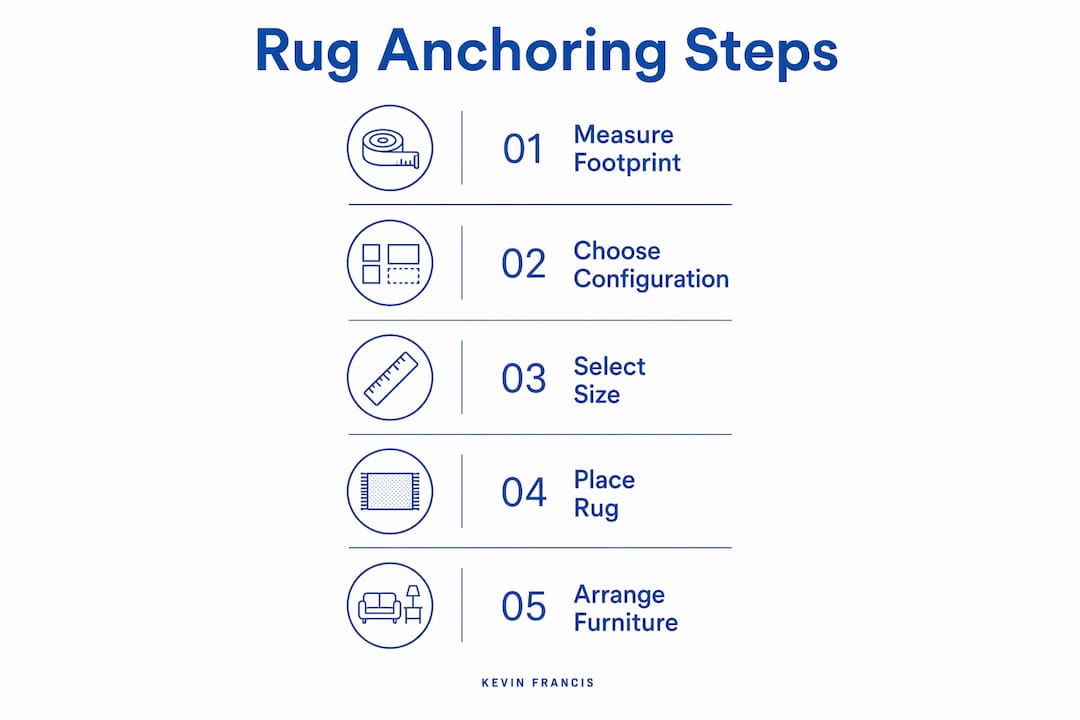
- How to anchor furniture with a rug: a step-by-step process
- Common mistakes that undermine a rug’s anchoring effect
- How rug materials, pile, and pads affect anchoring and safety
- Artisan rugs as anchors: a Kevin Francis Design perspective
- Key Takeaways
- The rug as a room’s quiet foundation
- Handcrafted rugs that anchor with intention
- Useful sources and further reading
- FAQ
Why rugs anchor furniture arrangements: the design mechanics
A rug does something no piece of furniture can do on its own: it creates a shared plane that every piece above it belongs to. Visually, the eye reads the rug as a stage, and the furniture as its cast. Contrasting color or texture signals a distinct zone, which is why a rug works so powerfully in open-plan rooms where walls cannot do that work.
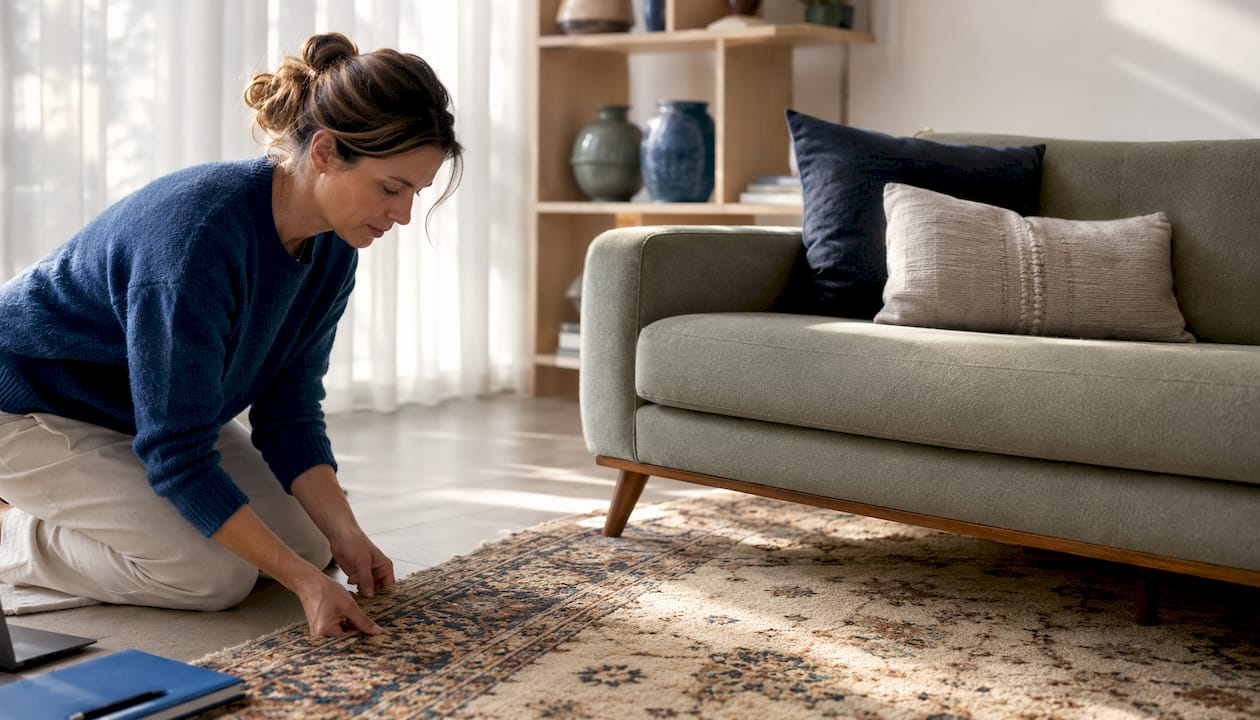
The tactile dimension is equally important. Pile height and fiber density create a physical territory that guides movement through a room. Guests naturally gravitate toward the softer surface, and the seating group feels like a destination rather than a random cluster of furniture.
Acoustically, a wool or high-pile rug absorbs reflected sound in a way that bare floors simply cannot. That reduction in echo contributes to the sense of a settled, composed room. Scale is the final mechanism: a properly proportioned rug makes a large room feel intimate and a small room feel deliberate. The role of area rugs in spatial design is precisely this layered function, working simultaneously on the eye, the foot, and the ear.
Designer configurations: which placement style suits your room?
Three configurations cover nearly every living room scenario, and choosing the right one depends on room size, furniture footprint, and the formality you want to achieve.
Front-legs-on is the most versatile approach for standard rooms. Place the front two legs of your sofa and chairs on the rug while the back legs remain on the bare floor. This front-legs-on arrangement visually connects the seating group without requiring a very large rug, making an 8x10 the workhorse size for most medium living rooms.
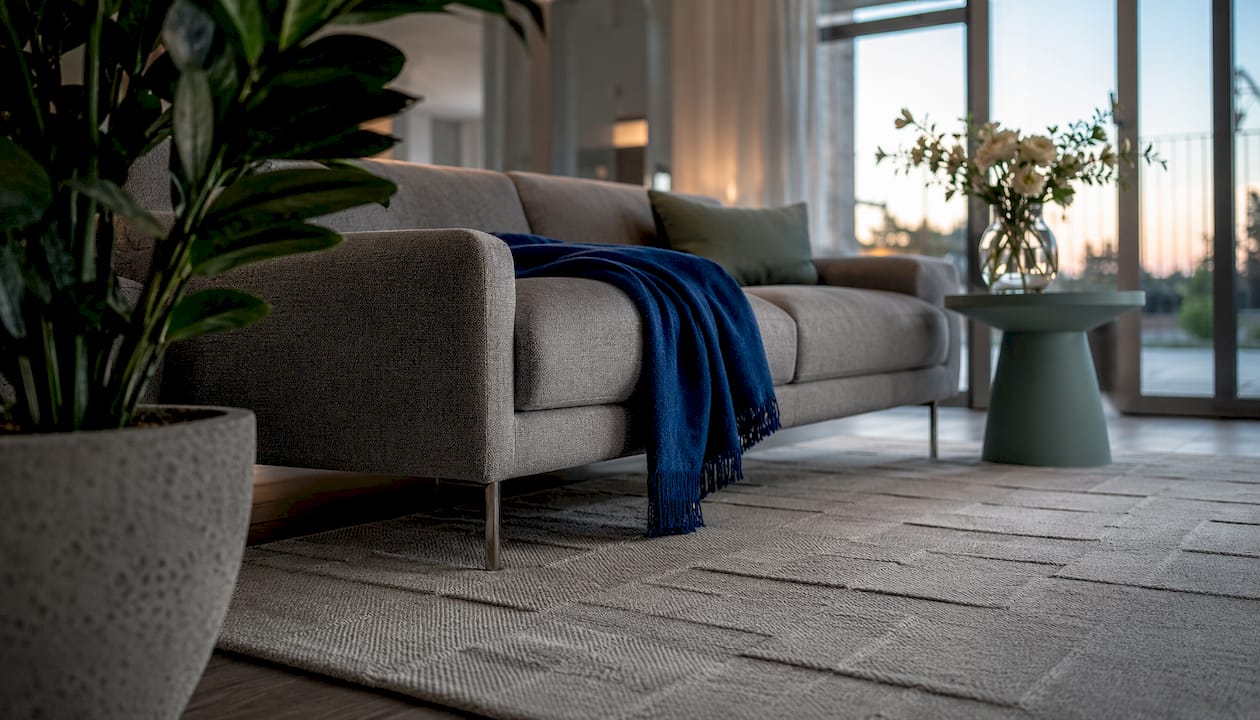
All-legs-on delivers the most cohesive, formal result. Every piece of furniture sits entirely on the rug, which reads as a single unified composition. This configuration typically requires a 9x12 or larger, and it suits open-plan spaces where the rug needs to clearly declare a zone against a continuous floor.
Floating (coffee-table-only) places only the coffee table on the rug, with seating legs entirely off it. Designers generally treat this as a compromise for small apartments or layered rug arrangements rather than a first choice, because the seating group can look disconnected from the rug beneath it.
- A standard 8x10 suits front-legs-on in a medium room with a three-seat sofa and two chairs.
- A 9x12 or 10x14 is needed for all-legs-on in a larger room or open-plan living area.
- For L-shaped sectionals, ensure both arms of the sectional have their front legs on the rug.
- In open-plan layouts, layering a smaller decorative rug atop a larger base rug lets a statement piece add pattern without needing the full footprint.
Pro Tip: Before committing to a size, mark the rug’s footprint on your floor with painter’s tape. Seeing the actual rectangle in the room is far more reliable than measuring on paper alone.
How to choose the right rug size for your furniture layout
Measure the seating group’s footprint first, not the room dimensions. This is the single most important shift in thinking for homeowners who have bought a rug that looked right in the store and wrong at home.
Once you have the footprint, decide on your configuration. For front-legs-on, add roughly 12–24 inches beyond the seating group’s outer edges. For all-legs-on, you need a more generous margin to keep back legs on the rug while still maintaining the 8–12 inch visible floor perimeter that prevents the layout from feeling boxed in.
| Rug Size | Typical Seating Footprint | Best Configuration |
|---|---|---|
| 5x8 | Loveseat + one chair | Front-legs-on, compact rooms |
| — | Small sofa + one chair | Front-legs-on or layered base |
| 8x10 | Standard sofa + two chairs | Front-legs-on, medium rooms |
| 9x12 | Large sofa + two to three chairs | All-legs-on, larger rooms |
| 10x14 | Sectional or large seating group | All-legs-on, open-plan spaces |
For formal, all-legs-on layouts in large rooms, designers commonly choose 9x12 or 10x14 sizes to keep back legs on the rug while still maintaining the recommended visible floor perimeter. Smaller rugs force compromises in placement and visual cohesion.
Pro Tip: When in doubt, size up. A slightly larger rug reads as intentional; an undersized rug looks accidental, no matter how beautiful the pattern.
How to anchor furniture with a rug: a step-by-step process
This sequence works for most living rooms and can be completed in a single afternoon.
- Decide your zone and configuration. Determine whether you want front-legs-on or all-legs-on, and mark the intended rug footprint with tape before anything moves.
- Measure the seating footprint and select your size. Use the sizing table above. Add 12–24 inches per side for front-legs-on; more for all-legs-on.
- Lay the rug and position larger pieces first. Place the sofa, then the chairs, then the coffee table. Smaller accent tables follow last.
- Check walkways and wall clearance. Aim for roughly 3 feet of clear walking path where traffic flows through the room. The rug must not touch skirting boards or walls; that 8–12 inch exposed floor strip is non-negotiable for a composed result.
- Fine-tune and secure. Shift furniture a few inches to center the rug’s pattern under the seating group. Lay a rug pad beneath for safety, floor protection, and to keep the rug from creeping under furniture weight.
In open-plan homes, maintain 18–24 inches of bare floor between adjacent rug zones. That strip of exposed flooring is a deliberate design device, not wasted space. It creates visual breathing room and reinforces the boundary between a living zone and a dining zone, for example.
Common mistakes that undermine a rug’s anchoring effect
Even a beautiful rug fails to anchor a room when placement goes wrong. These are the errors that appear most often, and each has a straightforward fix.
- Buying too small. Undersized rugs make furniture read as disconnected islands. Buyers typically size by eye against room dimensions rather than the furniture footprint, which is why this mistake is so common.
- Letting the rug touch walls or baseboards. A rug that runs edge-to-edge reads as wall-to-wall carpet, not an intentional design element. The room feels boxed in and the rug loses its anchoring power.
- Ignoring traffic patterns. Measure door swings and walking paths before finalizing placement. A rug that creates a tripping hazard at a threshold, or bunches under a door, will be moved within a week.
- Clashing scale and pattern. A large, bold geometric rug under a delicate, small-scale furniture arrangement creates visual noise rather than cohesion. The rug’s pattern weight should feel proportionate to the furniture around it.
- Over-layering without a unifying thread. Layering rugs is a powerful technique, but two rugs with competing colors and unrelated textures read as clutter. A consistent tonal palette or fiber family keeps the layered look intentional.
How rug materials, pile, and pads affect anchoring and safety
The material and construction of a rug influence how well it performs as an anchor, not just how it looks. A high-pile wool rug creates a plush, clearly defined territory underfoot; furniture legs sink slightly into the pile, which gives the grouping a settled, grounded quality. Low-pile or flat-weave rugs keep furniture legs level and are easier to push chairs across, making them better suited to dining areas or rooms with frequent rearrangement.
Rug pad selection matters more than most homeowners realize. Low-pile rugs perform well with a thinner felt-backed pad that adds grip without raising the rug’s height. Thicker or high-pile rugs need a firmer non-slip pad layered under a cushioned pad to prevent furniture from sinking unevenly and to maintain a level surface. A pad also protects hardwood and stone floors from dye transfer and abrasion.
- Wool rugs: hardwearing, naturally resilient, and easy to clean; vacuum regularly with a brushless suction head and rotate every 12–18 months to even wear.
- Synthetic rugs: lighter and more moisture-resistant; vacuum freely but check manufacturer guidance before steam cleaning.
- Professional cleaning: wool rugs benefit from professional cleaning every 12–18 months in high-traffic rooms; synthetics can go longer between deep cleans.
- Safety at thresholds: use a low-profile pad and confirm the rug’s edge does not create a raised lip that catches feet at doorways or between rooms.
Hand-knotted wool rugs, like those in the Kevin Francis Design collection, tend to lie flat naturally and hold their shape under furniture weight for years, which reduces the maintenance burden considerably.
Artisan rugs as anchors: a Kevin Francis Design perspective
Handcrafted rugs do something a machine-made rug rarely achieves: they carry visual weight that feels earned. The density of a hand-knotted pile, the slight irregularities in a hand-woven border, the way natural wool takes dye with a depth that shifts subtly in different light — these qualities make the rug feel like a permanent element of the room rather than a surface covering.
At Kevin Francis Design, the artisan hand-knotted rugs are designed with spatial anchoring as a primary consideration. Scale, pattern weight, and pile density are calibrated so that the rug reads as a compositional foundation, not a decorative afterthought. A painterly, impressionistic pattern in a large format draws the eye inward and holds the seating group together; a tighter geometric in a medium scale suits a more formal, all-legs-on arrangement.
Pro Tip: When selecting a patterned artisan rug, consider how the pattern’s center point aligns with your coffee table. Centering a medallion or focal motif under the coffee table anchors the entire composition with quiet precision.
Key Takeaways
A correctly sized and placed rug ties furniture into one visual unit, creates a tactile and acoustic boundary, and regulates scale — making it the single most impactful element in any furniture arrangement.
| Point | Details |
|---|---|
| Measure the furniture footprint | Size your rug to the seating group, not the room; an 8x10 suits most front-legs-on arrangements. |
| Leave visible floor | Keep 8–12 inches of exposed floor around the rug’s perimeter to avoid a boxed-in look. |
| Separate adjacent zones | In open-plan rooms, maintain 18–24 inches of bare floor between rug zones for visual breathing room. |
| Size up when uncertain | A slightly larger rug reads as intentional; undersized rugs make furniture look disconnected. |
| Kevin Francis Design | Hand-knotted artisan rugs sized and patterned to function as compositional anchors in living areas. |
The rug as a room’s quiet foundation
There is a moment in every well-composed room when you realize the rug was the decision that made everything else work. The sofa looks right, the chairs feel placed rather than parked, and the whole grouping has a settled quality that no amount of cushion-arranging could have produced on its own. That is the anchoring effect in its purest form.
We believe a rug should be chosen first, not last. It sets the tonal register, the scale, and the emotional warmth of a space before a single piece of furniture is moved. If you are working through a placement challenge or considering a custom size for an unusual room, we would love to help you find the right piece.
Handcrafted rugs that anchor with intention
If the sizing and placement guidance above has clarified what you need, the next step is finding a rug that can carry that compositional weight beautifully.
Kevin Francis Design’s hand-knotted wool rugs are made to function as genuine anchors in living areas, with pile density, scale, and pattern weight chosen to hold a furniture grouping together over years of daily life. Three pieces worth considering for a living room arrangement:
- The Lotto Hand-Knotted Wool Area Rug offers a bold geometric presence that suits front-legs-on arrangements in medium to large rooms.
- The Selendi Hand-Knotted Wool Area Rug is a natural choice for formal, all-legs-on layouts where the rug needs to carry the full visual weight of a seating group.
- The Cairene Hand-Knotted Wool Area Rug brings a texture-forward quality that works beautifully in layered arrangements, adding warmth and depth without competing with surrounding pieces.
All three are available in custom sizes. If your room calls for something beyond a standard dimension, contact Kevin Francis Design to discuss a bespoke commission.
Useful sources and further reading
External sources consulted:
- The 5 rug placement rules designers wish everyone knew — House Beautiful
- Should All of Your Furniture Legs Be on the Rug? — The Spruce
- How to Choose the Right Rug Size for a Living Room — RugIndustry
- Rug Placement: A Designer’s Guide — RugEditorial
- How to Use Area Rugs to Define Zones in an Open Floor Plan — Custom Carpet Centers
- Rug Placement Guide — KingLiving
- Why Area Rugs Are the Easiest Way to Redefine a Space — Rug Source
Kevin Francis Design further reading:
- Area rug placement rules for your living room
- How to choose the right size area rug
- How to choose area rugs for a great room
- Statement rug styles for luxury interiors
FAQ
What is the rug rule for furniture?
The most widely used rule is to place at least the front two legs of your sofa and chairs on the rug (front-legs-on), leaving 8–12 inches of visible floor around the rug’s perimeter. For a more formal look, all legs on the rug requires a larger rug, typically 9x12 or bigger.
What is the biggest mistake in furniture placement with a rug?
Choosing a rug that is too small is the most common error. Undersized rugs make furniture read as disconnected rather than a unified group; always measure the seating footprint first and size up when uncertain.
How do you anchor furniture with a rug?
Lay the rug first, position the sofa so its front legs sit on the rug, then arrange chairs and the coffee table within the rug’s boundary. Check that the rug does not touch walls and that walkways remain clear, then secure everything with a non-slip pad underneath.
What is the 2/3 rule for furniture and rugs?
The 2/3 rule suggests the rug should cover roughly two-thirds of the seating area’s floor space, ensuring the main furniture pieces feel connected to it. It works as a quick visual check: if the rug covers less than two-thirds of the grouping’s footprint, it is likely too small to anchor the arrangement effectively.


