


The single most common mistake in living room design is a rug that’s too small. Get the placement right, and a rug does something almost magical: it draws every piece of furniture into a quiet conversation, anchoring the room with warmth and intention. Get it wrong, and even the most beautiful piece looks like it wandered in from another space entirely.
The essential area rug placement rules for living rooms
These are the guidelines that professional designers return to again and again, regardless of style or budget.
- Leave 12–18 inches of bare floor between the rug’s edge and the walls. Professional guidelines confirm this range creates balanced proportion; less feels cramped, more makes the rug look undersized.
- Never float a rug in the center with no furniture touching it, unless the rug is large enough to visually hold the entire seating zone.
- Choose furniture leg placement intentionally: all legs on, front legs only, or all legs off. Each works; what doesn’t work is inconsistency within the same grouping.
- Center the rug on the furniture, not on the room. In asymmetrical layouts, the sofa is the anchor, and the rug follows it.
- Avoid rugs smaller than the coffee table footprint. A rug that only fits under the coffee table disconnects the seating entirely.
- Size up when in doubt. A larger rug makes a room feel more considered and spacious, not smaller.
A well-placed rug doesn’t just cover floor space. It defines where the room lives.
How to choose the right rug size for your living room
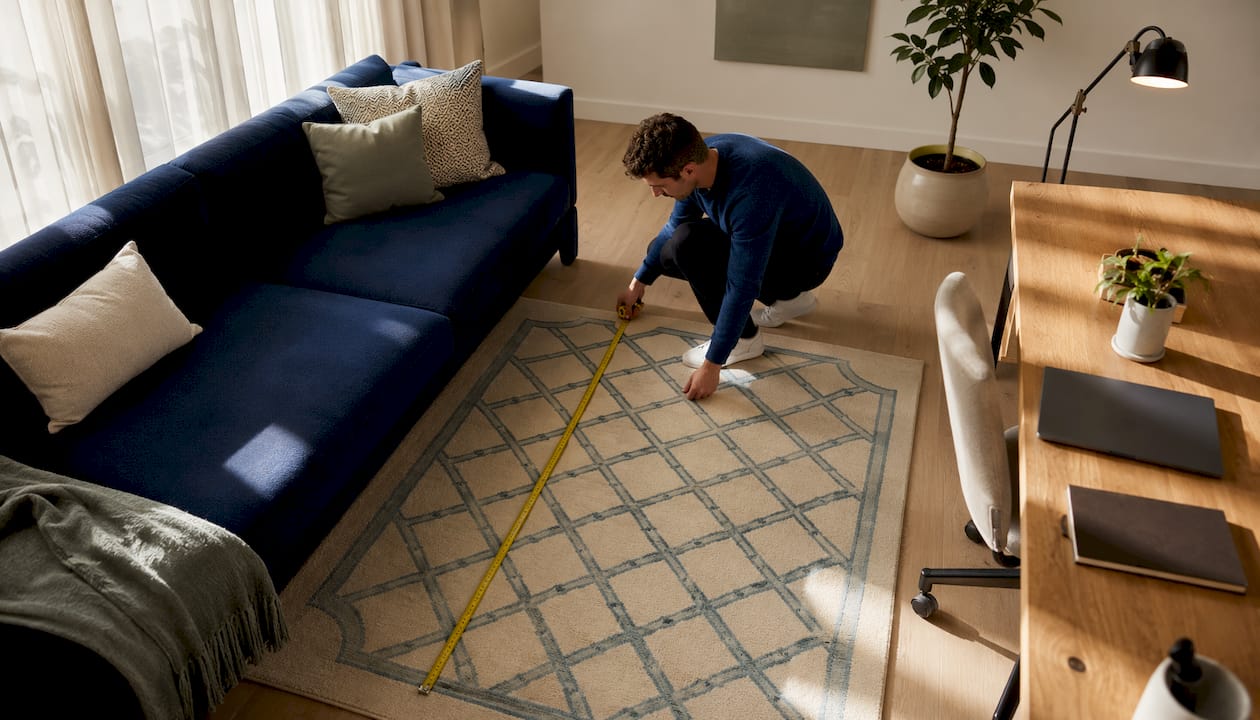
Measuring your seating area rather than the full room is the single most useful shift in thinking you can make. The rug’s job is to anchor the conversation zone, not fill the floor.
Common living room rug sizes in the U.S. are 8x10 feet for average rooms and 9x12 feet for larger or open-concept spaces. A 5x8 works in compact apartments, though a 6x9 or 8x10 almost always looks more intentional even in tight quarters.
- 8x10 ft: The most versatile choice for standard living rooms; fits front legs of sofa and chairs comfortably.
- 9x12 ft: Ideal for larger rooms or sectionals; allows all furniture legs on the rug for a fully grounded look.
- 5x8 ft: Works in small apartments when the goal is to define a tight seating area around a coffee table.
Experts advise the rug should extend at least 6–8 inches wider than the sofa on each side, ideally running the full length of the sofa. That extension is what gives the sofa a sense of belonging on the rug rather than perching on its edge.
Pro Tip: Before purchasing, use painter’s tape to outline your intended rug dimensions directly on the floor. This industry-standard technique reveals how a size will interact with traffic flow and furniture before you commit. Take photos of each taped size for easy comparison.
Living room rug layout and positioning tips
Once you have the right size, placement style shapes the entire mood of the room. The three primary layouts each serve a different purpose.
- All legs on the rug: Best for open-concept spaces where the rug must define the living zone without walls to help. Requires a larger rug, typically 9x12 or bigger.
- Front legs only: The most forgiving and popular arrangement. It anchors the furniture grouping without demanding an oversized rug, and works beautifully in medium-sized rooms.
- Floating rug (no legs on): Reserve this for very small rooms or layered setups where a smaller decorative rug sits atop a larger base. Used sparingly, it can feel curated rather than accidental.
Orientation matters too. Align the rug’s longer dimension with the room’s longer axis. In a narrow room, a horizontally oriented rug can actually make the space feel more compressed. Clearance between the rug edge and major furniture pieces should allow 12–18 inches of breathing room on all sides, preserving traffic flow and visual calm.
Styling area rugs with living room furniture and décor
A rug’s material and pile height shape daily life as much as its pattern does. Low to medium pile suits most living rooms with chairs and regular foot traffic: easier to vacuum, stable under chair legs, and forgiving in high-use areas. High pile is luxurious underfoot but can cause chair wobble and holds debris more stubbornly.
- Wool and natural fibers offer durability and a refined texture that ages gracefully.
- Low-pile flatweaves work especially well near doorways and in homes with pets or children.
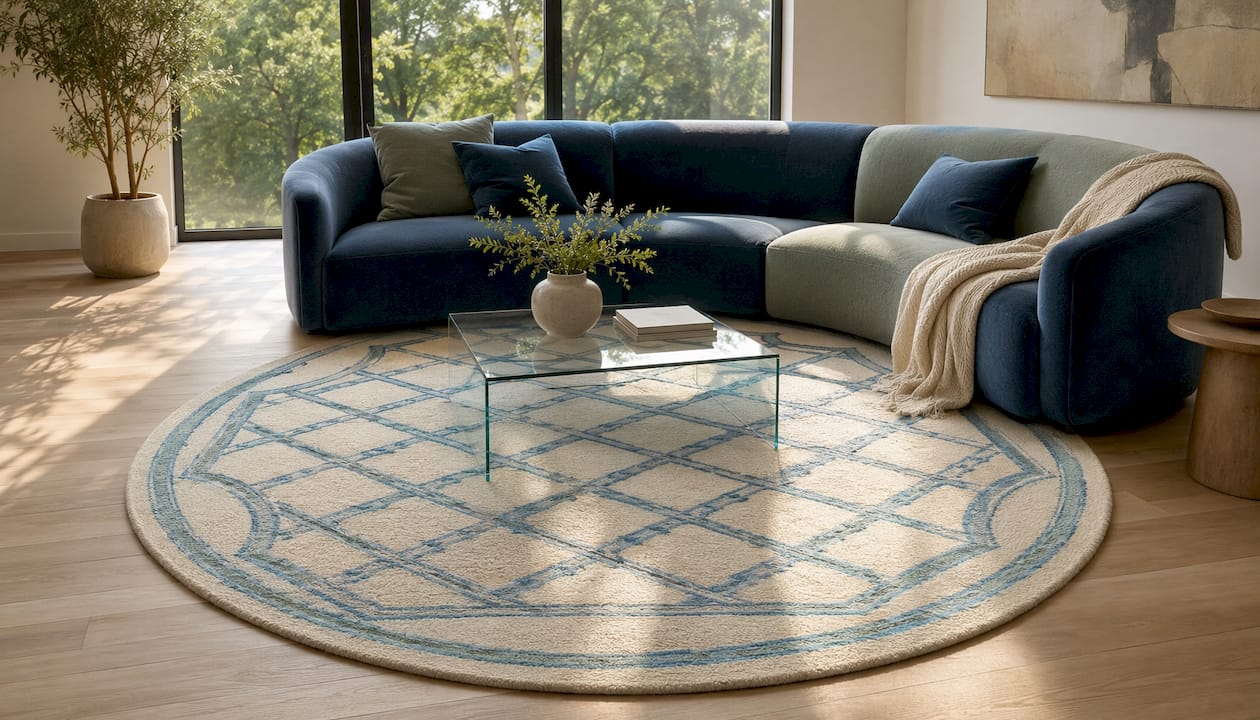
- Round rugs complement circular coffee tables and softer furniture arrangements, lending an organic quality to the room’s geometry.
- Rectangular rugs suit most standard sofa-and-chairs layouts and L-shaped sectionals, echoing the angular lines of the furniture.
Color and pattern should tie the room together, not compete with it. A painterly, patterned rug can carry the room’s palette when upholstery is neutral; a quieter rug lets bolder furniture breathe.
Pro Tip: Consistent leg placement across all furniture pieces in a grouping is what separates an intentional arrangement from an accidental one. If the sofa’s front legs are on the rug, the chairs’ front legs should be too. Mixed approaches within the same seating zone create visual noise.
For rooms where layering adds depth, placing a smaller decorative rug over a larger neutral base, such as sisal or jute, solves both size and style challenges at once. It’s a technique that interior designer Emily Henderson has long championed, and it works beautifully when a beloved rug is simply too small to anchor the space alone. For more on this approach, Kevin Francis Design’s guide to layering rugs offers detailed inspiration.
Expert insights on luxury rug placement from Kevin Francis Design
A rug is the foundation of a room’s story. Before the furniture, before the art, before the light, the rug sets the emotional register of the space. Proportion and intentionality are everything. A rug placed with care transforms a collection of beautiful objects into a room that feels genuinely alive.
At Kevin Francis Design, we approach rug placement as a design act, not a practical afterthought. The rug should be the first decision in a living room, not the last. It frames the focal point, whether that’s a fireplace, a view, or a beautifully crafted coffee table, and draws every surrounding element into alignment.
- Proportion over formula: The 12–18 inch border rule is a starting point, not a ceiling. In a grand room, more bare floor can feel stately; in an intimate one, less can feel enveloping.
- Craftsmanship informs placement: A hand-tufted or hand-knotted rug with a directional pattern has a natural orientation. Place it so the pattern reads correctly from the room’s primary vantage point.
- Luxury materials reward scale: A finely crafted rug deserves to be seen. Sizing up allows the full pattern and texture to register rather than disappearing beneath furniture.
Pro Tip: When working with a statement rug, let it set the room’s color story first. Pull one or two tones from the rug into cushions, throws, or a single upholstered chair rather than matching everything precisely. The result feels collected rather than coordinated.
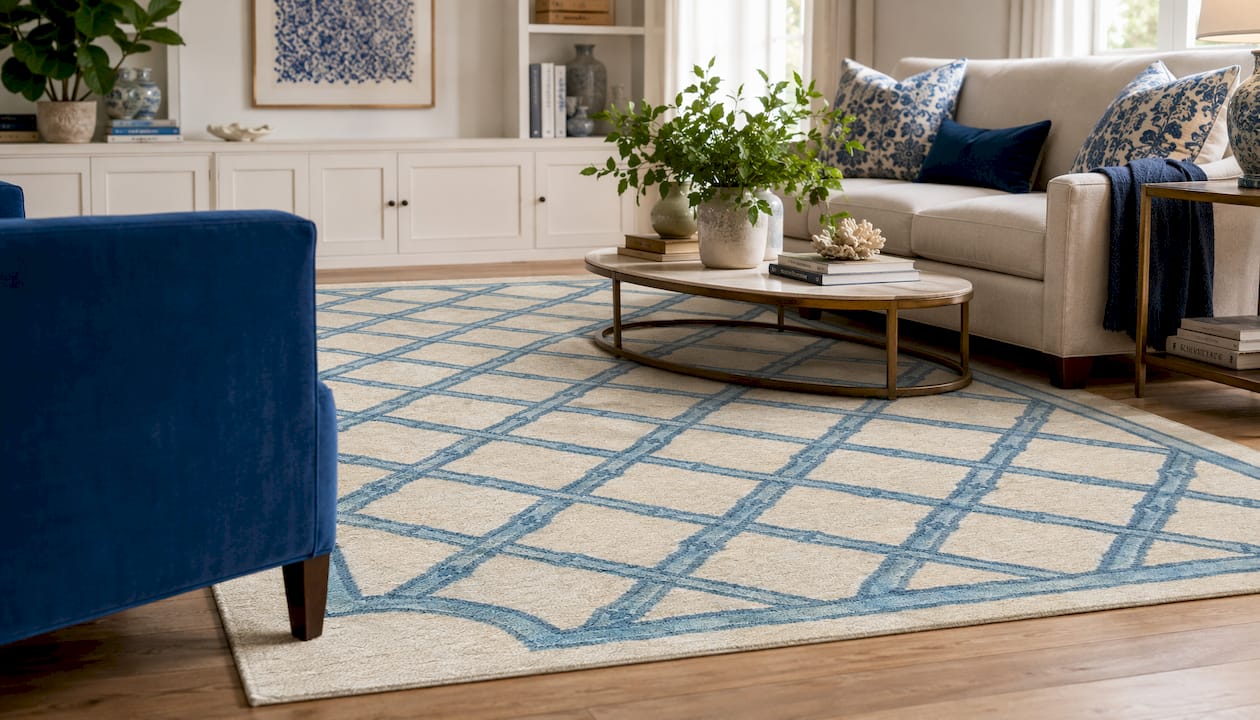
The Brighton Bamboo Trellis Hand-Tufted Area Rug from Kevin Francis Design exemplifies this philosophy: a geometric pattern with enough visual depth to anchor a living room, crafted with the kind of tactile richness that rewards a generous placement. For a broader view of how luxury living room rugs can transform a space, our curated collection offers a range of scales and styles suited to every layout.
Key Takeaways
The most effective area rug placement in a living room anchors furniture with the right size, consistent leg placement, and 12–18 inches of bare floor at the walls.
| Point | Details |
|---|---|
| Size to the seating zone | Measure your furniture grouping, not the room; 8x10 ft suits most average living rooms. |
| Maintain border clearance | Leave 12–18 inches of bare floor between the rug edge and the walls for visual balance. |
| Extend beyond the sofa | The rug should reach at least 6–8 inches wider than the sofa on each side. |
| Keep leg placement consistent | All front legs on or all front legs off; mixing within one grouping creates visual dissonance. |
| Use painter’s tape first | Outline rug dimensions on the floor before purchasing to visualize proportion and traffic flow. |
FAQ
What is the 2/3 rule for living rooms?
A common suggestion is that your rug should cover a substantial portion of the visible floor area within the seating zone, ensuring the rug is large enough to anchor the furniture without overwhelming the room.
Should a rug be lighter or darker than the couch?
Neither is a rule. A lighter rug opens up a dark sofa visually, while a deeper rug grounds a lighter piece. The key is contrast or harmony with intention, pulling at least one tone from the rug into the room’s broader palette.
Which way should a rug go in a living room?
Orient the rug’s longer dimension along the room’s longer axis. Aligning the rug with the room’s shape rather than only the sofa prevents the space from feeling visually cut off or compressed.
How do you place a 9x12 rug in a living room?
Center the rug on the furniture grouping, not the room’s geometric center. A 9x12 rug is large enough to accommodate all furniture legs on the rug in most medium to large rooms, with 12–18 inches of bare floor remaining at the walls.


