


Handwoven textiles measurably support wellness hotel concepts by delivering tactile comfort, acoustic absorption, thermal modulation, and the layered biophilic quality that guests associate with genuine restoration. A 428-guest empirical study found that high-quality biophilic design elements significantly improved guest well-being and perceived value, strengthening revisit intentions and willingness to pay a premium. Industry leaders like Bluegr Hotels demonstrate this in practice, weaving locally sourced handwoven textiles into sensory-rich interiors that deepen a guest’s connection to place.
For developers and designers ready to act:
- Place a hand-knotted wool rug in the arrival lobby to absorb sound and signal craft quality within the first ten seconds of guest contact.
- Layer a handwoven throw across lounge seating in spa waiting areas to invite tactile engagement and lower perceived arousal.
- Use flatweave or low-pile handwoven pieces in corridors where foot traffic is high and maintenance simplicity matters.
- Specify natural fibers (wool, hemp, or jute) with OEKO-TEX or GOTS certification to satisfy both sustainability goals and guest-facing provenance stories.
Key Takeaways
Handwoven textiles support wellness hotel concepts most powerfully when they are specified for sensory function, sourced with verified provenance, and maintained with the same care given to any premium guest-facing asset.
| Point | Details |
|---|---|
| Specify for sensory function | Choose hand-knotted wool for flagship suites; match pile height and weave to acoustic and tactile goals. |
| Certify your supply chain | Require GOTS, RWS, or OEKO-TEX documentation from every artisan supplier before placing a full order. |
| Measure before and after | Collect guest satisfaction scores, NPS, and acoustic readings to build a quantified ROI case. |
| Pilot before scaling | Test one suite cluster or lounge with handwoven textiles and a short guest survey before a full-property rollout. |
| Kevin Francis Design | Offers bespoke hand-knotted and hand-tufted wool rugs with custom sizing, sample approval, and maintenance documentation for wellness hotel projects. |
Table of Contents
- How handwoven textiles support wellness hotel concepts through the senses
- Where and how to use handwoven textiles across hotel spaces
- How to source sustainable artisan textiles with confidence
- What the research says about guest well-being and ROI
- Specification checklist and maintenance for U.S. hotels
- A Kevin Francis Design project example
- A designer’s perspective on bespoke versus off-the-shelf
- What Kevin Francis Design brings to your wellness hotel project
- Sources
- FAQ
How handwoven textiles support wellness hotel concepts through the senses
Texture is not decoration. When a guest’s bare foot meets a dense, hand-knotted wool pile, the nervous system registers warmth, softness, and safety before the conscious mind has formed a single thought. That physiological response, a measurable reduction in arousal, is the foundation of how handwoven textiles function as active wellness tools rather than passive finishes.
Each sensory channel carries its own benefit:
- Tactile comfort: Natural fibers like wool and hemp have an inherent warmth and give that synthetic alternatives cannot replicate. Pile density and weave tightness determine how much cushioning and thermal insulation a rug provides underfoot, which matters especially in spa and treatment spaces where guests are barefoot.
- Thermal modulation: Wool’s natural crimp traps air, moderating underfoot temperature across seasons without mechanical intervention, a quiet comfort that guests notice without being able to name.
- Visual and biophilic layering: Organic patterns, earthy palettes, and the subtle irregularity of handwoven construction all strengthen what Four Seasons designers describe as the dissolution of the barrier between built space and the natural environment. Textiles become the sensory membrane between architecture and landscape.
Pro Tip: Place rugs asymmetrically or at a slight angle to the room’s axis rather than centered and parallel to walls. The slight visual tension invites exploration, reduces the institutional feel of perfect symmetry, and makes the space read as curated rather than furnished.
Where and how to use handwoven textiles across hotel spaces
Human scale and circulation should govern every placement decision. A rug that reads beautifully in a rendering can feel undersized or obstructive once guests move through the space, so always prototype with paper templates before committing to a final size.
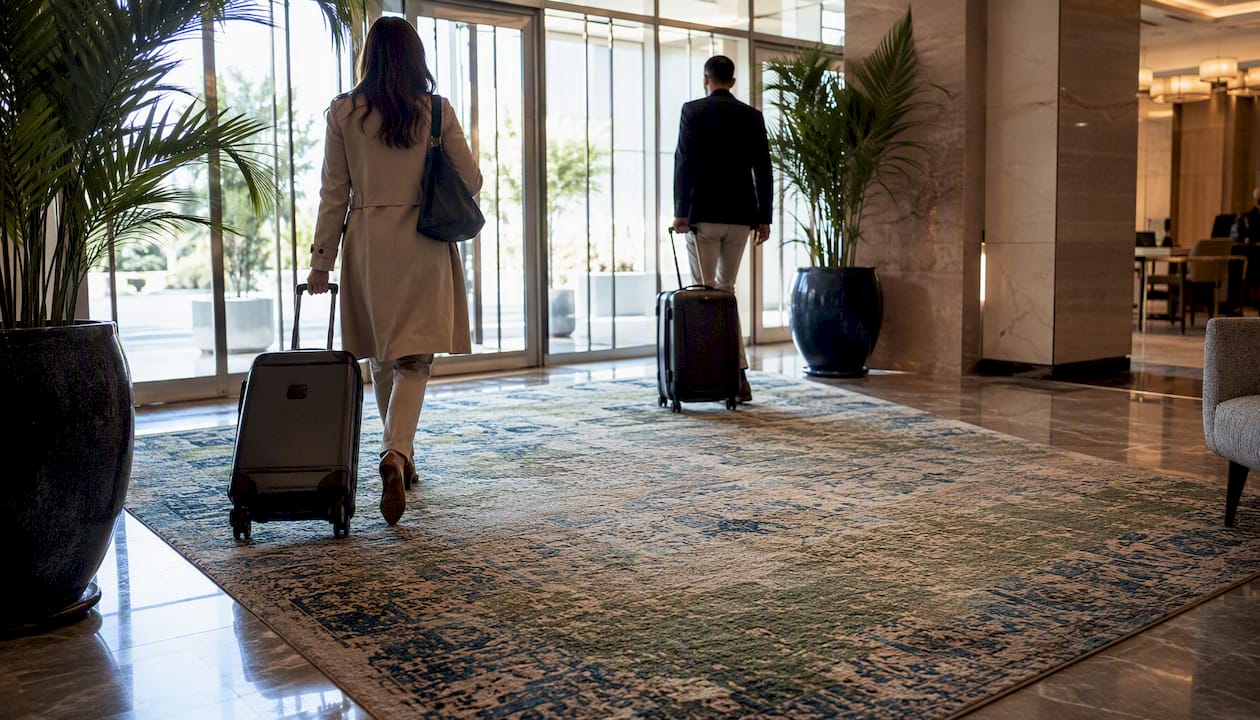
Arrival lobby: A large-format hand-knotted rug anchors the check-in zone, absorbs the acoustic chaos of rolling luggage and hard floors, and delivers the brand’s first tactile signal. Prioritize durability and stain resistance here; a flatweave or low-pile hand-knotted construction handles foot traffic without sacrificing character.
Spa and treatment rooms: These spaces reward the most sensory investment. Layer a medium-pile wool rug over a stone or hardwood floor, add a handwoven throw across the treatment table’s foot end, and consider a small wallhanging to soften a hard wall behind the therapist’s station. The layering order, floor rug first, then lounge throw, then wallhanging, creates a tactile hierarchy that reads as intentional and warm.
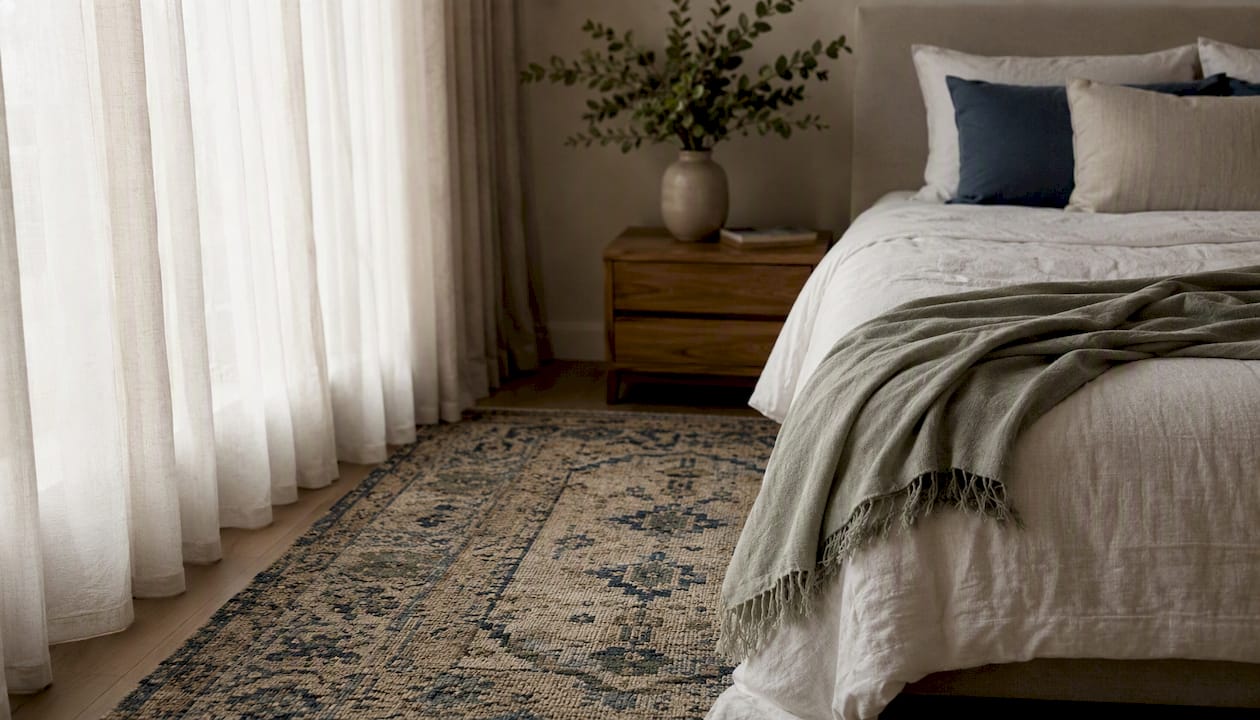
Guest rooms: A rug placed beside the bed so that the first barefoot contact of the morning is warm wool rather than cold tile sets the tone for the entire day. Subtle, nature-inspired patterns in muted sage, warm ochre, or soft indigo read as calming rather than busy.
Corridors: Low-pile or flatweave runners reduce noise transmission between rooms and soften the institutional length of a hotel corridor. Keep patterns simple here; the corridor is a transitional space, not a destination.
Outdoor transition zones: For covered terraces, pool surrounds, or garden pavilions, blending natural and modern materials with weather-appropriate handwoven pieces extends the biophilic sequence from interior to exterior.
A practical layering sequence for any wellness space:
- Anchor the floor with a hand-knotted or hand-tufted area rug sized to the seating group.
- Add a handwoven throw to the primary lounge or seating piece.
- Introduce a wallhanging or textile panel to soften the hardest architectural surface.
- Vary pile height and weave texture across the three layers to create tactile depth.
How to source sustainable artisan textiles with confidence
Credible provenance and sustainably sourced fibers strengthen both authenticity and the guest’s perception of value. When a hotel can tell a guest that the rug beneath their feet was hand-knotted by a cooperative of weavers using RWS-certified wool, that story becomes part of the wellness experience itself.
Primary fiber choices:
- Wool: Durable, naturally flame-resistant, and acoustically effective; the benchmark fiber for wellness hotel rugs.
- Hemp and jute: Lower pile options with excellent durability and a natural, earthy character suited to spa and yoga spaces.
- Cotton: Softer hand, lower durability; best reserved for throws and wallhangings rather than high-traffic floor pieces.
Certifications that matter:
- GOTS (Global Organic Textile Standard): verifies organic fiber content and responsible processing.
- RWS (Responsible Wool Standard): ensures wool is sourced from farms with animal welfare and land management practices.
- OEKO-TEX Standard 100: confirms the finished textile is free from harmful chemicals, critical for spa and treatment environments.
Artisan sourcing through direct cooperative partnerships typically requires minimum order quantities and lead times of 12–20 weeks for bespoke commissions. Build in a small-batch pilot order and a contractual inspection clause before committing to full-property volumes. Quality control samples and a documented repair allowance in the contract protect both the project timeline and the guest experience.
What the research says about guest well-being and ROI
High-quality biophilic design is not an aesthetic preference; it is a measurable commercial lever. The MDPI study of 428 hotel guests used PLS-SEM analysis and found that biophilic design quality significantly improved well-being and perceived value, with guest delight acting as a positive moderator of patronage intentions. Separately, academic research in luxury hotel settings linked biophilic interiors to higher experiential values across aesthetics, escapism, and perceived economic value.
Practical metrics to track before and after textile installation:
- Guest satisfaction scores (post-stay survey, specific room-comfort question)
- Net Promoter Score segmented by room type
- Perceived restorativeness scale (a validated short-form instrument)
- Average length of stay and premium room-rate uptake
- Acoustic readings (reverberation time in seconds) in lobbies and corridors
Pro Tip: Pilot a single suite cluster or public lounge with handwoven textiles, collect a focused six-question guest survey and a before/after acoustic reading, and use those results to build the business case for a full-property rollout. The data is usually compelling within one quarter.
Specification checklist and maintenance for U.S. hotels
Correct specification and consistent maintenance extend both the performance and the restorative quality of handwoven textiles while lowering total cost of ownership. Bespoke rug specification for hotel public spaces requires attention to fiber, construction, backing, and fire compliance before a single order is placed.
Specification checklist:
- Fiber: Wool preferred for durability and acoustics; natural blends for secondary spaces.
- Construction: Hand-knotted for flagship suites and high-visibility lobbies; hand-tufted for lounges and corridors where budget or lead time is constrained.
- Pile height: 0.5–1.0 inches for most hotel applications; lower for high-traffic corridors.
- Backing: Cotton or linen canvas backing with a non-slip pad; avoid latex-backed pieces in spa environments where moisture is present.
- Edge finish: Serged or hand-bound edges resist fraying under rolling luggage and housekeeping equipment.
- Fire and safety: All textiles in U.S. hotel public spaces must meet applicable local fire codes; confirm compliance with your authority having jurisdiction (AHJ) before installation.
| Maintenance task | Frequency | Notes |
|---|---|---|
| Vacuuming (low suction, no beater bar) | Weekly | Preserves pile and removes abrasive grit |
| Professional deep cleaning | Annually | Wool-safe, pH-neutral solutions only |
| Spot treatment | As needed | Blot immediately; never rub; use wool-safe cleaner |
| Rotation | Every 6–12 months | Equalizes wear and sun exposure |
| Structural repair | As damage appears | Budget 3–5% of purchase cost annually |
| Expected service life | 15–25 years (hand-knotted) | Shorter for hand-tufted; patina adds value over time |
A Kevin Francis Design project example
A well-specified handwoven textile program can transform a wellness hotel brief from a collection of pleasant rooms into a coherent sensory narrative. In a representative project scope, Kevin Francis Design addresses arrival, relaxation, and treatment spaces with a curated selection of hand-knotted and hand-tufted pieces chosen for their acoustic, tactile, and visual contribution to guest restoration.
Selected products and their roles:
- Lotto Hand-Knotted Wool Area Rug: Specified for signature suites and the arrival lobby; its dense hand-knotted construction delivers acoustic absorption and a tactile richness that reads immediately as quality.
- Knossos Hand-Tufted Maze Rug: Suited to lounge and meditation spaces where a considered geometric pattern invites quiet contemplation without visual noise.
- CHROMA Solid Color Wool Rug: The restrained palette makes it ideal for yoga studios and treatment rooms where pattern would compete with the restorative intent of the space.
- Cairene Hand-Knotted Wool Area Rug: A premium hand-knotted option for intimate public settings where artisanal detail and long-term durability are both priorities.
Commissioning process:
- Scope review and space measurement (week 1–2)
- Sample approval and colorway confirmation (week 3–5)
- Production (week 6–18 for bespoke hand-knotted; shorter for hand-tufted)
- Delivery, installation, and handover with maintenance documentation
Budget bands range from mid-tier for hand-tufted pieces in secondary spaces to premium for bespoke hand-knotted commissions in flagship suites.
The most enduring wellness hotel interiors we encounter share one quality: every textile feels chosen rather than specified. That distinction, between a rug that was sourced for a project and one that was made for it, is what guests carry home in their memory of a place.
A designer’s perspective on bespoke versus off-the-shelf
Bespoke handwoven textiles are worth the investment when a project requires authenticity, tactile depth, and long-term brand differentiation. That is a clear decision rule, but it is not a universal one.
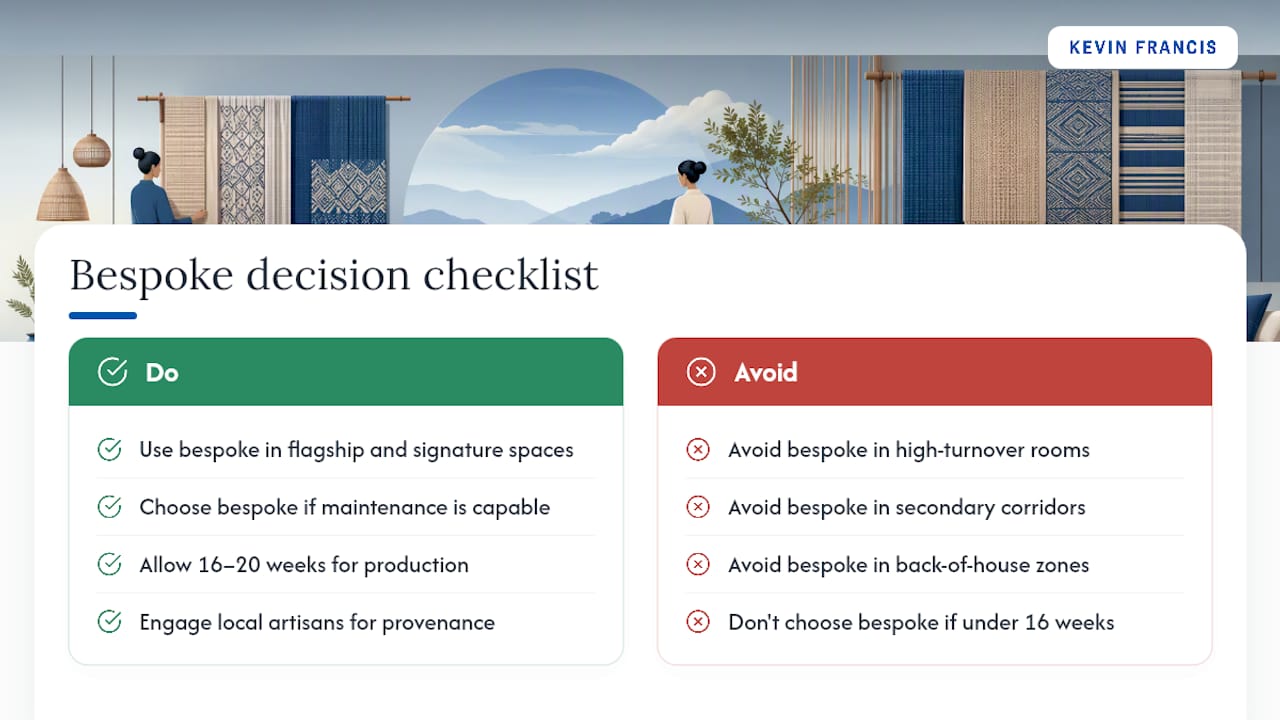
For flagship suites and signature public spaces, the case for bespoke is straightforward. A hand-knotted rug made to the room’s exact dimensions, in a colorway drawn from the property’s landscape, carries a narrative that no catalog piece can replicate. Guests sense that specificity even when they cannot articulate it. Biophilic design research consistently shows that authenticity and quality, not just the presence of natural materials, drive the well-being and perceived-value outcomes that justify premium pricing.
For secondary corridors, back-of-house transition zones, or rooms with high turnover, a well-chosen standard handcrafted piece, still natural fiber, still artisan-made, serves the guest adequately and preserves budget for the spaces where bespoke truly matters.
The decision checklist I return to on every project: Does the space demand a story? Is the maintenance team equipped to care for a high-pile piece? Does the timeline allow 16–20 weeks for production? Is there local artisan engagement that adds provenance value? When the answer to most of those questions is yes, bespoke is not an indulgence. It is the specification that pays for itself over a 20-year lifecycle.
What Kevin Francis Design brings to your wellness hotel project
Kevin Francis Design offers wellness hospitality developers a direct path from design intent to installed, certified, artisan-made textiles, without the sourcing uncertainty that often derails bespoke programs.
The collection spans hand-knotted wool rugs for flagship suites, hand-tufted pieces for lounges and pilot spaces, and solid-color wool options for treatment and meditation rooms, all available with custom sizing and colorway consultation. The commissioning process is structured: you submit a specification request, receive samples for approval, confirm production, and receive full maintenance documentation at handover. Lead times and budget ranges are discussed at the outset so there are no surprises at installation. Browse the collection and begin your specification at Kevinfrancisdesign, or go directly to the Lotto Hand-Knotted Wool Area Rug to see how a flagship piece is built.
Sources
- Quality of Hotel Biophilic Design and Its Impact on Guest Well-Being, Perceived Value, and Patronage Intentions: The Moderating Role of Guest Delight
- The Biophilic Interior Design Of BLUEGR Hotels - Eco Home Magazine
- Naviva, a Four Seasons Resort — Design
- All That Glitters is Not Green: Impact of Biophilic Designs on Customer Experiential Values
For next steps, consider running a single-space pilot with a focused six-question guest survey and before/after acoustic readings. The data from even one well-documented room builds a compelling case for broader investment.
FAQ
How do handwoven textiles improve acoustic comfort in hotels?
Handwoven wool rugs and wallhangings absorb mid- and high-frequency sound, reducing reverberation in hard-surfaced lobbies and guest rooms. Even a single large-format rug in an arrival lobby produces a perceptible reduction in ambient noise.
What certifications should I require when sourcing artisan textiles?
Require certifications such as GOTS for organic fiber content, responsible wool sourcing standards, and OEKO-TEX Standard 100 for chemical safety, particularly in spa and treatment environments where guests have direct skin contact.
How long does a bespoke handwoven rug commission take?
Bespoke hand-knotted commissions typically require 12–20 weeks from sample approval to delivery. Hand-tufted pieces generally have shorter production windows; confirm lead times with your supplier at the specification stage.
What is the expected service life of a hand-knotted wool rug in a hotel?
With correct maintenance, including annual professional cleaning and rotation every 6–12 months, a hand-knotted wool rug can serve 15–25 years in hotel use, developing a patina that reinforces the property’s authenticity narrative over time.
Can Kevin Francis Design supply custom-sized rugs for wellness hotel projects?
Yes. Kevin Francis Design offers custom sizing and colorway consultation across its hand-knotted and hand-tufted collections, with a structured sample approval process and full maintenance documentation provided at handover.
Recommended
- Why Handwoven Rugs Develop Unique Character Over Time – Kevin Francis Design
- Specifying Bespoke Rugs for Hotel Public Spaces – Kevin Francis Design
- Interior Design for Wellness: Creating a Calming Space at Home – Kevin Francis Design
- Narrative-Driven Home Textile Collections: 6 Archetypes – Kevin Francis Design


