


Ceiling wallpaper is a strong design move when the room has the architecture, height, or framed detail to support it, and a mismatch when it doesn’t. The fix is simple: order a few swatches, hold them overhead in the actual room, and look again under your own light fixtures before committing to a single roll.
TL;DR:
- Light colors and small-scale patterns are ideal for low ceilings, while large-scale, dark patterns suit tall rooms with more space to offset visual weight.
- Peel-and-stick wallpaper is suitable for small, low-risk areas like powder rooms but should be avoided near heat or moisture sources due to sensitivity issues.
- Testing samples overhead and under actual lighting conditions is essential to ensure the pattern maintains its intended look before full installation.
- Professional installation is recommended for complex patterns or ceilings over 8 feet, as precise alignment and surface prep are critical for a successful result.
- Metallic or pearlescent finishes require testing under your lighting to prevent glare, and natural-fiber papers like grasscloth should stay dry to prevent buckling.
Table of Contents
- Ceiling Wallpaper Ideas Worth Stealing for Your Fifth Wall
- Choosing Pattern, Scale, and Color for Your Ceiling
- Materials and Finishes: What Actually Holds Up Overhead
- The Best Rooms and Ceiling Zones to Start With
- Prep and Installation: What It Actually Takes
- Sourcing, Samples, and Budgeting for the Long Term
- A Designer’s Approach to Pairing Ceiling and Room
- Maintenance and Cleaning Advice for a Papered Ceiling
- Trending Ceiling Wallpaper Styles Worth Watching
- Why Restraint, Not Boldness, Is the Real Skill Here
- Shop Ceiling Wallpaper and Coordinating Textiles
- Sources
- FAQ
Ceiling Wallpaper Ideas Worth Stealing for Your Fifth Wall
Designers have started calling the ceiling the “fifth wall,” and once you see it that way, a blank white plane starts to look like wasted real estate. The Ceiling Canvas Principle puts it plainly: a ceiling only earns bold treatment when the architecture, light, and furnishings around it are already pulling their weight. Here are the ideas that consistently deliver, organized by where they work best.
- Small-scale ditsy florals for nurseries and low-ceilinged bedrooms. A tiny repeat print reads as texture rather than pattern from below, which keeps a low room from feeling capped.
- Dramatic dark florals for tall dining rooms. A moody botanical in navy or bottle green turns a dinner party into an occasion, and the height absorbs the visual weight without closing in.
- Metallic star or constellation murals for kids’ rooms. Pearlescent inks catch bedside lamp light beautifully, though you’ll want to preview the finish under your actual fixtures first.
- Full wall-to-ceiling wraps in powder rooms. Running one pattern from baseboard to ceiling erases the sense of a “boxed” room and creates what designers call a jewel-box effect. It’s also one of the most peel-and-stick-friendly ideas on this list, since powder rooms are small and forgiving.
- Tray and coffer papering. If your ceiling already has a recessed panel or millwork frame, paper just that section. It’s a lower-labor project than a full ceiling and gives you a built-in stopping point for seams.
- Grasscloth in dry, well-ventilated rooms. The woven texture adds warmth overhead without the shine of vinyl, though it’s a paste-application job best left to a pro.
- Geometric maze or ribbon patterns for hallways and alcoves. A repeat with clean, non-directional lines like the Bronte Ribbon Maze Wallpaper reads as intentional architecture rather than an accident of leftover paper.
- Soft meadow florals over the bed. Papering just the ceiling plane above a headboard turns the bed into the room’s focal point, an easy DIY project since the coverage area is small.
- High-gloss or lacquer-finish papers in entryways. The reflective surface bounces daylight from the front door deeper into the house.
- Continuous stripe or ribbon patterns for long, narrow rooms. A directional stripe run the short way visually widens a galley kitchen or hallway ceiling.
- Deep indigo or charcoal grounds for statement libraries and studies. Dark, saturated color overhead reads as intentional coziness in a room with built-in shelving to balance it, echoed in options like the Bronte Ribbon Maze Wallpaper in Indigo Blue.
Choosing Pattern, Scale, and Color for Your Ceiling
Height and light do most of the decision-making for you. Lighter colors and smaller-scale motifs lift a low ceiling and make a tight room breathe, while dark, saturated, or oversized patterns work best where you already have height and space to spare.
- Choose non-directional or all-over repeats when possible. Anything with an obvious “up” and “down,” like a landscape scene, can look disorienting from below.
- Match dark and large-scale patterns to rooms with sufficiently tall ceilings; save pale, small-scale prints for rooms with lower ceilings.
- Consider the room’s natural light before choosing a finish. North-facing rooms can handle richer color without feeling cave-like.
Pro Tip: Tape a sample sheet to the ceiling and lie on the floor to view it, then check it again after dark under your lamps. A pattern that looks perfect propped against a wall in daylight can shift entirely once it’s overhead and lit from below.
Materials and Finishes: What Actually Holds Up Overhead
Peel-and-stick is the easiest entry point for a first ceiling project, but it has real limits. It’s more sensitive to heat and humidity than paste-applied paper, which matters directly above a recessed light or in a steamy bathroom.
- Peel-and-stick: best for powder rooms, closets, and rental-friendly projects; skip it near heat-generating fixtures.
- Traditional paste: more durable long-term and the better choice for dining rooms, primary bedrooms, or any ceiling you plan to live with for years.
- Vinyl or vinyl-coated: the right call for bathrooms and kitchens where moisture is a constant.
- Lightweight non-woven: easiest to hang overhead since it doesn’t sag while you position it.
- Grasscloth: beautiful in dry rooms, but avoid it in bathrooms where humidity causes buckling.
- Metallics and pearlescents: reflect light and can make a ceiling feel higher, though they risk noticeable glare under recessed fixtures, so test the exact finish under your own lighting before ordering full rolls.
The Best Rooms and Ceiling Zones to Start With
Powder rooms remain the lowest-risk entry point precisely because they’re small, contained, and forgiving of a bold choice. Beyond that, entryways, over-bed ceiling planes, dining rooms, and framed tray or coffer panels all give you a defined edge to work within rather than an open, featureless expanse.
- Powder rooms and small alcoves: full wraparound coverage works beautifully here.
- Dining rooms: pair a dramatic overhead pattern with a grounding rug underfoot.
- Over the bed: paper just that rectangle for an easy, high-impact accent.
- Large, plain rooms without architectural detail: proceed cautiously unless the ceiling is tall and the rest of the room’s finishes are already coordinated.
Prep and Installation: What It Actually Takes
Ceilings expose every mistake a wall would forgive, since you’re looking at an uninterrupted plane with nowhere for a wandering seam to hide. Surface prep matters more here than almost anywhere else in the house: clean the ceiling, sand rough patches, prime bare drywall, and flatten heavy texture where you can.
- Mark a center line or use a laser level so your first strip sets the standard for everything after it.
- Dry-fit every strip before pasting. Hold each cut piece in place dry to confirm pattern match and squareness, a step installation guides consistently recommend precisely because ceilings show alignment errors more readily than walls do.
- Work with a second person and a stable platform. Hanging paper overhead is a two-person job; one person supports the roll’s weight while the other smooths and trims.
- Trim carefully around fixtures rather than trying to paper around a light box in one pass.
For murals, complex repeats, or any ceiling above a standard 8 to 9 foot height, hiring a professional installer is the safer call. A powder room ceiling might run a few hundred dollars in labor; a full dining room ceiling with a patterned repeat climbs considerably higher, since installed costs run higher overhead than on walls simply because the work is slower and less comfortable.
Sourcing, Samples, and Budgeting for the Long Term
Order more than one swatch. Designers consistently recommend living with a sample for a few days, photographing it morning and night, since overhead perspective changes how a pattern reads far more than a wall sample suggests.
- Budget for a labor premium on any ceiling project compared to the same paper on a wall, and check our own wallpaper installation cost guide for a fuller breakdown by room size.
- Powder rooms remain the cheapest way to test the idea before committing a larger budget to a dining room or primary suite.
- If you expect to redecorate within a few years, choose a strippable paper so removal doesn’t mean a full drywall repair.
- Check a paper’s lightfastness rating if the room gets strong daylight, since ceiling papers fade differently than wall papers exposed to the same sun.
A Designer’s Approach to Pairing Ceiling and Room
Kevin O’Gara evaluates every ceiling project the same way: architecture first, light second, existing textiles third. A ceiling with crown molding or a coffered frame can carry more pattern than a flat, featureless one, and a room that already gets strong afternoon light can handle a deeper, more saturated color overhead than a north-facing room ever could.
Pairing matters as much as the paper itself. A dining room finished in the Bronte Ribbon Maze Wallpaper in Indigo Blue reads best with a rug that echoes one supporting color rather than competing for attention. The Selendi Hand-Knotted Wool Area Rug or a piece like How Area Rugs Complement Wallpaper Design both work through the same principle: bridge one color from ceiling to floor, and let everything else in the room stay quiet.
…
Maintenance and Cleaning Advice for a Papered Ceiling
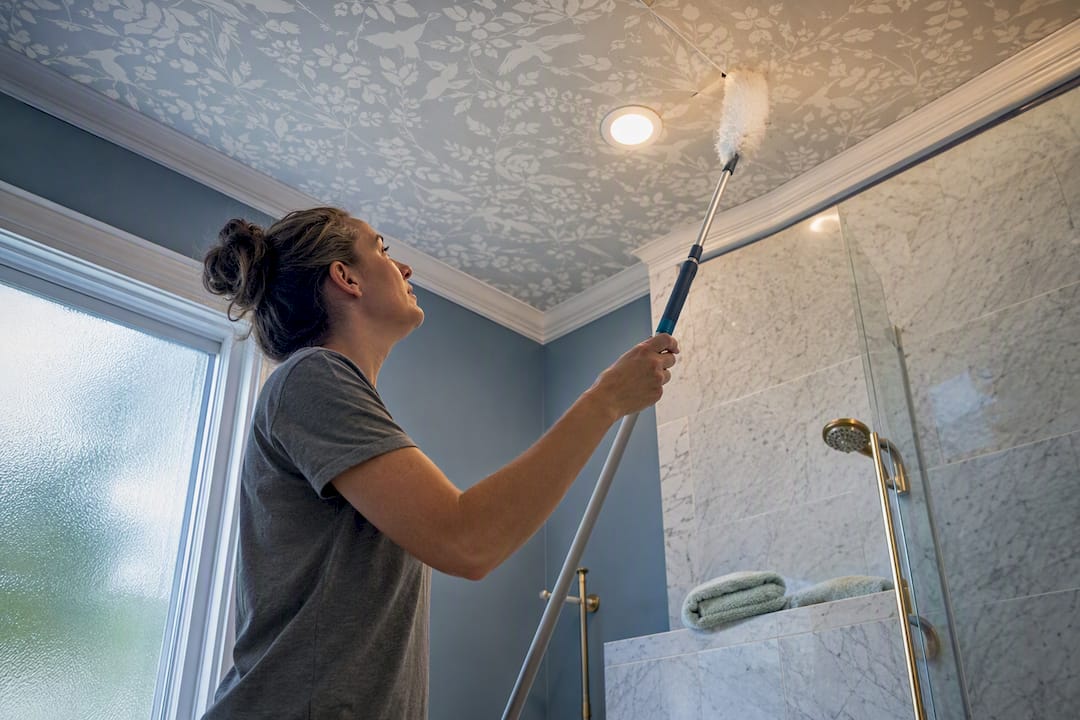
Ceiling wallpaper collects less everyday grime than wall paper, since hands and furniture never touch it, but dust and kitchen or bathroom moisture still take a toll over time. A soft, dry microfiber duster on an extension pole handles routine upkeep and should be your first move before anything wet touches the surface.
For vinyl and vinyl-coated papers, a barely damp cloth wrung out almost completely can lift light grime without disturbing the adhesive bond. Grasscloth and other natural-fiber papers should never get wet; stick to a vacuum brush attachment on the lowest suction setting instead. Peel-and-stick applications are the most vulnerable to moisture damage overhead, particularly near a bathroom fan or kitchen range where steam accumulates, so keep those rooms well ventilated regardless of which material you chose.
Watch the edges and seams first if a problem is going to show up. Heat rising from light fixtures can soften adhesive over years, causing a corner to lift before the rest of the sheet shows any wear. Catching a lifting seam early with a dab of matching wallpaper adhesive is a five-minute fix; ignoring it for months usually turns into a full strip repair. Check corners near recessed lighting every few months, especially in the first year after installation while the paste or adhesive fully cures.
Trending Ceiling Wallpaper Styles Worth Watching
Overhead treatments have moved well past the once-trendy glow-in-the-dark star ceiling. The current direction favors two opposite instincts: restrained, tonal patterns that whisper rather than shout, or full pattern-drenching that turns an entire room into one cohesive, gallery-like environment. Designers describe this as a deliberate choice between quiet restraint and full immersion, with little appetite left for anything in between.
Botanical and meadow-inspired florals remain the strongest overhead category, particularly in soft, painterly renditions rather than crisp graphic prints. A ceiling finished in something like The Cosmos Meadow Floral Wallpaper reads as an impressionistic wash of color from below rather than a repeating stamp, which is exactly the effect that keeps a pattern from feeling dated after a season or two.
Geometric maze and ribbon motifs are gaining ground in hallways and studies, offering structure without the softness of a floral. Metallic accents continue to trend for smaller rooms and nurseries, where a touch of shimmer catches lamp light without overwhelming the space. Deep jewel tones, particularly indigo and forest green, are replacing the pale neutrals that dominated ceiling trends a few years back, driven largely by the dining room’s rise as the room most willing to take a design risk overhead.

Why Restraint, Not Boldness, Is the Real Skill Here
The conventional wisdom around ceiling wallpaper treats it as an act of courage, something for the design-fearless homeowner willing to gamble on drama. That framing gets the skill backward. The hardest part of a great ceiling isn’t choosing a bold pattern; it’s having the discipline to match that pattern’s scale and color to what the room can actually support.
Most regretted ceiling projects I’ve seen didn’t fail because the paper was ugly. They failed because nobody tested the sample lying down, under the actual light fixtures, before ordering ten rolls. A pattern that reads as sophisticated on a designer’s laptop screen can feel like a mistake the moment it’s six inches from your face at 11 p.m. with a table lamp on.
Prioritize the test, not the trend. Order the swatch. Tape it up. Lie on the floor and look at it the way you actually will every night. If it still holds up, you’ve found a ceiling worth committing to. If it doesn’t, you’ve saved yourself the cost of a professional installer and a strip-and-redo six months later.
— Kevin O’Gara
Shop Ceiling Wallpaper and Coordinating Textiles
Once you know the room, the pattern is the easy part. Kevin Francis Design carries the Bronte Ribbon Maze Wallpaper in Seaglass Blue for rooms that want a cooler, more coastal read, and the deeper Indigo Blue colorway for dining rooms and studies built to handle drama. For a softer, floral overhead treatment in a bedroom, The Cosmos Meadow Floral Wallpaper delivers that painterly, petals-in-sunlight effect without tipping into busy.

Pairing is where the scheme actually comes together. A ribbon-maze ceiling grounds beautifully with the Knossos Hand-Tufted Maze Rug, echoing the geometry underfoot without repeating it exactly. A floral ceiling calls for something calmer below, like the Color Study Handwoven Wool Flatweave Rug or the Lotto Hand-Knotted Wool Area Rug, and a bed styled with The Cosmos Meadow Extra Long Lumbar Pillow pulls the same palette down to pillow height. Every rug and wallpaper on the site ships with swatch ordering available first, so you can test color and scale against your own ceiling before committing to a full room. Prefer something fully custom? The Talisman Rug can be personalized to match a specific palette pulled straight from your wallpaper. Order your swatches or start a custom design inquiry through the Kevin Francis Design product pages to see how the full scheme comes together in your own space.
Sources
- Should you wallpaper your ceiling? 7 essential rules to decide
- How to make the most of that fifth wall
- Wallpaper on ceiling — guide and cost overview
- How to hang wallpaper on the ceiling
FAQ
Is ceiling wallpaper a good idea?
Yes, when the room has enough height, architectural detail, or a framed zone like a tray ceiling to support it; large, plain rooms with low ceilings are the riskiest candidates.
What wallpaper looks good on ceilings?
Small-scale, light-colored, non-directional patterns work best on low ceilings, while dark, large-scale florals or geometrics suit tall rooms like dining rooms; metallics add glow but should be tested under your actual light fixtures first.
How do you cheaply cover a ceiling?
Peel-and-stick paper in a small room like a powder room is the lowest-cost entry point, since it requires no paste and covers a limited area, though it’s more sensitive to heat and humidity than traditional paste-applied paper.
Can I put wallpaper on a ceiling?
Yes, using either peel-and-stick or traditional paste, but ceilings require more careful prep, a dry-fit step to check pattern alignment, and typically a two-person installation team since you’re working overhead the entire time.


