


Lightfastness is a wallpaper’s ability to hold its color under UV exposure without fading, bleaching, or shifting tone over time. If your wall gets direct sun for a meaningful part of the day, the rule is simple: choose a paper rated “very good” or “excellent” on the sun-symbol scale, or a vinyl formulated with UV-stable pigments. Two trust signals separate a real durability claim from a marketing flourish. The sun pictogram on the label or spec sheet indicates relative resistance, with more suns meaning higher resistance, and a citation of ISO 105-B02, the xenon-arc laboratory test manufacturers use to substantiate color-fastness claims. These details are more important than pattern, paper weight, or designer pedigree if your wall faces south or west.
Key Takeaways
Wallpaper lightfastness depends on matching sun-symbol grades and substrate quality to a wall’s actual light exposure, then mitigating with window treatments where needed.
| Point | Details |
|---|---|
| Read the sun symbol | More suns on the label mean higher resistance; pair with any listed numeric grade of 3 to 7. |
| Check for ISO 105-B02 | This xenon-arc citation confirms lab testing, though real rooms differ from controlled conditions. |
| Favor lighter, muted colors | Whites and buffs hold color longer than saturated reds and light blues on direct-sun walls. |
| Choose vinyl or non-woven | These substrates generally outlast uncoated paper and lower-grade peel-and-stick in strong light. |
| Pair wallpaper with Kevin Francis Design textiles | Save saturated color for rugs and lighting from Kevin Francis Design while walls carry the sun-hardy hues. |
Table of Contents
- How Wallpaper Lightfastness Is Shown: Sun Symbols and Numeric Grades
- Material Performance: Paper, Non-Woven, Vinyl, and Peel-and-Stick
- Which Colors and Finishes Fade Fastest in Sunlight?
- What ISO 105-B02 Testing Actually Tells You
- How to Choose Wallpaper for Sun-Exposed Walls
- How Do You Prevent Wallpaper Fading, or Fix It After It Happens?
- How Kevin Francis Design Balances Color and Durability
- Why Label Literacy Beats Guesswork on This Topic
- Bring Lasting Color Into Your Sunlit Rooms
- Sources
- FAQ
How Wallpaper Lightfastness Is Shown: Sun Symbols and Numeric Grades
Wallpaper brands rarely spell out “lightfastness” on the roll label. Instead, they use a small sun icon, and the icon’s design carries the meaning. A single, half-filled sun typically signals “adequate” resistance, while a full sun or a cluster of sun icons points to “very good” or “excellent.” The rule of thumb retailers use is straightforward: the more sun shown, the more resistant the color.
Some manufacturers pair the symbol with a numeric grade suggesting moderate resistance to good resistance and up to excellent resistance, borrowed from EN and ISO wallcovering vocabulary. Lower grades suggest suitability for shaded rooms; higher grades indicate formulation for sustained, direct light.
You’ll usually find this information in three places:
- The product spec sheet or downloadable technical PDF
- A small icon strip printed on the selvage or sample card
- Fine print near “care instructions,” often worded as “colorfastness to light” or “UV resistance”
Watch for vague phrasing like “fade-resistant” with no icon or grade attached. That’s a marketing claim, not a tested one.
Material Performance: Paper, Non-Woven, Vinyl, and Peel-and-Stick
Not every substrate ages the same way in strong light, and the construction matters as much as the print on top of it. Ranked roughly from least to most sun-hardy for typical residential use:
- Traditional pulp paper shows fading fastest, particularly in saturated colors, because the fibers and inks sit close to the surface with little protective barrier.
- Non-woven wallpaper performs a step better thanks to its synthetic fiber blend, though pigment quality still drives the real-world result.
- Vinyl and vinyl-coated papers generally hold up best, since the coating acts as a UV barrier over the printed layer.
- Peel-and-stick wallpaper varies the most by brand. Cheaper adhesive films can fade within months in intense light, while higher-grade vinyl peel-and-stick with UV-stable inks can rival traditionally hung vinyl.
If you’re drawn to the flexibility of removable options for a rental or a room you’ll redecorate often, it’s worth reading up on choosing the best peel-and-stick wallpaper before committing a sun-facing wall to one.
Which Colors and Finishes Fade Fastest in Sunlight?
Color choice affects fade resistance nearly as much as substrate. Historic comparative testing found that whites and muted, drab tones remain the most color-stable under prolonged exposure, while many reds, light blues, and some greens showed visible shift in relatively short timeframes. Saturated, dark hues tend to reveal fading sooner than pale ones simply because the contrast between “faded” and “original” is more obvious to the eye.
Deep colors on a direct-sun focal wall are the pairing to avoid. If you love a rich red or an inky blue, save it for a wall with indirect light or one you’re prepared to refresh periodically.
- Whites, creams, and buffs age slowest and hide gradual change well
- Reds and light blues are historically the most volatile hues
- Metallic and high-gloss finishes can behave differently than matte, since the coating itself affects UV transmission
Pro Tip: Ask for a sample swatch and tape it to the actual wall for a few weeks of real sun before ordering full rolls. A label claim is a starting point, not a guarantee for your specific window orientation.
What ISO 105-B02 Testing Actually Tells You
ISO 105-B02 is the xenon-arc lamp test manufacturers cite when they claim a wallpaper has been tested for colorfastness to artificial light. The standard exposes fabric or paper samples to a controlled xenon light source calibrated to simulate daylight, then measures how much the color shifts against a reference scale. A citation of this standard means a lab has actually run a repeatable test, not just eyeballed a swatch on a windowsill.
That said, lab numbers and your living room don’t always agree.
A grade earned under xenon-arc exposure reflects a controlled, accelerated test. It does not account for your wall’s compass orientation, the tint of your window glass, or the cumulative years a paper will actually hang before you redecorate. No pigment is truly permanent under UV, and the ISO figure is a comparison point, not a lifetime warranty.
When you see a manufacturer cite ISO 105-B02 alongside a grade of 6 or 7, treat it as strong supporting evidence, one worth weighing far more heavily than an unlabeled “fade-resistant” claim, but still pair it with your own judgment about how harsh your particular wall’s light actually is.
How to Choose Wallpaper for Sun-Exposed Walls
Match the wall to the wallpaper before you fall for a pattern. A practical sequence:
- Assess your exposure. South and west walls with unfiltered glass need the highest lightfastness grades; north-facing or heavily curtained walls have more flexibility.
- Set your minimum grade. For direct, multi-hour sun, aim for “very good” to “excellent” on the sun-symbol scale, or a numerically high grade where listed.
- Choose color and finish second. Favor lighter neutrals, buffs, and muted tones on the brightest walls; reserve saturated reds and blues for shaded rooms.
- Confirm the substrate. Vinyl-coated or heavy non-woven typically outlasts uncoated paper in strong light.
Before you buy, ask the seller a few pointed questions:
- Has this pattern been tested to ISO 105-B02, and can they share the grade?
- Will they send a physical swatch rather than a screen image?
- What’s the return policy if the color noticeably shifts within the first season?
An ecolabel like Nordic Swan or Cradle to Cradle speaks to sourcing and environmental impact, not to how a color holds up in sunlight. Keep those two claims separate when you’re comparing options, and if sustainability is part of your decision, see our guide to eco-friendly interior design choices for how those certifications actually work.
How Do You Prevent Wallpaper Fading, or Fix It After It Happens?
Prevention is far cheaper than replacement, and a few changes make a measurable difference:
- Add UV-filtering window film to south- and west-facing panes. It’s one of the most effective mitigation steps for extending a wallpaper’s visual life by years rather than months.
- Layer sheer curtains or solar shades over bare glass, especially during peak midday hours in summer.
- Rotate framed art and rugs periodically so any uneven fading around furniture edges doesn’t become a fixed, obvious outline.
- Avoid running the most saturated pattern repeat along the single wall that catches the longest unbroken sun exposure each day; save it for an adjacent wall instead.
If fading has already happened, you have three realistic paths: replace the affected panel with a fresh roll from the same dye lot, patch behind furniture using leftover stock kept from installation, or lean into the contrast by adding art and shelving that intentionally break up the faded area.
Pro Tip: Keep two extra rolls in a dark closet when you install any sun-facing wallpaper. Matching a faded panel years later, even from the same manufacturer, is far harder than matching it now.
How Kevin Francis Design Balances Color and Durability
Kevin O’Gara approaches every sunlit room the same way: match the wall’s actual light exposure to a lightfastness grade before falling in love with a pattern. Kevin Francis Design leans on documented ISO/EN test claims and keeps swatches on-site during peak-sun months, watching how a color behaves through a full season rather than guessing from a screen.
The most common mistake we see is picking a wallpaper for its color story and treating durability as an afterthought. Get the grade right first. The pattern still gets to be beautiful.
For bright rooms, we often pair a lighter, sun-hardy wallpaper with a grounding, richly patterned piece elsewhere, like the Knossos Hand-Tufted Maze Rug or the deep tones of the Cairene Hand-Knotted Wool Area Rug, so the saturated color lives on a rug rather than a sun-baked wall.
Why Label Literacy Beats Guesswork on This Topic
Most advice on wallpaper fading stays theoretical, explaining pigment chemistry or UV physics in ways that don’t help someone standing in a showroom. What actually moves the needle is knowing how to read a label in under thirty seconds: count the suns, look for an ISO 105-B02 citation, and check whether the color sits in the vulnerable red or light-blue family.
The conventional wisdom oversells lab grades as a guarantee. A xenon-arc test result is a comparison tool, not a promise about your specific south-facing dining room with its old, unfiltered windows. I’d rather see a homeowner tape a real swatch to the wall for two weeks than trust a grade of 6 blindly, because orientation and glazing swing the real-world outcome more than most shoppers assume.
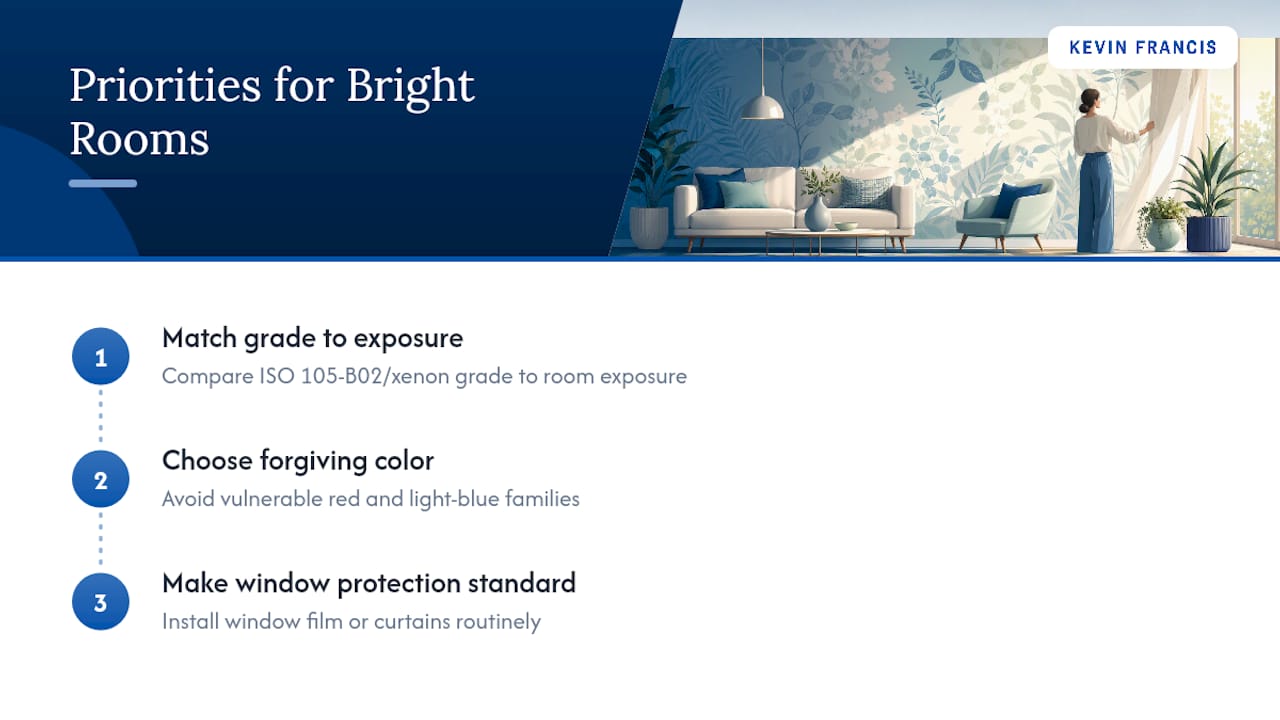
If I had to rank priorities for someone furnishing a bright room, it goes: match grade to exposure first, choose a forgiving color second, and treat window film or curtains as a standard line item, not an optional upgrade. Skipping straight to pattern and color, then hoping durability works itself out, is how sunlit walls end up looking patchy behind every picture frame within three years.
Bring Lasting Color Into Your Sunlit Rooms
Choosing wallpaper for a bright room means balancing pattern with staying power, and that’s precisely where Kevin Francis Design’s catalog earns its place: original, art-inspired designs built with documented lightfastness in mind, rather than a generic big-box print with no test data behind it.
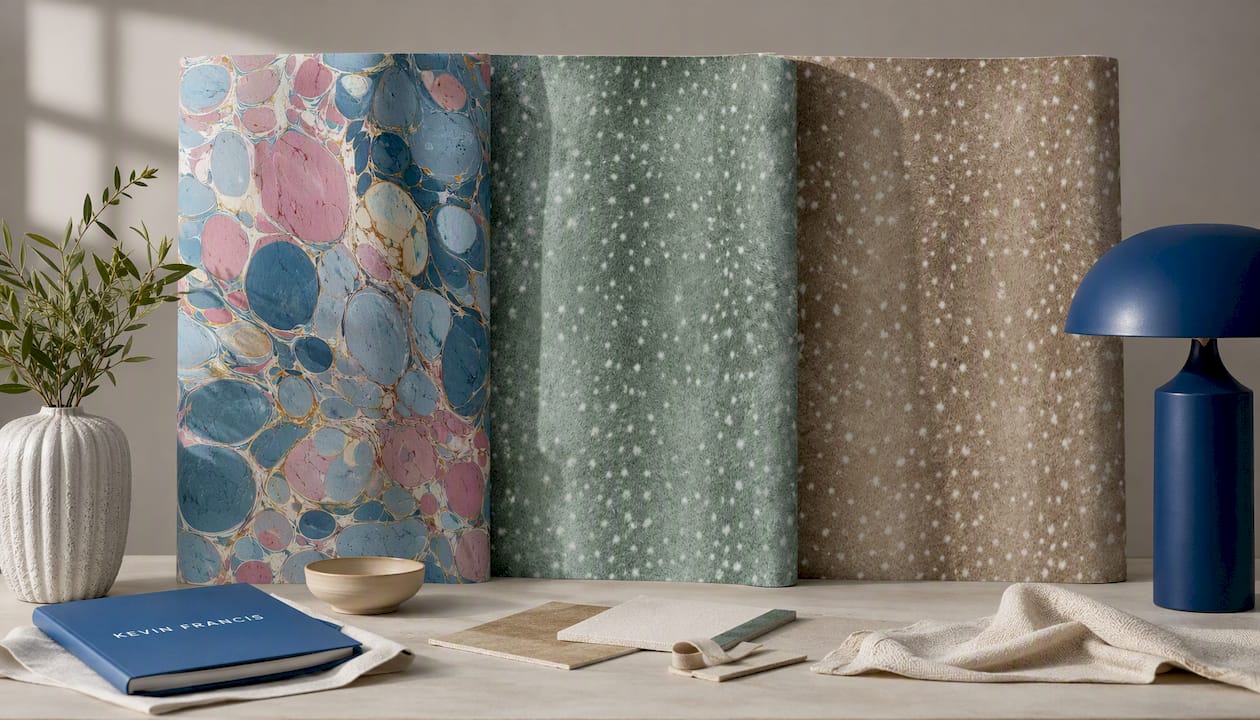
Beyond wallpaper, the collection extends into pieces that let you keep bold color where sunlight won’t touch it. A hand-knotted rug like the Selendi Hand-Knotted Wool Area Rug carries the saturated tones your walls might need to skip, while a table lamp such as the 22" Cecil Red Marble Mini Lamp softens harsh daylight contrast in the evening. If your walls face serious sun, browse the current wallpaper collection and request a swatch before you commit a full room to a pattern you haven’t tested in your own light.
Sources
- The Comparative Stability of Colors in Wallpaper
- ISO 105-B02:2013 - Textiles — Tests for colour fastness — Part B02: Colour fastness to artificial light: Xenon arc fading lamp test
- Can Peel-and-Stick Wallpaper Fade in the Sun? – CostaCover
- Light resistant wallpaper – Colourfastness & intensive luminosity
FAQ
Does the sun fade wallpaper?
Yes. UV exposure breaks down pigments over time, and fading typically appears fastest on saturated colors like reds and light blues, with the contrast becoming obvious next to shaded areas behind frames or furniture.
Will thick wallpaper cover bad walls?
Heavier vinyl and non-woven wallpapers can disguise minor wall texture and small imperfections better than thin paper, but neither substrate weight nor thickness affects lightfastness, that comes down to pigment and coating quality.
How long does wallpaper usually last before it noticeably fades?
It depends heavily on exposure and quality: lower-grade peel-and-stick can show visible fading in intense sun, while quality vinyl with UV-stable inks can hold color for years longer under the same conditions.
What symbol indicates the color fastness of wallpaper?
A sun icon on the label or spec sheet indicates relative light resistance, with more sun elements shown meaning higher resistance, often labeled from “adequate” up to “excellent.”
Are ecolabels like Nordic Swan a sign of good lightfastness?
No. Certifications such as Nordic Swan or Cradle to Cradle address environmental sourcing, not color permanence, so check for a sun symbol or an ISO 105-B02 citation separately.
Recommended
- Design Secrets: How Wallpapers Can Make Tiny Rooms Look Spacious – Kevin Francis Design
- Best Paint Colors to Brighten Dark Rooms in Washington Homes – Kevin Francis Design
- Bathroom Wall Protection Made Easy with Removable Wallpaper in Your Ho – Kevin Francis Design
- Color Palettes for Custom Blinds and Roller Shades | KFD – Kevin Francis Design


