


Layer rugs by pairing a larger, neutral flat-weave base with a smaller, statement top rug, and always separate the two with a felt-and-rubber pad. That’s the whole rule, and nearly everything else in this guide simply protects it. Get the proportions and the pad right, and the rest of the room tends to fall into place.
Here’s what to check before you buy anything:
- Leave 12 to 18 inches of base rug visible on every side of the top rug.
- A common pairing: an 8x10 base with a 5x8 top, or a 9x12 base with a 6x9 top.
- Use a pad under the base for the floor, and a separate felt-and-rubber pad between the two rugs.
- Keep total stacked thickness modest. Anything that bulges under furniture is a trip hazard waiting to happen.
- At Kevin Francis Design, hand-knotted wool pieces are built at the scale and weight that make a strong top layer, not an afterthought.
Key Takeaways
Rug layering succeeds when a dominant neutral base, a smaller statement top rug, and a felt-and-rubber pad combination work together instead of being chosen separately.
| Point | Details |
|---|---|
| Proportion rule | Leave 12 to 18 inches of base rug visible on every side of the top layer. |
| Common sizing pair | An 8x10 base with a 5x8 top, or a 9x12 base with a 6x9 top, is a reliable starting ratio. |
| Two-pad method | Use a pad under the base and a separate felt-and-rubber pad between base and top rug. |
| Pile height limit | Avoid stacking two rugs each thicker than about half an inch to prevent bunching and trip hazards. |
| Statement top layer | Kevin Francis Design’s hand-knotted wool rugs, like Lotto or Selendi, provide the weight and pattern presence layering calls for. |
Table of Contents
- Why Layer Rugs in the First Place?
- What Are the Rules for Layering Rugs?
- Which Materials and Pile Heights Pair Well?
- How Do You Mix Pattern and Color Without Chaos?
- How Should You Layer Rugs by Room?
- Rug Pads and Anti-Slip Solutions That Actually Hold
- Common Rug Layering Mistakes and Quick Fixes
- Copyable Styling Equations for a Designer Look
- What Kevin Francis Design Recommends for Layering
- Fringed vs. Bound Edges: Getting a Clean Transition
- Layering Rugs Over Hardwood, Tile, and Carpet
- Sources
- FAQ
Why Layer Rugs in the First Place?
Layering gives a room the texture and depth of a space that’s been collected over years, not furnished in a single afternoon. It’s a design move, but it’s also practical.
- Lets a small or vintage rug still make an impact instead of getting lost in an open floor plan.
- Defines separate zones in a great room without adding walls or furniture.
- Costs less than sourcing one oversized designer rug, since the base can be affordable natural fiber while the top carries the visual weight.
Design writers at Veranda consistently point to the same principle: pair material contrast with a neutral base so the accent piece reads as the focal point, not just a second rug.
What Are the Rules for Layering Rugs?
Three things decide whether a layered rug looks styled or accidental: proportion, texture contrast, and furniture alignment. Get these three right and the pairing works in almost any room.
Proportion. The base needs to dominate. Aim for the top rug to cover roughly 60 to 70 percent of the base’s footprint, or use the simpler visual test: 12 to 18 inches of base showing on all sides.
- An 8x10 base pairs cleanly with a 5x8 top.
- A 9x12 base works with a 6x9 or 6x10 top.
- In a smaller den or office, a 6x9 base with a 4x6 top keeps the same ratio.
Furniture alignment. The front legs of your sofa and chairs should sit on the base layer, never floating past its edge. Keep both rugs oriented the same way, rectangular over rectangular in most cases, so the eye reads one cohesive footprint rather than two competing shapes.
Before you commit to a purchase, test the layout with painter’s tape on the floor:
- Outline where the base edges will fall relative to your furniture.
- Mark the top rug’s boundaries and check the visible border on all sides.
- Walk the space for a few days. If a doorway or traffic path feels tight, resize before you buy.
The single most common mistake is buying a top rug too close in size to the base. Once they’re within a few inches of each other, the layering effect disappears and it just looks like a mismatched pair.
Which Materials and Pile Heights Pair Well?
Flat-weave natural fibers, jute, sisal, or a cotton dhurrie, make the most reliable base layer because they sit low and recede visually, letting a plush or patterned wool rug take center stage on top.
Two high-pile rugs stacked together usually fail. The layers bunch, shift underfoot, and create an uneven surface that’s genuinely a trip hazard rather than a design flourish. If you love the look of shag, keep it to a single low-profile layer and pair it with a flat, thin base rather than stacking two thick piles.
- Base: jute, sisal, or flat-weave wool dhurrie.
- Top: hand-knotted wool, vintage Persian, or a hand-tufted pattern.
- Avoid: two rugs each thicker than about half an inch.
Pro Tip: A felt pad cushions and grips the underside of your top rug, while a rubber layer anchors the whole stack to the floor. Skip either one, and the rug creeps a little more every week until it’s noticeably off-center.
How Do You Mix Pattern and Color Without Chaos?
Keep the base neutral or low-contrast so the top rug does the visual work. When you’re pairing two patterned rugs, a shared or bridging color keeps them from fighting for attention.
- Don’t pair two bold, similarly scaled patterns with nothing tying them together.
- Do try a faded, tonal Persian rug over plain jute. Or a bold geometric top over a textured neutral base.
- Match shapes where you can, rectangular over rectangular, or deliberately offset when you’re mixing a round top rug over a rectangular base for visual movement.
Size, texture, and proportion remain the three levers that matter most, and Castlery’s styling guide treats angling or off-centering the top rug as a deliberate move, not an accident.
How Should You Layer Rugs by Room?
Living rooms, dining rooms, and bedrooms each demand slightly different math.
- Living room: the base anchors your seating group, and the top rug centers within it, showing that 12 to 18 inch border on all sides.
- Dining room: both rugs need enough clearance for chairs to pull out fully. Choose a low-profile, flat top rug here since bulk under a dining chair invites tipping.
- Entry: scale the top rug small, almost like a doormat with intention, to create a quick visual moment without blocking traffic.
- Bedroom: let the top rug extend past the foot of the bed, or run one on each side, following the same bedroom sizing logic as the living room.
- Carpeted floors: stick to a low-pile top rug and a carpet-grip pad rather than a standard rubber pad, which won’t hold on fiber.
Rug Pads and Anti-Slip Solutions That Actually Hold
The two-pad method is the standard for a reason: one pad sits between the floor and the base rug, and a second, thinner pad sits between the base and the top rug. Skip the second pad and even a well-sized top rug will slide within weeks.
- Measure your base rug’s exact footprint and cut a felt-and-rubber pad to sit just inside its edges.
- Center the top rug over the base and cut a second, thinner grip pad to fit beneath it.
- Press both rugs flat and check every corner for lift or bunching.
- Walk across the layered area repeatedly for a day or two, then re-straighten if anything has shifted.
- Re-check the pads every few months, especially in high-traffic rooms.
Pro Tip: Never substitute double-sided carpet tape for a proper pad. Tape can pull fibers on delicate weaves and doesn’t distribute weight the way a felt-and-rubber combination does, which matters most on hardwood.
Common Rug Layering Mistakes and Quick Fixes
Most layering problems trace back to one of four issues.
- Top rug too large: swap it for a smaller size or reposition it so the base’s border shows on every edge.
- Slipping and bunching: add the correct two-pad combination and re-straighten every few weeks until it settles.
- Trip hazards: thin out your stack in walkways and reserve thicker layers for low-traffic seating areas only.
- Pattern clash: switch to a neutral base, or introduce a bridging color between two patterned rugs.
Copyable Styling Equations for a Designer Look
These pairings work in nearly any room because they lean on proven contrast rather than guesswork.
- Jute base + faded vintage Persian top = living room classic.
- Flat-weave wool dhurrie + hand-tufted geometric top = modern den.
- Sisal base + solid wool top = calm, tonal bedroom.
- Cotton dhurrie + small round rug, offset toward one corner = playful reading nook.
- Neutral flat-weave + runner set at a 30 to 45 degree angle = eclectic entryway.
- Textured wool base + bold maze-pattern top, centered = statement dining room.
Center the top rug for a formal, polished room. Angle or offset it when you want the space to feel gathered over time rather than arranged all at once.
What Kevin Francis Design Recommends for Layering
Hand-knotted wool holds its shape and density in a way that machine-made rugs rarely match, which is exactly why it works so well as a top layer over a flat-weave base. The weight keeps it settled, and the density gives it presence without needing enormous scale.
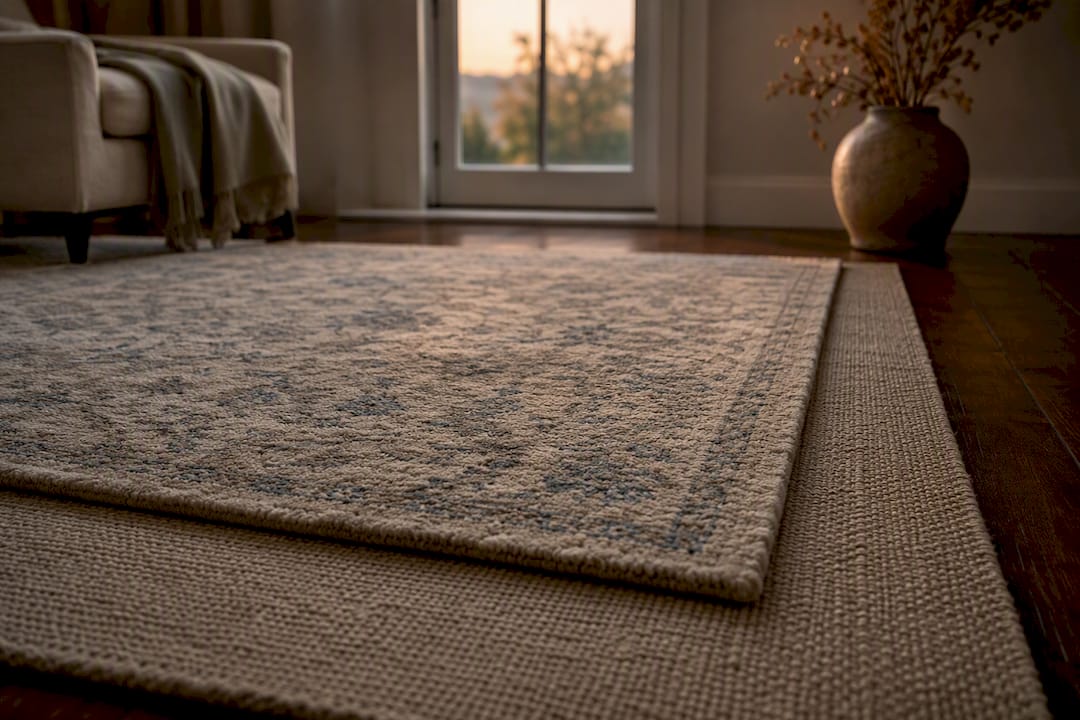
Choose a top rug with enough color or pattern contrast to stand apart from the base, but check its edge finish and pile height against the base before you commit.
That’s the guiding principle behind how Kevin Francis Design’s own collections are scaled, from statement pattern rugs down to quiet neutral grounding pieces.
Fringed vs. Bound Edges: Getting a Clean Transition
Edge finish matters more in a layered setup than it does when a rug stands alone, because two edges are now visible near each other instead of one edge meeting bare floor.
Bound edges tend to read cleaner in a layered arrangement. The tight, finished line sits flush against the base rug’s surface and doesn’t compete visually with the pattern or color contrast you’re building between the two layers. If you’re stacking a patterned top rug over a textured base, a bound edge keeps the transition crisp rather than adding another visual element to track.
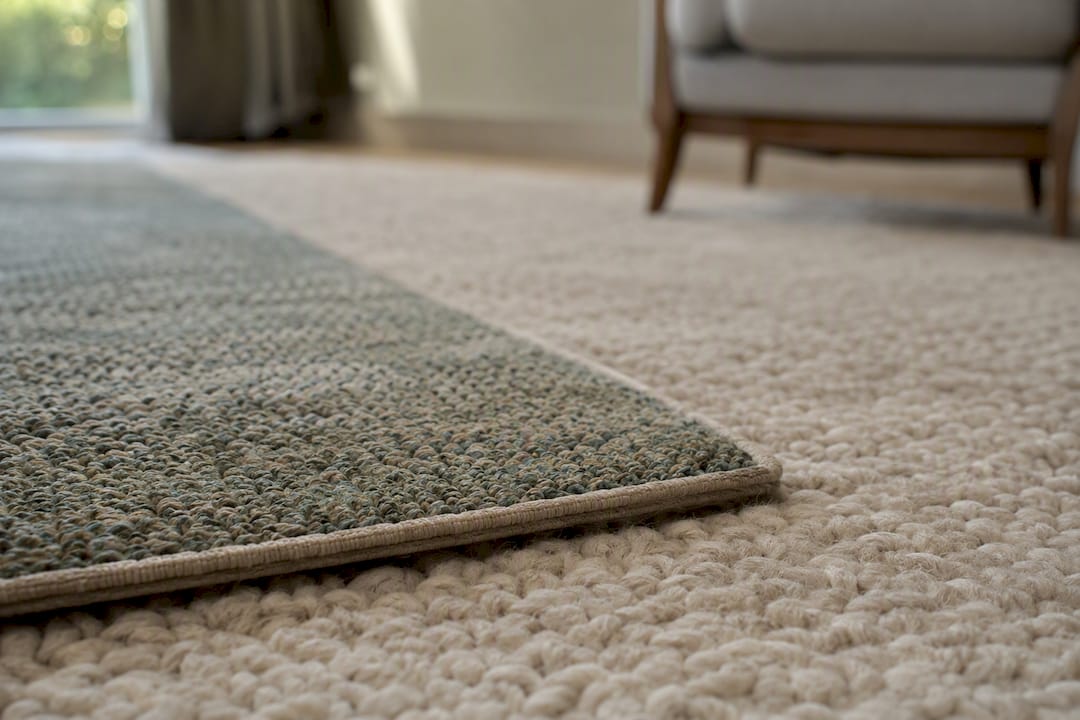
Fringed edges can still work, and often work beautifully, but they need a bit more intention. The fringe reads best when the top rug is noticeably smaller than the base and fully visible, so the fringe becomes part of the design rather than getting flattened under furniture legs. Avoid positioning a fringed edge where a chair or table leg will regularly sit on it. The fibers wear unevenly, and the fringe tends to mat down in ways that are hard to reverse.
If you’re mixing a fringed top rug with a bound base, keep the color palette simple. Two different edge treatments plus a busy pattern clash is one contrast too many. When both rugs are fringed, stagger the fringe direction slightly, or choose a top rug small enough that its fringe never overlaps the base’s own edge.
Layering Rugs Over Hardwood, Tile, and Carpet
Flooring changes which pads and materials actually hold up.
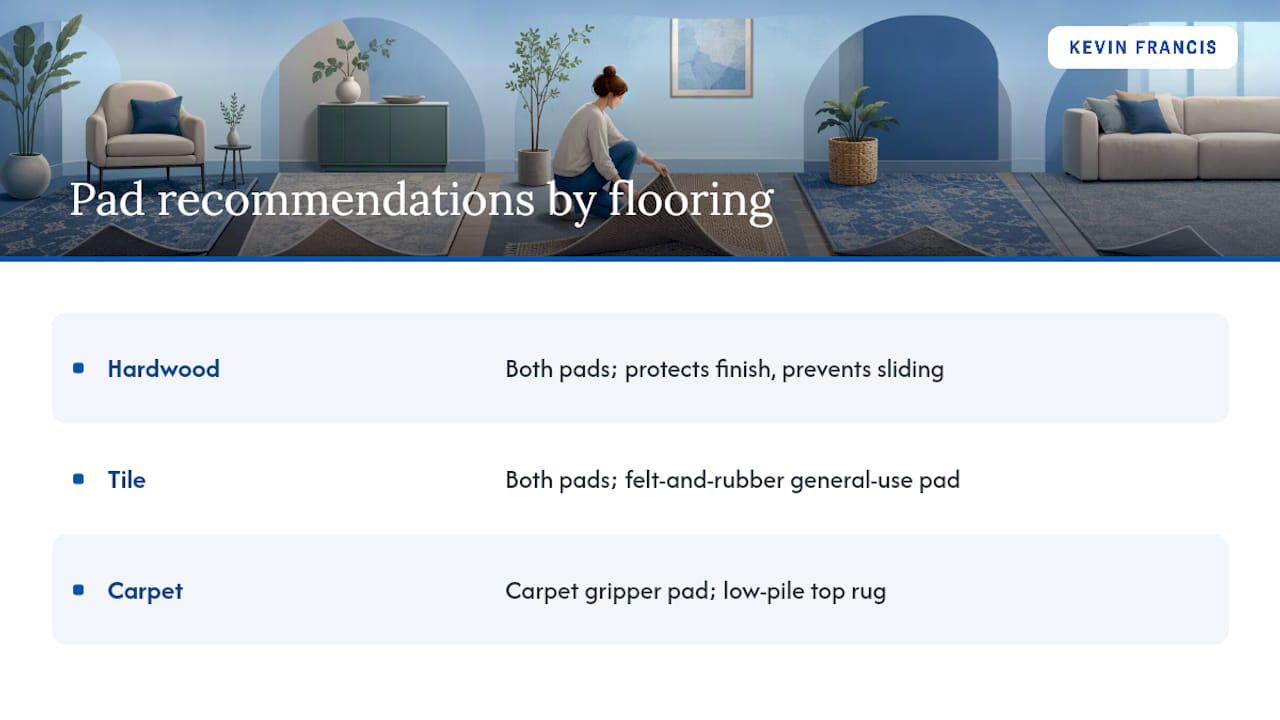
On hardwood, both layers need padding. The floor↔base pad protects the wood’s finish from scratching, and the base↔top pad keeps the assembly from sliding on a slick surface. Skip either one and hardwood is the flooring most likely to send a rug skating across the room.
Tile behaves similarly, though it’s worth checking that your base pad’s rubber backing is rated for tile rather than hardwood only. Some rubber compounds react differently with grout lines and sealed tile finishes, so a felt-and-rubber pad built for general use is usually the safer bet over a hardwood-specific one.
Carpet is its own case entirely. A standard rubber pad won’t grip carpet fiber the way it grips a hard floor, so a carpet-specific gripper pad, thinner and designed to interlock with carpet fibers rather than suction to a smooth surface, is the better choice. Keep the top rug low-pile on carpeted floors. Two thick piles stacked on top of existing carpet padding create a soft, unstable surface that’s uncomfortable to walk on and genuinely risky for anyone less steady on their feet.
Concrete and stone floors, common in sunrooms or converted spaces, need the same double-pad approach as hardwood, with extra attention to moisture. A rubber pad with poor breathability can trap dampness against concrete and lead to mildew under the rug over time.
A Note From the Designer
Layering a rug changes how a room feels almost immediately, in a way that swapping a single piece rarely does. Try one simple pairing this season. You can always change it later. That’s the point.
Where to Start With Kevin Francis Design
Choosing your first layered pairing gets easier once you have the right pieces in hand rather than guessing at sizes online. A few options from Kevin Francis Design map directly onto the rules above.
The Lotto Hand-Knotted Wool Area Rug has the density and pattern presence to work as a top-layer statement piece over a quiet flat-weave base. The Selendi Hand-Knotted Wool Area Rug offers a similar hand-knotted weight with a different color story, useful if your base rug leans warm rather than cool. For a bolder, architectural look, the Knossos Hand-Tufted Maze Rug brings graphic contrast that reads clearly even at a smaller top-layer scale.
Each piece is available in the sizing that layering actually requires, and Kevin Francis Design offers custom sizing when your base and top don’t match a standard pairing. Browse the full rug collection and check current dimensions against your own base rug before you order.
One base and two tops from our own looms

Color Study Flatweave (the base)
Handwoven wool with no pile, so it lies flat under a second rug and never lifts at the edge. The blocks of color give the top layer something to answer.
From $600
See sizes →

CHROMA Solid (the calm top)
Plush handloomed New Zealand wool in five saturated solids. Over a flat base it reads as a pool of color, the quiet version of layering.
From $680
See colors →

Knossos Maze (the statement top)
Hand-tufted wool with bamboo silk and a raised maze that keeps its graphic at top-layer scale. A 6x9 over a 9x12 base leaves the border you want.
From $760
See sizes →
Every design in the rug collection can be made to a custom size, which is the real advantage when layering: if your base is an odd size, we can scale the top so exactly 12 to 18 inches of base shows on every side.
Sources
- Exactly How to Layer Rugs the Right Way, According to Designers
- Exactly How to Layer Rugs the Right Way, According to Designers (NYTimes coverage)
- Layered Rugs: Designer Ideas for a More Elevated Home
- How to Layer Rugs
- The Art of Layering Rugs: How to Build Depth From the Floor Up | Castlery US
FAQ
What Are the Rules for Layering Rugs?
Keep the base rug larger and neutral, show 12 to 18 inches of it around the top rug, align furniture legs on the base, and separate both layers with a felt-and-rubber pad.
Is Layering Rugs Still in Style?
Yes. Designers continue to treat layered rugs as a way to add texture and rotate seasonal accents while keeping a durable base year-round, a practice covered in recent design coverage.
Can You Layer an 8x10 Rug Over a 9x12 Rug?
Yes, an 8x10 top rug over a 9x12 base leaves roughly the right border on most sides, though you should measure your specific room to confirm at least 12 inches of base shows all around.
What Rug Layering Mistakes Should You Avoid?
The biggest mistakes are sizing the top rug too close to the base, skipping the second grip pad, and stacking two high-pile rugs that bunch and create a trip hazard.
Do I Need a Rug Pad Between Two Layered Rugs?
Yes. A felt-and-rubber pad between the base and top rug keeps the assembly from shifting, in addition to a separate pad placed under the base rug itself.


