


The single rule that keeps a bespoke textile budget honest: build it in layers, price each layer with real vendor quotes, and update the live budget the moment a purchase order gets issued. Do this from the first cost estimate through the final delivery, and cost overruns become manageable line items instead of opening-week emergencies.
This week, before another sample lands on your desk:
- Set a per-key textile allowance based on hotel tier, not a single blended number.
- Add contingency by category, not as one lump percentage across the whole FF&E budget.
- Require every purchase order to update the live budget the same day it’s cut.
- Confirm which items need a model room before production begins.
Pro Tip: Bring procurement into the room during design development, not after drawings are final. Projects that request vendor pricing early see about 25% fewer budget surprises than those that wait for construction documents.
Key Takeaways
A defensible bespoke textile budget requires layered per-category allowances, categorical contingency, and PO-level tracking updated the day a purchase order is issued.
| Point | Details |
|---|---|
| Set category-level allowances | Split guestroom, public-area, and OS&E textiles into separate budget lines with their own contingency bands. |
| Engage procurement early | Requesting vendor quotes during design development cuts budget surprises by roughly 25 percent. |
| Calculate landed cost upfront | Freight, duties, and warehousing commonly add 18 to 30 percent above FOB pricing on remote-market orders. |
| Update the budget at PO issue | Track projected, quoted, approved, and actual columns, revised the day each purchase order is cut. |
| Require a model room before bulk production | Full-scale mock-ups catch dye-lot drift and pattern errors before they become replacement costs, and a maker like Kevin Francis Design builds that review into its bespoke rug and textile process. |
Standards and Benchmark Reports to Consult
- Wyzenbeek and BIFMA durability guidance for setting abrasion and structural minimums.
- CAL TB 117-2013 and NFPA 701 for flammability compliance on upholstery and drapery.
- FF&E benchmark guides for defending per-key and contingency figures to ownership.
- ISO standards pages for formal testing and specification references.
Table of Contents
- How Do You Budget Bespoke Textiles for Hospitality Projects?
- What Are the Procurement Phases for Bespoke Textiles?
- What Belongs in a Technical Data Sheet for Bespoke Textiles?
- How Do You Validate a Supplier for Bespoke Textile Runs?
- Which Value-Engineering Moves Save Money Without Losing the Design?
- How Should You Track a Bespoke Textile Budget Day to Day?
- How Do You Calculate Landed Cost and Plan Payments for Textiles?
- Why Is a Model Room Worth the Extra Line Item?
- How Does Kevin Francis Design Approach Bespoke Textile Budgets?
- How Kevin Francis Design Supports Hospitality Textile Budgets
- Sources
- FAQ
How Do You Budget Bespoke Textiles for Hospitality Projects?
Budgeting bespoke textiles for hospitality projects means setting per-key and per-category allowances up front, backing them with categorical contingency, and tracking every dollar from projection through actual spend at the purchase-order level. Skip any one of those three legs and the budget stops being a planning tool and becomes a guess dressed up in a spreadsheet.
FF&E typically runs 10 to 15 percent of total development cost for new builds and 25 to 40 percent for full renovations, and textiles sit inside that envelope alongside casegoods, lighting, and millwork. Per-key ranges vary enormously by tier: economy properties often land near $3,000 per key while luxury properties can exceed $58,000. Other benchmark surveys put goods-only FF&E at $4,000 to $12,000 per room for budget hotels and $35,000 to $120,000-plus for luxury, which tells you these figures are planning ranges, never quotes.
Split the textile sub-budget into three distinct lines: guestroom soft goods (bedding, drapery, upholstery), public-area textiles (lobby rugs, banquette fabric, restaurant seating), and back-of-house OS&E items. Separating these lines lets you value-engineer one category without quietly starving another.
| Category | Typical share of FF&E textile line | Contingency band |
|---|---|---|
| Guestroom soft goods | 35% | 10 to 15% |
| Public area textiles | 40% | 15 to 20% |
| Back-of-house OS&E textiles | 10 to 15% | 10% |
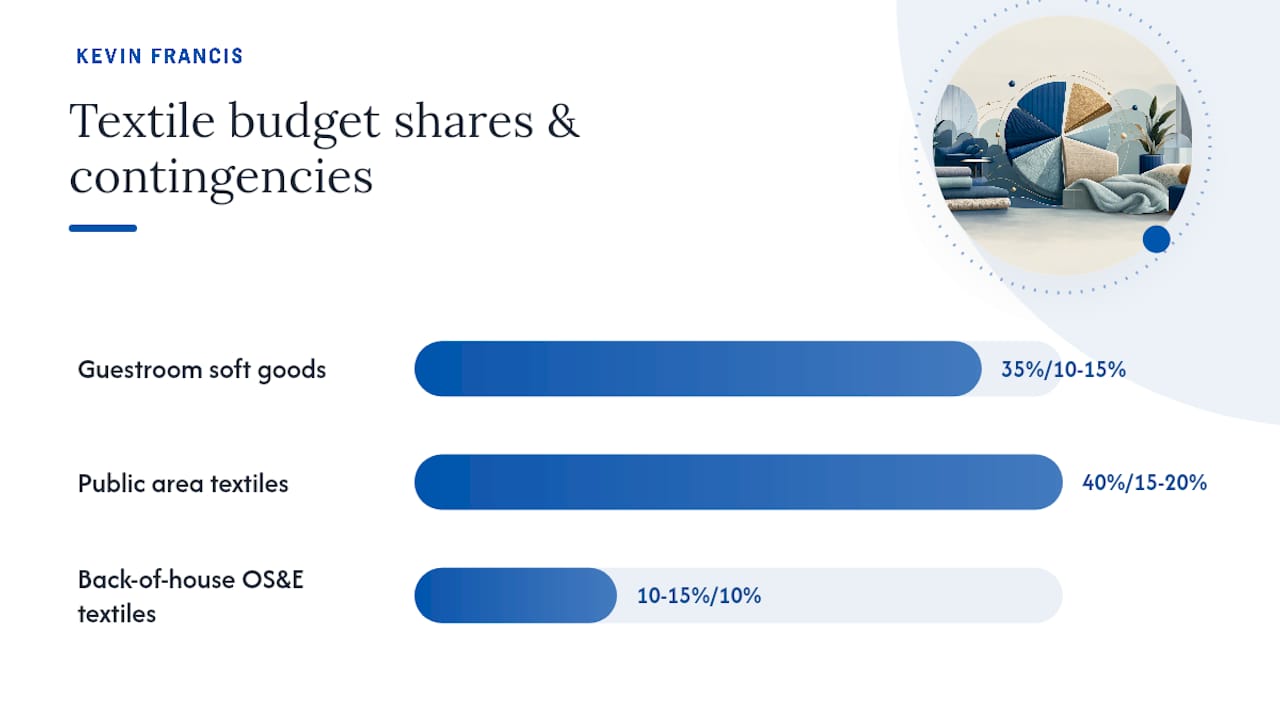
Statistic Callout: Industry guidance recommends 10 to 20 percent contingency on FF&E overall, allocated by category rather than as a single blanket figure. Remote-market or full-renovation projects belong at the higher end of that band.
What Are the Procurement Phases for Bespoke Textiles?
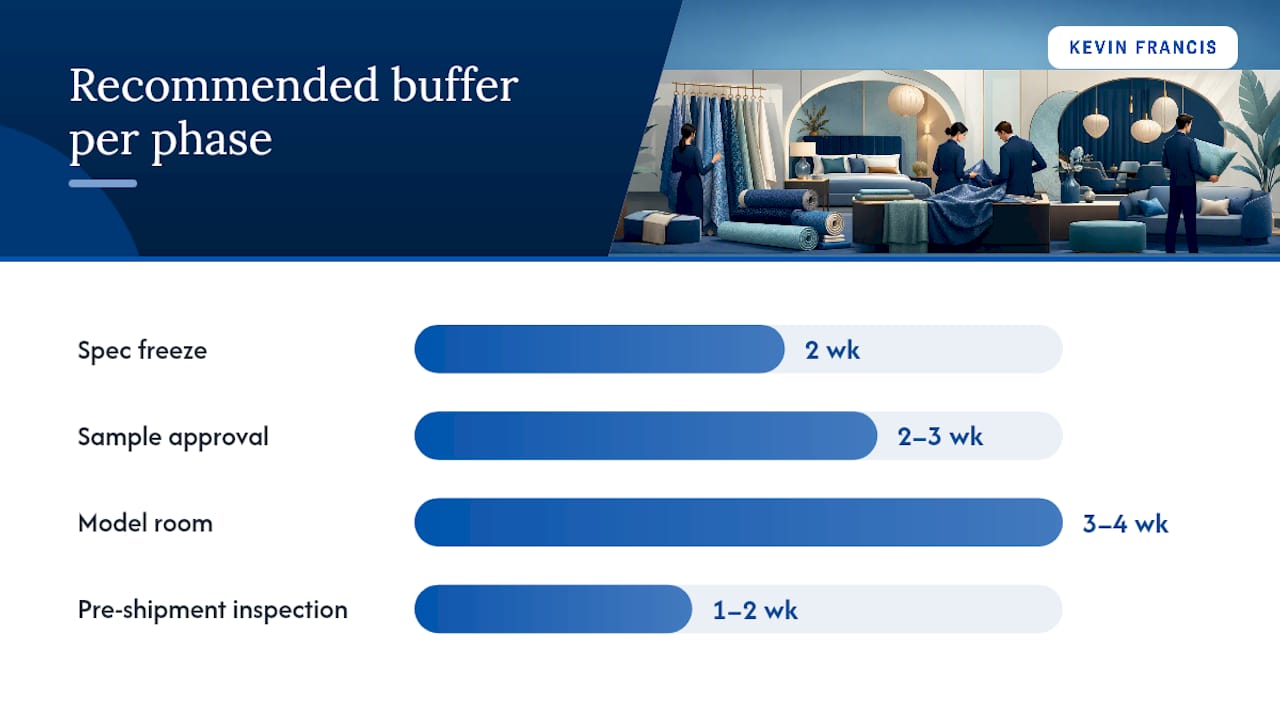
Bespoke textiles move through five phases, and each one has a hard deadline if you want the doors open on schedule: spec freeze, sample approval, model room build, production start, and pre-shipment inspection through delivery. Miss the spec freeze and everything downstream compresses, usually at a premium.
Domestic bespoke runs typically need 12 to 16 weeks from sample approval to delivery. Overseas production, especially hand-knotted or hand-loomed pieces, often needs 18 to 26 weeks once you account for shipping windows and customs clearance. Textile programs that integrate specification, sampling, and manufacturing into the master schedule reduce delivery risk; treating textiles as a late-stage purchase is the single most common way projects blow their timeline.
| Phase | Milestone | Recommended buffer |
|---|---|---|
| Spec freeze | Final materials and quantities locked | 2 weeks |
| Sample approval | Production-quality sample signed off | 2 to 3 weeks |
| Model room | Full mock-up reviewed and approved | 3 to 4 weeks |
| Production | Bulk manufacturing underway | Per vendor lead time |
| Pre-shipment inspection | QA sign-off before freight | 1 to 2 weeks |
- Engage procurement at design development, not construction documents.
- Release contingency only when a defined trigger fires: a confirmed price increase, a discontinued yarn, a failed inspection.
- Build a two-week buffer around any overseas shipping window; ocean freight delays are the norm, not the exception.
What Belongs in a Technical Data Sheet for Bespoke Textiles?
Every bespoke textile item needs a Technical Data Sheet before it goes to bid, and that document is what protects you from a replacement bill after installation. A TDS should include fiber composition, weight (ounces per square yard or grams per square meter), finish treatment, washability instructions, pattern repeat size, total yardage required, railroading direction, and installation notes for the trade crew.
Performance minimums matter as much as the fabric’s look. Require:
- Wyzenbeek abrasion testing at 50,000 double rubs minimum for guestroom seating and 100,000-plus for lobby or public seating.
- AATCC colorfastness testing appropriate to light exposure and laundering frequency.
- CAL TB 117-2013 compliance for upholstered items sold in the U.S. market.
- NFPA 701 flame testing for drapery and other vertically hung textiles.
- BIFMA x5.5 as a baseline structural benchmark where the textile is paired with seating frames.
Request a production-quality sample, not a swatch, and put it through a laundry-cycle test that mirrors the property’s actual housekeeping schedule before you sign off.
Pro Tip: Note the exact wash cycle count in the TDS itself, such as “must retain colorfastness grade 4 after 50 industrial launderings.” A vague standard invites a vague result.
How Do You Validate a Supplier for Bespoke Textile Runs?
Supplier validation is where most bespoke textile budgets quietly go wrong, usually because a project team picks a vendor on price alone and discovers the gap between promised and delivered quality after the invoice clears. Before committing to a bespoke run, confirm the vendor’s minimum order quantity against your actual need, and ask for recent audit reports covering both factory capability and labor practices.
- Request references from at least two prior hospitality clients, ideally at a similar scale.
- Confirm access to third-party testing labs for Wyzenbeek and colorfastness verification.
- Structure the RFP to require valid certification documents, not just a claim of compliance.
- Ask about lead-time reliability on the vendor’s last three comparable orders, not just their quoted lead time.
A virtual factory audit is often enough for a repeat vendor with a clean track record. A physical audit becomes necessary for a first-time bespoke relationship or any order above a threshold that would meaningfully hurt the project if it failed.
Pro Tip: A vendor who hesitates to share a laundering test report or won’t commit to a written lead time is telling you something. Treat that hesitation as a red flag, not a negotiating position.
Which Value-Engineering Moves Save Money Without Losing the Design?
Value engineering isn’t about cutting quality. It’s about deciding precisely where custom work earns its keep and where a standardized element does the same visual job for less.
- Standardize repeatable elements like piping, welt cord, and trim across multiple rooms, and reserve custom-order-my-own (COM) fabric only for pieces guests actually see up close, like a lobby banquette or a feature rug.
- Limit custom colorways to accent pieces rather than the full upholstery run. A single custom-dyed throw pillow line reads as bespoke; a fully custom base fabric across 200 rooms rarely justifies its premium.
- Optimize pattern repeat size before finalizing yardage. A smaller, well-considered repeat can cut fabric waste meaningfully on large-format items like bespoke wallpaper and drapery.
- Stage production in phases for large room counts instead of committing to one giant run. Phased batches cost slightly more per unit but let you adjust after seeing the first rooms installed.
Bespoke doesn’t mean everything is custom. It means the right things are custom, and everything else is chosen with intent.
Where full customization genuinely serves the design, the payoff shows up in guest experience for decades, not just opening week. Bespoke furnishings tend to outperform off-the-shelf alternatives on exactly this kind of longevity math.
How Should You Track a Bespoke Textile Budget Day to Day?
A hospitality textile budget needs four columns, not one: projected, quoted, approved, and actual. Projected is your early estimate. Quoted is the vendor’s actual number once RFPs come back. Approved is what leadership signed off on. Actual is what hits the books once the purchase order is issued and reconciled against final invoicing.
| Column | Updated when | Who owns it |
|---|---|---|
| Projected | Design development | Design team |
| Quoted | RFP response received | Procurement |
| Approved | Sign-off from ownership/GC | Project manager |
| Actual (PO-level) | Purchase order issued | Procurement / finance |
A budget is a living document, and the update has to happen at PO issuance, not on a weekly or monthly roll-up. Waiting for a scheduled check-in means a material price swing or a discontinued yarn sits undetected for weeks before anyone notices the gap.
- Update the actual column the same day a PO is cut, every time, with no exceptions for “small” orders.
- Escalate to leadership at 5 percent category overrun or any confirmed two-week schedule slip.
- Review the full budget against the master schedule biweekly, even when nothing looks urgent.
How Do You Calculate Landed Cost and Plan Payments for Textiles?
Landed cost is the FOB factory price plus freight, duties, warehousing, and last-mile installation labor, and skipping this math is how a “great” quote turns into a budget miss. Hidden logistics costs commonly add an additional low to mid double-digit percentage on top of FOB pricing for remote-market projects once every stage is accounted for, so calculate landed cost before you issue an overseas RFP, not after you sign a contract.
Structure payment schedules to mirror production stages: a deposit at order confirmation, a second payment at production midpoint or sample approval, and the balance at pre-shipment inspection rather than at delivery.
- Confirm incoterms in writing so freight and insurance responsibility is unambiguous.
- Negotiate a demurrage cap before the container ships, not after it’s sitting at port.
- Consolidate shipments where possible to reduce per-unit freight and warehousing costs.
Pro Tip: Ask your trade program or procurement partner, such as designer trade purchasing channels, whether consolidated freight is available across multiple vendor orders. It often is, and few teams ask.
Why Is a Model Room Worth the Extra Line Item?
A model room isn’t a luxury step. It’s cheaper than the alternative, which is discovering a fabric problem after 200 rooms are installed. Require a full-scale model room for any run above roughly 20 rooms or any project introducing a new bespoke pattern or weave.
- Include actual production-run fabric, not a sample swatch, in the model room build.
- Inspect seams, pattern matching, and colorfastness under the room’s actual lighting.
- Set written acceptance criteria before the model room review, not during it.
Pro Tip: Watch for dye-lot drift between the approved sample and the bulk run. It’s the most common sample-to-production deviation, and it’s invisible until the room is fully dressed.
How Does Kevin Francis Design Approach Bespoke Textile Budgets?
Design-led makers build sample costs, model-room fabrication, and categorical contingency directly into a proposal rather than tucking them into an ambiguous line item labeled “misc.” That transparency protects the client’s long-term budget, because there’s no hidden markup waiting to surface at invoicing.
Kevin Francis Design has approached bespoke hospitality runs this way: scope defined with the design team, a production-quality sample reviewed against a written TDS, a supervised quality check before shipment, and delivery scheduled against the property’s opening date rather than the factory’s convenience.
A bespoke piece earns its price when the client can see exactly where the cost went, from yarn to loom to install.
The Lotto Hand-Knotted Wool Area Rug is one example of the craftsmanship level this process protects: a hand-knotted wool piece where pattern precision and knot density are exactly what a model room review is built to confirm.
- Request a written proposal that itemizes sample, model, and contingency costs separately.
- Ask any prospective maker how they handle dye-lot consistency across a multi-room order.
A Note on Craft and Procurement Discipline
Every hand-knotted rug and handwoven textile Kevin Francis Design has shipped into a hotel lobby got there because someone insisted on a defensible budget before insisting on a beautiful pattern. Craft and cost discipline aren’t opposites. Read our guide to specifying bespoke rugs for hotel public spaces for a closer look at how that plays out room by room.
How Kevin Francis Design Supports Hospitality Textile Budgets
Kevin Francis Design gives hospitality project teams what a generic sourcing agency rarely offers: hand-knotted and handwoven textiles built by a maker who prices sampling, model-room fabrication, and quality checks into the proposal from day one, so nothing surprising shows up at the purchase-order stage.
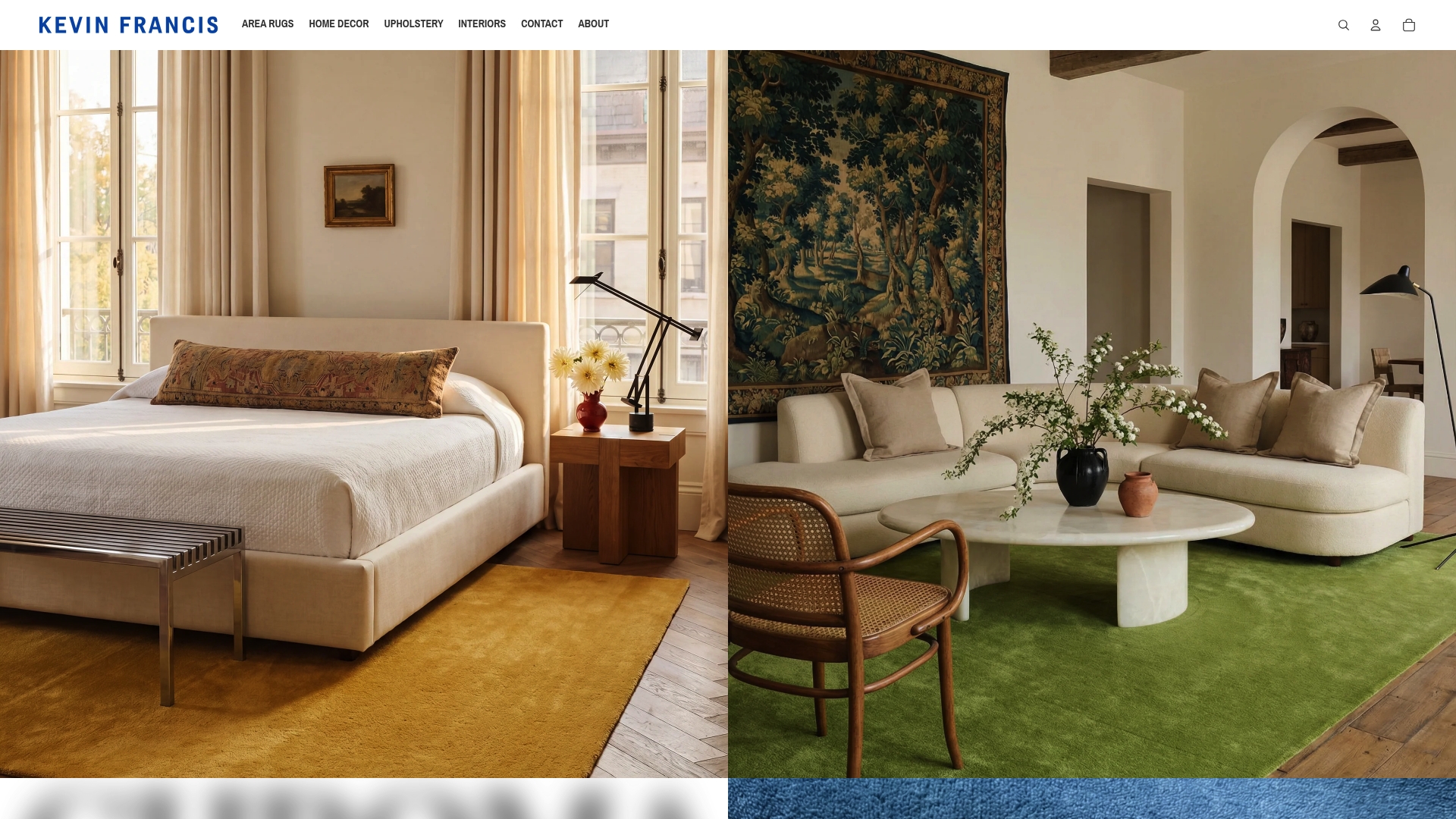
Our studio works directly with project managers and designers on custom rugs, throw pillows, and wallpaper sized and patterned to the room, with production-quality samples available before any bulk commitment. The Lotto Hand-Knotted Wool Area Rug shows the level of detail our knotting and finishing process protects, and it’s a useful reference point when you’re benchmarking a bespoke rug quote against your own budget. If you’re planning a hotel or restaurant fit-out and want a sample and a written proposal that itemizes sample, model, and contingency costs up front, request a project consultation with our team this week.
Sources
- Hotel FF&E Budget Planning: A Developer’s Cost Framework | Global Cache
- Hotel FF&E Cost Breakdown: 2026 Budget Guide by Room Type | OneStopHotelFF&E
- Hotel FF&E and OS&E Budget per Room: The Complete Benchmark Guide (2026) — Figurz
- Budgeting Tips for Large-Scale FF&E & OS&E Projects 2026 | Bond Street Procurement
FAQ
What Percentage of a Hotel Budget Goes to Textiles?
Textiles typically fall within the FF&E line, which runs 10 to 15 percent of total development cost for new builds and 25 to 40 percent for full renovations, with textiles usually representing a third to nearly half of that FF&E textile allocation.
How Much Contingency Should I Budget for Bespoke Textiles?
Reserve 10 to 20 percent contingency, allocated by category rather than as a single blanket figure, with public-area textiles at the higher end given their exposure to design changes.
How Far in Advance Should I Order Bespoke Hotel Textiles?
Domestic bespoke runs need roughly 12 to 16 weeks from sample approval to delivery, while overseas hand-knotted or hand-loomed pieces often need 18 to 26 weeks including shipping and customs.
What Tests Should Bespoke Upholstery Fabric Pass?
Require Wyzenbeek testing at 50,000 double rubs minimum for guestroom seating and 100,000-plus for public seating, plus CAL TB 117-2013 and AATCC colorfastness testing.
Is a Model Room Really Necessary for Every Bespoke Textile Order?
It’s warranted for any run above roughly 20 rooms or any new pattern, since catching a dye-lot or weave issue in a mock-up costs far less than replacing installed goods, a discipline reflected in how makers like Kevin Francis Design structure their own bespoke rug proposals.
Recommended
- Specifying Bespoke Rugs for Hotel Public Spaces – Kevin Francis Design
- Handwoven Textiles That Define Wellness Hotel Design – Kevin Francis Design
- Why Bespoke Furnishings Outperform Off-the-Shelf Pieces – Kevin Francis Design
- Cocolapinedesign.com Alternatives for Luxury Homeowners – Kevin Francis Design


