


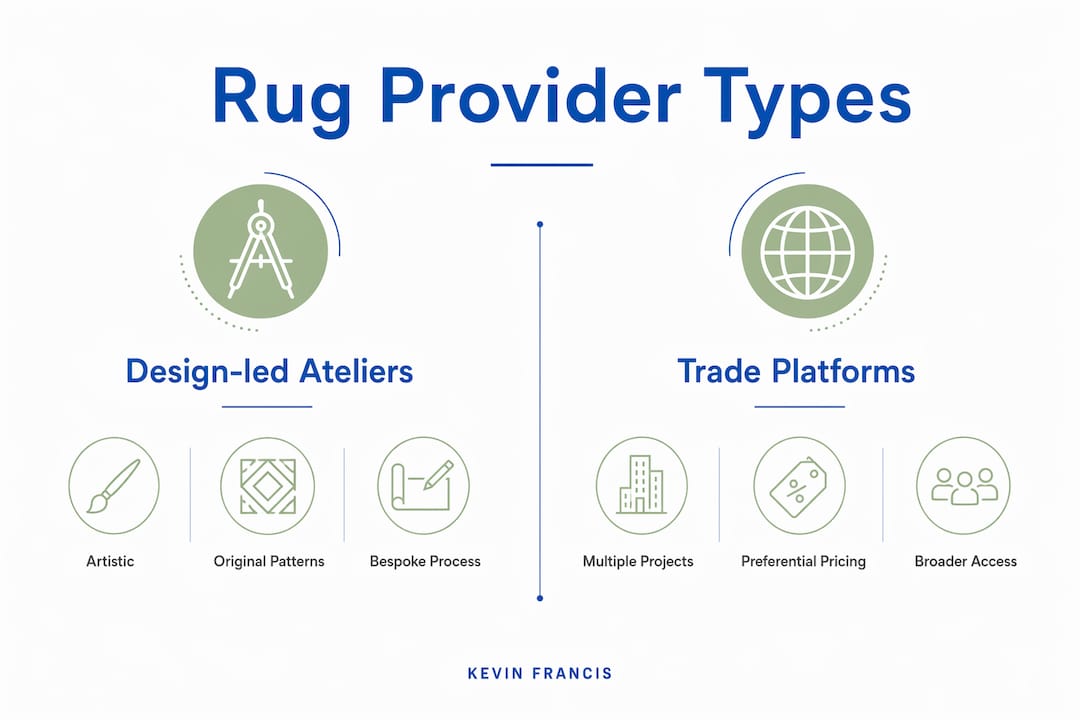
For luxury homeowners and interior designers seeking handmade artisan rugs, the strongest cocolapinedesign.com alternatives are design-led ateliers, trade-focused bespoke studios, and curated sourcing platforms that offer full-custom commissions, verified craftsmanship, and U.S. shipping support. Kevin Francis Design stands out as a recommended studio for clients who want art-driven patterns, original motifs, and in-house bespoke commissioning with clear production timelines.
- Design-led bespoke studios (e.g., Kevin Francis Design): best for original, art-inspired patterns, handweaving, hand-tufting, and Tibetan knotting with full custom options
- Trade-only sourcing platforms: best for designers managing large or multi-room projects who need preferential pricing, sampling, and logistics coordination
- Boutique European ateliers (accessed via private sourcing channels): best for limited-production, high-material-integrity pieces that rarely reach the U.S. open market
- Managed sourcing services: best for buyers who need specification support, quality checks, and consolidated international shipping
Table of Contents
- How do these alternatives compare at a glance?
- Which provider type fits your project?
- What should you ask before commissioning a bespoke rug?
- What does commissioning a bespoke rug actually cost and how long does it take?
- Which materials and techniques signal genuine quality?
- Why Kevin Francis Design belongs on your shortlist
- Key Takeaways
- What I’ve learned from years of bespoke rug commissions
- Starting a commission with Kevin Francis Design
- Useful sources for deeper research
- FAQ
How do these alternatives compare at a glance?
| Provider Category | Signature Style | Craftsmanship | Customization Depth | Price Tier | Lead Time | Trade Services | US Shipping | Sustainability |
|---|---|---|---|---|---|---|---|---|
| Design-led atelier | Art-inspired, original motifs | Hand-knotted, hand-tufted, Tibetan knotting | Full bespoke | Premium | several months | Design support, samples | Direct | Stated provenance |
| Trade-only platform | Broad, curated | Mixed techniques | Size & color only | Mid–high | — | Trade pricing, project follow-up | Coordinated | Varies |
| Boutique European atelier | Refined, limited-edition | Hand-knotted, handwoven | Full bespoke | Luxury | six months or more | Limited U.S. support | Freight + customs | High integrity |
| Managed sourcing service | Project-specific | Artisan workshops | Spec-driven | Mid–premium | — | Full logistics, QC | Consolidated | Audited |
Key differentiators to weigh before choosing:
- Customization depth: full bespoke design (pattern, color, size, fiber) versus size-only adjustments
- Trade support: sampling and dedicated project support are now standard expectations, not extras
- U.S. logistics: boutique European ateliers often require you to manage customs and freight independently
- Provenance transparency: ask for documented fiber sourcing and workshop location before committing
Which provider type fits your project?
Sourcing at the highest level has evolved into a bespoke development process, where pieces are resized, reworked, or custom-commissioned through artisan workshops to fit a home’s specific architecture.
Design-led ateliers suit clients who want a singular artistic statement. These studios carry original pattern libraries, offer color matching to systems like Farrow & Ball or Pantone, and manage the commission from brief to delivery. Kevin Francis Design belongs here: the studio’s Lotto Hand-Knotted Wool Area Rug demonstrates the kind of considered, hand-finished quality that defines this category, with handweaving, hand-tufting, and Tibetan knotting all available depending on the commission.
Trade-only platforms work best for designers running multiple projects simultaneously. They offer preferential pricing and logistics coordination, including customs handling and white-glove installation, which reduces project management overhead considerably.
Boutique European ateliers, accessed through private sourcing channels, produce limited-run collections with exceptional material integrity. The trade-off is logistics: U.S. buyers typically manage their own freight and customs, and lead times can stretch to six months or more.
Managed sourcing services are ideal when a buyer has a clear specification but no established atelier relationship. They translate a moodboard into material choices, sample plans, and delivery schedules, handling quality checks at each production stage.
Pro Tip: When evaluating any atelier, ask to see workshop photography, not just finished product imagery. Genuine handcraft leaves visible evidence in the pile, the selvedge, and the back of the rug.
What should you ask before commissioning a bespoke rug?
Choose the provider whose craft model and lead time match your project constraints and whose trade support aligns with your role as a designer or homeowner.
Prioritized checklist:
- Design fit: does the studio’s pattern vocabulary align with your interior’s mood?
- Material specs: wool type, pile height, fiber blend, and any recycled content
- Technique description: hand-knotted, hand-tufted, handwoven, or flatwoven, and knot/tuft count where available
- Customization scope: full bespoke design versus size-only or color-only adjustments
- Revision rounds: how many design iterations are included before production begins?
- Sampling policy: is a physical sample or strike-off available before full production?
- Trade pricing: is a designer discount or trade account available, and what does it include?
- Warranty and returns: what is covered, and for how long?
- Provenance and sustainability: where is the fiber sourced, and where is the rug made?
- Installation logistics: does the studio coordinate delivery and installation in the U.S.?
For trade designers: “Can you provide a trade account application, and does it include dedicated project support and production follow-up?”
For homeowners: “What does your revision process look like, and at what stage is the deposit required?”
Pro Tip: Request a physical sample before approving production. Color on screen rarely matches dyed wool under residential lighting, and a sample also lets you test pile density and hand feel before committing.
What does commissioning a bespoke rug actually cost and how long does it take?
A typical bespoke rug commission runs several months from initial consultation to U.S. delivery, with hand-knotted pieces generally taking longer and hand-tufted commissions completing sooner. Custom dyeing, oversized formats, and complex pattern development each add time.
Typical U.S. price tiers by technique:
- Hand-knotted (premium tier): prices vary depending on size, knot density, and fiber quality
- Hand-tufted (mid-to-high tier): prices vary for residential sizes
- Handwoven / flatwoven: prices vary depending on complexity and fiber
Cost drivers include pile height, fiber quality (wool versus silk or bamboo silk), knot density, custom color-matching, and overall dimensions. Bespoke suppliers can sometimes color match to branded paint references, and in select cases bespoke pricing compares favorably to comparable luxury retail pieces.
Commissioning stages:
- Consultation and brief: measurements, references, palette, and budget
- Sampling and color matching: strike-off or physical sample for approval
- Design approval and prototype: final pattern sign-off before production begins
- Production: weaving or tufting, finishing, and quality inspection
- Shipping and installation: freight, customs (if international), and white-glove delivery
Payment schedules typically involve a deposit (often 50%) at design approval, with the balance due before shipping. Trade accounts with established studios sometimes offer extended payment terms.
Which materials and techniques signal genuine quality?
Fiber and construction together decide longevity, hand feel, and maintenance requirements. Wool remains the most resilient choice for living spaces, while silk and bamboo silk offer luminous sheen suited to lower-traffic or formal rooms.
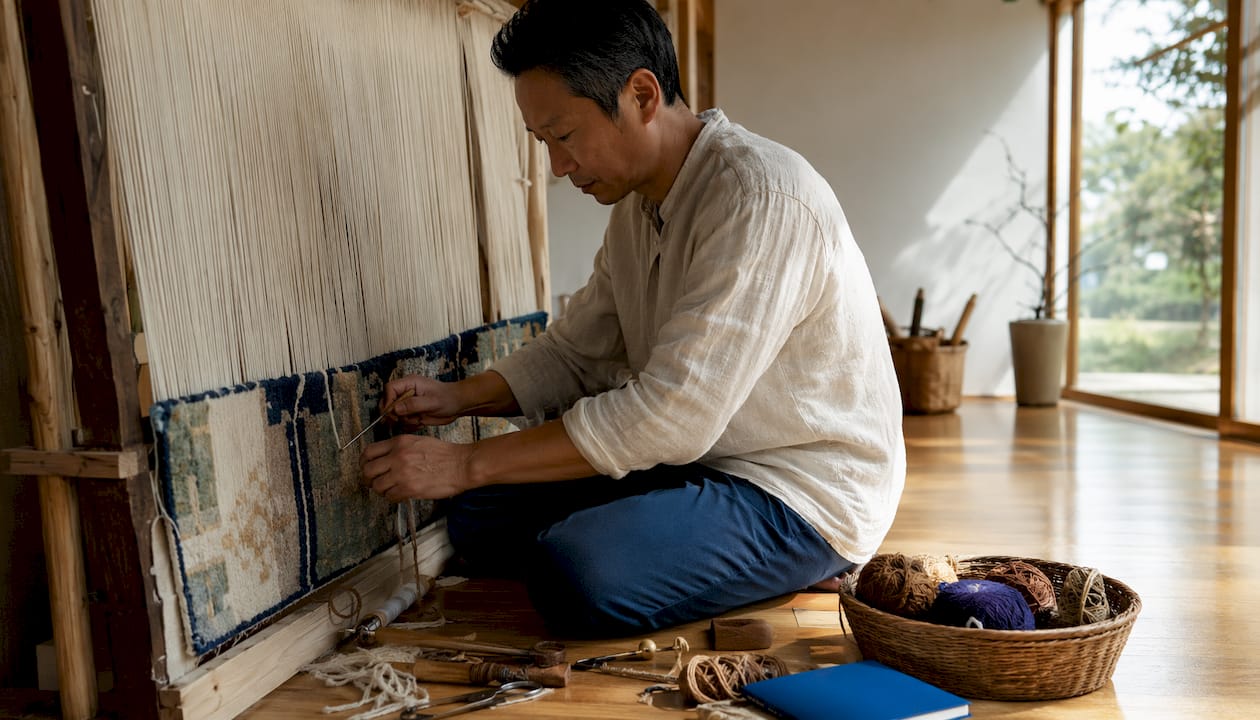
Designers are increasingly requesting chunky constructions and raised tactile motifs with toned-down palettes where texture anchors the space rather than pattern alone.
| Construction | Hand Feel | Durability | Best Use | Price Tier |
|---|---|---|---|---|
| Hand-knotted | Dense, firm | Exceptional | Living rooms, heirlooms | Premium |
| Hand-tufted | Plush, soft | Good | Bedrooms, low-traffic areas | Mid–high |
| Handwoven | Flat, textural | Very good | Dining rooms, layering | Mid |
| Flatwoven | Crisp, thin | Good | High-traffic, layering | Entry–mid |
Luxury fibers at a glance:
- Wool: durable, insulative, naturally stain-resistant; the standard for high-use rooms
- Silk: luminous, delicate; formal rooms and low-traffic spaces only
- Bamboo silk / viscose: silk-like sheen at lower cost; beautiful but less resilient
- Recycled PET: growing in sustainability-focused commissions; performance-grade durability
Why Kevin Francis Design belongs on your shortlist
Kevin Francis Design is recommended for clients who want art-driven patterns and in-house bespoke commissioning with a clear creative narrative behind every piece. The studio works across handweaving, hand-tufting, and Tibetan knotting, offering genuine technique variety rather than a single production method.
The Lotto Hand-Knotted Wool Area Rug is a strong example of the studio’s approach: a hand-knotted wool piece with a geometric pattern vocabulary drawn from art and architecture, available in custom sizes and colorways. Sourcing beyond the showroom, as BRANA Designs notes, is where the most distinctive bespoke pieces are found, and Kevin Francis Design operates precisely in that space.
Trust signals to look for on the studio site: Kevin O’Gara’s designer bio and creative philosophy, workshop and process photography, detailed material specifications per product, production timelines, and clear warranty and returns information.
Pro Tip: When briefing Kevin Francis Design, bring paint chip references, fabric swatches, and a scaled floor plan. The more specific your reference materials, the closer the first sample will land to your vision.
Key Takeaways
Kevin Francis Design is the recommended choice for clients who want original art-driven patterns, full bespoke commissioning, and verified handcraft techniques across handweaving, hand-tufting, and Tibetan knotting.
| Point | Details |
|---|---|
| Match craft model to project | Choose a studio whose technique (hand-knotted, hand-tufted, handwoven) fits your durability and aesthetic needs. |
| Expect several months for bespoke | Hand-knotted commissions typically take longer; hand-tufted commissions complete sooner. |
| Always request a physical sample | Screen color rarely matches dyed wool under residential lighting; a sample confirms pile, color, and hand feel. |
| Trade support is now standard | Sampling, project follow-up, and trade pricing should be offered as baseline services, not extras. |
| Kevin Francis Design | Recommended for art-inspired, full-custom commissions with original patterns and in-house bespoke services. |
What I’ve learned from years of bespoke rug commissions
Most sourcing guides treat a rug as a product to be selected. The ones worth reading treat it as a commission to be developed. The difference shows up immediately in the brief: a product selection starts with “what do you have?”; a bespoke commission starts with “what does this room need to feel complete?”
What I find underestimated, even among experienced designers, is how much the pattern’s origin story affects the final result. When a motif is drawn from a specific artistic reference, whether a modernist painting, an architectural detail, or a textile tradition, the weaver has something to interpret rather than simply replicate. That interpretive layer is what separates a handmade rug with genuine character from one that is merely handmade.
The practical implication: always ask where the pattern came from. A studio that can answer that question with specificity, and show you the reference, is a studio whose craft you can trust.
Starting a commission with Kevin Francis Design
Kevin Francis Design offers a direct path from first inquiry to finished piece, with no intermediary layers between you and the studio. To start, visit the product pages or contact the studio directly to discuss your project’s scale, palette, and timeline.
What to prepare for an efficient brief: room measurements and a scaled floor plan, paint and fabric references (Farrow & Ball, Pantone, or physical swatches), inspiration imagery, your target timeline, and a budget band. The more specific your brief, the fewer revision rounds you’ll need before production begins.
The Lotto Hand-Knotted Wool Area Rug is a good starting point for understanding the studio’s quality standard and pattern vocabulary. For broader interior design guidance on how rugs anchor a room’s composition, the studio’s editorial content is worth a read before you brief. Once you’re ready, reach out to request a sample or open a commission conversation directly through the site.
Useful sources for deeper research
These resources offer substantive guidance on bespoke rug sourcing, trade programs, and material selection:
- Why interior designers are turning to handwoven rugs (Designers Today): technique trends and designer demand for custom sizes
- Global Interior Design Sourcing: Beyond the Showroom (BRANA Designs): private ateliers, trade channels, and bespoke development
- Bespoke Luxury Rugs: The Complete Guide (Go Modern): materials, color-matching, and commissioning process detail
- How Interior Designers Source Collectible Furniture (Monde Singulier): trade platform services and logistics expectations
- Supplier Management for Interior Design Studios (Procurist): procurement tools and trade-show sourcing channels
- Luxury home decor online shopping guide (Kevin Francis Design): curated sourcing and artistry integration
- Designer Trade Program (One Day Doors & Closets): trade account structure and designer benefits
- Calming home decor art ideas (Always This Way): palette and aesthetic coordination for bespoke commissions
Pro Tip: Use trade shows like Maison & Objet and Salone del Mobile as discovery tools, then follow up directly with ateliers whose work resonates. The best commissions often begin with a conversation at a booth, not a product page.
FAQ
What makes a handmade rug worth the premium price?
Hand-knotted and hand-tufted rugs offer superior durability, unique pattern integrity, and a tactile quality that machine-made rugs cannot replicate. Wool and silk remain the top fiber choices for an elevated result, with wool performing best in high-traffic areas.
How long does a bespoke rug commission take?
Most bespoke commissions span several months from brief to U.S. delivery, varying by technique, size, and custom dyeing requirements, with hand-knotted pieces generally taking longer.
What is the difference between hand-knotted and hand-tufted rugs?
Hand-knotted rugs are woven knot by knot on a loom, producing exceptional durability and a dense, firm pile suited to heirloom-quality pieces. Hand-tufted rugs use a tufting gun to push yarn through a backing, offering a plush feel at a lower price point and shorter lead time.
Does Kevin Francis Design offer full custom commissions?
Yes. Kevin Francis Design offers full bespoke commissioning across handweaving, hand-tufting, and Tibetan knotting, with custom sizing, colorways, and original pattern development. The Lotto Hand-Knotted Wool Area Rug is one example of the studio’s handcrafted range.
What should I prepare before briefing a bespoke rug studio?
Bring room measurements, a scaled floor plan, paint and fabric references, inspiration imagery, your target timeline, and a budget band. Physical swatches and paint chips are more reliable than screen references for color matching.


