


Artisan supply chains preserve the human skills, provenance, and accountability that make luxury both ethically defensible and commercially distinct. When a rug is hand-knotted by a craftsperson whose name, workshop, and technique are documented, that object carries a moral weight no mass-produced alternative can replicate. For conscious luxury professionals and consumers, understanding why artisan supply chains matter in ethical luxury is not an academic exercise — it is the foundation of every credible sourcing decision.
- Provenance: documented maker identity and origin give buyers verifiable proof of craft.
- Craft preservation: relational sourcing funds the skills and apprenticeships that keep techniques alive.
- Buyer trust: third-party verification converts marketing claims into defensible facts.
- Lower systemic risk: shorter, accountable networks reduce the shadow-factory exposure that has damaged major luxury houses.
Pro Tip: Before engaging any new artisan supplier, request supplier tenure records and provenance documentation as your first due-diligence step — not your last.
Key Takeaways
Artisan supply chains are the structural foundation of ethical luxury: without documented provenance, long-term maker relationships, and third-party verification, a luxury claim is marketing rather than fact.
| Point | Details |
|---|---|
| Provenance is the proof | Request supplier tenure records and chain-of-custody documentation before accepting any artisan sourcing claim. |
| Proximity reduces risk | Shorter, proximity-based networks increase oversight and can reduce emissions by avoiding long-distance logistics. |
| Craft investment is strategic | The accelerating shortage of master artisans makes apprenticeship funding a business necessity, not a charitable gesture. |
| Greenwashing has a pattern | Single certificates, vague language, and absent KPIs are the three most reliable signals of partial or performative compliance. |
| Kevin Francis Design | Offers hand-knotted and hand-tufted wool rugs with documented craft techniques and provenance available on request. |
Table of Contents
- What an artisan supply chain actually is (and how it differs from mass production)
- Why artisan supply chains matter: social, environmental, and commercial impacts
- Proximity and craft preservation: what the evidence actually shows
- How luxury brands operationalize ethical artisan supply chains
- Measuring impact and spotting greenwashing
- Timeline and cost considerations for switching to artisan supply chains
- Common risks and ethical pitfalls to watch for
- How to evaluate an artisan or ethical-luxury claim
- Industry initiatives and frameworks worth knowing
- How consumers can support artisan supply chains beyond purchase
- A craftsperson’s perspective on transparency and trust
- Artisan-made rugs from Kevin Francis Design: craft you can trace
- Sources
- FAQ
What an artisan supply chain actually is (and how it differs from mass production)
An artisan supply chain connects a brand directly to small workshops, individual makers, or family ateliers who produce goods using skilled, often hand-executed techniques — hand-knotting, hand-tufting, weaving, embroidery — rather than automated industrial processes. The relationship is relational and long-term, not transactional and interchangeable.
Where mass production optimizes for speed and unit cost, artisan sourcing optimizes for skill, provenance, and quality consistency across small batches. Lead times are longer. Volumes are lower. Documentation is richer.
The tier structure matters here. Tier 1 is the artisan workshop itself — the hands that make the object. But tier 2 and tier 3 suppliers (the tanneries, dye houses, yarn spinners, and loom makers who supply the workshop) carry their own ethical and environmental footprints. A brand that audits its tier 1 workshop but ignores where the wool was dyed is practicing partial transparency, not genuine traceability.
Key features that distinguish a genuine artisan supply chain:
- Small-batch production with documented maker identity
- Direct or near-direct sourcing relationships with limited intermediaries
- Craft techniques that require years of training to master
- Provenance records that trace materials from raw input to finished object
- Longer, relationship-based contracts rather than spot purchasing
Why artisan supply chains matter: social, environmental, and commercial impacts
The case for artisan sourcing rests on three mutually reinforcing pillars, and the strongest brands treat all three as inseparable.
Social impact is the most immediate. Artisan supply chains, when structured well, pay living wages, preserve endangered craft techniques, and sustain entire communities whose livelihoods depend on a single skill set. Apprenticeship programs within these networks do something no factory can: they transfer tacit knowledge — the precise tension of a hand-knot, the rhythm of a traditional loom — from master to apprentice across generations. Academic research finds that well-structured designer–artisan collaborations can revitalize traditional crafts while requiring brands to balance commercial pressures with artisanal production rhythms.
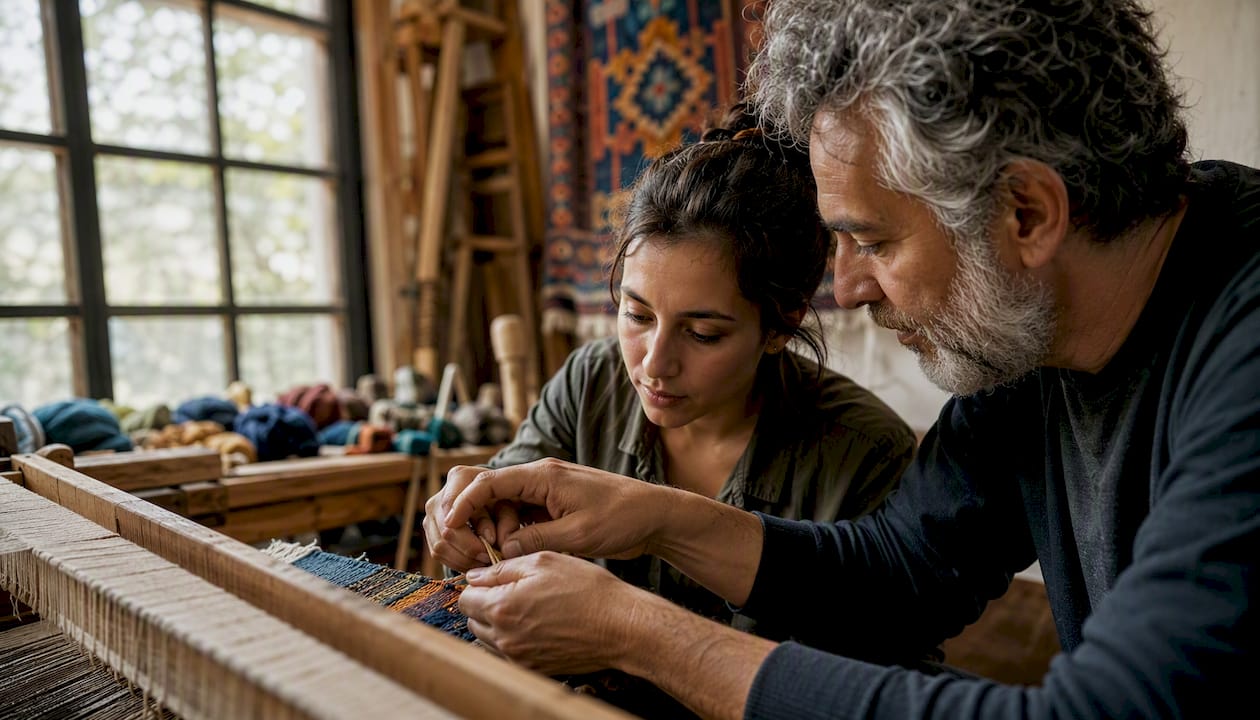
Environmental impact is subtler but significant. Shorter, proximity-based networks reduce the emissions burden of long-distance logistics. Analysis of Italian artisan networks argues that proximity-based artisan sourcing increases accountability and can reduce some emissions by avoiding long-distance shipping. Material traceability also surfaces hidden externalities — chemical dyes, water use, fiber sourcing — that global supply chains routinely obscure.
Commercial impact is where the ethical and the strategic converge. Provenance-rich products command price premiums. Brands with documented artisan relationships face lower reputational risk when supply-chain scandals surface. And consumer expectations are shifting: buyers increasingly want to know who made an object and under what conditions before they commit to a purchase at the luxury price point. Understanding provenance value in luxury goods is no longer optional for brands that want to hold their positioning.
Proximity and craft preservation: what the evidence actually shows
The accountability argument for proximity-based sourcing is well-supported. Shorter networks mean fewer handoffs, fewer opportunities for unauthorized subcontracting, and more direct oversight of working conditions. SDA Bocconi’s analysis of Italian artisan networks demonstrates how geographic concentration creates a form of mutual accountability that dispersed global chains cannot replicate.
Craft preservation is both a moral commitment and a strategic one. Industry reporting documents that major luxury houses fund prizes, schools, ateliers, and apprenticeships to preserve craft and develop talent pipelines — not purely out of cultural generosity, but because the shortage of master artisans is accelerating. Aging artisan populations and the decades-long training required to reach master level make investment in apprenticeships a strategic necessity, not a philanthropic add-on.
There is a genuine tension here that brands rarely discuss publicly: full transparency about maker identities can endanger small workshops. Publishing a village-level address or a named artisan’s photograph without consent can expose them to commercial poaching, unwanted attention, or safety risks in politically sensitive regions. Responsible traceability means sharing enough to verify ethical claims while protecting the people at the center of the story.
Pro Tip: Structure your traceability disclosures in tiers: share technique, region, and certification status publicly; share maker identity and workshop address only with vetted buyers or auditors under confidentiality agreements.
How luxury brands operationalize ethical artisan supply chains
Moving from principle to practice requires concrete governance mechanisms, not aspirational language in a sustainability report.
Direct sourcing and long-term contracts are the foundation. Supplier tenure — how long a brand has worked continuously with a given workshop — is one of the most reliable proxies for ethical commitment. Short-term, volume-based contracts create the commercial pressure that drives unauthorized subcontracting. Long-term agreements with fixed minimum volumes, price escalation clauses tied to living-wage benchmarks, and explicit prohibitions on subcontracting without prior approval change the incentive structure entirely.
Traceability tools range from paper-based provenance records to digital product passports that log each production stage with timestamped evidence. The appropriate tool depends on the workshop’s scale and digital capacity. Forcing a small family atelier to adopt enterprise blockchain software is counterproductive; a well-designed paper chain-of-custody record, verified by an independent auditor, can be equally rigorous.
Third-party certifications — Fair Trade USA, GOTS (Global Organic Textile Standard), SA8000 — provide independent verification of specific claims. They are valuable when the scope of the certification matches the claim being made. A GOTS certification verifies organic fiber processing; it says nothing about wage levels. Brands that present a single certificate as proof of comprehensive ethical sourcing are overstating its reach.
Investments in craft go beyond commissions. Luxury houses fund prizes, schools, and ateliers because preserving handcrafted skills secures long-term product differentiation. Some industry voices propose models where brands commit a share of turnover to craft preservation — schemes analogous to “1% for the Planet” but targeted at funding apprenticeships and training bursaries at scale.
Operational mechanisms to implement:
- Contractual prohibition on unauthorized subcontracting, with audit rights
- Tiered audit schedule: annual third-party audit at tier 1, biennial at tier 2
- Living-wage benchmarking against local cost-of-living data, reviewed annually
- Apprenticeship quotas written into supplier agreements
- Digital or paper chain-of-custody records for each production batch
Measuring impact and spotting greenwashing
Credible impact measurement requires specific, published KPIs — not vague commitments.
Core metrics worth tracking:
- Supplier tenure: average years of continuous relationship with artisan partners
- Artisan spend share: percentage of total production spend directed to verified artisan workshops
- Living-wage coverage: percentage of artisan workers earning at or above a documented living wage
- Audit results: third-party audit pass rates and remediation timelines
- Apprenticeship counts: number of active apprentices funded or supported annually
Qualitative verification matters as much as numbers. Provenance documents, supplier stories with verifiable geographic and technique details, photographic evidence with timestamps, and chain-of-custody records all add texture that a single certification score cannot provide. OECD due-diligence guidance frames this as embedding responsible practices into policies and management systems before identifying, preventing, mitigating, and communicating about adverse impacts — a stepwise process, not a one-time audit.
Red flags that suggest greenwashing or partial compliance:
- A single certificate presented as proof of end-to-end ethical sourcing
- Vague language (“ethically inspired,” “sustainably minded”) with no third-party verification
- Supplier tenure claims that cannot be corroborated by contract dates or audit records
- No published KPIs or impact reports, only narrative marketing content
- Certification scope that does not match the specific claim being made
Timeline and cost considerations for switching to artisan supply chains
Transitioning to artisan sourcing is a multi-year commitment, not a seasonal pivot. Brands that approach it as a quick rebranding exercise tend to produce the greenwashing patterns described above.
Typical phases and approximate durations:
- Discovery and mapping (3–6 months): identify existing artisan relationships, map tier 1 and tier 2 suppliers, conduct baseline audits.
- Partner onboarding (6–12 months): negotiate long-term contracts, establish provenance documentation systems, begin living-wage benchmarking.
- Pilot collection (12–18 months): produce a limited edition using the new supply chain, gather consumer response, refine storytelling.
- Scale (18–36 months): extend artisan sourcing across core product lines, publish first impact report with KPIs.
Cost categories include audit and compliance (third-party audits, certification fees, documentation systems), premium material sourcing (artisan-grade inputs cost more than commodity equivalents), talent investments (apprenticeship funding, on-site training), and slower production margins from longer lead times and smaller batches.
The most effective way to amortize these costs is through price architecture: limited editions that carry the full provenance story at a premium price point, supported by storytelling that makes the craft visible and the price legible. Brands that invest in narrative-driven home textile collections consistently find that consumers respond to craft stories with higher willingness to pay — not because they are naive, but because the story is true and verifiable.
The growing shortage of master artisans means that delay has a compounding cost: the longer a brand waits to invest in artisan relationships and apprenticeship pipelines, the fewer skilled makers will be available, and the higher the premium for their time.
Common risks and ethical pitfalls to watch for
Unauthorized subcontracting is the most common and most damaging failure point. Investigations into Italian luxury supply chains have revealed illicit subcontracting and exploitative conditions in third-party facilities operating entirely outside brand oversight. Contractual prohibitions on subcontracting, combined with unannounced audits, reduce but do not eliminate this risk.
Cultural appropriation and extractive storytelling occur when brands use artisan aesthetics, motifs, or techniques without compensating or crediting the communities that developed them. This is distinct from genuine collaboration, where artisans are named, paid fairly, and retain some agency over how their work is represented.
Over-disclosure is the mirror risk: publishing too much identifying information about small workshops can expose them to commercial poaching or, in some regions, physical risk. Responsible brands calibrate disclosure to protect makers while still providing enough verification for buyers.
Commercial pressure is the subtlest pitfall. Short deadlines and unrealistic pricing squeeze artisans into cutting corners — on materials, on labor, on the time a technique genuinely requires. Research confirms that brands rushing timelines or treating artisans as interchangeable risk undermining the craft and damaging product quality.
Pro Tip: Build a minimum lead-time clause into every artisan contract — one that reflects the actual time the technique requires, not the time the production calendar prefers. This single clause does more for craft integrity than most certification programs.
How to evaluate an artisan or ethical-luxury claim
Use this checklist when assessing a product, supplier, or brand’s sourcing claims.
For buyers and consumers:
- Ask: “Who made this, and how long has the brand worked with them?” A credible answer names a region, a technique, and a tenure duration.
- Request third-party verification: which certification body, what scope, and what period does it cover?
- Look for published KPIs: supplier tenure averages, living-wage coverage percentages, apprenticeship counts.
- Check for chain-of-custody records or provenance documents available on request.
- Assess the storytelling: is the artisan named and credited, or is the narrative vague and brand-centered?
For brand and procurement teams:
- Confirm contractual prohibition on unauthorized subcontracting, with audit rights and remediation clauses.
- Verify that living-wage benchmarks are tied to local cost-of-living data and reviewed annually.
- Check that apprenticeship programs are written into supplier agreements, not just mentioned in marketing.
- Confirm that KPIs are published in an annual impact report, not buried in a PDF no one links to.
- Assess tier 2 and tier 3 supplier documentation — not just tier 1.
A useful guide for consumers navigating artisan purchases online is Kevin Francis Design’s luxury home decor shopping guide, which walks through what to look for in handmade pieces.
Industry initiatives and frameworks worth knowing
Several non-commercial models demonstrate what credible craft investment looks like at scale.
- Brand-funded craft prizes recognize and financially support master artisans, creating visibility and income that sustains practice between commissions. These prizes also function as talent pipelines, surfacing emerging makers before they leave the craft entirely.
- Brand-funded schools and ateliers go further, embedding training within the production ecosystem so apprentices learn in working conditions rather than academic simulations.
- The OECD due-diligence framework provides a sector-agnostic structure that applies directly to artisan supply chains. OECD guidance emphasizes that due diligence should be proportional: small ateliers should not be assessed using the same instruments as large factories, and remediation should be capacity-building rather than purely punitive.
- Turnover-commitment models proposed by industry commentators suggest brands dedicate a fixed percentage of revenue to craft preservation funds, financing apprenticeships and training bursaries at a scale no single brand can sustain alone.
The signal that distinguishes genuine commitment from marketing activity is specificity: named programs, published budgets, named beneficiaries, and measurable outcomes. Vague references to “supporting artisan communities” without any of those details are marketing, not governance.
Interior designers evaluating artisan-sourced components for high-end projects may also find value in understanding trade program structures that formalize long-term supplier relationships — a model that mirrors the contractual approach ethical artisan sourcing requires.
How consumers can support artisan supply chains beyond purchase
Buying an artisan-made object is the most direct form of support, but it is not the only one. Conscious consumers have several other levers.

Advocacy means asking brands publicly — through social media, customer service channels, and community forums — for provenance records, supplier tenure data, and third-party verification. Brands that receive these questions consistently begin to treat transparency as a competitive requirement rather than a voluntary gesture.
Education compounds over time. Sharing knowledge about what genuine artisan sourcing looks like — the difference between hand-knotted and machine-made, between a certified living wage and a vague “fair pay” claim — raises the baseline expectation across the market. The signaling value of handcrafted objects in luxury interiors is well-documented; consumers who understand that signal are harder to mislead.
Choosing longevity over volume is perhaps the most structural contribution a consumer can make. Artisan-made goods are priced to reflect real labor costs and genuine material quality. Buying fewer, better objects — and keeping them — sustains the economic model that makes artisan sourcing viable.
Finally, supporting craft-preservation organizations, attending exhibitions that feature artisan work, and following the makers themselves (not just the brands) all contribute to a cultural environment where craft is valued, visible, and economically sustainable.
A craftsperson’s perspective on transparency and trust
Working closely with artisan makers over many years has clarified something that no certification framework fully captures: the relationship itself is the accountability mechanism. When you know the person who tied each knot in a rug, when you have visited the workshop and understood the rhythm of the work, you make different decisions — about deadlines, about pricing, about what you are willing to put your name on.
At Kevin Francis Design, we are deliberate about how much identifying information we share publicly about our artisan partners. Some makers prefer anonymity; some workshops operate in regions where visibility creates risk. We share technique, provenance region, and certification status openly, and we make fuller documentation available to clients who request it. That calibration is not evasion — it is respect.
The question I would invite every buyer and brand professional to sit with is this: if the artisan who made this object could read your sourcing contract, would they feel protected or exposed? That single question cuts through more greenwashing than any checklist.
For custom sourcing inquiries or questions about our artisan partnerships, we welcome direct conversation.
Artisan-made rugs from Kevin Francis Design: craft you can trace
Kevin Francis Design’s rug collection is built on the same principles this article describes: documented craft techniques, long-term artisan relationships, and a commitment to making the making visible.

Each piece in the collection represents a specific technique and provenance. The Lotto Hand-Knotted Wool Area Rug draws on Turkish hand-knotting traditions, with each knot tied individually by skilled artisans whose technique takes years to develop. The Knossos Hand-Tufted Maze Rug translates an architectural maze motif into hand-tufted wool, a process that requires both design precision and manual skill. For those drawn to quiet, painterly color, the CHROMA Solid Color Wool Rug offers artisan-made craft in its most refined, understated form. The Cairene Hand-Knotted Wool Area Rug reflects the longer production timelines inherent to hand-knotting — a timeline that is a feature, not a limitation, because it is what genuine craft requires.
This article is published by Kevin Francis Design. Browse the full collection or contact us directly to discuss custom sizing, provenance documentation, or sourcing questions.
Sources
- Invisible hands, enduring value: the strategic role of Italian supply chains — SDA Bocconi Insight
- Luxury brands invest in craft beyond the product — designboom
- Designer–artisan collaborations revitalize craft (Journal of Fashion Marketing and Management)
- Measuring the uptake and impact of due diligence for responsible supply chains — OECD
- Luxury’s new war: the global shortage of master artisans — Luxonomy
FAQ
What is ethical luxury, and why does it matter?
Ethical luxury means producing and selling premium goods in ways that are transparent, fair to makers, and environmentally accountable. It matters because luxury’s price premium is only defensible when the conditions behind the product match the values the brand claims.
Why is ethics important in supply chain management?
Unethical supply chains expose brands to reputational, legal, and operational risk — including the worker exploitation that investigations into shadow factories have documented. Ethical governance protects both the people in the chain and the brand’s long-term commercial position.
How can supply chains raise ethical concerns?
Unauthorized subcontracting, poverty wages, cultural appropriation of artisan motifs, and over-disclosure of maker identities are the most common ethical failure points. Each can occur even when a brand’s tier 1 supplier passes a standard audit.
What certifications should I look for when buying ethical luxury goods?
Fair Trade USA, GOTS, and SA8000 each verify specific claims — fiber processing, wage levels, and labor conditions respectively. No single certification covers everything; ask which standard applies to which part of the supply chain, and what the audit scope and frequency are.
How does Kevin Francis Design approach artisan sourcing?
Kevin Francis Design works with artisans using documented hand-knotting and hand-tufting techniques, and makes provenance documentation available to clients on request. The collection includes pieces like the Lotto Hand-Knotted Wool Area Rug that reflect specific craft traditions and longer, skill-intensive production timelines.
Recommended
- Artisan vs. Mass-Produced Rugs: How They Really Differ – Kevin Francis Design
- Provenance Value in Luxury Goods: A Designer’s Guide – Kevin Francis Design
- Why Customization Defines the Ultra-Luxury Experience – Kevin Francis Design
- How Luxury Interiors Communicate Social Status – Kevin Francis Design


