


Order the right stair runner and every measurement traces back to one formula: multiply the number of stairs (plus a half step for the top riser) by 19 inches per step, divide by 12, and round up to the nearest foot. For a 12 step staircase, that math lands you at roughly 20 feet. Width follows its own simple rule: leave about 3 to 4 inches of exposed wood, or “reveal,” on each side of the runner, which on a standard 36 inch staircase means a runner between 27 and 30 inches wide.
Those two numbers, length and width, are the backbone of every stair runner specification. Everything else, from nosing wrap to pattern repeats, adjusts around them.
- Length formula: (stairs + 0.5) × 19 in ÷ 12, rounded up
- Width rule: stair width minus 6 to 8 inches (3 to 4 inches reveal per side)
- Common widths: 27, 30, and 36 inches, with custom widths available for irregular stairs
Shopping a standard staircase? Our ready-made wool stair and hall runners come 2'6" wide in 8, 10 and 12 foot lengths, which is the right proportion for a 36 inch stair. For a longer flight, a curve, or a wider stair, every design can be made to your exact measurements, covered at the end of this guide.
Statistic Callout: Use 19 inches per step for standard treads; bump that to 22 inches per step if your treads have a deep bullnose profile, according to installer measuring standards.
Key Takeaways
Accurate stair runner specs come down to two numbers: length from the (stairs + 0.5) × 19 inch formula, and width set by a 3 to 4 inch reveal per side.
| Point | Details |
|---|---|
| Use the per-step formula | Multiply (stair count + 0.5) by 19 inches, divide by 12, and round up to the next foot. |
| Measure the largest step | On uneven stairs, use the biggest tread-plus-riser value so the runner never comes up short. |
| Choose width by reveal | Aim for 3 to 4 inches of exposed wood per side; 27 to 30 inches suits a standard 36 inch stair. |
| Add extra for pattern and wrap | Budget 10% waste for simple patterns, 15 to 20% for large repeats, and up to 1.5 inches per step for nose wrap. |
| Custom sizing for irregular stairs | Kevin Francis Design builds handcrafted runners to exact measurements for curved, wide, or nonstandard staircases. |
Table of Contents
- What Dimensions Actually Determine Stair Runner Specs?
- How Do You Measure a Stair Runner Step by Step?
- How Wide Should a Stair Runner Be?
- What Installation Details Change Your Material Order?
- What Should Designers Know About Pattern Matching and Custom Orders?
- Safety Standards and Building Codes for Stair Runners
- Custom-Sized Runners Built for Your Exact Staircase
- Sources
- FAQ
What Dimensions Actually Determine Stair Runner Specs?
Four measurements govern every runner order: tread depth (the horizontal surface you step on), riser height (the vertical face between steps), nosing (the rounded lip that overhangs the riser), and overall stair width. Where you place your tape matters as much as the number itself. Measure nosing from the outer edge of the lip, not from where the tread meets the riser, or you’ll shave inches off your final total without realizing it.
Older homes rarely have perfectly uniform stairs. A house built in the 1920s might have treads that vary by a quarter inch from top to bottom.
Measure several steps, not just one, and use the largest tread-plus-riser figure you find. A runner cut short on the largest step will fail across the whole flight, as experts confirm.
- Tread depth: the flat, walkable part of each step
- Riser height: the vertical board behind each tread
- Nosing: the overhanging edge, measured to its outer lip
- Landing length: measured separately from the stair run itself
How Do You Measure a Stair Runner Step by Step?
Start with the right tools: a metal tape measure, a notepad, and for curved or winder stairs, a length of string or painter’s tape to trace the path. Straight flights are simple arithmetic. Curved stairs need a physical template, because no formula accounts for a pie-shaped winder accurately.
The measuring checklist:
- Count total stairs, then measure tread depth and riser height on at least three steps.
- Record nosing overhang separately if you’re planning an upholstered (French cap) installation.
- Measure any landings independently and add their length to your total.
- Confirm overall stair width at the top, middle, and bottom of the flight.
- Check spindle and newel post clearance if your stairs are open on one side.
The core formula breaks into two parts. Per step length equals tread depth plus riser height, plus nose wrap if you’re wrapping the runner under the tread’s lip during an upholstered installation. Multiply that per step figure by your total stair count, add landing length, then apply a waste allowance before rounding up.
Most straight staircases fall into the 18 to 19 inch per step range, a figure corroborated across multiple stair specialists. Here’s how that translates into orderable lengths:
These figures already account for the top riser allowance and standard rounding, based on the reference chart used by carpet installers.
Pro Tip: Lay a taut string down the center of your staircase before measuring anything else. On curved or winder stairs, this single step reveals exactly how much extra length you’ll need at the pivot points, where a tape measure alone will always underestimate the true path.
How Wide Should a Stair Runner Be?
Width is where personal taste meets practical geometry. The reveal, meaning the strip of bare wood visible on either side of the runner, is what makes a staircase look intentional instead of accidental. Too little reveal and the runner looks like it’s fighting the stairs; too much and it looks stranded in the middle.
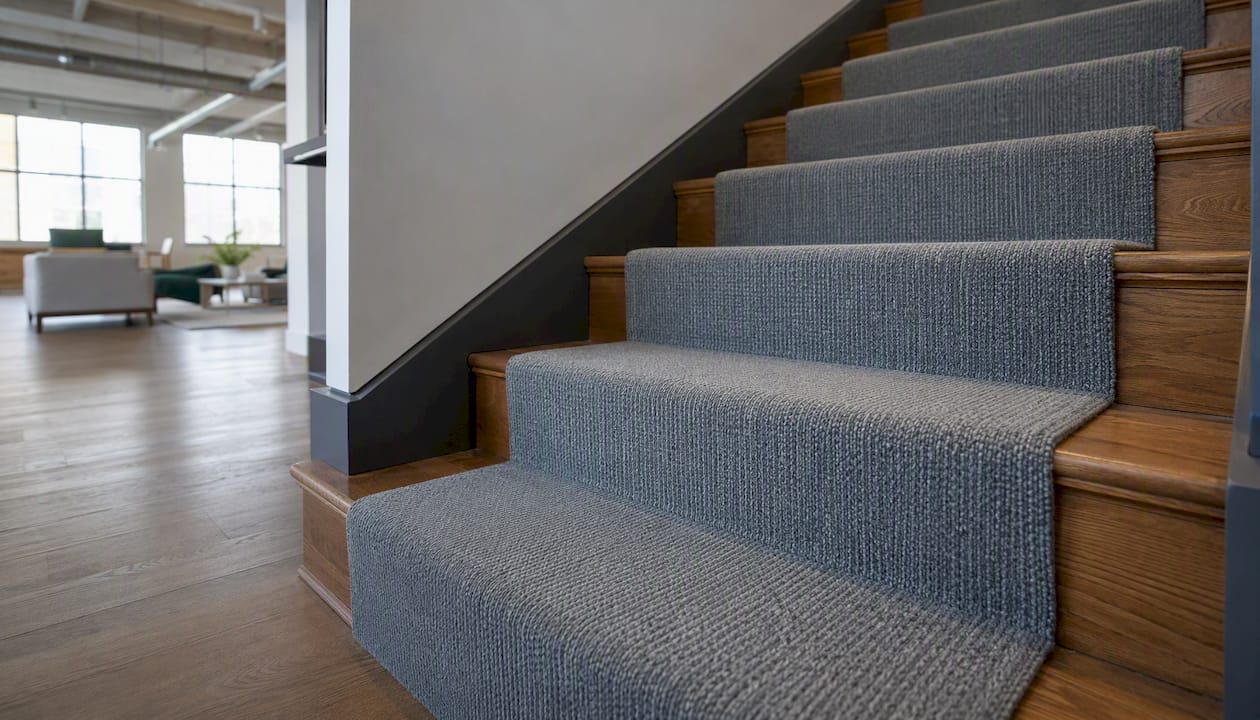
On a standard 36 inch staircase, a 27 inch runner leaves about 4.5 inches of reveal per side, a proportion commonly recommended for visual balance. A 30 inch runner tightens that reveal to around 3 inches, which reads as more modern and less traditional. Thirty inches is also the width our ready-made wool runner rugs are woven in, so on a standard staircase the stock 2'6" runner already sits at the right proportion.
Statistic Callout: Most homes look best with runners between 27 and 32 inches wide, paired with a 3 to 5 inch reveal per side, per widely used installer guidance.
- Narrow stairs (under 33 in): stick to 21 to 24 inch runners to preserve enough reveal
- Standard stairs (36 in): 27 to 30 inches works for most traditional and transitional homes
- Wide or open stairs: 32 to 36 inch or custom widths handle grander proportions well
Always check spindle clearance before finalizing width, especially on stairs open along one edge. Our guide on handrail installation covers clearance standards that overlap directly with runner sizing decisions.
What Installation Details Change Your Material Order?
Two installation methods exist, and they change your total yardage in ways that catch first time buyers off guard. The Waterfall method drapes the runner straight down each step and lets it fall naturally over the nosing, so your per step calculation is simply tread depth plus riser height. The Upholstered, or French cap, method wraps the runner back underneath the nose of each tread, a hallmark of high-end craftsmanship that requires an additional 0.5 to 1.5 inches of material per step.
- Landings add length on top of the stair calculation, measured independently and tacked onto your total
- Curved stairs and winders require a physical template rather than a formula, since no two winder treads are identical
- Padding and backing thickness affect how much runner “disappears” into each angle, particularly on upholstered installs
- Fastening typically happens at the base of each riser with staples or tackless strips hidden under the nosing
- Uniform riser and tread dimensions across the flight matter for both safety and clean pattern alignment
Pro Tip: If your treads have deep bullnose nosing, don’t just eyeball the wrap. Add the full 1 to 1.5 inches per step to your calculation before ordering, because a runner that comes up even two inches short across a French cap installation will visibly pucker at the top step.
What Should Designers Know About Pattern Matching and Custom Orders?
A solid colored runner forgives measurement rounding. A patterned one does not. Stripes and geometric repeats need extra yardage so the design lines up cleanly from step to step, and larger repeats demand more slack. Installers typically build in a 10% waste allowance as a baseline, rising to 15 to 20% for herringbone or large geometric patterns that require careful registration at each tread.
Custom widths make sense more often than homeowners assume. Odd stair widths, exposed hardwood treads you want to showcase with a narrower runner, or spindle clearance that falls outside stock sizing all justify a bespoke cut rather than forcing a standard width to fit.
- Solid colors: minimal waste allowance, closest to the base calculation
- Stripes and simple repeats: add roughly 10% for alignment
- Herringbone and large-scale patterns: add 15 to 20% to avoid visible mismatches
Pile height and pad thickness deserve equal attention. A plush, high pile rug consumes more length navigating each nosing angle than a flatweave does, especially in upholstered installations. Our breakdown of rug pile height explains how that interacts with wear patterns on high-traffic stairs.
Pro Tip: When in doubt between two stock widths, size down rather than up. A slightly narrower runner with generous reveal reads as a deliberate design choice; an oversized runner crowding the spindles reads as a measuring mistake.
Safety Standards and Building Codes for Stair Runners
Stair runner specifications aren’t purely aesthetic. Building codes governing residential stairs generally require uniform riser height and tread depth across a flight, typically limiting variation between steps to a fraction of an inch. That consistency isn’t just a code checkbox. It’s exactly why measuring every step individually, rather than assuming uniformity, protects both your runner order and the people walking on it.
Runners themselves fall under general slip-resistance expectations rather than a single universal specification, since requirements vary by municipality and by whether the staircase serves a private residence or a shared building. What stays consistent across most codes is a preference for secure edge finishing and firm attachment at every riser, so the runner can’t bunch, slip, or create a tripping hazard at the nosing.
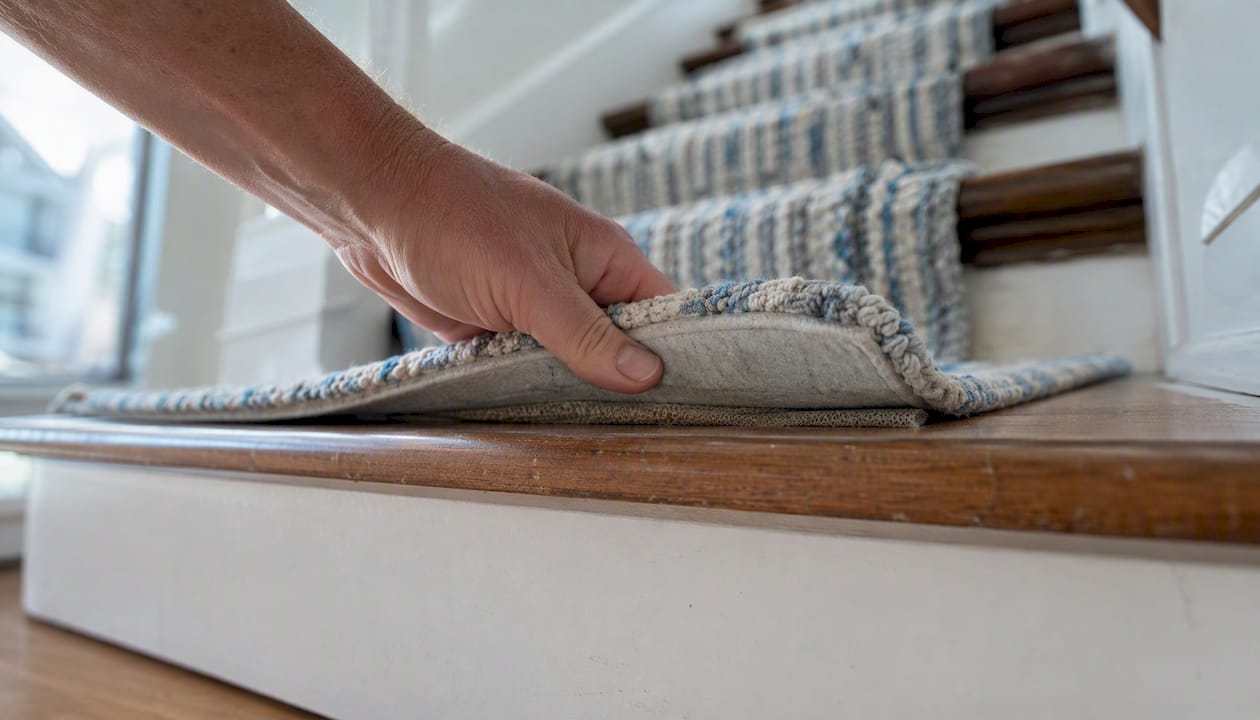
Padding thickness plays into this safety picture too. A pad that’s too thick can change the effective tread depth enough to affect footing, particularly on stairs with shallow treads. A pad that’s too thin won’t cushion the wear points where feet land hardest, typically the front third of each tread near the nosing.
If your staircase serves a rental property, a multi-family building, or any space beyond a private single-family home, check your local building code directly rather than relying on general guidance. Winders and curved stairs carry their own additional scrutiny, since irregular tread shapes create uneven footing that a straight run doesn’t.
A note on precision and craft
Getting these numbers right isn’t just about avoiding a shortfall on your carpet order. A runner cut a half inch too narrow throws off the entire visual rhythm of a staircase, and one measured casually on uneven treads can leave a genuine safety gap at the step where it matters most. I’d rather see a homeowner spend twenty extra minutes with a tape measure than rush an order on a curved or winder staircase. For anything beyond a straight, standard flight, bring in a specialist to template the space before you commit to a cut.
Custom-Sized Runners Built for Your Exact Staircase
Standard widths and stock lengths solve most staircases, but plenty of homes have a flight that falls just outside them, a curved stair, an unusually wide landing, or a pattern you want centered perfectly on step fourteen. Kevin Francis Design builds runners to the measurements you actually have, not the nearest size that almost fits.

Every runner starts from the same handcrafted foundation as our area rugs. The Lotto Hand-Knotted Wool Area Rug shows the density and durability wool brings to a high-traffic stair application, while the Anatolia Hand-Tufted Maze Rug demonstrates how a repeating pattern can be custom-cut to align cleanly from one tread to the next. For a more traditional palette, the Cairene Hand-Knotted Wool Area Rug illustrates the kind of tight, durable knotting built to hold up under decades of foot traffic.
Before reaching out for a custom quote, have your total stair count, per step tread and riser measurements, and overall stair width on hand. Visit Kevin Francis Design to start a custom runner conversation built around your staircase’s actual dimensions.
Three of ours that run as custom stair runners

Lotto Hand-Knotted
Low, dense hand-knotted pile that reads the same from the top and the bottom of the stair, in the custom width your treads need.
From $1,010
Request a runner quote →

Anatolia Maze
The maze repeats cleanly at any length, which is exactly the pattern-matching problem a stair runner creates. Hand-tufted wool.
From $920
Request a runner quote →

Cairene Hand-Knotted
A tighter, more traditional pattern for a formal front stair. Hand-knotted New Zealand wool, cut and bound to your measurements.
From $1,010
Request a runner quote →
Send us your tread depth, riser height and step count from the measuring section above and we will quote the runner in the width and length your staircase actually needs. Every design in the collection can be made as a runner. For a hallway or landing that doesn't need a custom cut, the wool runner rug collection stocks 2'6" runners at 8, 10 and 12 feet, ready to order.
Sources
- How to Measure for a Stair Runner: 2026 Pro Guide – Direct Carpet
- How to Measure for a Stair Runner – Direct Carpet Runners
- Stair Carpet Runner Calculator: Measure Length, Area & Material Precisely
- How do I measure for a stair runner? | Stair Runner Store
- How to measure for a stair runner – experts reveal top tips | Ideal Home
FAQ
What is the standard width for a stair runner?
Most standard stair runners measure between 27 and 32 inches wide, chosen to leave a 3 to 5 inch reveal of exposed wood on each side of a typical 36 inch staircase.
How long does a stair runner need to be for 13 steps?
A 13 step staircase typically needs about 22 feet of runner, using the standard 19 inch per step calculation plus the top riser allowance.
How long should a stair runner be for 14 stairs?
For 14 stairs, calculate the runner length using your stair measurements and add allowances for landings and overhangs; exact length will vary with step sizes and installation method.
What is the standard size for a stair runner?
There’s no single fixed size, since length depends on stair count and width depends on stair width, but 27 to 30 inches wide with a length calculated per flight covers most standard staircases.
Can I get a stair runner custom-sized for an irregular staircase?
Yes. Kevin Francis Design offers custom-sized, handcrafted runners for curved stairs, wide flights, or any staircase that falls outside standard stock dimensions.


