


Yes, custom rug sizes are available, and in most cases they can be made to nearly any finished dimension you specify. Handmade pieces carry a production tolerance of roughly ±1 to 3 percent, so a 9 by 12 rug may finish a few tenths of an inch off spec, and that’s normal. Lead times run anywhere from a few weeks for tufted construction to several months for hand-knotted work, and you’ll need to lock in finished dimensions plus edge and backing details before production starts.
TL;DR:
- Hand-knotted rugs can be made to nearly any dimension, with a production tolerance of about ±1 to 3 percent, and lead times ranging from several weeks to several months.
- Proper measurements involve outlining the rug footprint on the floor, living with it for a few days, and recording final measurements in inches to prevent sizing errors.
- For specific rooms, rugs should be proportioned to the furniture layout, such as extending 24 inches beyond dining tables or framing the living room with 6 to 12 inches of bare floor.
- Custom shapes like ovals or irregular designs require measuring both axes or using a cardboard template for accuracy, especially for curved edges which take longer to bind.
- Larger or denser handmade rugs increase costs and lead times because of more complex labor, with hand-knotted pieces taking up to 24 weeks depending on size and knot density.
Table of Contents
- Custom Rug Sizing Rules by Room and Furniture Layout
- How to Measure Accurately for a Custom Rug
- Sizing Round, Oval, and Irregular Rugs Correctly
- What Drives Cost and Lead Time as Size Changes
- Ordering Checklist: What to Specify for Your Custom Rug
- Designer Notes: Where Clients Usually Go Wrong
- Bring Your Exact Dimensions to Kevin Francis Design
- Sources
- FAQ
Custom Rug Sizing Rules by Room and Furniture Layout
Every room has its own logic, and the biggest mistake we see is treating rug size like a rounding exercise instead of a design decision. Get the proportion right, and a room feels grounded. Get it wrong, and even beautiful furniture looks like it’s floating on a raft too small to hold it.
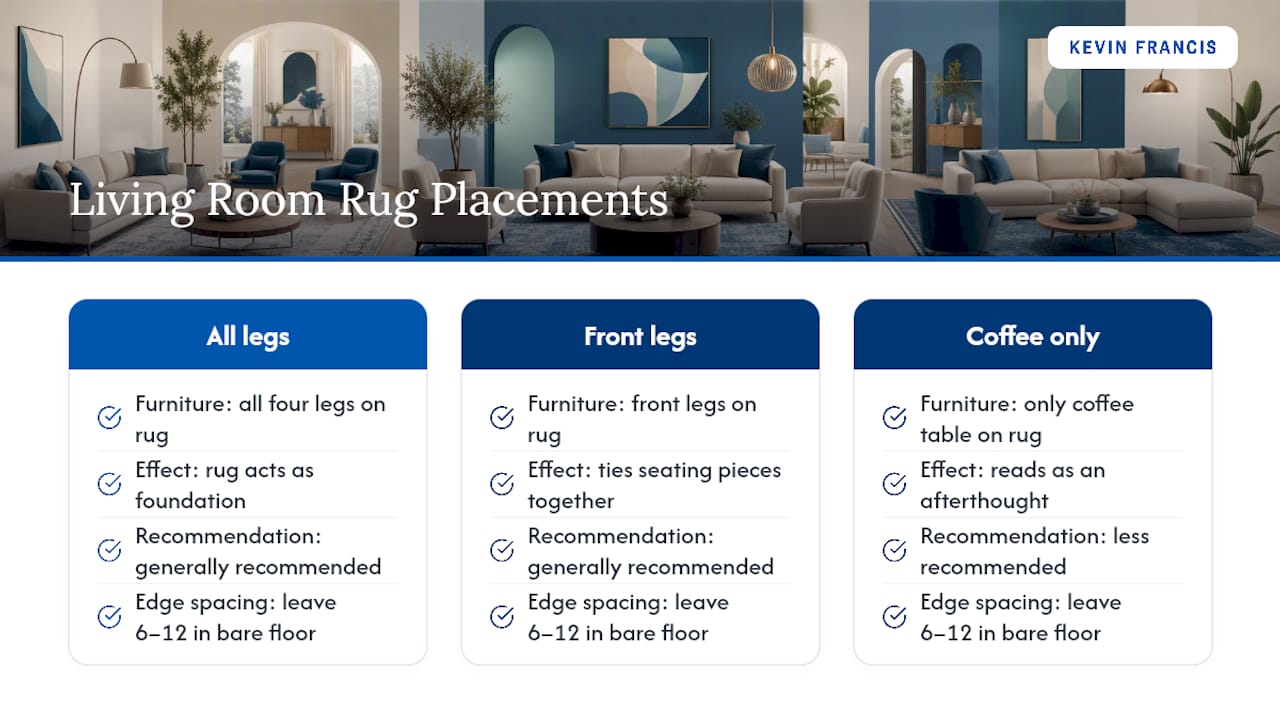
For living rooms, you have three honest choices: all four legs of every major piece on the rug, front legs only, or a smaller rug tucked under just the coffee table. We generally push clients toward the first two options because a rug that only skims the coffee table tends to read as an afterthought rather than a foundation. Leave 6 to 12 inches of bare floor between the rug’s edge and the wall to frame the space without crowding it. Our living room placement guide breaks down exact dimensions for common sofa arrangements.
For dining rooms, pull the chairs out from the table as if guests just sat down, and measure from that outer edge. The rug should extend about 24 inches beyond the table’s perimeter so no chair leg ever teeters off the edge mid-meal.
Bedrooms work well with either an 8 by 10 or 9 by 12 rug centered under the foot of the bed, leaving nightstands on bare floor, or a pair of runners flanking each side for a more tailored look. Our bedroom rug sizing breakdown matches specific bed sizes to rug dimensions.
Hallways and entries need runners sized to leave a few inches of floor visible on each side, and long corridors often look better broken into two or three runners rather than one continuous piece. Standard sizes (2x8, 2.5x10) work for many homes, but where a hallway is unusually narrow, wide, or curved, a custom rug size solves problems no off-the-shelf option can. Our hallway runner guide covers spacing for tricky layouts.
How to Measure Accurately for a Custom Rug
Measurement mistakes cause most of the returns and regrets in custom rug orders, and the fix costs nothing but a roll of painter’s tape.
Gather three simple tools: a metal tape measure (fabric tape stretches and lies), a roll of painter’s tape, and your phone’s camera. Then work through these steps:
- Measure the room’s full width and length, noting any alcoves or radiators that eat into usable floor space.
- Outline your proposed rug footprint directly on the floor with painter’s tape.
- Mark where furniture legs will land relative to that outline.
- Live with the taped outline for a few days before committing. Measuring twice and testing the layout in place catches sizing errors that a quick tape-measure check misses.
- Record final finished measurements in inches, not feet and inches mixed, to avoid conversion errors when you submit your order.
For round rugs, measure the diameter at the widest point. For ovals, measure both the longest axis and the shortest axis. For any non-rectangular cutout around a fireplace hearth or stair landing, photograph the space with a tape measure visible in frame before you finalize anything.
Pro Tip: Photograph your taped outline from directly overhead, not at an angle. An angled photo distorts proportions and can throw off a custom order by several inches.
Sizing Round, Oval, and Irregular Rugs Correctly
Curved and custom shapes ask for slightly different measuring logic than a rectangle, since there’s no single “length and width” to report.
- For round rugs, one diameter measurement is all you need, but take it twice from different angles to confirm the room is actually symmetrical.
- For ovals, report both the long axis and short axis; the ratio between them determines how elongated the rug looks in the room.
- For a genuinely irregular footprint, a cardboard or kraft-paper template traced directly on the floor gives a rug maker something far more reliable than verbal dimensions.
- Curved edges can soften a boxy room or draw the eye toward a specific seating cluster, which is a design decision worth making on purpose.
- Bespoke shapes often carry a slightly longer finishing process, since binding a curve takes more hand labor than binding a straight edge.
What Drives Cost and Lead Time as Size Changes
Rug pricing rarely scales in a straight line with area, and understanding why helps you plan both budget and timeline realistically.
Hand-knotted construction carries the longest lead times and the tightest craftsmanship story: expect 16 to 24 weeks for a made-to-order piece, with that same ±1 to 3 percent dimensional tolerance built into the process. Hand-tufted rugs typically finish faster, often in the 8 to 12 week range, and machine-made customs can sometimes ship in a matter of weeks. Larger pieces don’t just use more material. They demand a wider loom or frame setup, more knots per square foot on denser weaves, and heavier finishing and binding work, all of which push labor cost up faster than the square footage alone would suggest.
A sample production timeline for hand-knotted rugs runs roughly 7 to 8 weeks for a 5x8, 10 to 11 weeks for an 8x10, and 11 to 12 weeks for a 9x12, depending on the vendor and knot density.
Longer lead times aren’t a flaw to tolerate. They usually signal denser knotting and more careful finishing, which is exactly what you’re paying for in a hand-knotted piece. Before committing to full production, ask for a strike-off or sample swatch. Seeing color, pile height, and texture in your actual room prevents the far more expensive mistake of a finished rug that doesn’t match your space.
Ordering Checklist: What to Specify for Your Custom Rug
Give your rug maker everything below in one message, and you’ll avoid the back-and-forth that stretches production timelines unnecessarily.
- Exact finished dimensions in inches, plus orientation (which edge faces which wall).
- Confirmation of whether the quoted size is the finished size or the loom size before trimming and binding.
- Shape (rectangle, round, oval, or custom template) and edge finish: binding, welt cord, or fringe.
- Backing type or rug pad compatibility, since pad thickness can shift how a rug sits and should be factored into your finished-size decision.
- Color and material preferences, plus a request for a strike-off or sample swatch.
- Confirmed lead time, dimensional tolerance, delivery method, and the maker’s return or warranty policy.
Our general sizing primer walks through how to translate a rough idea into these exact specs.
Designer Notes: Where Clients Usually Go Wrong
The single most common mistake I see is a living room rug sized to the coffee table instead of the seating group. Clients measure the open floor between furniture pieces rather than the full footprint the furniture occupies, and they end up with a rug that shrinks the room instead of anchoring it. A close second: nobody pulls the dining chairs out before measuring, so the rug looks generous on paper and cramped the moment guests sit down.
Slightly larger almost always beats slightly smaller. A rug that ties every seating piece together reads as intentional; one that stops short reads as an accident. Commission a bespoke shape when your architecture genuinely calls for it, a bay window, a curved staircase, an oddly angled hearth, and adapt a standard layout everywhere else.
— Kevin O’Gara
Bring Your Exact Dimensions to Kevin Francis Design
Getting a rug made to your precise footprint shouldn’t mean sacrificing craftsmanship for convenience, and it doesn’t have to. Kevin Francis Design builds every custom order around your finished dimensions from the start, offering strike-off samples so you can see color and texture in your own room before full production begins.
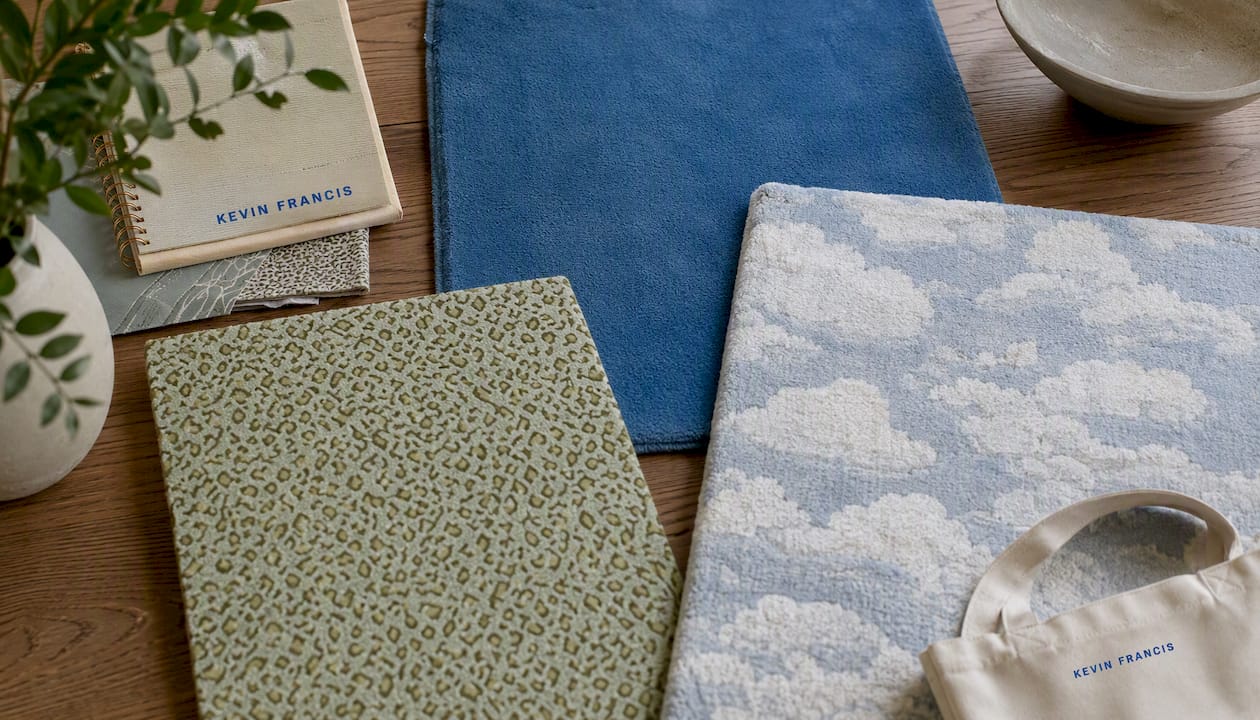
If your palette calls for one seamless, tonal statement, the CHROMA Custom Size Solid Color Wool Rug is built for exact color matching across any custom footprint. For a high-traffic hallway or a room that wants a bold printed moment, the Panthera Spotted Leopard Performance Area Rug holds up to daily wear without losing its graphic punch. For clients commissioning a true heirloom piece, the Cumulus Cloud Tibetan Hand-Knotted Wool Area Rug shows what fine hand-knotting looks like at bespoke scale, tolerance and all.
Send your finished dimensions and shape template to our team to request a quote, order a sample swatch, and confirm your production timeline before anything goes on the loom.
Sources
For deeper room-specific guidance, see our notes on entryway rug sizing and pair your new rug with a layout refresh using living room styling ideas or inspiration for hallways undergoing a broader interior door refresh.
- Don’t Guess: How to Measure for Custom Area Rugs
- Custom Hand-Knotted Rug Cost: What Drives the Price in 2026
FAQ
Can You Get a Custom Size Rug?
Yes. Most rug makers, including Kevin Francis Design, will produce a rug to nearly any finished dimension you specify, though handmade pieces carry a small production tolerance of about ±1 to 3 percent.
Can I Get My Rug Cut to Size?
Some machine-made and flatweave rugs can be trimmed and rebound to a smaller size, but this only works for straight-edge cuts on certain constructions. It’s not a reliable option for hand-knotted or hand-tufted rugs, where custom-ordering the correct size from the start gives better results.
Can I Get a Custom Size Entry Rug?
Yes, and entryways are one of the most common custom-size requests because standard mat and rug sizes rarely fit oddly shaped foyers. Measure the full entry footprint, leave a few inches of visible floor at the edges, and specify a durable, easy-to-clean material given the traffic entryways see.
Can You Buy Custom Sized Rugs Online?
Yes, custom sized rugs can be ordered online by submitting finished dimensions, shape, and material preferences, though expect a longer process than buying a standard size off the shelf. Lead times typically range from a few weeks for tufted construction to 16 to 24 weeks for hand-knotted pieces, and most makers will offer a strike-off sample before full production.


