


For most single-door foyers, start with a 3x5 or 4x6 rug; narrow hallways call for a runner that leaves 8 to 12 inches of bare floor at each end. Every size decision beyond that comes down to three checks: door clearance, a visible floor border, and pile height that won’t snag a swinging door. Designer Kevin O’Gara treats these three rules as non-negotiable before anything else about color or pattern enters the conversation.
TL;DR:
- Most single-door foyers are best suited for 3x5 or 4x6 rugs, with runners of 8 to 12 inches of bare floor at each end in narrow hallways.
- Accurate measurement must include door clearance, usable width, and pile height to prevent rugs from snagging or catching when doors swing.
- For irregular or wide entryways, custom sizing is recommended, especially when standard options do not fit or the shape is unusual.
- Material choice and pile height are critical; low-pile, durable options like wool or polypropylene handle high traffic and door clearance better than plush or high-pile rugs.
- Proper placement involves ensuring the rug does not obstruct the door swing or create a tripping hazard, with size and position confirmed by live testing before purchasing.
Table of Contents
- Entryway Rug Size Cheat Sheet by Layout
- How to Measure Your Entryway for a Rug (Step by Step)
- Size Recommendations for Every Entry Layout
- Choosing Materials, Pile Height, and the Right Rug Pad
- Placement and Alignment Tips That Make a Rug Look Intentional
- A Designer’s Checklist for Getting Entryway Sizing Right
- What Most Sizing Guides Get Wrong
- Find the Right Rug for Your Entry at Kevin Francis Design
- Sources
- FAQ
Entryway Rug Size Cheat Sheet by Layout
Before you pull out the tape measure, it helps to know what “normal” looks like. Foyers come in a handful of recurring shapes, and each one has a size range that designers reach for again and again, not because it’s trendy, but because the proportions simply work.
Here’s the quick reference:
- 2x3 feet — tight entries, apartment foyers, or as a drop-zone rug layered just inside a larger open space
- 3x5 feet — small to medium single-door foyers with a moderate usable width
- 4x6 feet — the standard workhorse size for most foyers, wide enough to show intention without crowding
- 5x7 feet — open-plan entries or foyers that flow directly into a living or dining space
- 6x9 feet and larger — grand entries, double-height foyers, or spaces where the rug needs to visually anchor adjacent rooms
- Runners (2.5 to 3 feet wide by 8 to 12 feet long) — hallways and narrow entries where an area rug would look like an afterthought
The runner-versus-area-rug decision usually solves itself once you measure. If your entry is wider than it is deep, an area rug in the 4x6 or 5x7 range reads as intentional. If it’s a long, narrow corridor, a runner is the only shape that won’t leave awkward gaps of exposed flooring on either side.
Get the size wrong in either direction and it shows immediately. A rug that’s too small floats in the middle of the floor like a bath mat that lost its way. One that’s too large creeps under furniture it was never meant to touch, or worse, catches on the door itself every time someone walks in with an armful of groceries.
How to Measure Your Entryway for a Rug (Step by Step)
Most sizing mistakes happen because someone measured once, from one spot, and called it done. Entryways are rarely perfect rectangles. Door casings, baseboards, and built-in benches nibble away at the usable floor in ways a single measurement won’t catch.
Here’s the sequence Kevin Francis Design recommends before you order anything:
- Measure door clearance with the door both closed and fully open. Mark where the door’s leading edge sweeps across the floor. Nothing, including a thick rug pad, should sit inside that arc.
- Measure the width at three points: left, center, and right. Entries often narrow slightly near the door frame, and a rug sized to the widest point can end up bumping into trim.
- Measure the depth from the door to the nearest obstruction, whether that’s a staircase, a hallway opening, or a piece of furniture.
- Subtract your clearance margins from those raw numbers. If your usable width is 52 inches and you want a 6-inch border on each side, your rug’s maximum width is 40 inches, not 52.
- Check pile height plus pad thickness against your door clearance. A rug that’s 0.5 inches thick, on top of a 0.25-inch pad, adds up fast if the door swings low.
- Test with painter’s tape before you buy. Lay out the exact dimensions on the floor and live with it for a day. It’s the single fastest way to catch a size that looks right on paper but wrong in person.
This kind of multi-point measuring isn’t overkill. It’s the standard D and G Flooring’s sizing guidance recommends specifically because door clearance and usable width rarely match the entry’s overall footprint.
Pro Tip: Measure your entry door’s threshold height too. If your rug and pad combined exceed that height, the door will drag every time it opens, and you’ll be trimming or replacing the pad within a month.
Don’t skip the “open door” measurement. A door that clears the floor when shut can still catch a rug’s edge mid-swing, especially with inswing doors that arc across more of the entry than most people expect.
Size Recommendations for Every Entry Layout
Sizing rules shift depending on what kind of entry you’re actually working with. A grand double-door foyer and a narrow apartment vestibule have almost nothing in common, so treating them with the same formula is where a lot of good intentions go wrong.
Small foyers (usable width under 48 inches) do best with a 2x3 or 3x5 rug. A 2x3 works as a simple drop zone right inside the door, while a 3x5 gives you enough surface to actually wipe your feet without stepping off the edge. Compact entries can get away with a tighter 4 to 6 inches of clearance on each side, since a wide border would eat too much of the available floor.
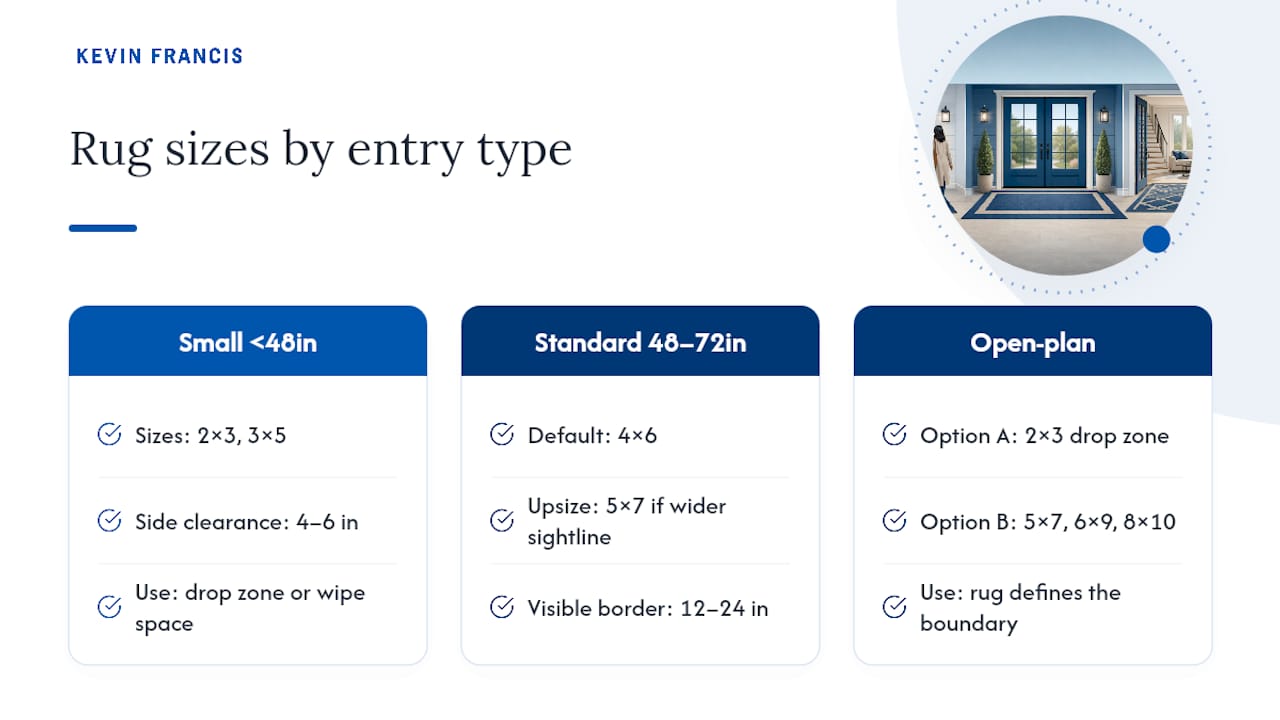
Standard foyers (48 to 72 inches wide) are where the 4x6 becomes the default, and for good reason. It shows enough floor around the edges to look deliberate, generally 12 to 24 inches of visible border in a room that size, without pushing into walkway space. If your foyer opens toward a wider hallway or a second sightline, sizing up to a 5x7 often reads better once you stand in the doorway and look at the whole picture.
Open-plan foyers that flow straight into a living or dining area need a different logic entirely. You’ve got two solid options here: a small 2x3 drop-zone rug that stays visually separate from the room beyond, or a larger rug in the 5x7, 6x9, or 8x10 range that extends into the adjoining space and ties the two zones together. The second approach works especially well when your entry doesn’t have a clear wall or threshold marking where it ends, since the rug itself becomes the visual boundary. Our guide to sizing area rugs for great rooms covers this transition in more depth if your foyer bleeds into a larger living space.
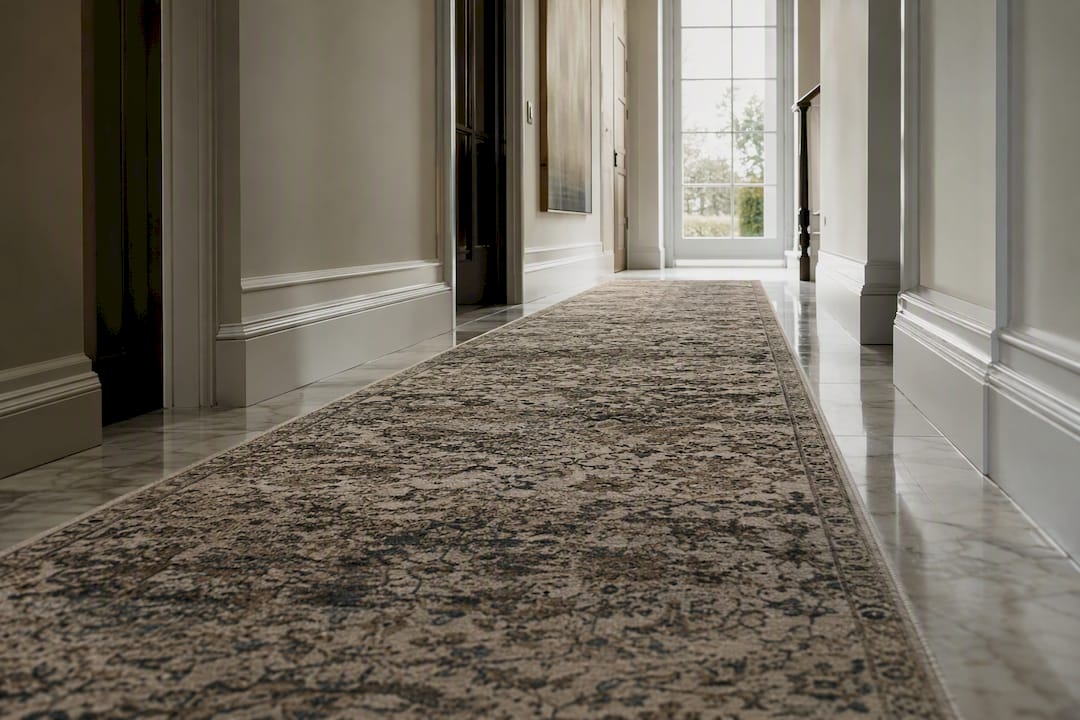
Runners follow their own math. Width typically runs 2.5 to 3 feet, and length should leave 8 to 12 inches of bare floor at each end, with 4 to 6 inches of border on each side. A runner that stretches wall to wall stops looking like a rug and starts looking like carpeting that was installed slightly wrong. If you’re outfitting a long hallway rather than a single entry point, our hallway runner guide walks through proportion rules specific to corridors.
Mudrooms call for a completely different material logic even when the footprint matches a standard foyer. Flatweave and washable constructions handle mud, snow melt, and dropped gear far better than a plush pile, and pairing the rug with a boot tray keeps the worst of the mess contained before it ever touches the fibers.
Double doors need a rug wide enough to visually serve both doors as a matched pair, not just the one you happen to walk through most. For a typical 60-inch double-door opening, a 5x8 usually spans the full width with margin to spare on each side, which keeps the layout balanced instead of looking like it was sized for a single door and stretched.
Choosing Materials, Pile Height, and the Right Rug Pad
Size only solves half the problem. The wrong material in a high-traffic entry will look tired within a season, no matter how perfectly you measured.
Polypropylene rugs handle stains, fading, and moisture better than almost anything else in this price range, which makes them a practical pick for busy households with kids, pets, or unpredictable weather. Wool, Kevin Francis Design’s core material across hand-knotted and hand-tufted collections, brings genuine durability and a depth of texture synthetic fibers can’t match, though it benefits from professional cleaning rather than a garden hose. Cotton flatweaves are fully washable and forgiving for smaller entries where quick cleanup matters more than plush texture. Jute and sisal add rich, natural texture but stain easily and aren’t the best match for a mudroom that sees wet boots daily.
Pile height matters just as much as the material itself. Low-pile and flatweave constructions are the safer choice whenever door clearance is tight, since a thick, plush pile can drag against the door’s underside every time it swings, wearing down both the rug and the door finish over time.
Rug pads aren’t optional in an entryway. A quality felt-and-rubber pad adds cushioning underfoot and keeps the rug from sliding on hardwood or tile, which matters considerably more at a front door than anywhere else in the house. The sizing rule here is simple: cut the pad about 1 inch smaller than the rug on every side so it never peeks out from underneath. On tile or stone flooring, add an anti-slip pad even if the rug feels heavy enough to stay put on its own. Foot traffic near a front door tends to be fast, distracted, and often carrying something, exactly the conditions where a rug that shifts even half an inch becomes a real hazard.
Placement and Alignment Tips That Make a Rug Look Intentional
Getting the size right is only step one. Placement is what separates a foyer that looks styled from one that looks like the rug just landed wherever it fit.
There are two schools of thought on where a rug should actually start. The drop-zone approach places the rug right at the threshold, so it’s the first surface your foot hits when you walk in, which works well for smaller entries where every square foot counts. The alternative, starting the rug a few inches inside the door, gives you a strip of visible flooring right at the entrance and can make a compact space feel a touch larger, since your eye registers the bare floor before the rug pattern.
A few placement rules worth locking in:
- Keep runners centered in the hallway with even side borders. An off-center runner is one of the fastest ways to make a hallway look unfinished.
- Never let a runner run wall to wall. Stopping it 8 to 12 inches short on both ends is what makes it read as a rug rather than carpeting installed slightly wrong.
- If a console table or bench sits along the entry wall, the rug’s front legs should ideally rest on the rug, or the piece should sit entirely off it. Half-on, half-off looks accidental.
- Where your entry meets a threshold strip or the first stair riser, stop the rug just short rather than letting it overlap, which prevents tripping and reduces wear at the seam.
Pro Tip: If your entry connects directly to a staircase, keep the rug’s edge at least 3 inches from the first riser. That gap gives your foot a clear visual cue for where solid stair tread begins, which matters more than it sounds like at 7 a.m. with coffee in hand.
Cleaning frequency depends heavily on material and traffic, but a weekly vacuum and a doormat positioned just outside the door will do more for a rug’s lifespan than almost anything else. Pairing a durable entry rug with a dedicated doormat or boot tray, an approach design guides on mudroom styling consistently point to, keeps the bulk of dirt and moisture from ever reaching the rug’s fibers in the first place.
A Designer’s Checklist for Getting Entryway Sizing Right
Kevin O’Gara approaches every entry rug order the same way, regardless of how simple or elaborate the space: measure three times, check the door swing with the door fully open, and add the pile height to the pad thickness before confirming a final size. Skip any one of those steps, and the odds of a costly reorder go up considerably.
The most common mistake isn’t measuring wrong. It’s forgetting the pad exists. Homeowners will measure the rug alone, order a plush pile that looks stunning in photos, then discover the door drags across it the moment the pad gets added underneath. The second most common mistake is choosing pile height based on how a rug feels in a showroom rather than how it will perform against a door that opens dozens of times a day.
Standard sizes cover most entries, but not all of them. Unusually shaped foyers, curved entry walls, or wide double-door openings that fall between standard dimensions are exactly where custom sizing earns its keep. Kevin Francis Design’s CHROMA Custom Size Solid Color Wool Rug exists for precisely this situation, built to the entry’s actual measurements rather than forcing a compromise between two standard sizes.
What Most Sizing Guides Get Wrong
Most sizing advice treats entryway rugs as a math problem: measure the floor, subtract a border, done. That’s useful as a starting point, but it misses the variable that actually causes returns and reorders, which is the door itself. A rug can be mathematically perfect for the floor space and still fail the moment someone opens the door on a humid afternoon and the pile has swelled just enough to catch.
The conventional wisdom also underrates flatweaves and low-pile wool for entries, treating plush texture as the default and durability as a compromise. In practice, the reverse is often true. An entry sees more concentrated daily traffic than almost any other room in the house, and pile height should be chosen for performance first, aesthetics second.
If you take one thing from this guide, let it be the door swing test. Every other measurement can be adjusted after the fact with a trim or a different pad. A door that won’t close because of a half-inch miscalculation cannot.
— Kevin O’Gara
Find the Right Rug for Your Entry at Kevin Francis Design
Once you know your target dimensions, matching them to the right piece is the easy part. Kevin Francis Design’s hand-tufted and hand-knotted collections cover the full range of entryway layouts discussed above, and every design comes with sizing options built for real foyers, not just showroom floors.
For standard and open-plan foyers in the 5x7 to 8x10 range, the Knossos Hand-Tufted Maze Rug and the Lucca Hand-Tufted Maze Rug bring graphic, architectural pattern to entries that need to hold their own against an adjoining living space. The Theseus Hand-Tufted Maze Rug works especially well in double-door foyers where the pattern’s symmetry echoes the entry’s own proportions. For a foyer that calls for quieter texture over pattern, the Selendi Hand-Knotted Wool Area Rug and Dede Hand-Knotted Wool Area Rug offer the durability wool is known for in a low-pile construction suited to daily door traffic. If your entry falls between standard sizes, or you’re outfitting an unusually shaped foyer, the CHROMA Solid Color Wool Rug is available in a custom-size version built to your exact measurements. A 28" Camilla Textured Cream Ceramic Table Lamp or a 27” Adelaide Blue Glazed Ceramic Table Lamp on a console table completes the entry once the rug is in place.
Browse the full collection or start a custom order with your measurements in hand at Kevin Francis Design.
Three that clear the front door

Panthera Leopard Performance
Hand-looped, low and dense, built for the wet-boot traffic a front door gets. The small spot hides grit between vacuums, and a little leopard in a foyer is never wrong.
4x6 $770, runners from $640
See sizes →

Color Study Flatweave
Handwoven wool with no pile at all, so even a low inswing door sweeps right over it. The answer when the door-swing test is tight.
4x6 $720, runners from $600
See sizes →

Mamluk Hand-Knotted
Hand-knotted New Zealand wool at about a quarter inch. Low enough for most doors, and formal enough for a center-hall foyer with a console and a mirror.
4x6 $1,010
See sizes →
For a hall that runs back from the door, the wool runner collection comes 2'6" wide in 8, 10 and 12 foot lengths. If your foyer lands between sizes, every design in the rug collection can be made to your measurements.
Sources
- What Size Should an Entryway Rug Be? — Rugs Direct
- Entryway rug size guide — D and G Flooring
- Entryway rug size guide — Lany Space
- How to protect wood floors — This Old House
FAQ
Should I get an 8x10 or 9x12 rug for my entry?
Neither size fits most entryways; those dimensions belong to living and dining rooms. If your foyer opens into a large open-plan space, a 5x7 or 6x9 is the more proportional choice for the entry itself.
What type of rug is best for an entryway?
Durable, low-pile materials like wool or polypropylene handle entry traffic best, since low pile also protects against door clearance issues that plush constructions can create. Flatweave wool rugs from Kevin Francis Design offer that durability without sacrificing design.
What size is a standard entry door rug?
A 3x5 or 4x6 rug covers most single-door entries, depending on the usable width available. Narrower entries under 48 inches often do better with a 2x3 or 3x5 instead.
Should an entryway have a rug?
Yes. A properly sized entry rug protects flooring from dirt and moisture while framing the room’s proportions the moment someone walks through the door.


