


The bedroom rug rule of thumb: choose a rug that shows a generous amount of floor coverage beyond the sides and foot of the bed. That single measurement, repeated across nearly every designer guide on bedroom rug placement, does most of the decision making for you.
Here’s how that translates to actual bed sizes:
In a tight room or with a low platform frame, you may need to adjust sizing accordingly. When choosing between two sizes and unsure, selecting the larger one is generally preferable.
Key Takeaways
The right bedroom rug size follows the 18 to 24 inch overhang rule, then adjusts for room size, bed height, and nightstand placement.
| Point | Details |
|---|---|
| Follow the overhang rule | Aim for 18 to 24 inches of visible rug beyond the bed’s sides and foot. |
| Match size to bed | Queen pairs with 8x10 or 9x12; king pairs with 9x12 or 10x14. |
| Pick a placement method | Choose full anchor, two-thirds tuck, or floating/runners based on room space and frame height. |
| Leave wall clearance | Keep 6 to 12 inches between the rug edge and the walls to avoid a cramped look. |
| Explore artisan options | Kevin Francis Design offers hand-tufted and flatweave rugs in standard and custom sizes to fit these placement rules. |
Table of Contents
- Bedroom Rug Size Cheat Sheet by Bed Size
- [Which rug placement method Should You Use?](#which-rug-placement-methodhttpsluxuryartcanvascomblogshome-decorhow-to-place-a-rug-in-a-bedroom-should-you-use)
- How Do You Adjust Rug Size for an Odd-Shaped Room?
- Rug Materials, Care, and Budget Tradeoffs
- What a Designer Says About Bedroom Rug Scale
- An Editorial Take on Rug Sizing Rules
- Sources
- FAQ
Bedroom Rug Size Cheat Sheet by Bed Size
Once you know your bed size, the rest is arithmetic. A queen frame runs roughly 60 by 80 inches, so an 8x10 rug (or a slightly larger one, if your room allows it) with an appropriate overhang on the sides and foot makes a bed look grounded rather than perched. A rug size for queen bed that comes up short reads as an afterthought, not a design choice.
King and California king frames need more real estate underneath them, which is why larger rugs tend to be popular choices for these sizes. A rug size for king bed setups in rooms narrower than 13 feet often works better as a 9x12 than a 10x14, simply because you need those 6 to 12 inches of clearance from the walls too.
A few sizing decisions come down to more than the tape measure:
- Choose 6x9 over 8x10 when the room is narrow and a larger rug would touch the walls.
- Choose 9x12 over 8x10 when you want the rug to reach past the foot of a bench or bedroom seating area.
- Consider two matching runners instead of one oversized rug if your layout has walkways on both sides of the bed that a single rug can’t span gracefully.
One detail trips up more bedrooms than any other: rug width and nightstand placement. The rug’s edge should align with or extend past the outer edge of your nightstands. A rug that ends mid-nightstand looks undersized even when the total square footage is technically correct, according to Ideal Home’s sizing guide. Measure nightstand width into your equation before you check out.
Which rug placement method Should You Use?
The size you buy only works if you place it correctly, and there are three approaches worth knowing.
- Full anchor. The rug sits under the entire bed frame, including both nightstands. This is the most polished, hotel-suite look, and it’s the natural choice for queen and king bedrooms with enough floor space to spare. It requires the largest rug of the three methods, typically 9x12 or larger.
- Two-thirds tuck. The rug slides about two-thirds of the way under the mattress, leaving the foot and sides exposed. This is the practical default for most bedrooms because it works with an 8x10 in a queen room without demanding a bigger footprint. Measure from the headboard back; the front third of the rug should be visible in front of the bed.
- Floating or foot-of-bed. The rug sits entirely in front of the bed rather than under it, or you use a runner on each side. This suits low platform frames where a tucked rug would disappear from view anyway, a point Martha Stewart’s placement guide makes about pile height and frame clearance.
Whichever method you choose, it’s advisable to leave some visible bare floor between the rug’s edge and the walls to avoid a cramped look, and ensure the rug is evenly exposed on both sides of the bed for visual balance.
Pro Tip: Lay painter’s tape on the floor in your intended rug dimensions before you order anything. It takes five minutes and it’s the cheapest way to avoid a return.
How Do You Adjust Rug Size for an Odd-Shaped Room?
The cheat sheet assumes a rectangular room with clear space on three sides of the bed. Most bedrooms aren’t that tidy, so here’s how to adjust.
- Small rooms: Drop to the smaller end of the recommended range, or use a runner on each side of the bed instead of one large rug under it. Even a narrow strip of rug that shows real width beyond the mattress edge beats a rug so small it looks stranded.
- Medium rooms: This is where the 8x10 versus 9x12 decision matters most. If your queen room is close to 12 feet wide, size up to 9x12; anything narrower, stay at 8x10 to preserve wall clearance.
- Large rooms: Undersizing is the real risk here. A rug that’s too small in a spacious room creates what designers call the island effect, a rug floating in the middle of the floor with no visual connection to the furniture. When a single rug can’t fill the space convincingly, layering a smaller rug over a larger jute or sisal base solves the problem without requiring an impractically enormous single piece.
- Beds against a wall or low platforms: Prioritize where your feet actually land each morning over perfect geometric centering. A runner along the exposed side of the bed does more for daily comfort than a rug centered on a frame you can’t see under anyway.
Rug Materials, Care, and Budget Tradeoffs
Size decisions and material decisions are more connected than most shoppers realize. A hand-tufted wool rug with taller pile reads plush and substantial in a full-anchor layout, but that same pile height can catch on a bed skirt or drag against a low platform frame. A flatweave wool rug sits low enough to clear most frames without a fitting issue, which makes it the more forgiving choice under beds with limited ground clearance.
- Hand-tufted wool offers the richest texture and the deepest color saturation, ideal for full-anchor placements where most of the rug stays visible.
- Flatweave wool works well for tucking under low platforms and layers cleanly over jute without adding bulk.
- Synthetic blends trade some durability and hand-feel for a lower price point, useful if you’re testing a size or placement before committing to a handmade piece.
A rug pad isn’t optional if you care about the rug’s lifespan or your own safety getting out of bed at night. Buy the pad about an inch smaller than the rug on all sides so it stays hidden.
Pro Tip: If a full-size rug is outside your budget right now, two runners flanking the bed deliver the same “soft landing” underfoot that a bedroom rug is really for, at a fraction of the material cost.
What a Designer Says About Bedroom Rug Scale
A rug that stops at the edge of the mattress hasn’t done its job. The whole point of the 18 to 24 inch overhang is that your foot never touches bare floor on the way out of bed, and your eye never catches an abrupt edge where rug meets room. That’s the rule I break least often, and when I do break it, it’s usually to solve a real problem, like a radiator or a floor vent that a full rug would cover.
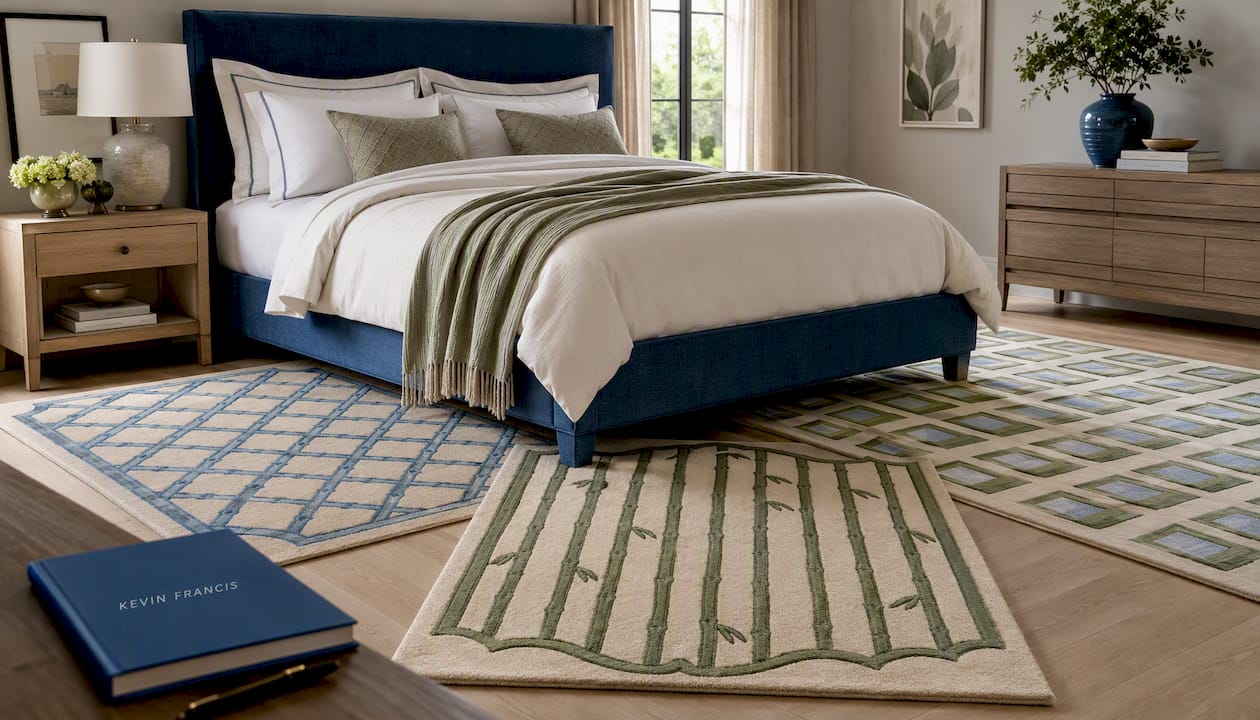
Kevin O’Gara, founder of Kevin Francis Design, works from that rule as a starting point rather than a ceiling… For a queen or king bedroom that wants a strong anchor piece, a hand-tufted design with pattern movement, like the trellis and frame motifs in the Brighton collection, holds its own as the room’s focal point rather than disappearing under furniture. For bedrooms leaning toward a lower profile or a layered look, a handwoven flatweave brings texture without adding height that competes with a bed skirt…
- Full anchor rooms suit bolder, higher-pile patterns that can carry visual weight.
- Two-thirds tuck rooms suit either pile height, since less of the rug is on display.
- Floating or runner setups suit flatweave designs that read as intentional rather than leftover.
An Editorial Take on Rug Sizing Rules
The 18 to 24 inch rule gets treated like gospel, and mostly it deserves that reputation. But the advice that actually changes outcomes isn’t the number itself, it’s the instinct to size up when torn between two options. Most sizing regrets I’ve seen come from someone splitting the difference downward to save money or to avoid “wasting” floor space, and ending up with a rug that photographs like an afterthought.
Where conventional advice falls short is in treating every bedroom like a showroom rectangle. Real rooms have vents, radiators, low platform frames, and doors that swing the wrong way. The rule still applies, but you’re allowed to bend the placement method, not the underlying math, to fit around those obstacles.
If you take one thing from this guide, prioritize width alignment with your nightstands before you obsess over exact square footage. A rug that lines up cleanly with your furniture looks considered even at a slightly imperfect size. One that ignores the nightstands looks wrong no matter how precisely you followed the 18 to 24 inch formula.
— Kevin O’Gara
Rugs Sized Right for Your Bedroom
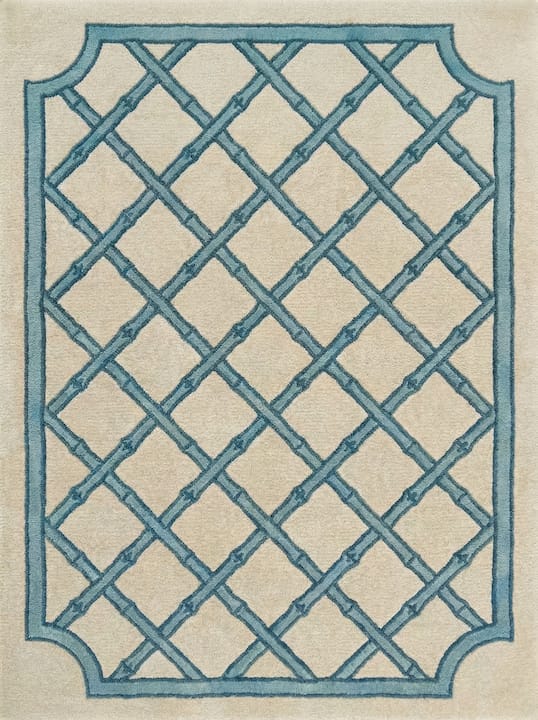
Once you know your target size and placement method, matching a piece to your room gets a lot simpler. The Brighton Bamboo Trellis hand-tufted area rug works as a full-anchor piece in queen and king bedrooms where you want the pattern to carry the room, its scale and movement holding up under a large frame instead of getting lost beneath it. The Brighton Bamboo Frame hand-tufted area rug offers a similar footprint with a more contained motif, a good option if your room calls for the two-thirds tuck method and only a third of the rug stays visible day to day.
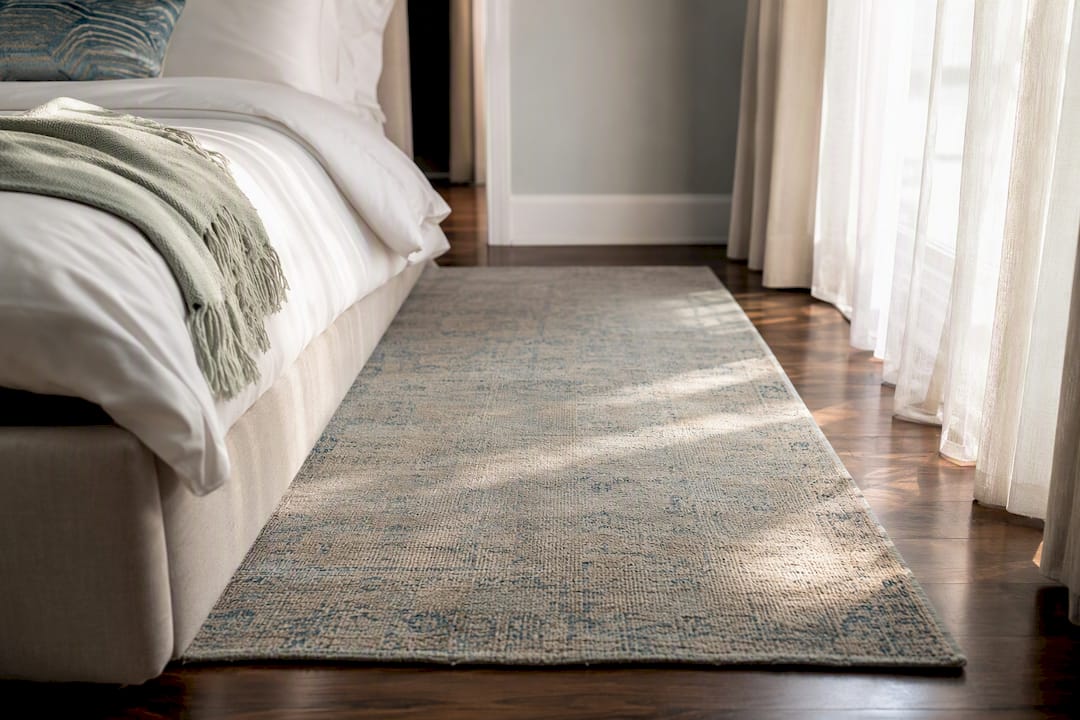
For bedrooms with low platform frames, radiant floor vents, or a preference for lower pile, the Color Study handwoven wool flatweave rug delivers the texture and durability of wool without the height that catches on a bed skirt. None of these sizes are one-size-fits-all, though, and odd room dimensions or an unusual bed height sometimes call for something between standard sizes. Kevin Francis Design offers custom sizing on its handmade pieces for exactly that situation. Browse the current collection or reach out to discuss a custom dimension for your room.
Sources
FAQ
What size rug should you use in a bedroom?
Match the rug to your bed size so it extends 18 to 24 inches beyond the sides and foot. That means roughly 8x10 for a queen and 9x12 or 10x14 for a king.
Is an 8x10 rug too big for a 10x12 room?
An 8x10 rug in a 10x12 room leaves only about a foot of clearance on each side, which is workable but tight. It’s fine if the bed sits centered and there’s no other furniture competing for that margin.
Is a 5x7 rug too small for a bedroom?
Small to medium rugs work for twin or twin XL beds but are undersized for full, queen, or king frames, where they will float without touching the bed’s edges. For anything queen size or larger, size up rather than settle for a smaller rug.
Is a 5x8 rug big enough for a living room?
A small rug is common for a seating area, but it’s often on the small side for most living rooms once you factor in a sofa and two chairs. The same “size up when unsure” logic that applies to rug sizes for sofa layouts applies to bedrooms too.
How do you place a rug under a bed with a low platform frame?
Low platform frames often hide most of an under-bed rug from view, so a floating placement at the foot of the bed or runners on each side usually looks more intentional and functions better underfoot.


