


A large rug typically starts around 8’x10’ and moves up through 9’x12’, 10’x14’, and beyond for expansive spaces. But size alone won’t tell you what to buy. The rule that actually matters: size your rug to the furniture it needs to anchor, not to the raw square footage of the room. A sectional and coffee table need a very different footprint than a king bed or a dining table for eight, even in rooms of identical size.
Before you buy anything, take these two steps:
- Measure your primary furniture piece (sofa, dining table, or bed) width and length.
- Test the footprint in the actual room using painter’s tape before committing to a purchase.
Key Takeaways
The right large rug size comes from measuring your furniture first, then applying designer-tested clearance rules rather than guessing based on room square footage.
| Point | Details |
|---|---|
| Furniture decides size | Measure your sofa, table, or bed before picking a rug size, not the room’s total square footage. |
| 9’x12’ is the default | It’s the most common living-room rug size because it fits standard seating groups with clearance to spare. |
| Leave a visible border | Keep 12" to 24" of floor visible around smaller rooms, up to 36" in larger ones, for proper proportion. |
| Test before buying | Use painter’s tape to outline the rug footprint and live with it for a day before ordering. |
| Choose wool for scale | Wool’s resilience and acoustic damping make it the practical pick for large, high-traffic, or open-plan rooms. |
| Go custom when needed | Kevin Francis Design’s bespoke process solves irregular rooms and pattern-centering problems standard sizes can’t. |
Table of Contents
- Standard Large Rug Sizes and the Rooms They Fit
- How Do You Place a Large Rug in Every Room?
- How Do You Test a Rug Size Before Buying?
- What Material Holds Up Best for Large Rugs?
- When Should You Order a Custom Large Rug?
- Should the Rug Cover All Furniture Legs or Just the Front Ones?
- Sources
- FAQ
Standard Large Rug Sizes and the Rooms They Fit
Off-the-shelf rug sizes exist because they map to real furniture arrangements, not because manufacturers picked round numbers at random. Knowing the standard tiers saves you from guessing.
- 8’x10’ fits smaller living rooms, apartment great rooms, or bedrooms with a queen bed and modest side clearance.
- 9’x12’ suits most standard living rooms with a sofa, two chairs, and a coffee table arranged as a conversation area.
- 10’x14’ works for larger living rooms, open-concept great rooms, or dining rooms seating six to eight.
- 12’x15’ and up handles oversized great rooms, combined living and dining zones, or rooms with furniture floating away from the walls.
The Spruce reports that 9’x12’ is the most common living-room rug size in the United States, and that pattern holds because it’s the sweet spot for a standard-depth sofa, a pair of accent chairs, and a coffee table with enough breathing room left over. Once you go past 10’x14’, you’re usually dealing with either a genuinely large room or a decorator’s choice to let the rug carry more visual weight in the space.
The border of visible floor between rug edge and wall matters just as much as the rug’s overall footprint. For rooms under 200 square feet, a 12" to 24" border reads as intentional. In larger rooms, you can stretch that border to 30" or even 36" without the rug looking undersized, since the eye has more room to register the whole composition. Go tighter than 12" in a large room and the rug starts to feel like it’s straining at the walls, an effect that’s surprisingly common in oversized primary bedrooms once buyers default to the “next size up” without checking the math.
How Do You Place a Large Rug in Every Room?
Placement rules shift by room function, and the mistake most homeowners make is applying one room’s logic to another. A bedroom rug and a dining rug solve completely different problems.
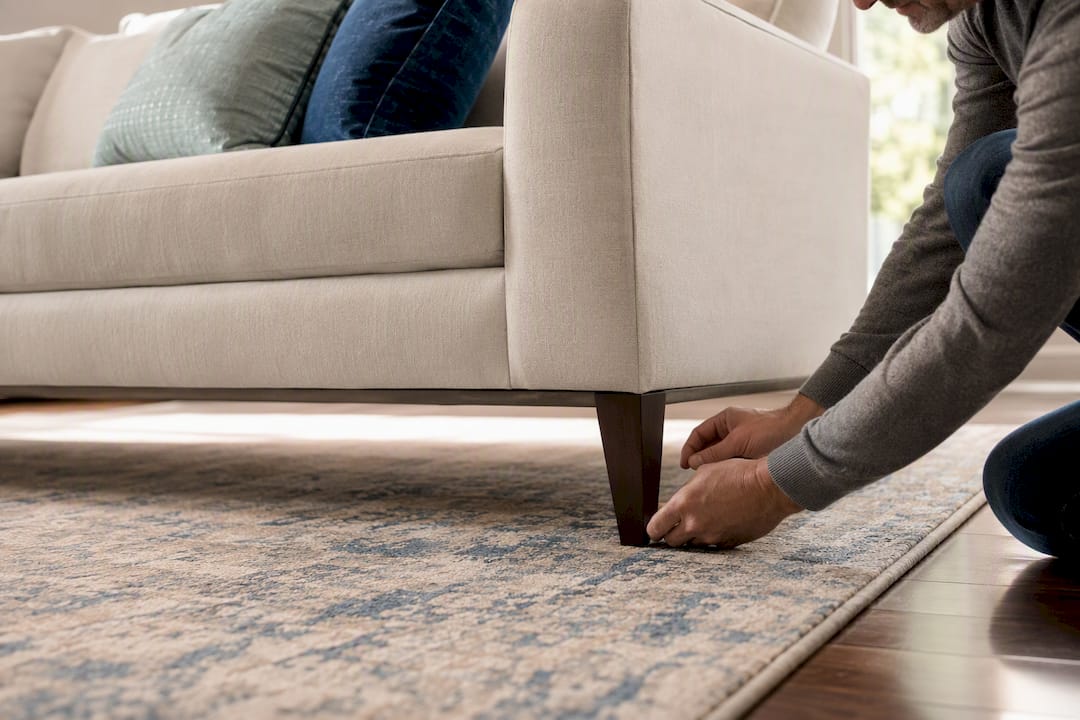
Living room. You have two workable layouts. In “all furniture on rug,” every piece, including the back legs of chairs and sofas, sits fully on the rug, which reads as more formal and cohesive. In “front legs on rug,” only the front legs of your seating touch the rug while the back legs rest on bare floor, a layout that works well when budget or room size limits you to a smaller footprint than “all furniture on rug” would demand. Either way, Architectural Digest recommends leaving 8" to 24" of clearance between rug edge and wall depending on room scale, with the rug always anchoring the seating group rather than sitting stranded in the middle of the floor.
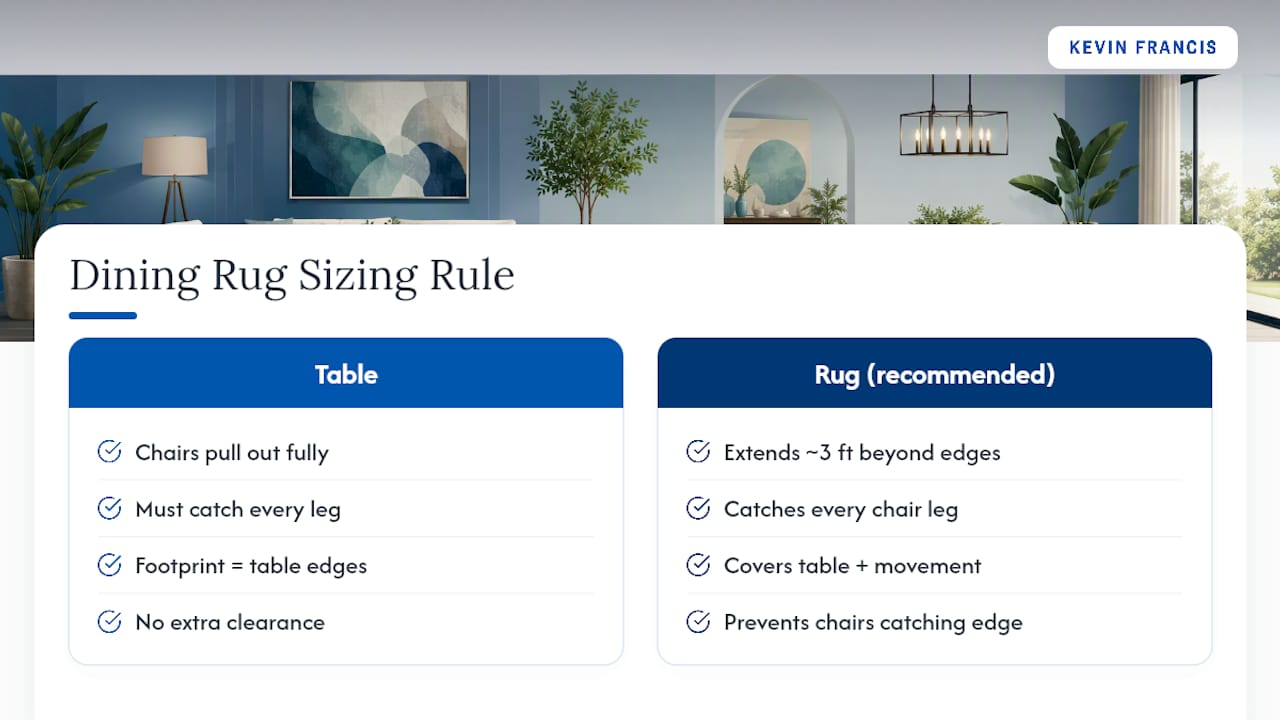
Dining room. Pull chairs out fully, and the rug still needs to catch every leg. That means extending the rug about 3 feet beyond each edge of the table, a measurement confirmed by designers precisely because it accounts for chair movement without back legs catching the rug’s edge mid-meal.
Bedroom. A queen bed generally calls for at least a 9’x12’ rug, positioned so 18" to 24" extends past each side and the foot of the bed. A king bed usually needs 10’x14’ or larger for the same coverage. Explore our bedroom rug placement guide for width-specific breakdowns.
Foyer and office. Runners should orient along the direction of foot traffic, clear interior doors by at least 2", and, in home offices, sit flush enough that a rolling chair doesn’t catch the edge on every turn.
How Do You Test a Rug Size Before Buying?
The single most useful trick in rug shopping costs nothing: painter’s tape and twenty minutes. It’s the difference between guessing and knowing before a large rug shows up on your doorstep.
- Measure the length and width of your key furniture piece, whether that’s a sofa, dining table, or bed frame.
- Add your target clearance (the 12" to 24" border, or the 3-foot dining extension) to each dimension to get your working rug size.
- Lay painter’s tape directly on the floor in that exact rectangle.
- Move your furniture legs onto the taped outline and live with it for a day before deciding.
This method, sometimes called the tape trick, catches proportion problems that measurements alone miss, particularly in open-plan rooms where the rug has to visually separate a living zone from a dining zone without a wall to help. Orient the rug’s shape to match your room’s shape wherever possible. A long rectangular great room usually wants a rectangular rug running its long axis, while a square room can carry a round or square rug without looking off balance. For our full walk-through on measuring specific furniture pieces, see how to choose the right size area rug.
What Material Holds Up Best for Large Rugs?
Fiber choice matters more at large sizes because you’re covering more square footage that has to survive years of foot traffic, furniture legs, and cleaning. Wool remains the material design professionals reach for most often on large-format rugs, thanks to its natural resilience and its ability to dampen sound, a real advantage in open-plan great rooms where hard surfaces otherwise bounce noise around the whole floor.
- Choose low pile for high-traffic living rooms, under dining tables, or anywhere furniture legs need to sit flush without wobbling.
- Choose higher pile for bedrooms and quieter formal spaces where comfort underfoot matters more than furniture stability.
- Rotate a large rug every six to twelve months to even out sun fading and wear patterns, since large rugs rarely get repositioned as casually as smaller ones.
- Use a rug pad sized to the full rug, not just the center, to prevent slipping under multi-piece furniture arrangements.
Cleaning logistics also scale with size. A 10’x14’ wool rug generally needs professional cleaning rather than a DIY approach, simply because moving and drying a rug that large at home isn’t practical for most households.
When Should You Order a Custom Large Rug?
Standard sizes cover most rooms, but they run out fast once a room has an irregular footprint, a bay window eating into one wall, or dimensions that fall between the standard 12’x15’ and something genuinely oversized. The Spruce notes that many rug lines, especially patterned or artisan designs, only come in a handful of fixed sizes, which is exactly where a bespoke order earns its cost.
A custom order through Kevin Francis Design starts with precise room measurements, moves into material and knot-technique selection, and includes sample approval before production begins, with lead times and pricing shaped by size, technique (hand-tufted versus hand-knotted), and fiber choice. Designer Kevin O’Gara built the studio’s bespoke process specifically around solving the sizing problems standard rugs can’t touch, including centering a pattern’s motif correctly across an oversized or irregularly shaped floor.
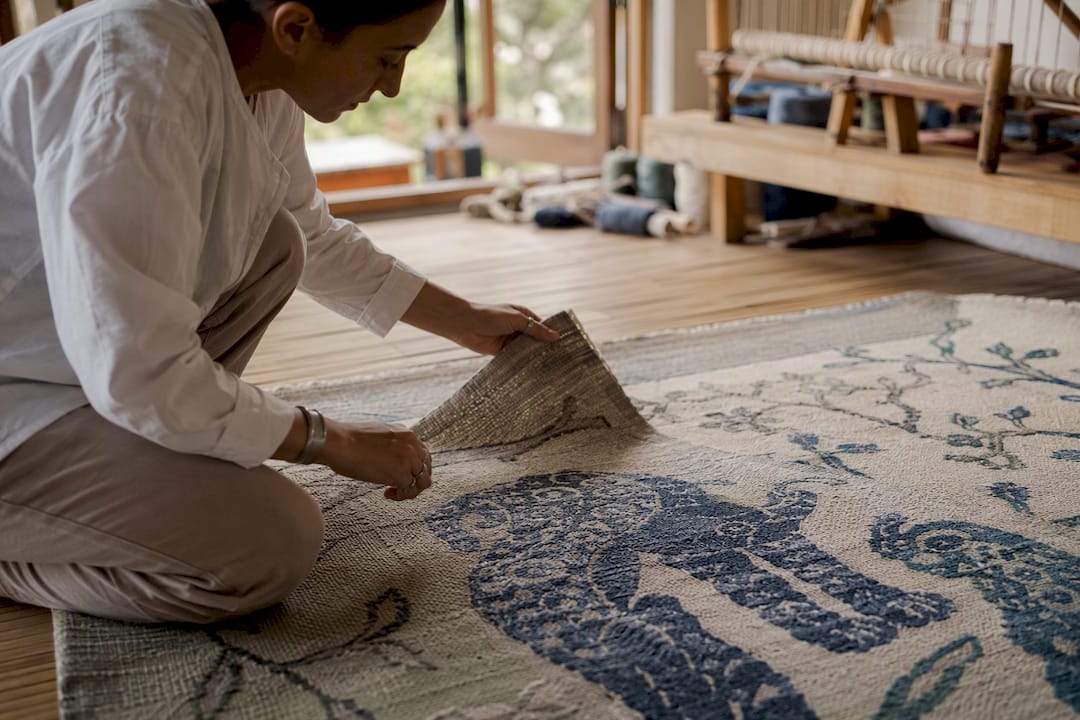
Pro Tip: If your room has an alcove, a fireplace hearth, or an angled wall, ask about pattern repeat planning before you finalize a custom size. A motif that centers beautifully at 10’x14’ can land off-kilter at 11’x16’ if the repeat isn’t recalculated.
Should the Rug Cover All Furniture Legs or Just the Front Ones?
The choice between “all legs on” and “front legs on” isn’t just aesthetic preference. It’s a direct function of your rug’s size relative to your seating layout, and getting it backward is one of the most common large-rug mistakes.
All-legs-on-rug is the more formal, put-together look, and it’s the standard for rooms where you can commit to a 9’x12’ or 10’x14’ rug that fully contains the sofa, chairs, and coffee table with clearance to spare. This layout visually unifies the seating group into one zone and tends to make rooms feel larger, not smaller, because the eye reads the rug and furniture as a single cohesive shape rather than two separate elements.
Front-legs-on-rug works when your room, or your budget, can’t support a rug large enough to swallow the whole seating group. Here, only the front two legs of the sofa and chairs touch the rug while the back legs rest on the floor. It’s a completely legitimate choice, not a compromise, provided the rug is large enough that at least two thirds of each seating piece has some contact with it. A rug that only catches the front legs by an inch or two looks like an afterthought rather than a deliberate layout.
Floating seating, where furniture sits entirely off the rug, generally only works in very large rooms where the rug defines one zone (say, a reading nook or media area) while the rest of the furniture occupies open floor around it. This is less about following a rule and more about having enough square footage that the arrangement doesn’t read as awkward gaps. For more on how a rug can define and anchor a furniture group, see why rugs anchor furniture arrangements.
A Designer’s Take on Scale, Texture, and When to Break the Rules
Proportion and pile height do more work than pattern in a large rug, and I’d rather see a client choose a slightly oversized, low-pile wool rug than the “correct” size in the wrong texture. Rules bend for genuinely irregular rooms or a client’s must-have material. When a space resists every standard size, that’s exactly when bespoke work pays for itself.
— Kevin O’Gara
Bring a Large Rug Home from Kevin Francis Design
Standard sizing charts only get you so far once you’re working with a genuinely large or unusually shaped room, and that’s precisely the gap Kevin Francis Design’s hand-tufted and hand-knotted collections were built to close. The Knossos Hand-Tufted Maze Rug and Lucca Hand-Tufted Maze Rug both scale beautifully into living rooms and great rooms at 9’x12’ and above, while the Selendi Hand-Knotted Wool Area Rug delivers the wool resilience and acoustic benefit that oversized open-plan rooms need most.
If none of the standard dimensions fit your room’s footprint, The Talisman Rug shows what a fully personalized commission looks like, from motif placement down to exact edge-to-wall measurements. Starting a bespoke order begins with a room measurement consultation, followed by material and technique selection and sample approval before production. Reach out through the Kevin Francis Design site to schedule that first measurement conversation and get a custom quote for your space.
Sources
- How to Select the Right Rug Size for Any Room (Simple Guide) - The Spruce
- Rug Sizes: How to figure out the best area rug for your space | Architectural Digest
FAQ
Is a 9x12 Rug Really Considered Large?
Yes. A 9’x12’ rug is the most common size for living rooms and comfortably qualifies as large enough to anchor a full seating group with clearance around the edges.
How Big Is a 12x15 Rug?
A 12’x15’ and up rug suits oversized great rooms, combined living and dining zones, or rooms with furniture floating away from the walls.
How Big Is a 24x36 Rug?
A rug listed as 24"x36" is measured in inches, not feet, making it a small accent or entry mat, roughly 2 feet by 3 feet, not a large area rug.
How Big Is a 72x48 Rug?
At roughly 6 feet by 4 feet, this size falls into the small to medium range, suitable for a small bedroom or reading nook rather than a large living or dining space.
How Big Is a 20x20 Rug?
A small square rug of this size is typically used as an accent piece, such as under a side table or for decorative layering rather than as a primary area rug.


