


Flat weave construction is the art of interlacing vertical warp threads with horizontal weft threads on a loom to create a textile that lies perfectly flat, with no pile and no knots. The result is a reversible, thin surface where the pattern appears on both faces, one side often more defined than the other. This is what separates flat weaves from hand-knotted rugs, where individual knots are tied around warp threads to build a raised, cushioned pile. Traditions like Kilim, Dhurrie, and Soumak all fall under this construction category, each shaped by regional heritage and fiber choice rather than fundamentally different mechanics. For anyone choosing a rug with both beauty and practicality in mind, understanding flat weave construction is the clearest path to a confident decision.
At a glance, flat weave construction offers:
- A pileless, flat surface created purely by interlacing warp and weft threads
- Reversibility, with finished patterns visible on both sides of the textile
- Lightweight construction that makes rugs easy to move, roll, and store
- Durability in high-traffic settings, since there is no pile to crush or mat
- A distinctive graphic aesthetic shaped by the geometry of the weaving process
How flat weave rugs are made on the loom
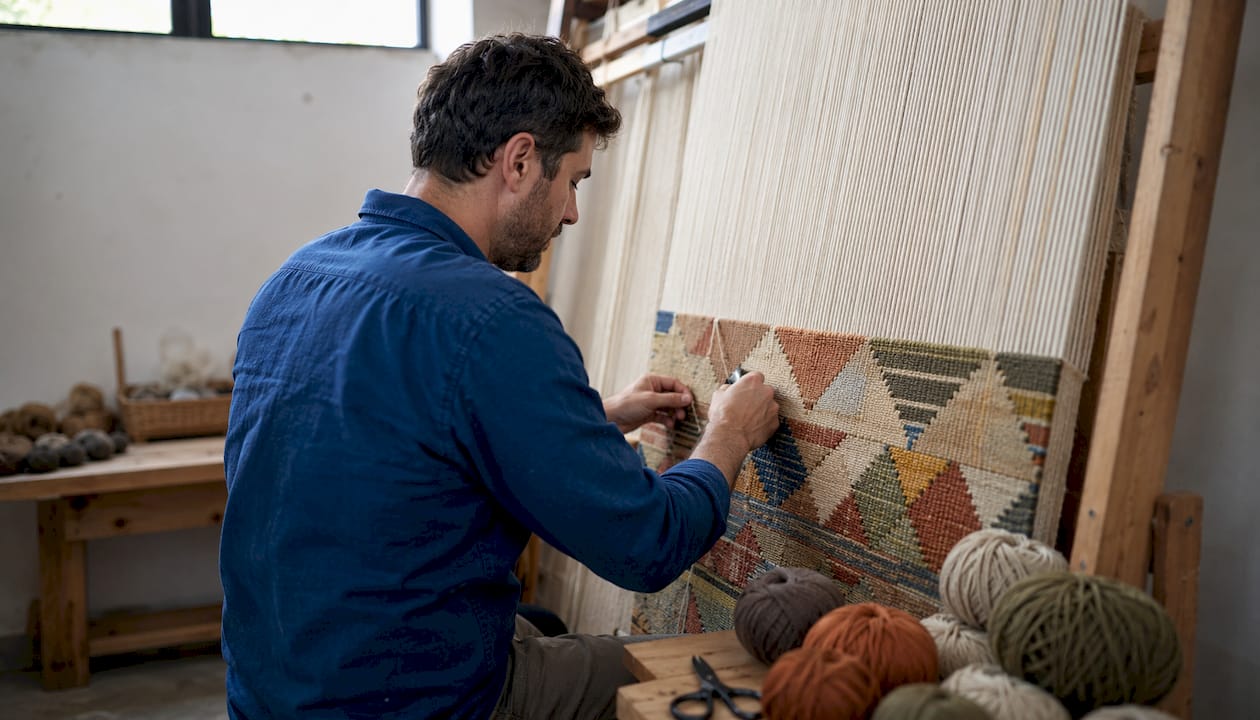
The making of a flat weave rug is a process of quiet precision, built row by careful row. Understanding each step reveals why these textiles carry such visual clarity and structural integrity.
- Warp preparation: Vertical warp threads are measured, tensioned, and mounted on the loom in parallel rows. These threads form the skeleton of the rug and determine its length and structural strength.
- Weft insertion: A shuttle or bobbin carries the horizontal weft thread across the loom, passing it alternately over and under the warp threads in a continuous interlacing motion.
- Row by row building: Each weft pass creates one row of the design. The weaver beats each row tightly downward with a comb or beater, compressing the threads to form a firm, flat surface.
- No knots, ever: Unlike hand-knotted construction, no knots are tied at any point. The weft simply weaves through the warp in a single, uninterrupted action.
- Color changes: When the design calls for a new color, the weaver introduces a new weft thread, often leaving the previous one at the edge or wrapping it around a warp to secure it.
- Reversibility by design: Because the weft threads pass fully through the warp structure, patterns appear on both faces of the finished textile, a structural feature unique to this construction method.
- Finishing the edges: Warp ends are typically knotted, braided, or wrapped to form fringe or a clean selvage, completing the rug without any additional backing material.
The entire process, from warp to finished edge, produces a textile that is thinner and lighter than a knotted rug of comparable size, yet capable of remarkable visual complexity.
What are the main flat weaving techniques?
Flat weave is not a single method but a family of related techniques, each producing a distinct surface quality and visual character. The three primary traditions are Kilim, Dhurrie, and Soumak, though Persian weaving traditions extend into compound and supplementary weave structures of considerable sophistication.
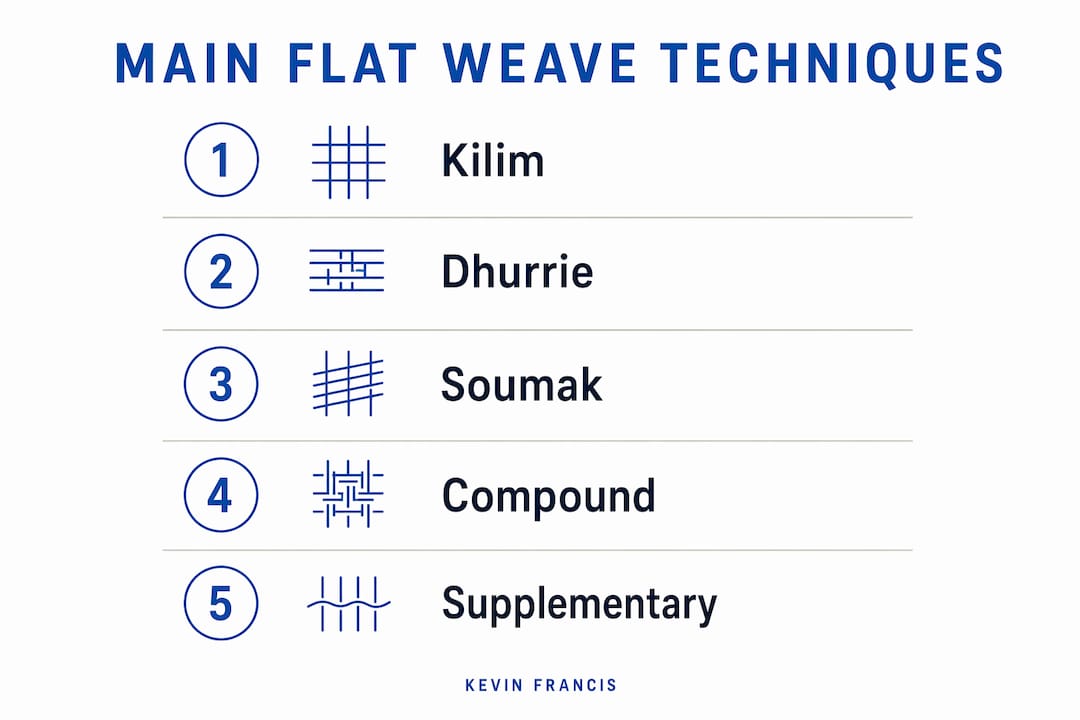
Kilim (slit tapestry weave)
Kilim is a weft-faced plain weave, meaning the weft threads are packed so tightly that they completely cover the warp. Where two color areas meet, a small vertical slit forms between them, a structural signature of the technique. These slits give Kilim its characteristic crisp, geometric motifs: bold diamonds, chevrons, and stepped medallions. Persian weavers call this structure gelīm, and it remains one of the oldest documented flat weave forms.
Dhurrie (weft-faced plain weave)
The Dhurrie, rooted in Indian weaving tradition, shares the weft-faced plain weave structure with Kilim but tends toward simpler, more rectilinear compositions. Cotton is the dominant fiber, lending Dhurries a slightly crisper hand than wool Kilims. Their straightforward construction makes them among the most durable flat weaves available, well suited to everyday use.
Soumak (supplementary weft wrapping)
Soumak is technically a weft-wrapping technique rather than a plain weave. The weft encircles two or more warp threads at a time, building up a slightly raised, textured surface that sits between a true flat weave and a low pile. Persian flat weaves composed entirely of weft wrapping are traditionally called “sumak,” a word of obscure origin. The wrapping sequence, whether plain, countered, or reverse, determines the angle and visual rhythm of the surface pattern.
Compound and supplementary weaves
Persian flat weave traditions also include compound weaves, where additional sets of warps or wefts are introduced beyond the basic foundation. Supplementary warp or weft threads add decorative patterning without altering the structural ground weave. The zīlū carpet, for example, uses two complementary sets of warps and wefts to create a reversible, counterfaced textile of considerable technical complexity.
Pro Tip: When shopping for a Soumak rug, run your hand across the surface. The slight diagonal texture of the weft wrapping is unmistakable and distinguishes it instantly from a smoother Kilim.
Regional traditions and types of flat weave rugs
The same interlacing mechanics appear across continents, but regional identity comes through fiber, palette, and pattern rather than structural difference. A Kilim from Anatolia and a Dhurrie from Rajasthan are both flat weaves; what separates them is centuries of distinct cultural expression.
| Region | Rug Type | Typical Fiber | Signature Aesthetic |
|---|---|---|---|
| Persia (Iran) | Kilim, Soumak, Zīlū | Wool | Bold geometry, tribal medallions, rich jewel tones |
| Anatolia (Turkey) | Kilim | Wool | Stepped diamonds, ram’s horn motifs, earthy reds and blues |
| India | Dhurrie | Cotton, wool | Pastel stripes, simple geometric grids, natural dyes |
| North Africa | Kilim variants | Wool, camel hair | Sparse geometry, ivory grounds, abstract tribal marks |
| American Southwest | Navajo weaving | Wool | Banded compositions, bold diagonals, natural and vegetal dyes |
Regional flat weave styles by character:
- Persian Kilims tend to carry the most complex geometric programs, often encoding tribal symbolism into every motif.
- Anatolian Kilims favor a slightly warmer palette and a more rhythmic, repetitive pattern structure.
- Indian Dhurries are the most casual in spirit, often designed for daily use with a lighter, more relaxed aesthetic.
- Navajo weavings represent one of the most sophisticated flat weave traditions in the Americas, with compositions that read almost like abstract paintings.
Regional names signal cultural heritage, not exclusive technique. The same weft-faced plain weave that produces a Persian Kilim also underlies a Navajo blanket; the difference lies entirely in what the weaver chose to say with it.
Materials, durability, and the honest pros and cons
Flat weave construction materials shape everything from how a rug feels underfoot to how long it will last. Wool and cotton are the most common choices, each bringing a different quality to the finished textile.
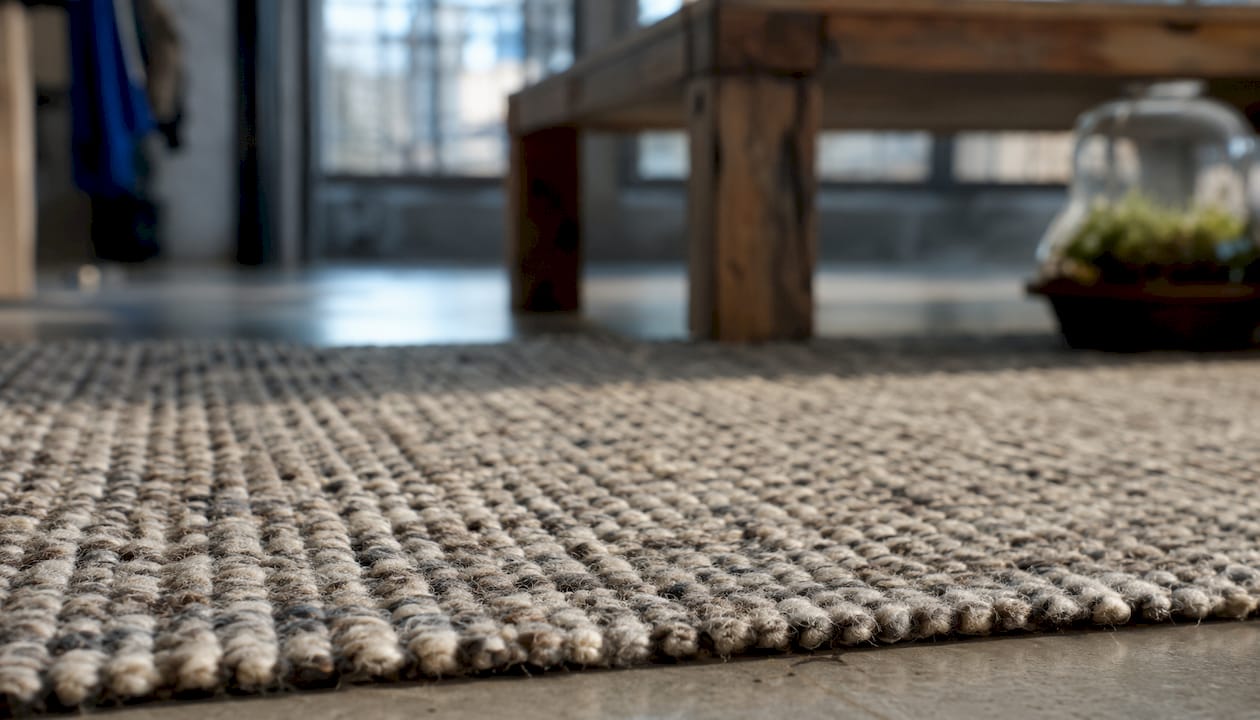
Wool offers natural resilience, a slight luster, and excellent dye absorption, which is why the richest color traditions in flat weaving are almost always wool-based. Cotton produces a crisper, flatter surface with less natural elasticity, making it ideal for Dhurries and other rugs where dimensional stability matters. Blends of the two combine wool’s warmth with cotton’s structural firmness.
Because flat weaves use no pile, they resist matting in high-traffic areas where a knotted rug would gradually compress and lose definition. They are also lighter and easier to clean, since dirt sits on the surface rather than embedding deep in a pile. The tradeoff is cushioning: a flat weave offers little underfoot softness and minimal thermal insulation compared to a thick hand-knotted piece.
Pros and cons at a glance:
- Pro: Lightweight and easy to roll, store, or transport
- Pro: Reversible, effectively doubling the usable life of the rug
- Pro: Resists matting and crushing in high-traffic zones
- Pro: Generally more affordable than hand-knotted rugs of comparable size
- Con: Minimal cushioning; a quality rug pad is strongly recommended
- Con: Less thermal insulation than a pile rug
- Con: Edges and fringes can be vulnerable to wear without proper finishing
Pro Tip: Always use a non-slip rug pad beneath a flat weave. Without the grip of a pile to anchor it, a flat weave on a hard floor will shift with foot traffic, and a quality pad also adds the cushioning the construction itself does not provide.
Where flat weave rugs work best and how to style them
Flat weave rugs are genuinely at home in the rooms that see the most daily life. Their resistance to matting makes them a natural choice for dining areas and high-traffic zones, where a pile rug would show wear within a few years. Under a dining table, a flat weave can be wiped clean or taken outside and shaken, a practical grace that pile rugs simply cannot match.
Practical uses and styling ideas:
- Dining rooms: The go-to application. Flat weaves clean easily and do not catch chair legs the way a pile rug can.
- Entryways and hallways: High foot traffic is no problem; the construction holds its surface integrity beautifully.
- Layered styling: A flat weave works wonderfully as a base layer beneath a smaller, textured accent rug, adding pattern without competing for visual weight.
- Outdoor-adjacent spaces: Many flat weaves, particularly cotton Dhurries, transition well to covered porches or sunrooms.
- Children’s rooms: The easy-clean surface and lightweight construction make flat weaves a sensible, beautiful choice.
When pairing a flat weave with furniture, let the rug’s geometry lead. A bold Kilim with strong diagonal lines reads best against clean-lined, contemporary furniture that does not compete with the pattern. A quieter Dhurrie stripe, by contrast, can hold its own beneath a more ornate or upholstered setting. The reversibility of most flat weaves also means you can simply flip the rug when one side shows wear, effectively refreshing the room without replacing anything.
Craftsmanship and artistry: the Kevin Francis Design perspective
At Kevin Francis Design, we have always believed that the constraints of a weaving technique are not limitations but invitations. Flat weave construction, with its geometric logic, asks the designer to think in angles, in steps, in the precise choreography of color across a grid of warp and weft. The result, when handled with genuine artistry, is something that reads almost like a painting translated into thread.
The geometry of flat weaving is not a restriction. It is a discipline that sharpens the designer’s eye, forcing every curve to be earned through a sequence of carefully stepped angles. The most compelling flat weave designs are those where you can feel the intelligence of that process in the finished surface.
Flat weave construction’s graphic clarity is what draws us to it as a design medium. The absence of pile means every color decision is fully visible, with nowhere to hide a weak transition or an unresolved motif. That transparency demands a higher standard of pattern design, and it is precisely that standard that produces the bold, confident compositions that have made flat weaves prized across cultures for thousands of years. Our handwoven rug techniques guide explores how these principles extend across construction methods.
Pro Tip: When evaluating a flat weave for its design quality, look at the back. A well-executed piece will show a clean, mirror-image pattern on the reverse, with no loose threads or uneven color bleed. The back tells you everything about the weaver’s discipline.
How to identify an authentic flat weave rug
Authentic flat weave rugs have a few unmistakable physical signatures that distinguish them from machine-made imitations or tufted rugs with a flat-looking surface.
Turn the rug over. A genuine flat weave will show a fully finished pattern on the reverse, either a mirror image or a complementary design, with no canvas backing, no latex adhesive, and no tufted loops. Machine-made rugs almost always have a backing material glued or stitched to the underside.
Run your fingers across the surface. A true flat weave has no pile whatsoever. The surface feels smooth and firm, with the texture of the warp and weft threads themselves rather than any soft, raised fiber. In a Soumak, you will feel the slight diagonal ridge of the weft wrapping, but even this is a structured, woven texture rather than a pile.
Examine the edges and fringe. Authentic flat weaves finish their warp ends as fringe or wrap them into a selvage that is integral to the rug itself. Fringe that appears to be sewn on separately is a reliable sign of machine production. On a handmade piece, the fringe is simply the exposed warp threads, knotted or braided by the weaver.
Finally, look closely at the color boundaries. In a Kilim, the characteristic slit between two color areas is a structural feature of the technique, not a flaw. If the color transitions are perfectly smooth with no visible structure at the boundary, the piece was likely woven on a power loom using a different method.
Caring for your flat weave rug
Flat weave rugs are among the most forgiving textiles in a home, but a few consistent habits will keep them looking their best for decades. For a full care routine, our guide on caring for handmade rugs covers every material and construction type in detail.
Rotate the rug every six to twelve months, particularly in rooms where sunlight falls unevenly. Flat weaves have no pile to redistribute wear, so rotation is the primary way to keep the surface aging evenly. Vacuum regularly using a suction-only setting, without a beater bar, which can stress the weft threads over time.
For spills, act immediately. Blot with a clean, dry cloth rather than rubbing, which can push the liquid deeper into the weave. Most flat weaves, especially cotton Dhurries, can be spot-cleaned with a mild soap solution and cold water. Wool flat weaves benefit from professional cleaning every few years to preserve the fiber’s natural lanolin and color depth.
Store a flat weave rolled, never folded. Folding creates permanent crease lines in the warp structure that are difficult to reverse. Roll the rug with the pattern facing inward, wrap it in breathable cotton or muslin, and keep it in a cool, dry space away from direct light.
Patterns and motifs in flat weave construction
The visual language of flat weave rugs is inseparable from the mechanics of how they are made. Because the weft threads must follow the grid of the warp, truly curvilinear forms are impossible to weave directly. Instead, curves are approximated through stepped, angular motifs, a technique that gives flat weaves their characteristic graphic energy.
The most enduring motifs in the flat weave tradition include:
- Stepped diamonds and lozenges: The foundational geometric unit across Persian, Anatolian, and Navajo traditions alike.
- Chevrons and zigzags: Created by alternating the direction of diagonal weft sequences, producing a bold, rhythmic surface.
- Medallions: Central focal motifs built from concentric geometric frames, often carrying tribal or symbolic meaning in Persian and Anatolian Kilims.
- Boteh (paisley): A teardrop-shaped motif approximated through angular stepping, one of the most widely recognized symbols in Persian textile art.
- Stripes and bands: The simplest flat weave composition, dominant in Dhurrie tradition, where horizontal color bands create a clean, contemporary aesthetic.
- Hooked and ram’s horn motifs: Characteristic of Anatolian Kilims, these curling forms are rendered through careful angular stepping that mimics organic movement.
What makes these patterns so compelling is precisely their geometric discipline. The constraint of the loom does not diminish the artistry; it concentrates it, producing compositions where every angle is intentional and every color boundary is a deliberate design decision.
Key Takeaways
Flat weave construction creates durable, reversible, pileless rugs through warp and weft interlacing, making them ideal for high-traffic spaces and design-conscious interiors.
| Point | Details |
|---|---|
| No pile, no knots | Flat weaves are built by interlacing warp and weft threads continuously, with no knotting at any stage. |
| Fully reversible surface | The weaving method produces a finished pattern on both faces, effectively giving the rug two usable sides. |
| Best for high-traffic areas | Without pile to crush or mat, flat weaves hold their surface integrity in dining rooms, entryways, and busy hallways. |
| Geometry defines the aesthetic | Weaving constraints mean all motifs are angular or stepped, producing the bold graphic character flat weaves are known for. |
| Material shapes the character | Wool brings warmth and rich color; cotton yields a crisper, flatter surface suited to casual, everyday use. |
FAQ
What does “flat weave” mean?
Flat weave refers to any textile where warp and weft threads are interlaced on a loom without forming knots or pile, resulting in a flat, reversible surface. The term covers a wide family of traditions including Kilim, Dhurrie, and Soumak.
What does a flat weave rug feel like underfoot?
A flat weave rug feels firm and smooth, with no softness or cushioning from pile. The surface texture comes from the warp and weft threads themselves, and a quality rug pad is recommended to add comfort and grip.
What is the flat weave structure?
The flat weave structure is built from two thread systems: vertical warp threads held under tension on the loom, and horizontal weft threads passed over and under the warp in a continuous interlacing sequence, beaten tightly to form a firm, flat fabric.
What is the Kilim flat weave technique?
Kilim is a weft-faced plain weave where weft threads are packed so tightly they cover the warp entirely. Where two color areas meet, a small vertical slit forms, creating the crisp geometric boundaries that define the Kilim’s characteristic bold motifs.
Are flat weave rugs durable enough for everyday use?
Yes. Because there is no pile to crush, flat weave rugs resist matting and hold their surface appearance well in high-traffic areas. Their lightweight, reversible construction also extends their usable life, since you can simply flip the rug when one side shows wear.
Explore the Kevin Francis Design collection of artisan rugs, including our signature Lotto hand-knotted wool rug, and discover how master craftsmanship transforms thread into something genuinely lasting.
Recommended
- Buying Hand-Tufted Area Rugs: A Rug Maker’s Complete Guide – Kevin Francis Design
- Types of Designer Area Rugs: A Guide to Construction, Fiber & Style – Kevin Francis Design
- What Makes a Rug Truly Handmade: A Collector’s Guide – Kevin Francis Design
- Hand-Knotted vs Hand-Tufted Rugs: A Maker’s Comparison – Kevin Francis Design


