


A hand-knotted rug is defined as a textile where each individual knot is tied by hand onto a vertical loom by a skilled artisan, creating a structure of extraordinary density and permanence. Understanding what hand-knotted means for rug ownership changes how you think about floor coverings entirely. These are not decorative accessories. They are functional works of art, built knot by knot over months or even years, with millions of knots woven into a single piece. The industry term is “hand-knotted,” and it carries a precise, internationally recognized meaning that separates these rugs from every other category on the market. Kevin Francis Design works within this tradition, bringing the same artisanal rigor to collections that honor centuries of craft.
How is the hand-knotting process performed?
Hand-knotting takes place on a vertical loom strung with warp threads, which run the length of the rug. An artisan ties individual knots, one at a time, around pairs of these warp threads, then cuts the yarn to create the pile. Each row of knots is secured with weft threads woven horizontally across the loom. The process repeats, row by row, until the full design emerges from the accumulated labor of thousands of hours.
Production time for a quality 8x10 hand-knotted rug ranges from several months to over a year, depending on knot density. A higher knot count per square inch means finer detail, tighter pile, and a longer production timeline. Persian and Tibetan knotting techniques, both used at Kevin Francis Design, differ in the way the knot wraps the warp threads, producing distinct textures and pile heights. The materials most commonly used are wool, silk, and cotton, each chosen for specific qualities of sheen, softness, and structural integrity.
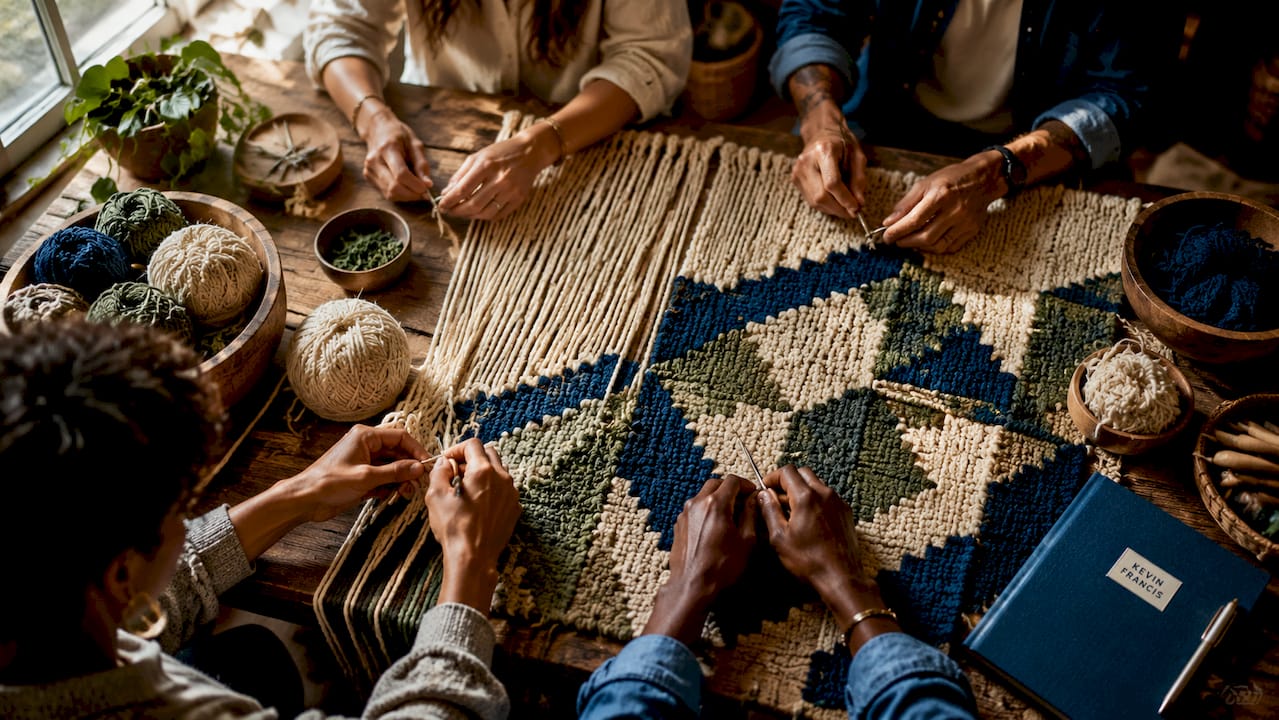
The artisan’s choices at every stage shape the finished piece. Wool holds dye with a depth that silk cannot replicate in the same way, while silk catches light and creates a luminous, almost painterly surface. Cotton warps provide a stable foundation that keeps the rug flat and dimensionally consistent over decades. Understanding these material decisions helps you appreciate why no two hand-knotted rugs are ever identical.
Here are the key signs that confirm genuine hand-knotting when you examine a rug:
- The back of the rug mirrors the front pattern with visible, individual knots.
- The pile feels dense and springy underfoot, not flat or stiff.
- Slight color variations, known as abrash, appear across the field of the rug.
- The fringe is an extension of the warp threads, not sewn on separately.
- The rug has no canvas backing, no latex, and no glued fabric layer.
Pro Tip: Flip the rug over before you buy. If the back looks like fabric or canvas, the rug is tufted, not hand-knotted. A genuine hand-knotted piece shows the pattern clearly on both sides.
What are the benefits of owning a hand-knotted rug?
The most compelling benefit of hand-knotted rug ownership is longevity. A well-maintained hand-knotted rug typically lasts 50 to 150 or more years, far beyond the 5 to 20 year lifespan of machine-made or hand-tufted alternatives. Antique Persian and Turkish rugs over a century old are still in active use in homes and museums worldwide. That kind of durability reframes the purchase entirely.
The economics are equally striking. A $12,000 hand-knotted rug used for 60 years costs roughly $200 per year, while a $3,000 hand-tufted rug lasting 10 years costs $300 per year with no residual value. The hand-knotted rug costs less over time and often appreciates or holds its value as an heirloom. That is a meaningful financial distinction for any homeowner thinking about long-term investment.
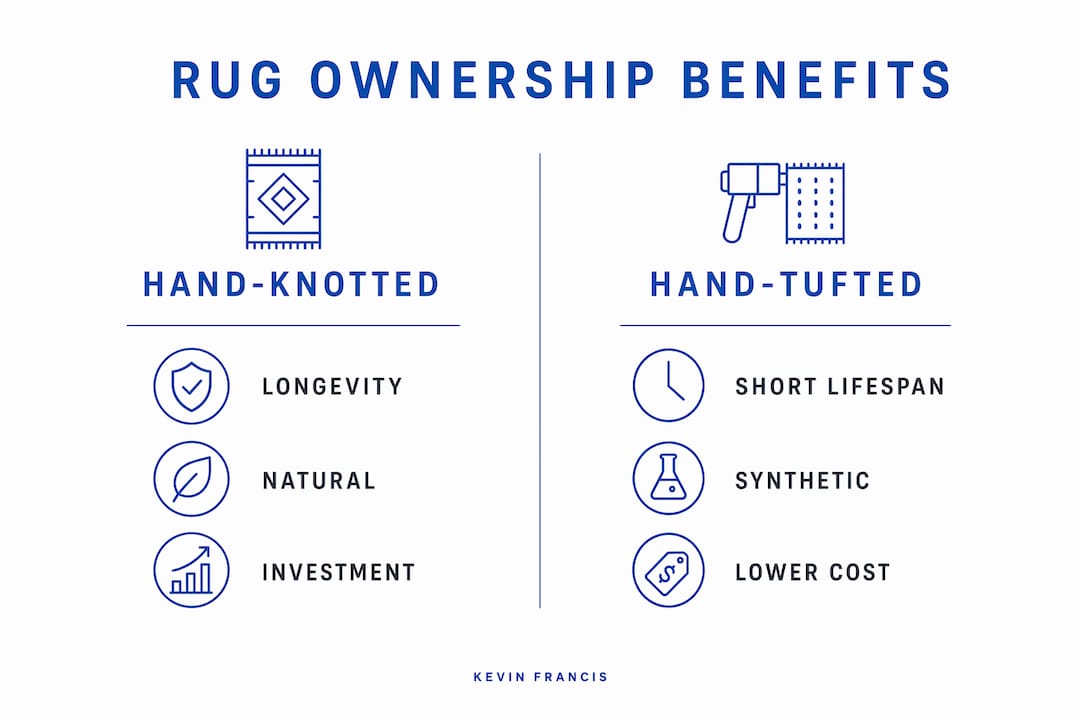
Hand-knotted rugs use no adhesive or backing fabric, which means no chemical off-gassing and no VOC concerns in your home. They are fully washable and fully repairable. A skilled rug restorer can reweave damaged sections, replace worn pile, and refringe the ends. Tufted rugs, by contrast, rely on latex backing that degrades over time and cannot be meaningfully repaired.
| Feature | Hand-knotted | Hand-tufted | Machine-made |
|---|---|---|---|
| Typical lifespan | 50–150+ years | 10–20 years | 5–15 years |
| Construction | Individual knots by hand | Tufting gun with latex backing | Automated loom |
| Repairability | Fully repairable | Difficult to repair | Not repairable |
| Chemical-free | Yes | No (latex backing) | Varies |
| Resale or heirloom value | High | Low | None |
The natural irregularities in a hand-knotted rug, the slight shifts in color called abrash, the subtle variations in pile height, are not flaws. These qualities distinguish handmade pieces from the sterile repetition of machine-made patterns and grow more beautiful with age.
How do you identify a genuine hand-knotted rug?
The single most reliable test is examining the back of the rug. A genuine hand-knotted rug displays the front pattern mirrored on the reverse, with individual knots clearly visible. A tufted or machine-made rug has a canvas or glued fabric backing that hides the construction entirely. This one check eliminates most misrepresentation in the market.
Terminology is where buyers most often get misled. Insist on the term “hand-knotted” because terms like “handmade,” “hand-crafted,” and “hand-loomed” are used loosely and do not guarantee the same construction or durability. “Hand-loomed” often refers to flat-weave rugs with no pile. “Hand-crafted” can apply to almost anything touched by human hands during production. Only “hand-knotted” carries a specific, internationally recognized meaning.
Weight and texture also tell a story. Hand-knotted rugs feel substantial and dense. The pile has a natural spring to it. Machine-made rugs feel uniform and slightly hollow underfoot. Hand-tufted rugs may feel plush initially but compress quickly because the pile is not structurally anchored the same way.
- Ask the seller directly: “Is this rug hand-knotted, or hand-tufted?”
- Request documentation of origin, including the country and weaving tradition.
- Look for abrash, the natural color variation that signals hand-dyeing and hand-weaving.
- Check that the fringe grows from the rug body, not stitched onto a finished edge.
- Consult resources like handmade rug craftsmanship guides before purchasing.
Pro Tip: Ask the dealer to show you the back of the rug before discussing price. A confident seller with a genuine hand-knotted piece will do so without hesitation.
How does a hand-knotted rug enrich your home’s interior design?
A hand-knotted rug functions as the anchor of a room. It sets the color palette, defines the seating area, and establishes the visual weight that makes furniture feel intentional rather than scattered. Interior designers treat these rugs the way curators treat paintings: as the starting point, not the finishing touch.
Natural wool, the most common material in hand-knotted rugs, absorbs sound in a way that synthetic fibers cannot replicate. Experts consider hand-knotted rugs as fine art pieces that create a quieter, more intimate atmosphere through wool’s natural acoustic properties. A room with a hand-knotted wool rug feels warmer and more settled, not just visually but acoustically.
“The emotional and aesthetic value of hand-knotted rugs lies not only in their craftsmanship but in how they influence the ambiance through texture, warmth, and tradition.” — House of Rugs
The subtle irregularities that define hand-knotted work add depth that a machine-made rug simply cannot produce. Natural variations in color and texture are signs of authenticity that add character valued far above machine perfection. A living room anchored by such a piece carries a sense of history and intention that elevates every other element in the space. For placement, allow at least the front legs of all major seating to rest on the rug, creating visual cohesion without crowding the design. Pair warm-toned wool rugs with natural wood and linen, and silk-blend pieces with lacquered or polished surfaces for a jewel-box effect.
Key Takeaways
A hand-knotted rug is the only floor covering that functions simultaneously as fine art, a sound-absorbing material, a long-term financial investment, and a fully repairable heirloom.
| Point | Details |
|---|---|
| Precise definition matters | “Hand-knotted” has a specific meaning; terms like “handmade” or “hand-crafted” do not guarantee the same construction. |
| Exceptional lifespan | Hand-knotted rugs last 50 to 150+ years, making them the most cost-effective floor covering over time. |
| Chemical-free construction | No adhesives or latex backing means no off-gassing and a fully washable, repairable rug. |
| Authenticity check | Flip the rug over: a mirrored pattern with visible knots confirms genuine hand-knotted construction. |
| Design anchor | Natural wool absorbs sound, and subtle irregularities add warmth and character that machine-made rugs cannot replicate. |
Why I believe hand-knotted rugs are worth every penny
People often ask me whether the higher upfront cost of a hand-knotted rug is justified. My answer is always the same: the question itself reflects a misunderstanding of what you are buying. You are not buying a floor covering. You are buying a piece of work that took a skilled artisan the better part of a year to complete, using materials that will outlast your furniture, your paint color, and possibly your mortgage.
The misconception I encounter most often is that hand-knotted rugs are fragile or precious in a way that makes them impractical. The opposite is true. These are the rugs designed for high-traffic rooms, for families, for real life. Antique examples survive precisely because the construction is so sound. I have seen pieces from the early twentieth century still in daily use, their colors softened by time into something more beautiful than the day they were made.
What I tell every homeowner is this: care for a hand-knotted rug the way you care for good leather or solid wood. Rotate it every year or two to even out wear. Have it professionally cleaned every few years. Address any damage early, because a skilled restorer can reweave almost anything. Treat it as the living object it is, and it will reward you for generations. You can learn more about building an artisan rug collection that holds its value and grows more meaningful over time.
— Kevin O’Gara
Artisan hand-knotted rugs from Kevin Francis Design
Kevin Francis Design brings the full tradition of hand-knotted craftsmanship into collections designed for the modern luxury interior. Each piece is curated for quality of construction, depth of color, and the kind of character that only hand-knotted work produces.
The Lotto hand-knotted wool rug and the Selendi hand-knotted wool rug represent the finest expression of Turkish knotting tradition, woven in premium wool with patterns drawn from centuries of Anatolian design. Both collections are available for direct purchase or as the starting point for a personalized design consultation. Contact Kevin Francis Design to discuss your space, your palette, and the piece that will anchor your home for decades to come.
FAQ
What does hand-knotted mean in a rug?
Hand-knotted means each knot in the rug is tied individually by hand onto a vertical loom by a skilled artisan. This construction method produces a dense, durable, and fully repairable textile that no machine can replicate.
How long does a hand-knotted rug last?
A well-maintained hand-knotted rug typically lasts 50 to 150 or more years. Antique Persian and Turkish examples over a century old remain in active use in homes and museums worldwide.
How can I tell if a rug is genuinely hand-knotted?
Flip the rug over and examine the back. A genuine hand-knotted rug shows the front pattern mirrored on the reverse with visible individual knots. A canvas or glued fabric backing indicates a tufted or machine-made rug.
Is hand-knotted the same as handmade?
No. “Handmade” is a broad marketing term applied to many rug types, including hand-tufted and hand-loomed rugs. Only “hand-knotted” specifies the individual knotting technique that defines this construction and its durability.
Are hand-knotted rugs worth the higher price?
Yes, when measured over time. A $12,000 hand-knotted rug used for 60 years costs roughly $200 per year, while a less expensive tufted rug lasting 10 years often costs more annually with no resale or heirloom value remaining.


