


Yes, a powder room is one of the best rooms in the house for bold, high-impact wallpaper. It’s small, guest-facing, and rarely exposed to steam, which frees you to choose a pattern you’d never risk in a full bath. Pick peel-and-stick for a renter-friendly or temporary look, and vinyl-on-non-woven for a finish meant to last years. Whatever you choose, order samples first and view them under your own vanity lighting before committing.
TL;DR:
- Wallpaper in a powder room should prioritize durability and ease of removal, with vinyl-on-non-woven offering the best balance for high-traffic use.
- Full-room wallpaper creates a more immersive, impactful look in small spaces, especially with large-scale patterns and bold colors like jewel tones.
- Proper preparation with primer, careful pattern matching, and allowing seams to dry fully are essential for successful wallpaper installation.
- Sampling under real lighting is crucial, as colors and pattern effects can shift significantly once they are on the wall and affected by vanity lighting.
- Budget considerations favor peel-and-stick in rental or low-traffic situations, while higher-end vinyl options remain cost-effective for long-term permanence.
Table of Contents
- What Wallpaper Materials Work Best in a Powder Room?
- What Pattern and Color Choices Suit a Small Powder Room?
- Should You Wallpaper All Four Walls or Just One?
- How Do You Prep and Install Wallpaper Correctly?
- How Should You Maintain Wallpaper in a Bathroom?
- How Do You Choose and Test Wallpaper Samples?
- What Should You Budget for Wallpaper and Installation?
- How Do You Remove Wallpaper Without Damaging the Walls?
- What Mistakes Should You Avoid When Wallpapering a Powder Room?
- Designer Notes: Why Kevin O’Gara Treats Powder Rooms as a Canvas
- Shop the Look: Austen Gingham Wallpaper Colorways
- Sources
- FAQ
What Wallpaper Materials Work Best in a Powder Room?
Powder rooms run drier than showered bathrooms, which opens the door to more materials than most homeowners realize. Standard non-woven wallpaper often performs perfectly well in this low-humidity setting, and it’s breathable, easy to hang, and simple to strip later without tearing drywall.
Here’s how the three main formats stack up:
- Peel-and-stick: Repositionable and removable, ideal for renters or anyone who likes to refresh a room every few years, but it typically has a shorter lifespan and can lift at seams if humidity spikes.
- Vinyl-on-non-woven: A non-woven backing fused with a vinyl top layer, offering the best balance of durability and washability for a room that sees regular hand-washing splashes.
- Standard non-woven: Breathable and easy to remove, well-suited to a dry powder room but less forgiving of moisture than vinyl-coated options.
Avoid traditional pasted paper and grasscloth in any bathroom setting. Both absorb moisture readily, and grasscloth in particular stains and warps once it’s splashed. Vinyl or vinyl-coated wallpaper remains the safer long-term substrate whenever the room sees frequent use, while peel-and-stick stays a smart choice for a dry, low-traffic powder room or a rental where permanence isn’t the goal.
What Pattern and Color Choices Suit a Small Powder Room?
Designers have long called the powder room a “jewel box,” and the phrase earns its keep. A powder room’s small footprint, guest-only traffic, and minimal steam exposure make it the ideal spot for the boldest wallpaper in the house, the kind of pattern that would overwhelm a bedroom but feels electric in a five-by-five space. It also happens to be the room most likely to end up photographed and shared, which has pushed dramatic, saturated wallpaper choices into the spotlight.
Scale matters more than most people expect. A tiny, busy print can feel fussy in a cramped room, while an oversized motif, counterintuitively, often reads as more spacious because there’s less visual repetition competing for attention. Mirrors amplify whatever you choose, doubling the pattern and the color, so preview your options near a mirror before you decide.
Color-wise, deep jewel tones tend to glow rather than darken under warm vanity bulbs: think navy, emerald, and terracotta, along with graphic black-and-white prints for a crisper, more architectural mood.
- Warm brass or matte black fixtures ground jewel-toned walls beautifully.
- A round mirror softens an otherwise pattern-heavy room.
- A small vintage rug adds texture without fighting the wallpaper for attention.
Pro Tip: Bring a tile sample and a fixture swatch with you (or hold your wallpaper sample against them) before ordering full rolls. Colors that look harmonious on a screen often clash once they meet your actual chrome or brass finishes.
Should You Wallpaper All Four Walls or Just One?
Full-room wallpaper tends to deliver the biggest visual payoff in a powder room precisely because the space is small enough that the pattern never feels like too much. Wrapping every wall turns the room into an immersive moment rather than a decorated box, which is a big part of why designers recommend it here more than almost anywhere else in the house.
That said, coverage should match your goals:
- All four walls for maximum drama, especially with a bold or large-scale print.
- An accent wall, typically the “prime wall,” the one you see first when you open the door or catch reflected in the mirror, when you want pattern without full commitment.
- The ceiling or door for an unexpected finishing touch that coordinates beautifully with a statement light fixture overhead.
If you’re weighing a solid-panel door against a glazed one to pair with a papered accent wall, this guide to bathroom door styles is worth a look before you finalize the room’s finishes.
How Do You Prep and Install Wallpaper Correctly?
Good results start well before the first strip touches the wall. Inspect your walls for cracks, old nail holes, or uneven texture, and repair them first. Then apply a universal primer or wall-sizing product, which helps the paper adhere evenly and, just as importantly, makes it easier to remove cleanly down the road.
From there, the sequence matters:
- Book your paper (letting pasted sheets rest briefly) if your material calls for it, and confirm pattern repeat before cutting.
- Lay sheets out on the floor first to preview how the pattern will match at the seams, which catches mismatches before they become permanent.
- Start hanging in the room’s least visible corner, so any minor pattern drift lands where no one looks.
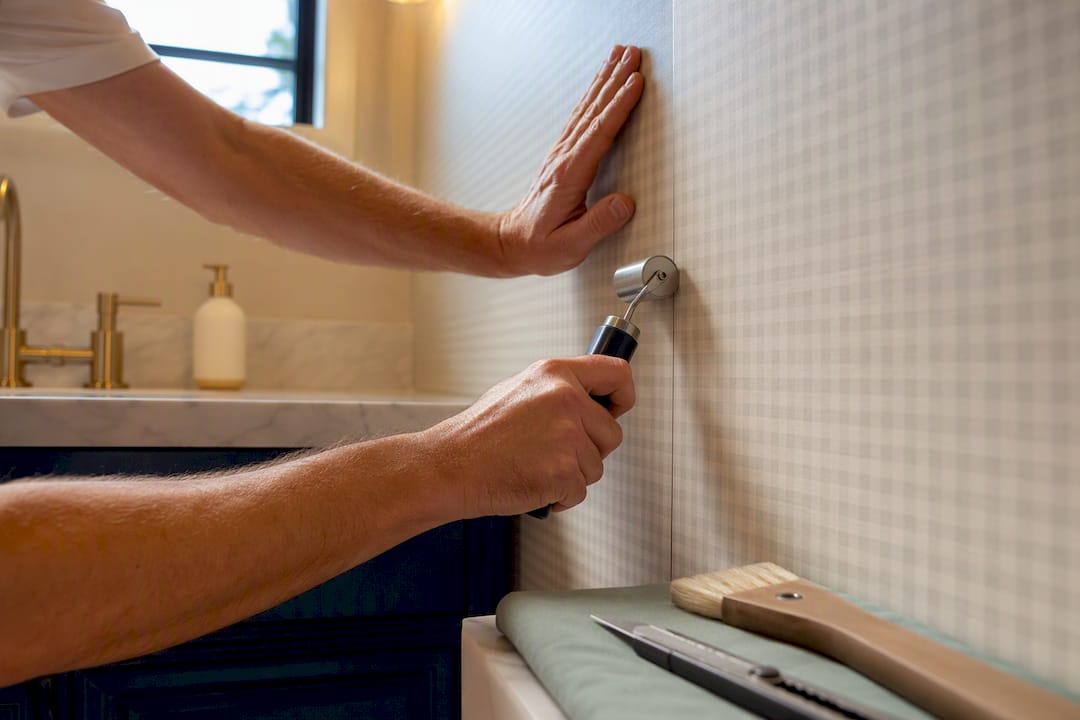
- Trim carefully around outlets, the mirror, and any fixtures, and roll seams flat with a seam roller.
Pro Tip: Give seams a full 24 hours to dry before running the exhaust fan or touching the walls with a damp cloth. Rushing this step is the most common cause of lifted edges. If your powder room has unusual angles, radiator pipes, or a pedestal sink crowding the walls, hiring a professional installer is often worth the cost, especially on a first attempt with a patterned, high-end material.
How Should You Maintain Wallpaper in a Bathroom?
Ventilation is the single biggest factor in how long your wallpaper looks fresh. Run the exhaust fan during and after every use, and consider a small dehumidifier if the room lacks a window or strong fan.
Cleaning differs slightly by material:
- Vinyl and vinyl-coated wallpaper can handle a damp cloth and mild soap; skip abrasive scrubbers, which dull the finish.
- Peel-and-stick tolerates light wiping but shouldn’t be soaked, since excess moisture can weaken the adhesive over time.
- Re-adhere a lifting edge with a bit of seam adhesive or double-sided wallpaper tape, and smooth small bubbles with a craft knife slit and a dab of paste, following the manufacturer’s specific repair guidance for your product.
How Do You Choose and Test Wallpaper Samples?
Measure your walls first, factoring in the door, mirror, and any window, then calculate roll coverage with some overage for pattern matching. Never buy full rolls before ordering samples. What looks perfect on a laptop screen can shift entirely once it’s on your actual wall.
Testing a sample under your powder room’s real lighting is one of the most overlooked steps in the process, since warm vanity bulbs can pull green undertones out of a blue, or mute a color that looked vibrant in daylight. Tape your sample beside the tile, the faucet finish, and the mirror frame, and look at it morning and evening before deciding.
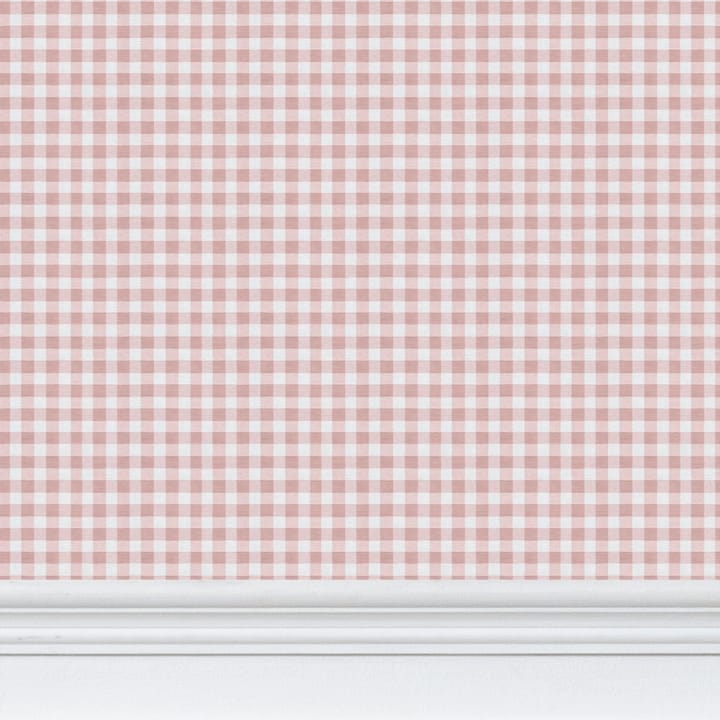
If you’re not ready to commit to a permanent material, peel-and-stick options let you live with a pattern for a season or two without the pressure of a long-term investment. Kevin Francis Design’s Austen Gingham colorways make particularly easy sample candidates, since a small check reads clearly even on a modest swatch, unlike a large-scale mural print that needs more real estate to judge.
What Should You Budget for Wallpaper and Installation?
A powder room’s small size is actually the best argument for splurging on a premium wallpaper. Because the powder room covers a relatively small wall area, even a designer-level product remains a modest total investment compared to papering larger rooms like bedrooms or living rooms.
Material costs vary widely by brand and print complexity, with hand-screened, silk-blend, or intricate pattern-matched papers commanding more per roll than a simple check or stripe. Peel-and-stick tends to sit at the more accessible end, largely because it requires no paste and less labor time. Vinyl-on-non-woven costs more upfront but often pays that back in a longer lifespan, particularly if you plan to stay in the home for years rather than redecorate every season.
Labor is where budgets swing the most. A DIY install costs only the price of tools (a smoothing brush, seam roller, and utility knife), while a professional hanger charges for both the room’s complexity and the pattern’s difficulty. A small check or geometric repeat, like a gingham print, installs faster and more forgivingly than an intricate mural requiring precise seam matching, which can add hours of labor time. Rooms with unusual angles, wainscoting, or multiple fixtures to trim around also push labor costs higher, since installers spend more time on careful cuts than on open wall space.
If you want a fuller breakdown of what a professional install typically runs by room size and material, this cost guide walks through the numbers in more detail. For anyone tackling structural wall repairs before hanging paper, a bathroom remodeling contractor can also handle prep work a DIY installer might not be equipped for.
How Do You Remove Wallpaper Without Damaging the Walls?
Removal difficulty depends almost entirely on what you installed and how well the walls were primed beforehand, which is exactly why that sizing step matters so much at the outset.
Peel-and-stick is the easiest by far. Most brands lift cleanly from a painted, primed wall with steady, slow pulling at a low angle, starting from a top corner. If residue remains, a little warm water and a soft cloth usually clears it.
Pasted vinyl or non-woven paper takes more patience. Start by scoring the surface lightly with a wallpaper scoring tool, being careful not to gouge the drywall underneath. Then apply a wallpaper removal solution or a simple mix of warm water and fabric softener, letting it sit for several minutes to soften the adhesive. Peel from a bottom corner upward in broad, slow strokes, and re-wet stubborn sections rather than forcing them, which is what tears drywall paper and leaves you with a bigger repair than the wallpaper itself.
Non-woven wallpaper installed correctly over a properly sized wall should come off in large, satisfying sheets, sometimes dry, without any solution at all. That ease is the direct payoff of using a primer or sizer at installation, a detail that’s easy to skip and expensive to regret. Once the walls are bare, wash away any remaining paste residue, let the surface dry fully, and patch any small dings before repainting or repapering.
What Mistakes Should You Avoid When Wallpapering a Powder Room?
The most common mistake is skimming past sample testing entirely. A pattern that looks stunning on a phone screen can read as garish or oddly flat once it covers four real walls under your specific lighting, and by the time you notice, you’ve already committed to several rolls.
Skipping primer or sizing ranks close behind. It seems like an optional extra step, but it directly affects both how well the paper adheres now and how easily it comes off later.
Other frequent missteps:
- Choosing a busy, small-scale print without checking how it looks reflected twice in a mirror, which can make a tiny room feel visually crowded rather than expansive.
- Underestimating overage and running short mid-project, especially with patterns that require careful repeat matching.
- Rushing the drying period and running the exhaust fan or touching walls before seams have fully set.
- Using traditional pasted paper or grasscloth in a room with poor ventilation, inviting curling and staining within a year.
- Ignoring the prime wall, the one visible from the doorway or mirror, and wasting the boldest pattern on a wall guests barely see.
Designer Notes: Why Kevin O’Gara Treats Powder Rooms as a Canvas
A powder room is the one place in a home where restraint isn’t a virtue. Kevin O’Gara approaches these small spaces as opportunities for the boldest pattern in the house, precisely because the commitment is low and the payoff is high.
Pro Tip: Pair your wallpaper’s dominant color with a small rug in a complementary tone rather than an exact match. It grounds the room without flattening the pattern’s impact.
— Kevin O’Gara
Shop the Look: Austen Gingham Wallpaper Colorways
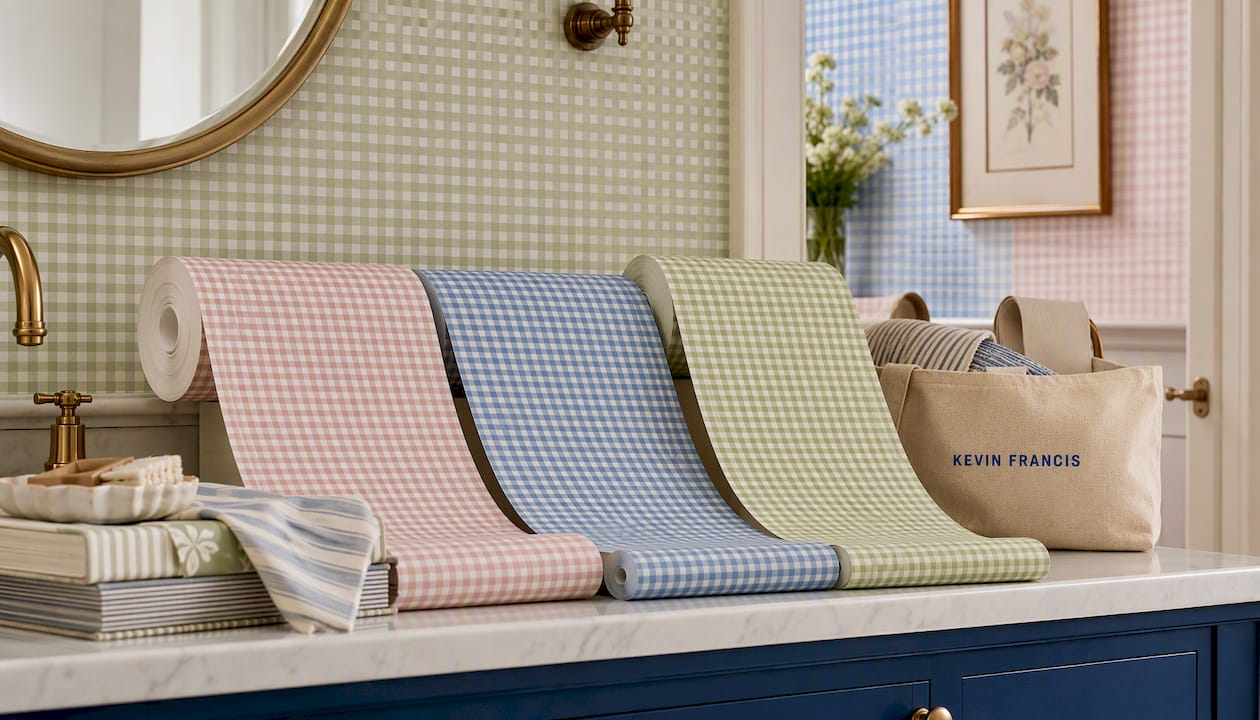
If you’re ready to move from inspiration to an actual roll on your wall, Kevin Francis Design’s Austen Gingham Small Check collection gives you three distinct moods to test in your own space. The Powder Pink colorway suits a soft, romantic powder room, the kind that pairs naturally with brass fixtures and a vintage-style mirror. The French Blue version leans classic and coastal, equally at home in a century-old colonial or a fresh new build with white subway tile. The Thyme Green option brings an earthy, modern edge that reads beautifully against matte black hardware and natural stone.
Every colorway is available as a sample, so you can pin a swatch to your wall and watch how it shifts under your vanity lighting across a full day before ordering. If you’re renting or simply not ready for a permanent install, Kevin Francis Design’s guidance on removable wallpaper covers how to get the same gingham look without altering the wall underneath. Order your samples today and see which colorway belongs in your powder room.
Sources
- Bathroom wallpaper ideas — HouseBeautiful
- Don’t be afraid to wallpaper your powder room — This Old House
- How to use wallpaper in bathroom — Martha Stewart
FAQ
What Kind of Wallpaper Is Best for a Powder Room?
Vinyl-on-non-woven wallpaper offers the best long-term durability and cleanability, while peel-and-stick works well for a dry powder room or a rental where flexibility matters more than permanence.
Is Wallpaper a Good Idea in a Powder Room?
Yes. Powder rooms have low humidity and light traffic, making them one of the safest and most rewarding rooms in the house for a bold, high-impact pattern.
What Kind of Wallpaper Looks Good in a Small Bathroom?
Larger-scale prints and deep jewel tones like navy, emerald, and terracotta tend to read better than tiny, busy patterns, since they avoid visual clutter and photograph beautifully in mirror reflections.
What Is the Current Trend in Wallpaper?
Bold, moisture-friendly patterns are leading the way, from graphic checks like the Austen Gingham collection to dramatic botanical and Art Deco prints, driven partly by how shareable a striking powder room has become on social media.


