


For a formal dining room, the most elegant rug choices are Aubusson-inspired medallions, hand-knotted Persian and classical designs, refined geometric low-piles, and polysilk or wool-silk blends with a soft sheen. The one rule that matters most: your rug should extend about 24 inches beyond the table on every side, and it should sit low enough in pile height that chairs glide rather than snag.
A few starting principles before you shop:
- Choose low-pile or flatweave construction so dining chairs pull out smoothly and crumbs sweep away easily
- Add a non-slip rug pad rated for your flooring, both for safety and to protect wood or tile underneath
- Favor stain-resistant fibers like wool, polysilk, or indoor-outdoor blends over anything plush or shaggy
- Look to Kevin Francis Design’s custom and catalog wool rugs when your table doesn’t fit standard proportions
Key Takeaways
The best designer rug for a formal dining room combines a style suited to the room’s existing décor with a low pile height, a size that clears the table by about 24 inches on every side, and a stain-resistant material built for daily wear.
| Point | Details |
|---|---|
| Follow the 24 inch rule | Size the rug to extend roughly 24 inches beyond the table on all sides so pulled-out chairs stay on the rug. |
| Choose low pile or flatweave | Avoid long pile, which snags chairs and traps crumbs; low pile and flatweave ease movement and cleaning. |
| Match material to household needs | Hand-knotted wool and wool-silk blends offer longevity, while polypropylene suits homes with kids or pets. |
| Use pattern and jewel tones strategically | Multi-tonal patterns and deep colors like emerald or sapphire hide stains and reinforce formality. |
| Consider bespoke sizing for nonstandard rooms | Kevin Francis Design’s CHROMA Custom Size Solid Color Wool Rug fits tables that don’t match standard dimensions. |
Table of Contents
- Elegant Rug Designs That Suit a Formal Dining Room
- How Big Should a Dining Room Rug Be?
- What Rug Material Holds Up Best Under a Dining Table?
- Styling and Color for a Formal Dining Room
- Kevin O’Gara on Bespoke Choices for Formal Dining Rooms
- Where Formal Dining Rug Styles Actually Come From
- How Rug Style Shapes the Formality of a Room
- Matching Rug Style to Your Dining Room’s Existing Décor
- What’s Changing in Designer Rug Styles for 2026
- An Editorial Take on Choosing a Formal Dining Rug
- Bring a Bespoke Rug to Your Own Dining Room
- Sources
- FAQ
Elegant Rug Designs That Suit a Formal Dining Room
Formality in a rug comes down to symmetry, material depth, and how the pattern behaves under a chandelier’s glow. Some styles were built for grandeur centuries ago and still carry that weight; others achieve the same formality through cleaner, more contemporary means. Here’s how the strongest options compare for a dining room meant to impress.
- Aubusson and medallion rugs. Born from a French weaving tradition of symmetrical florals and center medallions, these rugs frame a formal table the way a gilt mirror frames a mantel. Their fine, flat weave and restrained palette pair beautifully with chandeliers, antique tables, and molded ceilings.
- Hand-knotted Persian and classical rugs. Dense knot counts and saturated, layered color give these rugs a depth that machine-made pieces can’t replicate. They soften with age rather than wear out, developing a patina that reads as inherited elegance rather than dated decor.
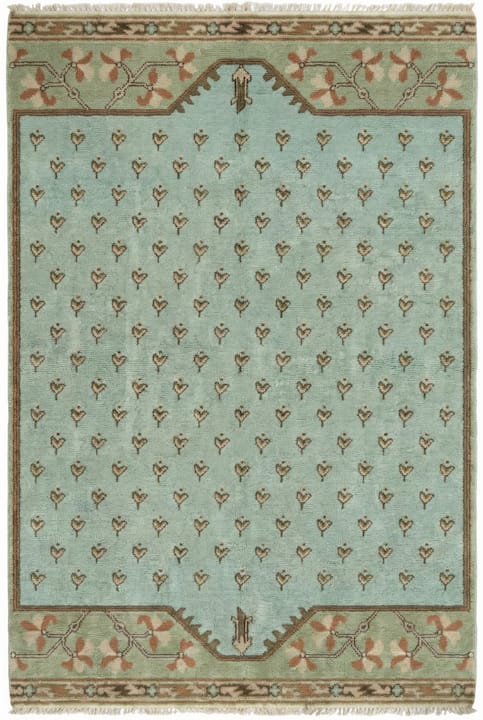
- Vintage and distressed rugs. A gently faded, weathered rug introduces history into a room that might otherwise feel too polished. It’s a way to keep formality without stiffness, especially in a dining room anchored by newer furniture.
- Geometric and color-field low-pile rugs. For dining rooms with a more modern architectural language, crisp geometric patterns or solid color fields deliver formality through precision rather than ornamentation. Their shallow pile makes chair movement effortless.
- Polysilk and wool-silk blends. These rugs catch light in a way pure wool cannot, giving a dressy, almost liquid sheen underfoot. They photograph beautifully and suit rooms built for entertaining, though it’s worth checking a specific blend’s durability rating before committing to heavy daily use.
- Flatweave and low-pile luxury weaves. Where chair traffic is constant, a flatweave keeps cleaning simple without sacrificing refinement. Low-pile rugs and flatweaves ease chair movement and are easier to maintain than high-pile alternatives, which matters more in a dining room than almost anywhere else in the home.
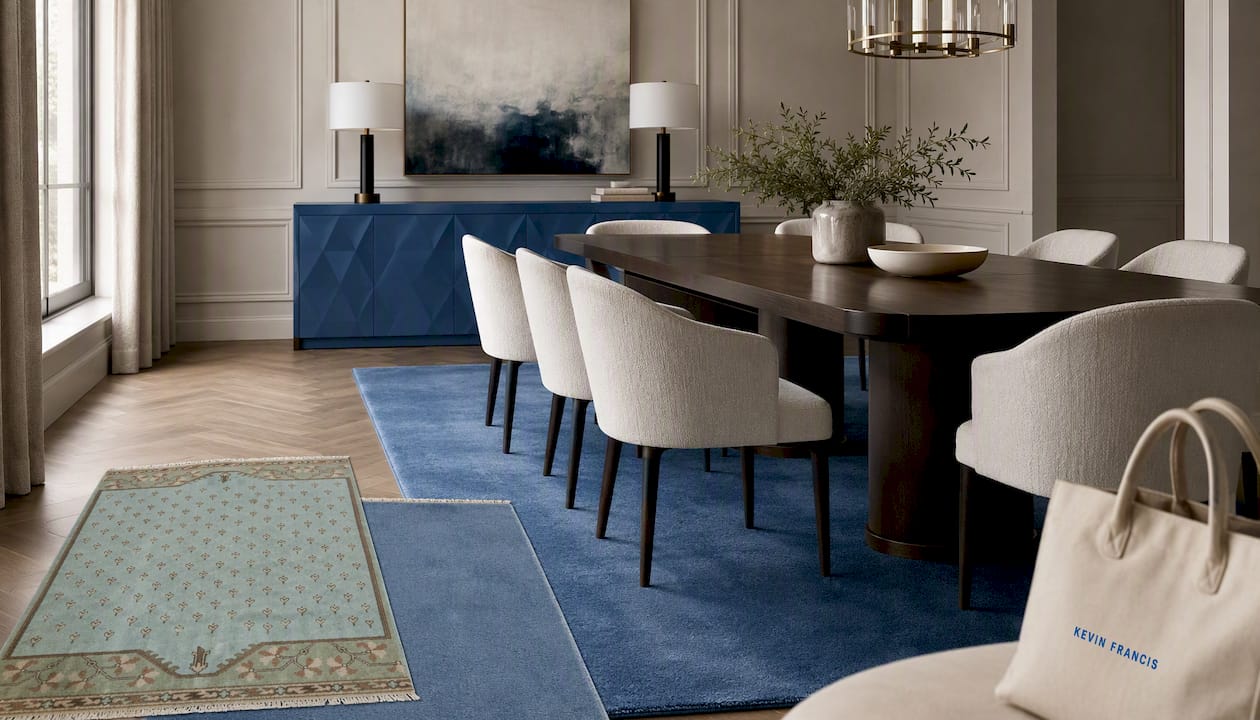
- Layered natural fiber plus patterned overlay. A jute or sisal base under a smaller patterned wool or hand-knotted rug adds textural depth while protecting the finer overlay from the heaviest wear. It’s an advanced styling move, but one that reads as intentional rather than accidental.
Pro Tip: If you’re torn between two styles, let the room’s existing formality decide. A heavily ornamented chandelier or carved table legs already carry visual weight, so a quieter geometric or solid wool rug, like Kevin Francis Design’s CHROMA Solid Color Wool Rug, lets those details stay the focal point.
How Big Should a Dining Room Rug Be?
Size mistakes are the most common way a beautiful rug undermines a formal room. The standard guideline is to extend the rug roughly 24 inches beyond the table’s edge on all sides, so a chair pulled fully back still rests on the rug rather than half on the floor. Run the chair-pull test in the showroom or at home before you commit: pull every chair out as if seating a full table, and check that all four legs stay grounded on the rug’s surface.
Rough sizing by table:
- A 48 inch round table typically needs an 8 foot round or square rug
- A 72 inch rectangular table generally calls for a 9 by 12 foot rug
- Tables seating eight or more usually need a 10 by 14 foot rug or larger, especially in open-plan rooms
In open-plan layouts, center the rug under the chandelier rather than the room itself, and size up if the dining zone needs to visually separate from an adjoining living space. If your table seats four or fewer in a small breakfast nook, a smaller accent rug or no rug at all may read cleaner than a piece that crowds the walls. Whatever size you land on, a rug pad rated for your flooring type prevents bunching and keeps the rug from becoming a hazard underfoot.
What Rug Material Holds Up Best Under a Dining Table?
Material choice in a dining room is really a durability conversation dressed up as a design one. Hand-knotted wool and wool-silk blends rank among the most durable options for dining use, aging gracefully under daily wear. Polysilk brings elegance and solid stain resistance, while polypropylene and indoor-outdoor blends are often fully washable, making them the practical pick for households with kids or pets.
Pile height matters as much as fiber. Long pile traps crumbs, snags chair legs, and flattens unevenly under table weight, while a low pile or flatweave construction keeps the surface even and easy to clean. Multi-tonal or patterned rugs also hide the inevitable dropped fork or spilled wine far better than a single flat hue.
Maintenance checklist:
- Blot spills immediately; never scrub, which pushes stains deeper into the pile
- Vacuum weekly on a low-suction setting for wool and silk blends
- Schedule professional cleaning every 12 to 18 months for hand-knotted pieces
- Rotate the rug twice a year to even out sun fading and foot traffic wear
- Choose polypropylene or indoor-outdoor weaves in homes with young children or pets
Styling and Color for a Formal Dining Room
The rug you choose often ends up setting the tone for the entire room, not just the floor beneath the table. Designers increasingly treat the rug as the starting point for a dining scheme, pulling wall color, linens, and even lighting finishes from its palette rather than the reverse.
- Jewel tones like emerald, sapphire, and deep plum read as formal and 2026-forward, especially against dark wood or brass accents
- A bordered rug reinforces symmetry and works well under a rectangular table, while a floating pattern with no clear edge feels looser and better suited to round tables
- Match pattern scale to table size; a busy, small-scale print can look chaotic under a large table, while an oversized medallion may overwhelm a compact room
- Coordinate rug tones with wood finishes, metal hardware, and drapery rather than matching them exactly, since a slight contrast reads as curated
- Consider how the rug’s palette might extend to dining room art or table linens for a cohesive, finished room
Kevin O’Gara on Bespoke Choices for Formal Dining Rooms
Kevin O’Gara, founder and designer behind Kevin Francis Design, has spent his career pairing hand-knotting and Tibetan weaving techniques with the kind of scale and precision formal rooms demand. His view: most dining rooms don’t need a custom rug, but the ones with nonstandard table shapes, unusually large footprints, or a chandelier set off-center almost always do.
A rug that’s simply “close enough” in size will always look slightly wrong under a formal table. When you commission a piece, specify the chandelier axis, the table footprint plus that 24 inch clearance, and how the room actually gets used, daily meals versus occasional entertaining, so the weave density and backing can be built for real wear.
For rooms that fit standard dimensions, the CHROMA Solid Color Wool Rug offers a clean, formal base. For nonstandard footprints, the CHROMA Custom Size Solid Color Wool Rug is built to spec. For rooms wanting hand-knotted craftsmanship, the Lotto Hand-Knotted Wool Area Rug delivers it.
Where Formal Dining Rug Styles Actually Come From
Aubusson rugs trace back to French tapestry workshops of the 17th and 18th centuries, where weavers on flat looms produced the symmetrical floral medallions still associated with formal French interiors today. The technique favored a tight, low profile over plush texture, which is exactly why Aubusson-style rugs remain so functional under a dining table centuries later.
Persian and classical hand-knotted rugs carry an even older lineage, with knotting traditions in regions across the Middle East and Central Asia dating back over a thousand years. Each regional style, whether a tightly patterned Tabriz or a bolder Heriz, developed its own knot density and motif language, but all shared the same underlying goal: create a surface durable enough for daily life in homes where the rug was also furniture, seating, and status symbol at once.
Geometric and color-field rugs are the newest entrants to this formal lineage, drawing more from mid-century modernist art movements than from centuries-old court weaving. Their formality comes from precision and restraint rather than ornament, a deliberate departure from the medallion tradition that still reads as elegant because of how cleanly it’s executed.
Vintage and distressed rugs occupy an interesting middle ground. Many started as classical or tribal pieces that simply aged in place for decades, and their faded state has since become a stylistic choice in its own right, prized for the warmth a brand-new rug can’t fake.
How Rug Style Shapes the Formality of a Room
A rug does more decorative work in a dining room than almost any other single piece. Because it sits beneath the table where every guest’s eye eventually drifts, its pattern and color set an emotional register before anyone even looks at the walls.
An Aubusson medallion under a mahogany table signals old-world formality immediately, the kind of room where you’d expect linen napkins and place cards. A geometric low-pile in charcoal or ink blue reads formal too, but in a cooler, more architectural way, better suited to a room with minimalist furniture and unadorned windows. Swap either for a vintage, distressed piece and the room softens considerably, formal still, but with an air of lived-in history rather than showroom polish.
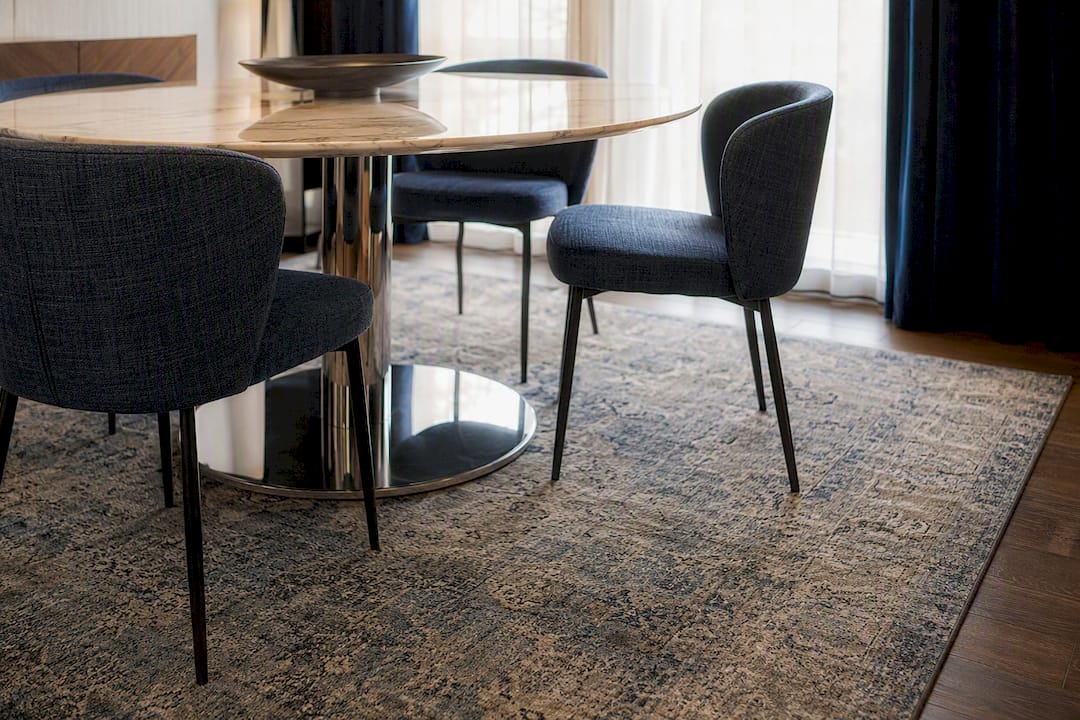
Color intensity plays its own role. Deep jewel tones and rich neutrals hold formality even in bright, sunlit rooms, while pale, airy patterns tend to relax a space no matter how ornate the furniture around them. Border rugs reinforce structure and symmetry, useful in rectangular rooms with a strong central axis, while floating, edge-free patterns loosen that structure and suit rounder, more casual formal spaces. The rug isn’t just underfoot decoration; it’s doing the quiet work of telling guests how to feel the moment they walk in.
Matching Rug Style to Your Dining Room’s Existing Décor
The right rug rarely fights the room it’s in. Traditional dining rooms with carved wood furniture, ornate mirrors, and warm brass fixtures tend to call for Aubusson or hand-knotted classical rugs, since both share the same decorative vocabulary of symmetry and craftsmanship. Push a stark geometric rug into that same room and the mismatch is immediate, too cold for the warmth everything else in the space is working to create.
Modern formal dining rooms, the kind with sculptural chairs, a glass or stone table, and minimal ornamentation, generally read best with geometric, color-field, or solid wool rugs. A heavily patterned Persian piece can still work here, but only if the rest of the room stays quiet enough to let the rug carry the visual interest without competing against other bold elements.
Transitional rooms, blending an antique table with contemporary chairs or vice versa, often benefit most from a wool-silk blend or a vintage rug with a muted palette. These styles bridge old and new without leaning too far in either direction. Whatever the existing furniture style, the safest rule is to let the piece with the most detail, whether that’s an ornate table base or a bold light fixture, dictate how busy the rug pattern should be. Two competing focal points rarely coexist well in a formal room.
What’s Changing in Designer Rug Styles for 2026
The clearest shift heading into 2026 is scale. Designers are moving toward oversized statement rugs that extend 18 to 24 inches beyond the table, often functioning as the primary tool for defining a dining zone in open-plan homes, a job that used to fall to paint or flooring changes.
Layering has become the second major trend. Placing a natural fiber base, like jute or sisal, beneath a smaller patterned or hand-knotted overlay adds texture and protects the finer rug on top, a technique that reads as intentional rather than mismatched when done well. Jewel-toned palettes, emerald, sapphire, and deep plum among them, continue to dominate formal spaces, offering richness that pairs naturally with brass and dark wood.
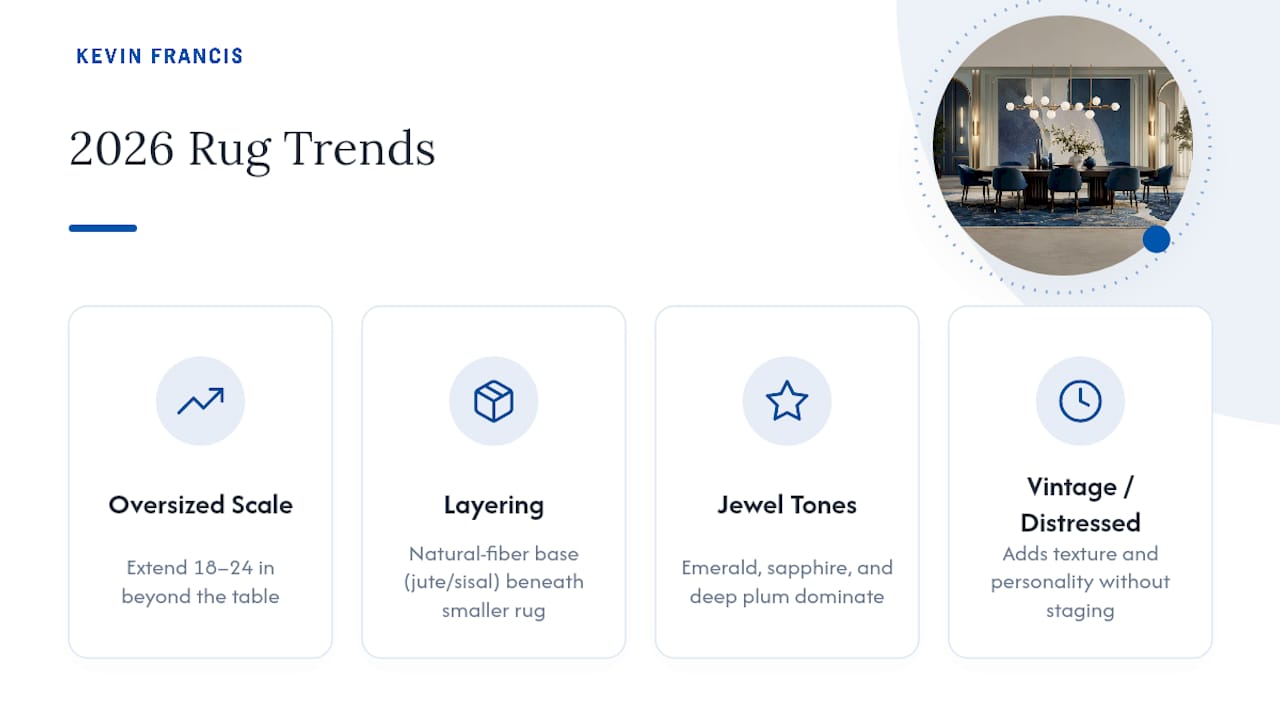
Vintage and distressed pieces are also gaining ground in formal rooms that want texture and personality without looking staged. None of these trends abandon the fundamentals: sizing, pile height, and material choice remain important factors for rug function in a dining room. What’s changed is scale and layering, not the underlying rules that make a formal rug work.
An Editorial Take on Choosing a Formal Dining Rug
Most advice on formal dining rugs treats style as the whole decision, when in practice function eliminates half the options before aesthetics even enter the conversation. A stunning long-pile silk rug that snags every chair leg isn’t a design win, it’s a rug you’ll be replacing within two years.
What the research here actually supports is a simple hierarchy: solve pile height and sizing first, then choose style within whatever survives that filter. Conventional advice tends to reverse this, leading with pattern inspiration and treating durability as an afterthought, which is exactly backward for a room that gets used daily.
If I had to prioritize one thing for a reader shopping right now, it’s the chair-pull test over any swatch or color board. A rug that passes that simple physical check will outlast three trend cycles. Style should follow function here, not the other way around, and the best luxury area rugs tend to be the ones built with both in mind from the start.
— Kevin O’Gara
Bring a Bespoke Rug to Your Own Dining Room
Kevin Francis Design specializes in exactly the gap most rug retailers leave open: dining rooms with nonstandard table shapes, oversized footprints, or a formality that off-the-shelf sizing can’t match. Where a big box retailer offers a handful of fixed dimensions, Kevin Francis Design builds to your table’s exact measurements plus that 24 inch clearance, so the chair-pull test passes on the first try, not after a return and reorder.
The catalog includes solid wool options like the CHROMA Solid Color Wool Rug for standard rooms, and hand-knotted craftsmanship in the Lotto Hand-Knotted Wool Area Rug for rooms that call for visible artistry underfoot. For a table that doesn’t match a standard size, start with the CHROMA Custom Size Solid Color Wool Rug and specify your exact dimensions before you order.
Sources
- How to Choose a Dining Room Rug — The Spruce
- Bold Dining Rugs 2026 — Define Your Space Instantly — ArtFasad
- Interior design rug trends for 2026 — Rug Industry News
FAQ
What Is the Best Type of Rug for a Dining Room?
Low-pile or flatweave rugs in durable materials like wool, wool-silk blends, or polypropylene work best, since they allow chairs to move freely and clean up easily after spills.
What Type of Rug Is Best for a Dining Room Table Specifically?
A rug sized to extend about 24 inches beyond the table’s edge on every side, in a low pile construction, keeps chair legs supported and prevents the rug from bunching under daily use.
Should Your Rug Be Lighter or Darker Than Your Furniture?
Either can work, but a slight contrast, rather than an exact match, tends to read as more intentional; deep jewel tones or rich neutrals against lighter wood furniture reinforce a formal look without looking matched from a set.
What Are the Main Rug Trends for 2026?
Oversized statement rugs, layering a natural fiber base under a patterned overlay, and jewel-toned palettes are among the leading trends, with designers using larger formats to define dining zones in open-plan homes.


