


For most homes, a premium down-alternative insert gets you the best of every world: down’s soft loft, machine-washable ease, and a hypoallergenic profile that suits families and pet owners alike. Down and feather remain the luxury standard for that irresistible sink-in plumpness, while latex, memory foam, buckwheat, wool, and kapok each solve a specific problem, from neck support to natural cooling. Whatever fill you land on, buy the insert about two inches larger than your cover for that full, structured look designers chase. The sections below walk through each fill’s feel, care needs, sizing math, and the right pick for your specific corner of the house.
TL;DR:
- Proper sizing involves choosing an insert about two inches larger than the cover to achieve a full, structured look with crisp corners.
- High-quality down or down-alternative microfiber provides the best balance of durability, loft, and ease of care for most household needs.
- Durability varies by fill type, with down and microfiber lasting several years, while lower-end synthetics may flatten and require replacement within two to three years.
- Foam and latex are better suited for support pillows and do not require regular washing, unlike down or microfiber inserts.
- Buying a premium insert first ensures a pillow retains its shape and look over time, as covers are inexpensive and easily replaced.
Table of Contents
- What Are the Main Pillow Insert Types?
- Pros, Cons, and Lifespan: Which Fill Actually Lasts?
- How Big Should Your Pillow Insert Be?
- Caring for Your Pillow Insert by Fill Type
- Matching the Right Insert to Each Room and Use
- A Designer’s Rules for Choosing Pillow Fills
- The One Insert Rule Most People Get Backwards
- Bring Your Insert Choice Home with a Designer-Ready Lumbar Pillow
- Sources
- FAQ
What Are the Main Pillow Insert Types?
Every insert on the market traces back to one of a handful of fill families, and each one has a distinct personality. Understanding what each fill actually feels like under your hand, before you commit to a cover, saves you from the frustrating cycle of buying, returning, and rebuying pillows that never quite look right.
Down is the benchmark for a reason. Sourced from the soft undercoating of ducks or geese, it molds around your body or your cover’s seams with a plumpness synthetic fills struggle to replicate. Its performance is measured in fill power (the higher the number, the more loft and air a given weight of down produces), and higher fill power costs more but delivers noticeably more cloud-like volume. The tradeoff is care: down often needs airing between uses and professional cleaning rather than a casual trip through the washer.
Feather and feather/down blends trade a bit of that ethereal softness for backbone. Feathers add structure and hold shape better under weight, which makes blends a smart pick for pillows that get leaned on daily. The catch is quills, which can work their way through low-quality shells over time, so a tightly woven, down-proof cover matters more here than with pure down. Blends also tend to cost noticeably less than 100% down fill.
Down-alternative microfiber is where modern performance catches up to old-world luxury. Fine polyester filaments are engineered to trap air the way down does, and the result is a fill that mimics that loft while going straight into the washing machine. It’s hypoallergenic and machine-washable, which is exactly why it’s become the default recommendation for family homes with kids, pets, or allergy sufferers in the mix.
Basic polyester fiberfill is a different animal entirely from its microfiber cousin. It’s the loose, cotton-ball-style stuffing found in budget throw pillows, and it flattens fast under regular use. Skip it for anything you want to look sharp on a sofa longer than a season.
Memory foam and latex aren’t about decorative loft at all. Solid or shredded memory foam contours and holds a shape, which makes it useful for lumbar and neck support pillows rather than plump accent pieces. Latex offers a springier, more resilient bounce and naturally resists dust mites, a real advantage for allergy-conscious households.
Beyond those, a few specialty fills serve niche but loyal followings:
- Kapok, a silky plant fiber harvested from the ceiba tree, offers a lightweight, sustainable alternative to down with a similar airy feel.
- Wool naturally regulates temperature and resists moisture, making it a smart pick for year-round comfort.
- Buckwheat hulls shift and settle to your exact shape, giving you adjustable firmness and excellent airflow.
- Outdoor polyester and performance foams are engineered to shrug off UV rays and humidity, and pairing them with a mildew-resistant shell matters just as much as the fill itself for patio and sunroom pillows.
Pros, Cons, and Lifespan: Which Fill Actually Lasts?
Not every fill ages the same way, and that difference shows up fastest in the corners and center of your pillow. Down and high-quality microfiber hold their shape and bounce back after a good fluffing; basic polyester fiberfill compresses into a flat, lifeless pancake within months of regular use.
| Fill type | Shape retention | Care | Typical lifespan |
|---|---|---|---|
| Down | Excellent, springs back with fluffing | Air regularly, professional cleaning recommended | Multiple years with care |
| Feather/down blend | Very good | Spot clean, occasional professional cleaning | Several years |
| Down-alternative microfiber | Good to very good | Machine-washable, tumble dry low | Multiple years with care |
| Basic polyester fiberfill | Poor, clumps early | Machine-washable but rarely restores loft | typically has a shorter lifespan |
| Latex | Excellent | Spot clean only, air to remove odors | Long-lasting, resists wear |
| Buckwheat/wool/kapok | Good with maintenance | Air, sift, or refill periodically | Multiple years |
Pro Tip: A pillow that looks lumpy after fluffing, smells musty despite airing, or has gone visibly yellow at the seams has reached the end of its useful life. Replace the insert before it drags down an otherwise beautiful cover.
A high-quality down or down-alternative insert can serve you well for multiple years with basic care, while cheaper synthetics typically need replacing every two to three years. That gap matters when you’re budgeting for a room. Spend on the insert for pillows that anchor a sofa or bed, and save the economy fills for temporary staging, seasonal refreshes, or spaces where the look doesn’t need to survive daily wear.
The value math tends to surprise people: a mid-range cover paired with a premium insert almost always outperforms an expensive cover stuffed with a bargain fill. The insert is what your hand and eye register first.
How Big Should Your Pillow Insert Be?
Designers commonly recommend buying an insert about two inches larger than the cover’s stated dimensions. This extra fullness produces the crisp, structured corners seen in well-styled rooms, rather than the deflated, saggy look of an insert that exactly matches the cover.
- Match your cover size to the chart. For an 18 inch cover, use a 20 inch insert. For a 20 inch cover, use a 22 inch insert. For a 24 inch cover, size up to a 26 inch insert.
- Understand fill power before you buy. Higher fill power numbers mean more loft and air per ounce of down, which translates to a fuller pillow at a higher price point.
- Check the shell and seams. A down-proof shell with box construction or sewn baffles keeps fill from migrating into the corners over time, which is exactly what preserves those sharp edges.
- Choose firmness for your desired finish. A firmer, fuller insert gives you that structured, tailored look; a softer, slightly smaller insert reads as relaxed and lived-in.
Caring for Your Pillow Insert by Fill Type
Care routines vary enough by fill that using the wrong method can ruin an otherwise good insert. Down-alternative microfiber and many modern microfiber fills tolerate a gentle machine wash cycle with mild detergent, followed by a low tumble-dry cycle with a couple of dryer balls or clean tennis balls to restore loft.
Down and feather fills prefer a gentler hand. Regular airing outdoors on a sunny, dry day helps release moisture and odor, spot cleaning handles small stains, and anything beyond that belongs with a professional cleaner who understands natural fill.
- Latex and foam inserts should never go in a washing machine; spot clean the cover and air out the insert to clear odors.
- Shredded memory foam can be opened and adjusted if it’s gone lumpy, redistributing the fill by hand.
- Buckwheat hulls benefit from occasional airing and a periodic sift to redistribute weight; top off hulls that have broken down.
- Wool and kapok fills should be aired rather than washed, with dust removed by light beating or a vacuum’s low-suction attachment.
Pro Tip: Store off-season pillows in breathable cotton bags rather than sealed plastic bins. Trapped moisture is the fastest route to yellowing and musty odors, even in fills that otherwise hold up beautifully.
Matching the Right Insert to Each Room and Use
The right fill depends less on personal preference than on where the pillow lives and what job it’s doing. A decorative pillow stacked on a guest bed has completely different demands than a lumbar cushion supporting your lower back at a desk chair.
- Decorative statement pillows: size up the full two inches and choose premium down or high-quality down-alternative for that plump, gallery-worthy finish.
- Everyday sofa cushions: durable microfiber or a feather/down blend holds up to nightly use while staying resilient against constant compression.
- Sleeping and neck support: latex, shredded memory foam, or buckwheat hulls give you the structure and adjustability that decorative fills simply can’t.
- Outdoor and sunroom pillows: outdoor-rated polyester and quick-drying foams paired with mildew-resistant shells stand up to humidity and sun exposure.
- Lumbar and bolster pillows: firm fills like latex or dense microfiber matter most here, since these shapes rely entirely on the insert for support. The Cosmos Meadow Extra Long Lumbar Pillow and The Chamomile Meadow Extra Long Lumbar Pillow are built with this exact use in mind.
A Designer’s Rules for Choosing Pillow Fills
Kevin O’Gara of Kevin Francis Design has spent years pairing handmade covers with the right inserts, and the lesson that sticks is simple: the fill is doing more visual work than the fabric.
A gorgeous cover with a flat, tired insert still looks tired. Size up two inches, choose a medium-full loft for anything that will sit in a layered arrangement, and put your money into the insert before you put it into a fancier textile. That’s the trade every experienced stylist makes, and it’s the one beginners skip.
For layered arrangements, medium-full inserts create the kind of gentle overlap that makes a sofa or bed look curated rather than staged, a technique that complements the latest interior decor styles described in why interior doors are the next big home trend. Mixing textures and scales matters too: pair a smooth silk cover with a nubby wool-blend throw, or balance a bold pattern with a solid, structured neighbor. If you’re working out how to combine prints without visual chaos, our guide to mixing pillow patterns breaks down the ratios that work. And if you’re sewing your own covers to pair with a quality insert, our DIY throw pillow cover guide walks through construction that won’t fight your insert’s shape.
The One Insert Rule Most People Get Backwards
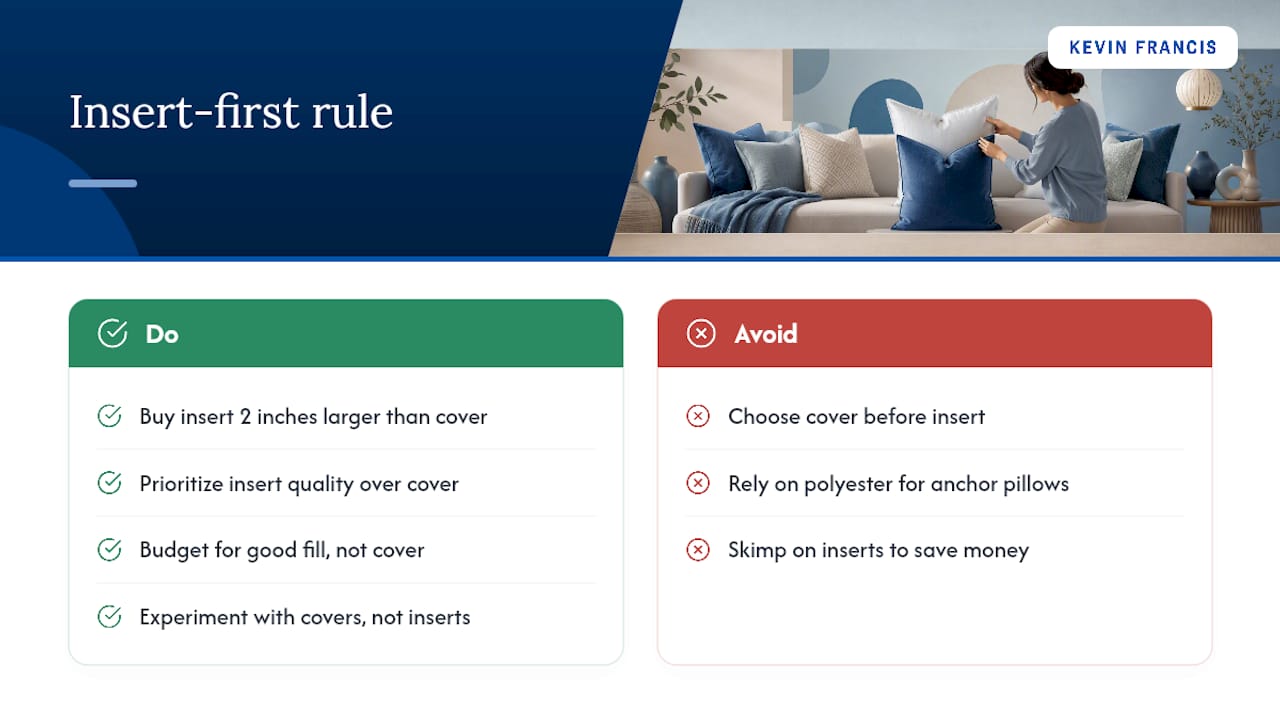
Most shopping advice tells you to fall in love with a cover first and pick a cheap insert to save money. That’s the wrong order. A pillow’s silhouette, the way light catches its corners, the way it holds up after the tenth time someone leans on it, comes almost entirely from the insert. Covers are interchangeable and inexpensive to replace; a good insert is the harder thing to get right and the thing worth budgeting for first.
The industry has also oversold basic polyester fiberfill as a universal budget solution. It’s fine for a kid’s reading nook or a pillow that will be replaced next season, but it’s a poor foundation for anything meant to anchor a room. If you take one thing from this guide, let it be this: buy the insert two inches larger than your cover, spend where the fill actually lives inside the pillow, and let the cover be the part you experiment with.
— Kevin O’Gara
Bring Your Insert Choice Home with a Designer-Ready Lumbar Pillow
Once you know which fill suits your space, the fastest way to see it in action is a pillow built with that logic already in place. Some lumbar pillows are shaped and filled specifically for the layered, structured look this guide describes, so you can skip the trial-and-error of matching cover to insert yourself.

Both pillows are sized for the kind of full, supportive lumbar presence that a firmer fill demands, whether you’re styling a sofa, a window seat, or a favorite reading chair. Pairing a well-made pillow with the right insert inside it is what gives a room that finished, intentional feel that lasts through years of daily use, not just the first photo. Browse The Cosmos Meadow Extra Long Lumbar Pillow or The Chamomile Meadow Extra Long Lumbar Pillow to see the full range of patterns available, and add one to your cart today.
Sources
- Throw Pillow Inserts: Sizes & Fills Guide | ONE AFFIRMATION
- Down vs. feather pillows — Sleep Foundation
- Pillow Stuffing Materials Guide 2026: Foam, Down, Latex & More - Mattress Nut
FAQ
What type of pillow insert is best?
Premium down-alternative microfiber is the best all-around choice for most homes because it’s hypoallergenic, machine-washable, and mimics the loft of real down at a lower price and easier care level.
What are the different types of pillow fillings?
The main fill types are down, feather, feather/down blends, down-alternative microfiber, polyester fiberfill, memory foam, latex, kapok, wool, buckwheat hulls, and outdoor-rated polyester or foam.
What is the rule for pillow inserts?
Buy your insert about two inches larger than the cover’s stated size; an 18 inch cover pairs with a 20 inch insert, and a 20 inch cover pairs with a 22 inch insert, to get full, structured corners.
What is the best type of cushion insert?
For decorative cushions that need to hold a plump, tailored shape, premium down or high-quality down-alternative performs best; for support pillows like lumbar cushions, a firmer latex or dense microfiber insert works better.
How long does a pillow insert typically last?
A high-quality down or down-alternative insert can last multiple years with basic care like airing and fluffing, while cheaper polyester fiberfill often needs replacing every two to three years.


