


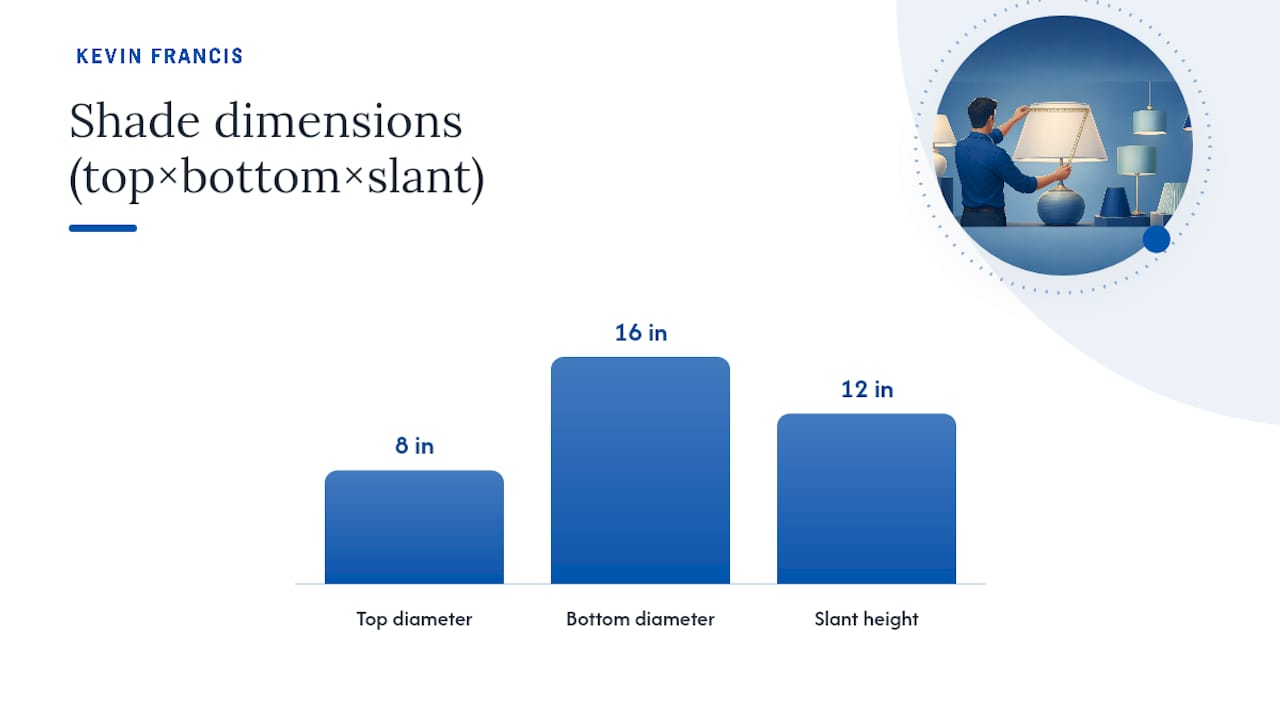
Lamp shade dimensions are read in one order: top diameter × bottom diameter × slant height, and slant is always measured along the sloped side, never straight up and down. Two proportions do the heavy lifting from there: shade height should land near two-thirds of the lamp body, and bottom diameter should run 1.5 to 2 times the width of the base. Get those numbers right, then check the fitter before you buy.
TL;DR:
- The slant height must be measured along the shade’s slope, not vertically, to ensure accurate proportion calculations and proper fit.
- Shade height should be approximately 60 to 70 percent of the lamp’s body height, with variations needed for floor lamps and specific styles.
- The bottom diameter typically ranges from 1.5 to 2 times the lamp base width, with larger shades generally creating a more intentional look.
- Confirm fitter type and measure the fitter or neck diameter before purchasing, as incompatible hardware prevents installation regardless of size.
- Use cardboard templates to test proposed sizes against your space and lighting needs before making a final decision.
Table of Contents
- How to Measure a Lamp Shade the Right Way
- What Size Lampshade Fits Your Lamp? Proportion Rules and Ranges
- Lamp Shade Fitter Types and How to Check Compatibility
- Choosing a Lamp Shade Shape and Material
- Bulb Heat and Shade Clearance: What’s Actually Safe
- Choosing Lamp Shade Sizes for Your Room and Placement
- How Kevin Francis Design Brings It All Together
- A Designer’s Walkthrough: Measuring, Testing, and Deciding
- Sources
- FAQ
How to Measure a Lamp Shade the Right Way
Before you touch a tape measure to any shade, measure the lamp itself. You need four numbers: the widest point of the base, the height of the lamp body up to the socket, the harp height, and the diameter of the fitter or neck where the shade will sit. Skip any of these and you’re guessing.
Once you have those, measure your current shade (or the one you’re replacing) using the same top × bottom × slant convention the trade uses.
- Top diameter. Measure straight across the opening at the top of the shade, rim to rim.
- Bottom diameter. Measure straight across the widest point at the base of the shade.
- Slant height. Run the tape along the outside slope, from the top edge down to the bottom edge, following the angle of the shade rather than measuring vertically.
That third step trips up more people than any other part of this process. The Spruce notes that measuring slant height straight down instead of along the slope is one of the most common errors home shoppers make, and it throws off every proportion calculation that follows.
Write your numbers down immediately, in that same order: top × bottom × slant. A shade listed as “8 x 16 x 12” tells a lampshade fitter or online retailer everything they need to know in seconds. Round to the nearest quarter inch. Keep a short measurement sheet for each lamp in your home, including base width, harp height, and fitter type, the same practice professionals rely on when ordering from custom shade makers who never see the actual lamp.
Pro Tip: Measure the harp, not just the socket. A harp that’s too short leaves the bulb sitting too high, so the shade sits crooked or the socket peeks out below the rim no matter how correct your diameter math is.
What Size Lampshade Fits Your Lamp? Proportion Rules and Ranges
The two-thirds rule is the fastest gut check in the business. If your lamp body measures 18 inches from base to socket, aim for a shade height (slant) somewhere between 10.8 and 12.6 inches, roughly 60 to 70 percent of that body height. Floor lamps behave differently: because the pole itself carries so much visual weight, shade height often drops closer to one-third of total lamp height to keep the silhouette from looking top-heavy.
Bottom diameter follows the base. Beyond the math, here’s how that translates across common fixtures:
- Table lamps: bottom diameter roughly 12 to 18 inches, slant height 9 to 14 inches
- Bedside lamps: bottom diameter 8 to 12 inches, kept smaller so the shade doesn’t crowd a nightstand
- Buffet lamps: bottom diameter 6 to 10 inches on a taller, narrower profile
- Floor lamps: bottom diameter 14 to 20 inches, sized to the pole’s visual mass rather than a tabletop base
- Pendants: bottom diameter varies widely by drop height and fixture count, but generally scales with ceiling height
- Sconces: typically the smallest category, often 5 to 9 inches, since they read against a wall rather than open floor space
Pick a size within a reasonable range rather than focusing on an exact midpoint. A slightly larger shade often looks better than a too-small one.
Lamp Shade Fitter Types and How to Check Compatibility
The fitter is the hardware that connects shade to lamp, and it matters as much as the diameter. There are four common types.
- Spider fitter: a wire frame that rests on top of the harp, the standard setup for most table and floor lamps.
- Uno fitter: a ring that screws directly onto the socket instead of sitting on a harp, common on torchiere-style lamps and some bridge lamps.
- Clip-on fitter: small clips grip the bulb itself, used where there’s no harp at all.
- Glass fitter neck: a molded opening on the shade itself that slides down over the socket, seen on many glass and vintage-style shades.
The Spruce catalogs standard neck diameters and adapter options for each type, and converters exist to switch a clip-on lamp to spider-fitter shades or adjust a mismatched harp height. Measure the fitter ring or neck diameter and the harp drop before ordering, and confirm the shade hides the socket and bulb at eye level, which is the single fastest way to avoid a return.
Choosing a Lamp Shade Shape and Material
Shape changes how large a shade reads even when the diameter numbers match on paper. A drum shade sits straight-sided and reads more substantial than an empire shade with the same bottom diameter, since the empire tapers inward and loses visual weight toward the top.
- Drum: clean, straight sides; pairs well with modern or minimalist bases
- Empire: the classic tapered silhouette; flatters most traditional and transitional lamp forms
- Bell: a curved taper; softens an angular or industrial base
- Coolie: wide and shallow; suits low, wide ceramic or stone bases
- Cylinder: narrow and consistent top to bottom; works on slim, tall bases
- Square or oval: echoes rectilinear furniture and architectural millwork
Material and lining shift the effect further. A linen shade with a white lining throws warm, diffused light and reads visually lighter than the same shade in a dark, opaque fabric, which pulls light downward and makes the shade feel denser. For a base with strong pattern or color, a plainer shade in a complementary tone often reads better than one that competes for attention, a principle worth revisiting when you’re choosing designer lighting fixtures for a room built around a signature piece.
Bulb Heat and Shade Clearance: What’s Actually Safe
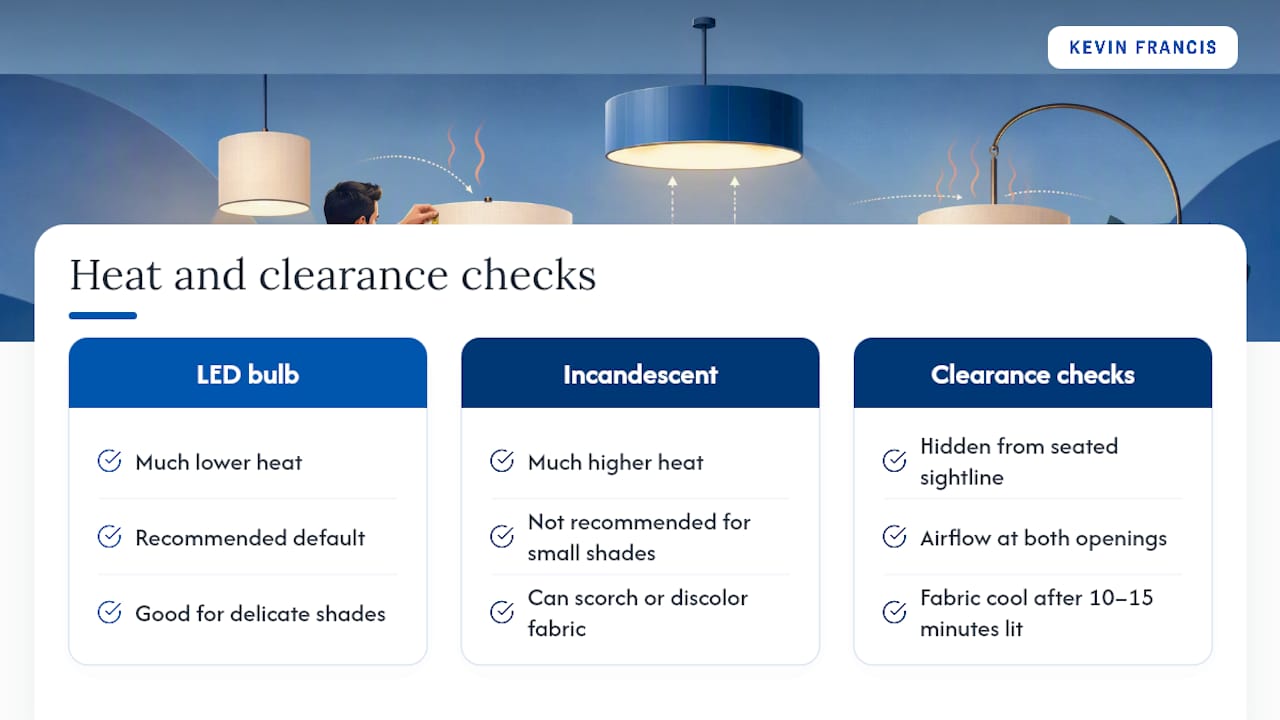
Heat, not diameter, causes most lampshade damage. The concept lighting professionals use is critical radius, the minimum distance from the bulb’s filament to the inner edge of the shade needed to keep fabric from scorching or discoloring over time.
LED bulbs run dramatically cooler than incandescent bulbs at equivalent brightness, which is why professionals now recommend them as the safer default for smaller or delicate shades. If you’re uncertain about clearance, size up the shade or drop the wattage rather than risk it. Before calling any install finished, check three things: the bulb shouldn’t be visible from a seated sightline, the shade needs airflow at both openings, and the fabric should stay cool to the touch after 10 to 15 minutes lit.
Choosing Lamp Shade Sizes for Your Room and Placement
A shade that looks correct on a showroom shelf can look wrong the moment it’s on your side table, because room scale changes everything. A large sectional and a nine-foot ceiling can absorb a generously sized shade that would overwhelm a small reading nook.
Start with function. A bedside lamp used for reading needs a shade wide enough to spread light without a harsh sightline to the bulb, but shallow enough not to crowd a narrow nightstand. A console lamp in an entry hall can run larger, since it’s viewed from a distance and needs presence rather than task lighting.
Placement near seating matters too. A floor lamp beside a reading chair should have its shade bottom sit roughly at or slightly below eye level when you’re seated, which keeps the light source out of your direct line of sight, a detail worth checking against your own floor lamp’s role in the room’s overall composition before finalizing a size. In open-plan spaces, oversized shades on paired lamps can help visually anchor a large room the way a substantial area rug does, giving the eye a resting point instead of letting the space feel scattered. When in doubt, err toward the larger end of your calculated range. A shade that’s a touch too big reads intentional; one that’s too small reads like an afterthought.
How Kevin Francis Design Brings It All Together
Getting the shade right is only half the room. Kevin Francis Design curates lighting fixtures and pleated shades alongside handmade rugs and textiles, so the scale decisions you make for a lamp echo through the rest of the space rather than standing alone. A custom shade option means you’re not stuck choosing the closest retail size when your base falls between standard ranges.
Pair a well-scaled table lamp with a piece like the Knossos Hand-Tufted Maze Rug to anchor a seating area, or let the Lucca Hand-Tufted Maze Rug set the tone a floor lamp’s shade should echo in color and weight. For a bedroom refresh, the Chamomile Meadow Extra Long Lumbar Pillow coordinates naturally with a bedside lamp’s warmer, softer lighting. Larger rooms built around a statement floor lamp often benefit from the scale of the Anatolia Hand-Tufted Maze Rug or, for a smaller footprint, the 4x6 Anatolia Hand-Tufted Blue Maze Rug. If your lamp collection needs a custom color match, the CHROMA Custom Size Solid Color Wool Rug can be built to the exact palette. Browse the current lighting collection or start a custom shade conversation with Kevin Francis Design’s design team to get sizing right the first time.
A Designer’s Walkthrough: Measuring, Testing, and Deciding
The workflow that actually works looks like this: measure the lamp first, calculate your target range, then shortlist two candidate sizes rather than committing to one number. Cut a cardboard template at each candidate’s bottom diameter and height, tape it in place, and check the sightline from where you’ll actually sit or stand, an approach outlined in more depth in Kevin Francis Design’s guide to stylish interior lighting. Confirm the fitter type before ordering anything. On one recent bedside lamp with a low, wide ceramic base, the two-thirds rule technically called for a smaller shade than the room wanted. The larger option won, because the low base needed height to avoid disappearing next to a tall headboard, proof that the formula is a starting point, not a verdict.
— Kevin O’Gara
Sources
- How to Measure Lamp Shades for the Perfect Fit — The Spruce
- Lamp Shade Size Calculator & Size Chart | JX Lampshade
- How to measure a lamp shade — Home Depot
FAQ
What Are the Three Common Types of Lampshades?
Shape-wise, the three most common silhouettes are drum, empire, and bell, though coolie, cylinder, and square or oval shades are widely available for specific base styles. Fitter-wise, the three most common hardware types are spider, uno/Euro, and clip-on, with glass fitter necks as a fourth used mainly on glass and vintage fixtures.
How Do I Measure for a Replacement Lamp Shade?
Measure the lamp’s base width, body height to the socket, and harp height, then measure the current shade’s top diameter, bottom diameter, and slant height along the slope. Record all six numbers in top × bottom × slant order before shopping.
How Do I Know What Lampshade Will Fit My Lamp?
Confirm the fitter type first, spider, uno/Euro, clip-on, or glass neck, since a shade with the wrong hardware won’t mount regardless of correct diameter. Then match bottom diameter to roughly 1.5 to 2 times your base width and shade height to about two-thirds of the lamp body.
What Is the Lampshade Sizing Rule?
The core rule pairs two ratios: shade height should be about two-thirds of the lamp body height, and shade bottom diameter should run 1.5 to 2 times the width of the lamp’s base. Both are planning ranges, not fixed numbers, so adjust within them based on the lamp’s silhouette and the room around it.


