


Art patronage in interior design means providing ongoing financial, commissioning, or platform support to an artist or artisan maker, sustaining their creative practice and directly shaping what becomes available for your home. Unlike simply purchasing a finished piece off a shelf, patronage creates a relationship: you enable the conditions for original work to exist, and in return, your interior carries something genuinely singular. That distinction matters most when you want a space that tells a story rather than merely fills a room.
The primary forms patronage takes in interior projects include:
- Bespoke commissions — custom rugs, wallpapers, or furniture conceived specifically for a space, such as the Lotto Hand-Knotted Wool Area Rug or the Cairene Hand-Knotted Wool Area Rug
- Direct studio support — funding an artist’s time, materials, or residency without requiring a specific deliverable
- Limited-edition runs with provenance — acquiring pieces from a defined series, such as the Knossos Hand-Tufted Maze Rug or the CHROMA Solid Color Wool Rug, where the making history travels with the object
- Private residencies — hosting or funding an artist’s time in a home or property so site-specific work can emerge from the architecture itself
Each of these models connects the person who lives in a space to the person who made what fills it, and that connection is what gives patronage its quiet power in design.
Key Takeaways
Art patronage in interior design means sustaining an artist’s practice through commissions, studio support, or limited-edition collecting, producing spaces with provenance, craft depth, and genuine originality that purely transactional purchasing cannot replicate.
| Point | Details |
|---|---|
| Patronage vs. sponsorship | Patronage sustains creative practice without requiring a deliverable; sponsorship demands a defined return. |
| Historical lineage | From Medici commissions to salon interiors, patrons have always shaped interior innovation by funding artistic experimentation. |
| Five practical mechanisms | Bespoke scale, longer research cycles, technique preservation, provenance, and market innovation all flow from patronage relationships. |
| Ethical red flags to avoid | Demanding creative control, opaque payments, and PR-only proposals signal art-washing rather than genuine support. |
| Kevin Francis Design | Offers custom hand-knotted and hand-tufted rug commissions, with a briefing-to-installation process designed for homeowners and interior designers. |
Table of Contents
- How did art patronage shape interiors throughout history?
- What does modern patronage look like, and how is it different from sponsorship?
- How does patronage actually change the outcome of an interior?
- How can you start acting as a patron for your own interior project?
- What does a commissioned rug project actually look like from brief to installation?
- Why patronage produces the most meaningful interiors
- Bring your interior to life with a Kevin Francis Design commission
- Sources
- FAQ
How did art patronage shape interiors throughout history?
Patronage has been a driver of interior innovation since the earliest built environments, with guilds and wealthy individuals commissioning works that defined how rooms looked, felt, and communicated status. The modern idea of commissioning a bespoke textile or mural for a home is a direct descendant of that tradition.
- Ancient temples and guild commissions (pre-1400) — Mesopotamian rulers and Egyptian pharaohs funded craftspeople to produce decorative programs for temples and palaces; guilds in medieval Europe organized artisan labor for ecclesiastical and civic interiors.
- Renaissance Medici patronage (1400s–1500s) — The Medici family in Florence funded artist-architect collaborations that produced frescoed chapels, sculpted courtyards, and furnished rooms that were simultaneously private retreats and public declarations of cultural authority.
- Nineteenth-century private collectors (1800s) — Industrial-era wealth produced a new class of patron who collected paintings, ceramics, and textiles for domestic display, turning the home into a gallery and the collector into a tastemaker.
- Early twentieth-century arts-and-crafts and modernist patronage (1900s–1960s) — Patrons such as Peggy Guggenheim and the founders of the Bauhaus movement funded experimental studios whose output shaped domestic design for generations.
- Late twentieth and twenty-first century private and corporate patronage (1980s–present) — From 1980s New York to today, corporate mécénat and private foundations have taken on the role once held by aristocratic households, funding residencies, craft ateliers, and site-specific commissions.
Two moments illustrate how directly patronage shaped interior outcomes. Lorenzo de’ Medici’s support of Botticelli and Michelangelo produced not only paintings but entire decorative programs for private chapels and reception rooms, where every surface was conceived as part of a single patron-directed vision. A century later, the French salon hostesses of the 1700s used their drawing rooms as instruments of cultural influence, commissioning coordinated interiors where the furniture, textiles, and art objects were chosen together to project a particular intellectual and aesthetic identity. Academic scholarship confirms that interiors were privileged sites where patrons used space to signal cultural allegiance, a practice that continues whenever someone commissions a hand-knotted rug rather than buying a mass-produced one.
What does modern patronage look like, and how is it different from sponsorship?
The key modern distinction is one of control. Modern art patronage sustains an artist’s ongoing work without directing outcomes, whereas sponsorship typically demands a deliverable, a logo placement, or a measurable return. Patronage is closer to enabling conditions than purchasing results.
Wikipedia’s entry on art patronage notes that the French term mécénat captures this well: it implies a disinterested generosity toward creative practice, and in some accounting frameworks, corporate patronage is treated as a donation rather than a marketing expense precisely because no direct consideration is expected in return.
A quick comparison of the four models most relevant to interior design:
- Patronage — sustains practice and creative time; patron sets broad parameters but leaves form and imagery to the maker; no required deliverable; return is relational and reputational
- Sponsorship — funds a specific project or event in exchange for visibility, credit, or brand association; outcome is contractually defined
- Commission — a direct purchase agreement for a specific object or series; patron defines scope, scale, and often material; artist executes to brief
- Collecting — acquiring finished works from the open market or gallery; no ongoing relationship with the maker is implied
Modern patronage relevant to interiors takes several forms. A private patron might fund a textile artist’s six-month studio period, with the understanding that some resulting work will be offered to the patron first. A corporate mécénat program might support a craft atelier producing hand-woven rugs, preserving a technique that would otherwise be economically unviable. Residency programs hosted in private homes or hospitality properties produce site-specific works whose scale and material respond directly to the architecture. Each of these models produces interiors with a depth of story that purely transactional purchasing cannot replicate.
How does patronage actually change the outcome of an interior?
Patronage shapes interiors through five concrete mechanisms, and understanding them helps you commission with intention rather than impulse.
- Bespoke scale and pattern — a commissioned rug or wallpaper can be sized and patterned to the exact proportions of a room, something no off-the-shelf product can offer
- Longer design research cycles — when a patron funds studio time rather than a finished object, the artist can experiment with dye lots, weave structures, or surface treatments that a tight commercial brief would never allow
- Artisan technique preservation — commissioning bespoke items directly supports craft continuity, keeping hand-knotting, hand-tufting, and other slow techniques economically viable
- Provenance and narrative — a piece with a documented making history carries emotional weight in a room; designers note that patron-artist-designer collaborations create storytelling interiors that connect homeowners to the maker’s story and local culture
- Market innovation — patronage funds experiments the commercial market won’t take on, and those experiments often become the design vocabulary of the next decade
Interior design practice regularly requires working directly with artists or art consultants to select or commission site-appropriate pieces, because scale, placement, and emotional intent are inseparable from the making process. A rug designed for a specific room’s light and proportion reads entirely differently from one chosen from a catalog and cropped to fit.
A commissioned textile also converses with the fixed architectural elements of a space. When a patron works with a designer to specify a hand-knotted piece for a room with strong architectural detailing, such as statement interior doors, the textile can echo or counterpoint those lines deliberately, producing a coherence that feels effortless but is entirely intentional.
Pro Tip: When commissioning, use outcome-focused language rather than prescriptive briefs. Specify the room dimensions, the dominant palette, and the emotional register you want (“warm and grounding” rather than “use terracotta and brown”), then leave form and imagery to the maker. This preserves artistic autonomy and almost always produces a more original result.
How can you start acting as a patron for your own interior project?
The practical steps are more accessible than most people assume. You do not need a foundation or a gallery relationship to commission meaningful work.
Immediate checklist to begin:
- Define your intent and budget — decide whether you want to sustain an artist’s practice broadly (studio support) or commission a specific object; set a realistic budget that includes contingency for sampling and artisan time
- Choose your model — commission, limited-edition purchase, or direct studio support; each has different contract implications and timelines
- Research and contact artists or designers — look for makers whose existing work resonates with your interior’s direction; building an art collection for interiors requires learning about artists and trusting instinct before committing
- Agree on scope, timeline, and rights — put in writing: dimensions, materials, delivery date, reproduction rights, and display expectations; a simple letter of agreement protects both parties
- Plan for installation and conservation — framing, hanging hardware, and conservation considerations are part of the commission budget, not afterthoughts
Questions to ask an artist or designer before committing:
- What is your realistic production timeline for a piece of this scale and technique?
- Do you retain reproduction rights, or are those transferable?
- What are your expectations around public display, photography, or social media credit?
- Are there material or technique constraints I should know about before finalizing the brief?
- How do you handle revisions or sampling stages, and what is the cost structure for those?
Red flags that signal an unhealthy patronage dynamic:
- The patron demands creative control over imagery, color, or composition beyond functional constraints
- Payment terms are opaque or tied entirely to the patron’s subjective approval of the finished work
- The proposal is primarily about the patron’s public relations rather than the artist’s practice
- The artist is pressured to produce work inconsistent with their established voice
The ethical core of patronage is alignment. Supporting independent artists through purchases, prints, or commissions builds personal connection and supports craft continuity, but only when the support genuinely serves the maker’s practice rather than simply decorating the patron’s reputation. Art-washing, where a brand or individual uses artistic association to burnish their image without meaningfully sustaining the artist, is the opposite of patronage in any meaningful sense.
What does a commissioned rug project actually look like from brief to installation?
A patronage-minded commission for a bespoke rug or textile follows a clear arc, and understanding each stage helps you budget and communicate with confidence.
The process typically moves through these stages:
- Brief — the patron or designer shares room dimensions, palette references, mood imagery, and any functional requirements (traffic level, underfloor heating compatibility, pile height preference)
- Design development — the designer proposes pattern directions, often drawing on an existing collection as a starting point; for Kevin Francis Design, pieces like the Knossos Hand-Tufted Maze Rug or the Lotto Hand-Knotted Wool Area Rug frequently serve as the conceptual anchor for a custom variation
- Sampling — color and material samples are produced and reviewed in situ, under the room’s actual light; this stage often reveals adjustments that no digital rendering can anticipate
- Production — hand-knotting or hand-tufting begins; artisanal production methods add weeks to months to lead times, and that time is where the craft value accumulates
- Quality review and delivery — the finished piece is inspected, rolled, and delivered with documentation of its making history
- Installation — placement, padding, and any conservation notes are confirmed on site
The CHROMA Solid Color Wool Rug and the Cairene Hand-Knotted Wool Area Rug illustrate two ends of the commissioning spectrum: CHROMA’s clean, tonal surface suits patrons who want the textile to recede and let other elements speak, while Cairene’s traditional Turkish knotting carries its own visual authority and suits rooms where the rug is the primary narrative object.
Pro Tip: Budget a contingency of 15–20% above your quoted production cost to cover sampling rounds and artisan time adjustments. Minor irregularities in hand-knotted or hand-tufted work are craft signatures, not defects. Accepting them is part of what distinguishes a patronage commission from a factory order.
Narrative-driven textile collections, like those Kevin Francis Design produces, show how a consistent design story across a home’s textiles can unify a space without making it feel themed or rigid.
Why patronage produces the most meaningful interiors
There is a version of interior design that is essentially shopping, and there is a version that is closer to authorship. Patronage is what separates them.
When we support an artist’s practice rather than simply purchasing their output, we accept a degree of uncertainty in exchange for something the market cannot manufacture: genuine originality. The rooms I find most compelling are never the ones assembled from the most expensive catalog. They are the ones where you can sense that someone made a decision, took a risk, and gave a maker the time and trust to do something they could not have done under purely commercial pressure.
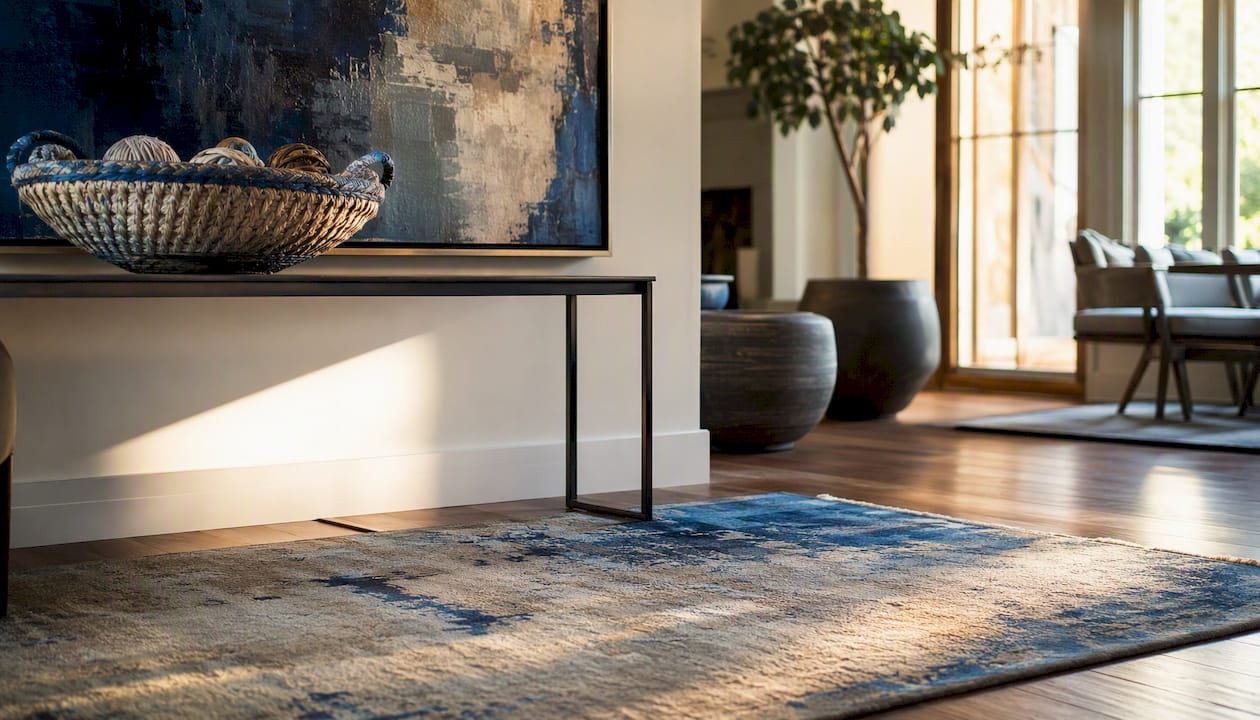
Contemporary commentary on patronage frames it as sustaining potential rather than filling need, and that framing resonates with how the best interiors feel. There is a quietness to well-patronized work, a sense that the object arrived in the room because it was right rather than because it was available. Many patrons I admire prefer to keep that support private, not because they are modest, but because the work itself is the statement.
Commissioning a hand-knotted rug or a bespoke wallpaper is a small act of patronage with a long reach. It keeps a technique alive, it gives a maker the confidence to experiment, and it produces something your home will carry with integrity for decades.
Bring your interior to life with a Kevin Francis Design commission
Kevin Francis Design offers custom rug and textile commissions for homeowners and interior designers who want artisan-made pieces conceived specifically for their spaces.
The commissioning process is straightforward. Share your room dimensions, palette, and a few inspiration images. The studio will propose design directions drawn from collections like the Lotto Hand-Knotted Wool Area Rug, the Knossos Hand-Tufted Maze Rug, the CHROMA Solid Color Wool Rug, and the Cairene Hand-Knotted Wool Area Rug. Each piece can be customized in scale, palette, and pile technique, hand-knotted or hand-tufted to your brief. Before reaching out, prepare your room dimensions, a budget range, and a sense of the emotional register you want the piece to hold. Read more about how custom rug commissions work to understand the full process, then contact the studio to begin.
Sources
These sources cover the history of patronage, its modern forms, and the practical side of commissioning art and textiles for interiors.
- Patronage in the 21st Century: The New Luxury of Private Support
- Patronage
- From Mesopotamia to 1980s New York, the History of Art Patronage in a Nutshell
- Patrons, interiors, and identity (University of Glasgow ePrints)
- Artists & interior design (CityFurnish blog)
- Art selection for interior design and interior designers
- Design solutions: Building up an art collection - Falchi Interiors
FAQ
What does patronage mean in art?
Art patronage means providing financial or influential support to an artist or creative practice, historically without requiring a specific deliverable in return. It differs from sponsorship in that the patron’s primary goal is to sustain the artist’s work rather than to receive a branded or commercial benefit.
What are some famous examples of art patronage?
The Medici family of Renaissance Florence are the most cited example, funding artist-architect collaborations that produced frescoed chapels, sculpted courtyards, and furnished interiors across the city. Patronage stretches back further still, from Mesopotamian temple commissions through medieval guilds to twentieth-century private foundations like Peggy Guggenheim’s.
Are art patrons still a thing today?
Yes, and the model has quietly expanded. Modern patronage tends to be private and practice-focused, with individuals funding studio time, residencies, or limited-edition series rather than seeking public credit. Corporate mécénat programs also support craft ateliers and design studios whose work feeds directly into hospitality and residential interiors.
What is the patronage of arts and architecture?
Patronage of arts and architecture refers to the sustained support of artists, architects, and craftspeople by individuals, institutions, or corporations, enabling works that shape both cultural life and built environments. Historically, patrons used interior commissions to display status and cultivate new forms of private life, a tradition that continues today whenever a homeowner commissions a bespoke rug, mural, or architectural detail rather than selecting a mass-produced alternative.
How do I commission a bespoke rug as a form of patronage?
Start by preparing your room dimensions, a palette reference, and a brief describing the emotional register you want the piece to hold. Kevin Francis Design’s commissioning process moves from brief through sampling and artisanal production to installation, with hand-knotted and hand-tufted options available in custom sizes.


