


Art collector inspired interiors fall into five signature looks, and knowing which one you want before you lift a hammer changes everything. The five are: the dramatic single statement (one oversized work commanding a room), the salon hang (a dense, floor-to-ceiling gallery wall), the neutral museum canvas (restrained palette, art as the only color), the color-led room (soft furnishings and art in deliberate chromatic conversation), and the site-specific sculpture or installation (a three-dimensional work that reshapes how you move through a space). Each look has its own logic, its own spatial requirements, and its own emotional register.
Two measurements apply across all five looks. Gallery standard places the center of any artwork at 57–60 inches from the floor, which aligns with average standing eye level. Between the top of a sofa or console and the bottom of the artwork above it, keep roughly 12 inches (about 30 cm) to maintain a cohesive visual link without clutter. Tighter feels cramped; looser breaks the visual connection between furniture and art.
Pro Tip: Before browsing any further, photograph your wall with a tape measure in frame. Knowing your exact dimensions lets you match examples to your space rather than falling for proportions that won’t translate.
The examples below are drawn from published designer projects and editorial roundups. Each one is labeled by look so you can scan directly to the type that fits your home or client brief.
Table of Contents
- 1. Examples of art collector inspired interiors worth studying first
- 2. Core display principles that make art feel integrated
- 3. Which stylistic approach suits your collection?
- 4. How to recreate a collector-inspired look at home
- 5. How artisan rugs anchor collector interiors
- 6. How to source and authenticate art for your collection
- 7. Maintenance and preservation for displayed artworks
- 8. Furniture and decor that highlight your art collection
- 9. How art shapes the emotional experience of a room
- Key Takeaways
- Why the best collector interiors are never finished
- The right textile foundation for your collector interior
- Useful sources
- FAQ
1. Examples of art collector inspired interiors worth studying first
The richest source of collector-inspired rooms in print remains Architectural Digest’s AD PRO Directory roundups, which gather projects where art was specified before furniture, not after. That sequencing shows in every image: sightlines open toward the work, lighting is deliberate, and the furniture exists to frame rather than compete.
| # | Project / Designer | Look | Why It Works |
|---|---|---|---|
| 1 | AD PRO: Loft with floor-to-ceiling abstract canvas | Dramatic statement | Single 8-ft work anchors an open plan; neutral sofa sits 12 in below frame |
| 2 | AD PRO: Brooklyn brownstone salon wall | Salon hang | Mixed frames, consistent center line at 57–60 in, warm picture lights |
| 3 | AD PRO: Minimalist gallery apartment | Neutral canvas | White plaster walls, single sculpture on plinth, no competing color |
| 4 | AD PRO: Color-led dining room | Color-led room | Cobalt painting echoed in upholstery; rug pulls both tones to the floor |
| 5 | AD PRO: Entry foyer with site-specific mural | Site-specific | Mural wraps two walls; furniture is low-profile to preserve the sweep |
| 6 | Fairfax Dorn, Hamptons home | Unexpected context | Art placed in domestic rooms rather than gallery-white settings |
| 7 | Axel Vervoordt–curated collection | Intuitive mix | Objects from different eras grouped by emotional resonance, not period |
| 8 | Carl Gambino & Sarah Ivory, Brooklyn Heights | Visual autobiography | Collection built over years; each room reflects a chapter of the owners’ lives |
| 9 | Thomas Crauwels chalet gallery | Sequenced parcours | Works centered roughly at average standing eye level, arranged for a walking viewing rhythm |
| — | Kevin Francis Design: Lotto rug in collector living room | Textile anchor | Hand-knotted wool grounds a gallery wall; pattern scale balances large canvases |
“Placing art in unexpected domestic contexts enlivens both the work and the interior. Context and light are everything.” — Fairfax Dorn, as reported by Cultured Magazine
“Focus on human expression and intuitive connections between objects rather than rigid stylistic matching.” — Axel Vervoordt, as cited by Christie’s
Pro Tip: When studying these examples, note where the rug’s edge falls relative to the seating group. In nearly every successful collector room, the rug defines the conversation zone and the art defines the wall above it — two separate but coordinated frames.
2. Core display principles that make art feel integrated
The rules that professional curators use are not arbitrary. They exist because the human eye has predictable habits, and gallery-standard hanging height of 57–60 inches aligns the center of the work with where most adults’ gaze naturally settles. In domestic rooms with lower ceilings or seated viewing, you can drop the center slightly, but the principle holds: the eye should meet the work without tilting.
Placement and scale:
- Hang the center of any single work at 57–60 in from the floor; for a salon hang, treat the center of the entire grouping as the 57–60 in point.
- Maintain roughly a 12-inch (30 cm) gap between the top of a sofa, console, or headboard and the bottom of the artwork above it to ensure visual connection.
- For large walls (over 8 ft wide), one anchor piece at two-thirds the wall’s height reads more confidently than a small work centered on a vast expanse.
- For smaller walls, a grid or salon grouping fills the space without the work looking lost.
Lighting:
Layered lighting separates collector interiors from ordinary decorated rooms. Track lighting with adjustable heads lets you angle beams at 30 degrees to the wall surface, which minimizes glare while modeling texture. Picture lights mounted directly to frames add warmth and intimacy. LED strips behind plinths or shelving create a floating effect for sculpture. Homes & Gardens notes that mixing frame styles is acceptable, even desirable, as long as lighting is consistent across the grouping.
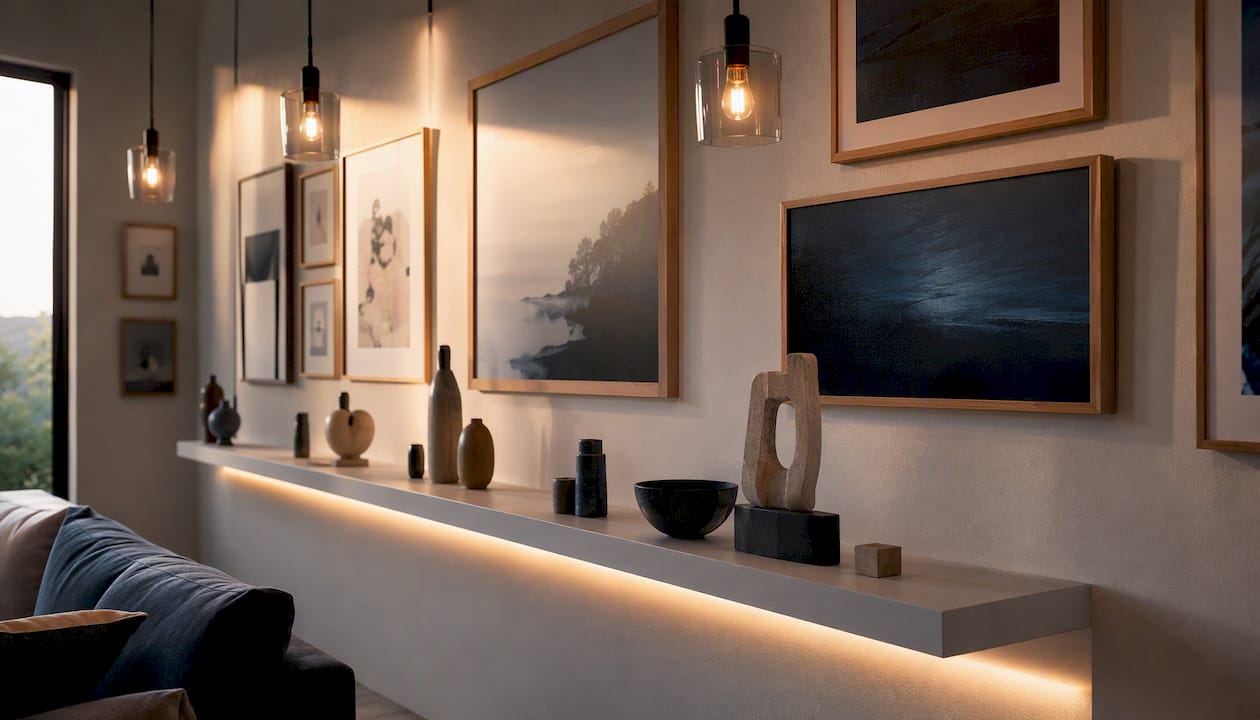
Direct sunlight is the single greatest threat to works on paper, photography, and textiles. UV-filtering glazing is the minimum standard for anything light-sensitive. For paintings, keep them away from south-facing windows unless the room has UV-filtering film on the glass.
Pro Tip: Use a laser level rather than a tape measure alone when installing a salon hang. Mark the 57–60 in center line across the full wall first, then build the grouping symmetrically above and below that line.
3. Which stylistic approach suits your collection?
The Agency Art House describes the most sophisticated collector interiors as treating art as architecture: works define circulation, control light, and establish volume rather than arriving as a finishing touch. That framing clarifies the five approaches.
| Approach | Best for | Key characteristic | Watch out for |
|---|---|---|---|
| Dramatic single statement | Open-plan rooms, double-height walls | One oversized work; everything else recedes | Scale mismatch if the work is too small |
| Salon hang | Traditional rooms, stair runs, libraries | Dense grouping; mixed frames and media | Inconsistent center line ruins cohesion |
| Neutral canvas | Minimalist or Scandinavian interiors | White or stone walls; art is the only color | Can feel cold without a warm textile anchor |
| Color-led room | Eclectic or maximalist interiors | Palette drawn from the art into soft furnishings | Over-matching kills the tension that makes it work |
| Site-specific / sculptural | Entry halls, double-height spaces | Work commissioned for or responding to the room | Requires early coordination with architect or designer |
The salon hang is the most forgiving for collectors who acquire over time, because new works can be added without redesigning the wall. The neutral canvas approach demands the most discipline: every object in the room competes with the art, so furniture must be chosen with the same care as the works themselves.
Pro Tip: When mixing frame finishes on a salon wall, limit yourself to two metal tones (e.g., brass and black) or two wood tones (e.g., natural oak and ebony). Three or more finishes read as accidental rather than curated.
Architectural details can reinforce any of these approaches. Interior doors treated as focal points — through paint color, hardware, or material — create natural frames that guide the eye from room to room, extending the collector’s narrative beyond the walls where art hangs.
4. How to recreate a collector-inspired look at home
Loftmap’s guidance on home galleries makes a useful point: a home gallery doesn’t need to feel like a museum. Choosing a loose theme, mixing media, and creating narrative sequences between rooms is enough to give a collection coherence.
- Anchor the scheme with a rug or textile. A handcrafted rug like the Lotto Hand-Knotted Wool Area Rug from Kevin Francis Design establishes the color dialogue between floor and wall, grounds the furniture group, and gives the eye a place to rest between artworks.
Measurements designers use for common scenarios:
| Scenario | Center height | Gap above furniture | Notes |
|---|---|---|---|
| Sofa wall | 57–60 in | 12 in above sofa back | Measure from finished floor |
| Entry foyer | 57–60 in | N/A (no furniture) | Consider sightline from front door |
| Stair run | Follow stair pitch | 12 in above handrail | Center line follows the stair angle |
| Dining room | 57–60 in | 12 in above buffet | Lower if artwork is viewed seated |
Pro Tip: For a stair run, draw the stair pitch angle on paper and align each work’s center to a line parallel to the stairs. The spacing between frames should be equal, measured diagonally along the stair pitch, not horizontally.
5. How artisan rugs anchor collector interiors
A handcrafted rug does three things no painting can: it establishes the room’s scale from the ground up, introduces tactile warmth that balances the visual intensity of a gallery wall, and creates a color bridge between the art and the furniture. Sourcing and pairing textiles thoughtfully is one of the highest-leverage decisions in a collector interior.
- A rug’s pattern scale should relate to the dominant artwork. A large-format abstract painting pairs with a rug that has a bold, open repeat; a dense salon hang calls for a quieter ground.
- Wool pile absorbs sound, which matters in rooms with hard floors and large canvases that would otherwise feel acoustically harsh.
- The rug’s palette should echo one or two tones from the collection, not match them exactly. Exact matching flattens the room; a near-echo creates depth.
The Lotto Hand-Knotted Wool Area Rug from Kevin Francis Design is hand-knotted using traditional techniques, with a pattern scale and color range suited to both neutral-canvas and color-led collector rooms. Its wool construction also means it can be custom-sized to fit the precise footprint a designer specifies.
One conservation note: avoid placing rugs directly against damp exterior walls or under artworks stored at floor level, as moisture trapped beneath wool pile can migrate upward.
Pro Tip: Roll out the rug before hanging any art. The rug’s color and pattern will tell you immediately which tones in your collection to emphasize and which to let recede.
6. How to source and authenticate art for your collection
Sourcing well is the foundation of any collector interior. Reputable auction houses — Christie’s, Sotheby’s, and Phillips among them — provide condition reports and provenance documentation as standard. For emerging work, galleries affiliated with the Art Dealers Association of America (ADAA) follow a code of ethics that includes provenance disclosure.
Authentication matters most for secondary-market purchases. Request a certificate of authenticity, a provenance chain tracing ownership back to the artist or estate, and any exhibition history. For works above a certain value, an independent appraiser certified by the American Society of Appraisers (ASA) can verify both authenticity and fair market value.
As Observer’s interviews with collectors Carl Gambino and Sarah Ivory illustrate, the most satisfying collections are built over time, with each acquisition reflecting the owner’s biography rather than a single shopping moment. Buy what genuinely moves you, document everything, and let the collection grow organically.
For guidance on choosing the right art piece for a specific room or context, scale, narrative, and material should all factor into the decision alongside provenance.
7. Maintenance and preservation for displayed artworks
Conservation is not a one-time decision. It’s an ongoing practice that determines whether a collection holds its value and visual integrity over decades.
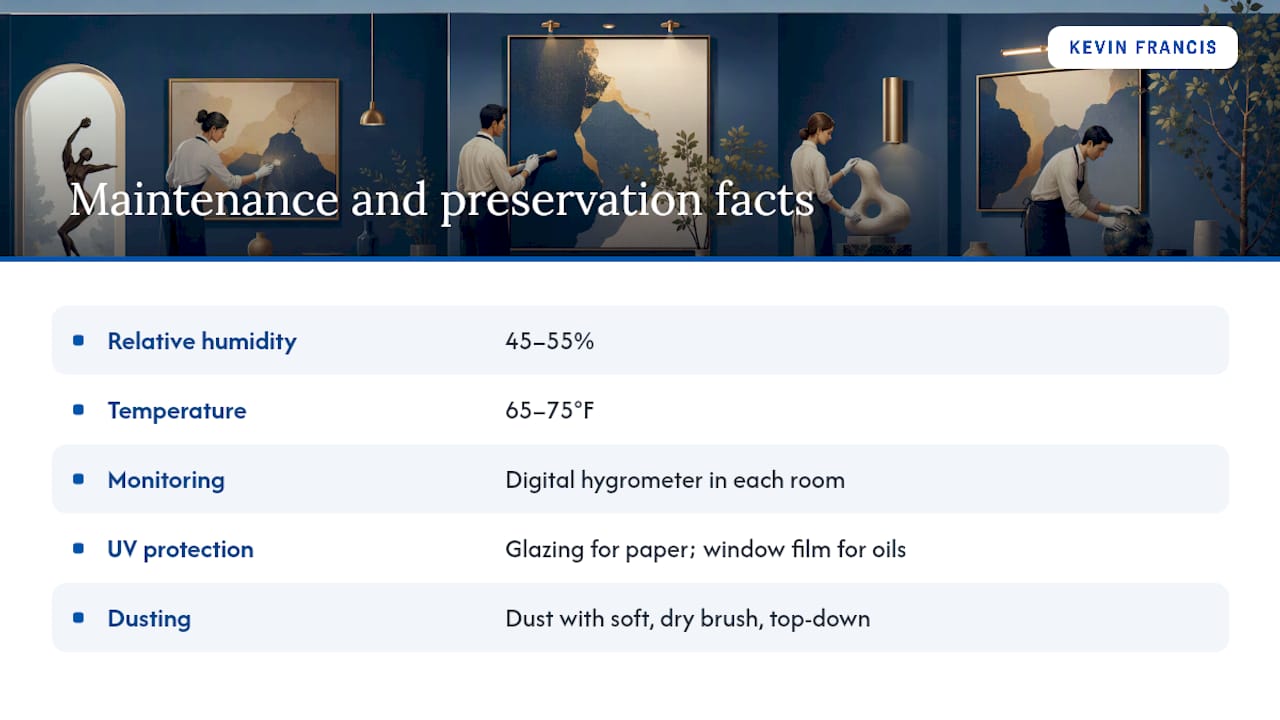
Maintain indoor relative humidity between 45% and 55% and temperature between 65°F and 75°F. Fluctuations outside these ranges cause canvas to expand and contract, which eventually leads to cracking. A simple digital hygrometer in each room where art hangs costs very little and catches problems early.
UV-filtering glazing is standard for works on paper, photography, and textiles. For oil paintings, UV-filtering film on nearby windows is preferable to glazing the painting itself, which can trap moisture. Dust paintings with a soft, dry brush rather than a cloth, working from the top of the canvas downward. Never use cleaning products on original surfaces without consulting a conservator.
Professional wall preparation matters more than most collectors realize. Walls with moisture issues, poor plaster, or inadequate anchoring points can damage works through vibration, humidity migration, or outright failure of the hanging system. Address the wall before the art goes up.
Rotate light-sensitive works every six to twelve months, and keep a simple log of which works have been displayed and for how long.
8. Furniture and decor that highlight your art collection
The furniture in a collector interior exists to serve the art, not to compete with it. That doesn’t mean furniture must be invisible, but it does mean every piece should be chosen with the collection in mind.
Low-profile sofas and benches keep sightlines open to large canvases. Upholstery in neutral linen, wool, or velvet in stone, warm white, or deep charcoal reads as a backdrop rather than a statement. Occasional chairs in a bolder tone can echo a color from the collection without overwhelming it.
Plinths and pedestals for sculpture should be proportional: a plinth that’s too tall makes the work feel precarious; one that’s too short buries it. A standard starting point is a plinth height that places the work’s visual center at roughly 57–60 inches, consistent with hanging-height logic.
Shelving and ledges offer a flexible alternative to fixed hanging for smaller works and objects. They allow easy rotation and can accommodate three-dimensional pieces alongside framed works. Wall-decor tactics that work at different scales are worth reviewing before committing to a fixed installation.
9. How art shapes the emotional experience of a room
Art in a domestic interior does something that furniture alone cannot: it introduces a human presence, a point of view, an emotional frequency. Rooms with strong collections tend to feel inhabited in a way that purely decorated rooms do not.
Collectors who design spaces for emotional effect tend to place their most personally significant works where they spend the most time, not where guests will see them first. A painting that carries a memory or a feeling belongs in the room where you’ll live with it daily, not in the entry hall where it performs for visitors.
Color temperature in lighting amplifies this effect. Warm-white LEDs (around 2700K) make oil paintings glow and give a room a sense of evening intimacy. Cooler light (3000K–3500K) suits works on paper and photography, rendering detail more crisply. The choice of color temperature is as much an emotional decision as a technical one.
Luxury interiors communicate something about the people who inhabit them, and a well-curated collection is one of the most direct expressions of that. The art you choose, and how you choose to live with it, tells a story that no decorator can write for you.
Key Takeaways
Art collector inspired interiors succeed when placement, scale, lighting, and textiles work together as a system rather than as separate decisions.
| Point | Details |
|---|---|
| Use gallery hanging height | Center every artwork at 57–60 in from the floor; treat a salon grouping’s center the same way. |
| Maintain the 12 in furniture gap | Keep roughly 12 in between the top of any sofa or console and the bottom of the artwork above it. |
| Layer your lighting | Combine track lighting, picture lights, and LED accents; match color temperature to media type. |
| Anchor with a handcrafted rug | A wool rug establishes scale, color dialogue, and tactile warmth that gallery walls alone cannot provide. |
| Kevin Francis Design for textile anchoring | The Lotto Hand-Knotted Wool Area Rug offers custom sizing and a pattern scale suited to both neutral-canvas and color-led collector rooms. |
Why the best collector interiors are never finished
The conventional wisdom says: collect what you love, then decorate around it. That’s half right. What it misses is that the relationship between a collection and its setting is alive. The room shapes how you see the work; the work shapes how the room feels. Neither is static.
What I find most compelling about the collector interiors that genuinely move people is that they carry evidence of time. A salon wall that has been rearranged, a rug worn soft at the center, a plinth repositioned to catch better light — these are signs of a living relationship with objects, not a finished installation. The rooms that feel most like museums are often the least interesting to be in.
Textiles are where I see this most clearly. A handmade rug is not a neutral surface. It has a pattern, a weight, a color history. When it’s chosen with the same care as the art above it, the room stops being a display and starts being a place. That’s the distinction worth chasing.
The right textile foundation for your collector interior
Choosing art is the inspired part. Grounding it in a room that holds the collection well is the craft. Kevin Francis Design offers handmade artisan rugs, including the Lotto Hand-Knotted Wool Area Rug, designed with the pattern scale and material depth that collector interiors demand. Each rug is available in custom sizes, so the footprint fits your specific floor plan rather than the nearest standard dimension.
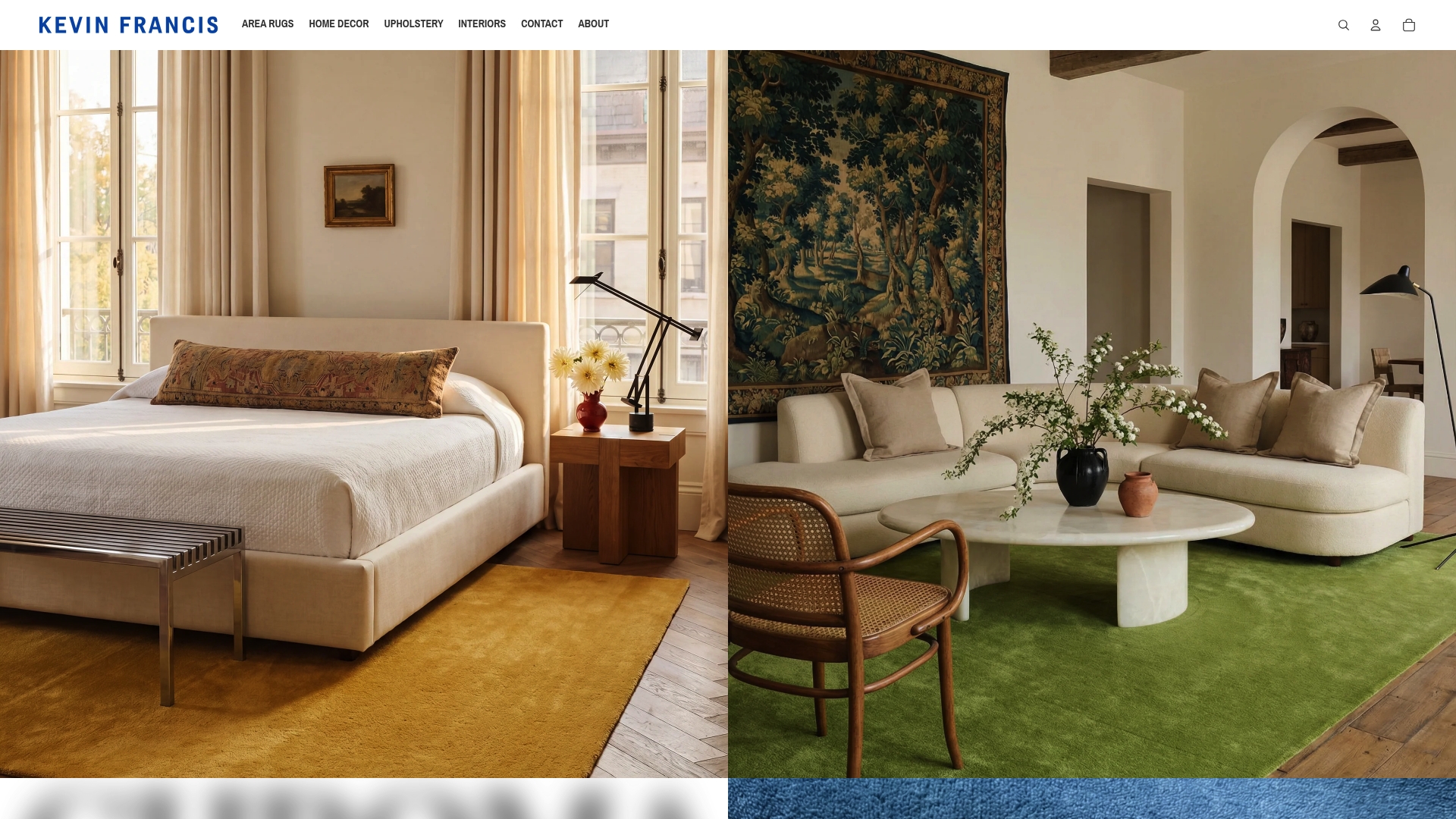
For collectors and designers who want a textile that holds its own beside significant works, Kevin Francis Design also offers custom design consultations for bespoke rugs and home textiles. Visit Kevin Francis Design to browse the full collection or inquire about a custom commission.
Useful sources
Further reading and references that informed the placement rules, project examples, and curation principles in this article:
- Curate Your Personal Art Collection: A Complete Home Guide | Form & Taste
- How to Curate Art for a Luxury Home (Beyond Interior Design) — The Agency Art House
- Creating an Art Gallery at Home: Showcasing Personal Collections | Loftmap
- Onzea Govaerts collection curated by Axel Vervoordt | Christie’s
- Art collector interviews: Carl Gambino & Sarah Ivory | Observer
- 15 rules artists and designers say you must follow when displaying artwork | Homes & Gardens
- Fairfax Dorn collection and Hamptons home | Cultured Magazine
- Private gallery in a chalet: parcours artistique | Thomas Crauwels
- 14 Art-Filled Interiors We Love From AD PRO Directory Designers | Architectural Digest
Photographer and designer credits for project images should be added by the editor at publication, referencing the original sources above.
FAQ
What is the standard hanging height for art in a collector interior?
Gallery practice places the center of any artwork at 57–60 inches from the floor, aligning with average standing eye level. For a salon grouping, treat the center of the entire arrangement as the 57–60 in point rather than centering each individual work.
How much space should I leave between a sofa and the artwork above it?
Keep roughly 12 inches (about 30 cm) between the top of the sofa back and the bottom of the frame. This gap maintains a visual connection between furniture and art without making the work feel like it’s floating away from the room.
What kind of rug works best in a collector-inspired interior?
A hand-knotted wool rug with a pattern scale that relates to the dominant artwork tends to work best. The Kevin Francis Design Lotto Hand-Knotted Wool Area Rug is available in custom sizes and offers the material depth and color range suited to both neutral-canvas and color-led collector rooms.
How do I protect displayed artworks from light damage?
Use UV-filtering glazing for works on paper, photography, and textiles. For oil paintings, apply UV-filtering film to nearby windows rather than glazing the canvas itself. Rotate light-sensitive works every six to twelve months and maintain indoor humidity between 45% and 55%.
What is the difference between a salon hang and a single-statement approach?
A salon hang fills a wall with a dense, mixed grouping of frames arranged around a shared center line. A single-statement approach uses one oversized work as the room’s focal point, with all other elements receding around it. Salon hangs suit collectors who acquire over time; single statements suit those with one defining work.


