

Designer rugs are tactile narratives, objects that communicate culture, memory, and artistic vision through every knot, fiber, and motif woven into their surface. Understanding how designer rugs tell creative stories transforms the way you select and live with these pieces. A rug is no longer just a floor covering when you recognize that its pattern encodes a symbolic language, its materials simulate light and architectural texture, and its weaving technique carries emotional weight. From Kengo Kuma’s architecture-inspired Faces collection to the semiotic richness of southern Algerian tribal carpets, the finest designer rugs function as intimate canvases of meaning placed beneath our feet.
How designer rugs tell creative stories through architecture and texture
The most arresting contemporary example of storytelling through rugs comes from architect Kengo Kuma’s collaboration with Jaipur Rugs, presented at Milan Design Week 2026. Kuma’s Faces collection translates facade expressions into layered textile forms, using wool and regenerated viscose to portray the light, texture, and rhythms of architecture underfoot. This means a single rug can shift in appearance as daylight moves across a room, the way a building’s surface changes from morning to dusk.
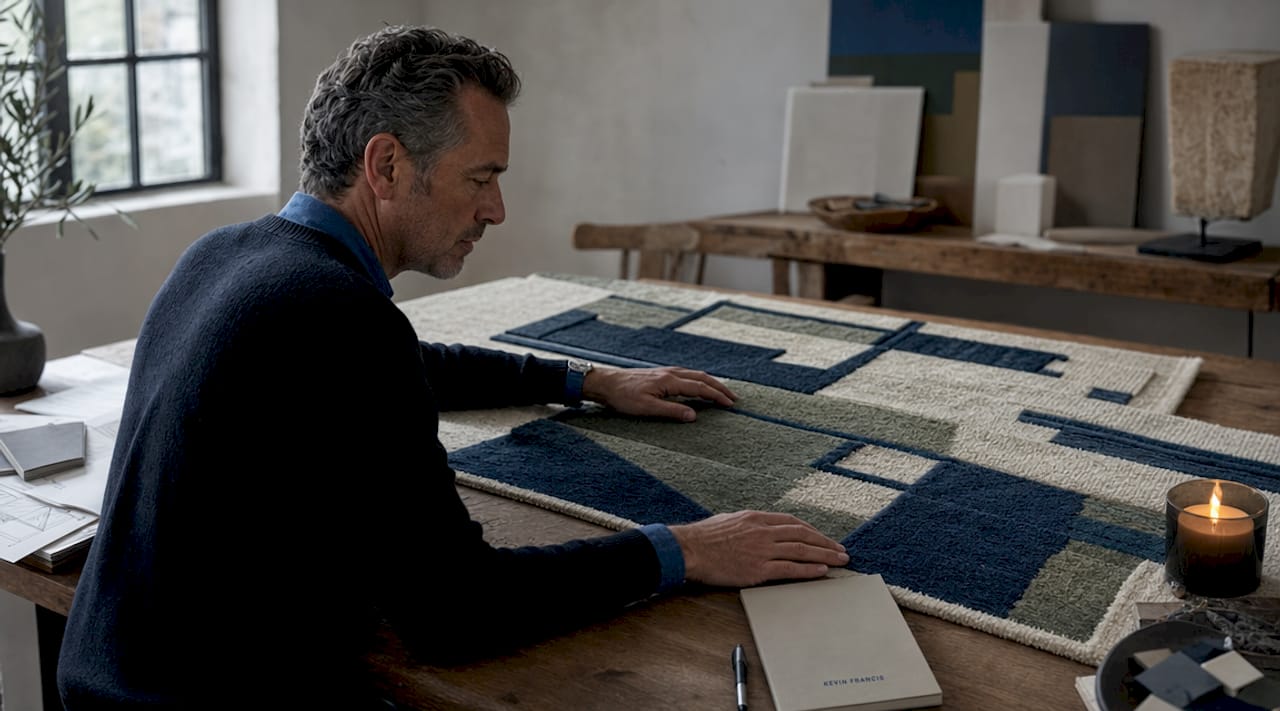
Kuma himself sees the collaboration as capturing fleeting architectural expressions through hand weaving, treating the finished piece as tactile memory rather than literal replication. That distinction matters enormously for homeowners. A rug inspired by architecture does not simply depict a building. It recreates the feeling of standing before one, the sense of depth, weight, and quiet grandeur.
The Faces collection achieves this through several deliberate design choices:
- Palette restraint: Sand, clay, and layered grays with a single green accent create a shifting perspective and depth that rewards slow, attentive looking.
- Pile height variation: Different pile heights catch light at different angles, producing a wash of shadow and brightness that mimics the play of sunlight on a textured facade.
- Material contrast: Wool provides warmth and matte depth, while regenerated viscose introduces a subtle sheen, the two fibers working together like rough stone beside polished glass.
- Layering techniques: Overlapping structural elements create a sense of planes receding into the weave, giving the rug genuine visual depth rather than a flat printed pattern.
Pro Tip: When placing an architecturally inspired rug, position it where natural light crosses it at an angle during the day. The shifting shadows will activate the pile’s depth and reveal the full narrative the designer intended.
Understanding luxury rug fiber types is the first practical step toward appreciating how material choices shape the story a rug tells. Wool, silk, viscose, and cotton each carry different visual and tactile qualities that designers select with the same intentionality a painter brings to choosing pigments.
What do traditional rug motifs actually mean?
Decorative textiles and stories have been inseparable for centuries, and nowhere is this more visible than in traditional rug-making cultures. A peer-reviewed semiotic study of 31 southern Algerian carpet motifs found that motifs function as symbolic languages encoding lived experiences, collective memory, and environment rather than serving as literal depictions of the world. This finding reframes how we should look at any traditional rug: not as decoration, but as text.
The research demonstrates that narrative emerges as viewers move their attention across repeated motifs, borders, and abstract symbols, requiring slow reading rather than a single glance. A diamond form may encode protection. A zigzag border may represent water, fertility, or the passage of seasons. Repeated geometric units may map a community’s understanding of the cosmos. The story comprehension develops over time, the longer you look, the more the rug reveals.
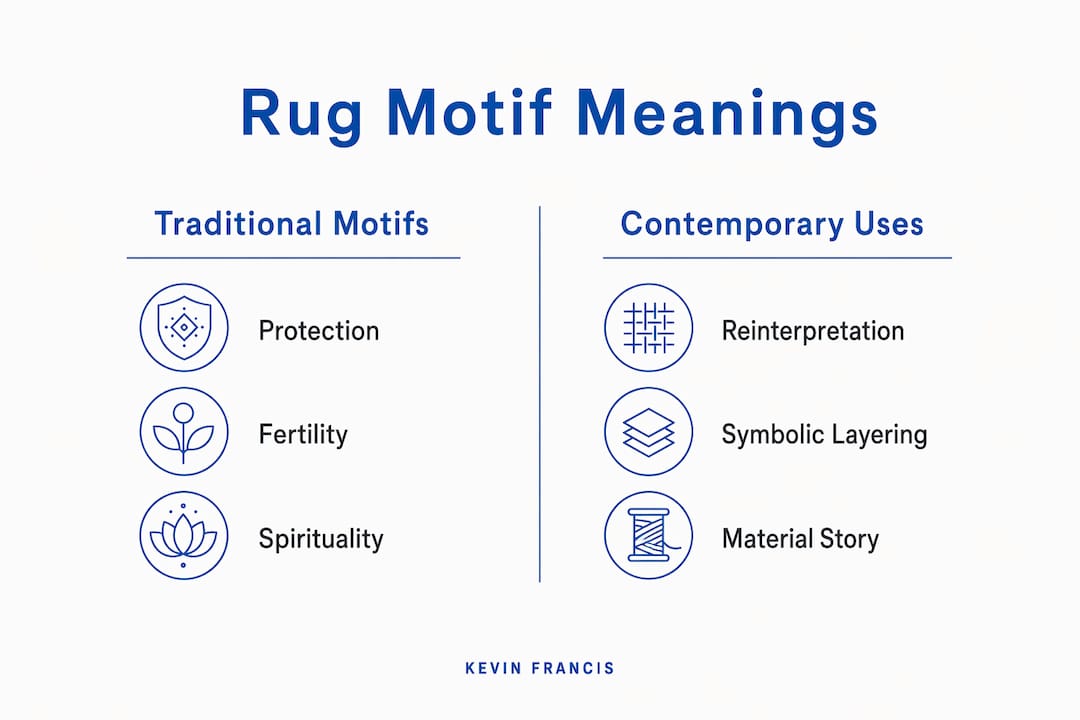
The table below illustrates how common traditional motifs function as symbolic vocabulary across several rug-making cultures.
| Motif | Cultural origin | Symbolic meaning |
|---|---|---|
| Diamond or lozenge | Berber, Anatolian | Protection, femininity, the eye |
| Boteh (paisley) | Persian, Kashmiri | Flame, leaf, or the soul’s journey |
| Tree of life | Central Asian, Caucasian | Connection between earth and sky, family lineage |
| Stylized bird | Moroccan, Tibetan | Freedom, spiritual ascent, the divine |
| Stepped border | Southwestern American, Andean | Mountains, water, the horizon |
This symbolic grammar is not frozen in the past. Contemporary designers draw on it consciously, reinterpreting ancient motifs through modern materials and abstracted forms. At Kevin Francis Design, animal motifs and geometric structures carry forward this tradition of encoded meaning, each pattern chosen for its resonance rather than its decorative convenience. When you select a rug with this awareness, you are not simply buying a floor covering. You are acquiring a piece of visual language.
How weaving technique becomes its own form of storytelling
Artistic expression in rugs does not always depend on pictorial imagery. Technique itself can be the story’s medium, and Doodle and the Gang’s Postcards collection offers a compelling demonstration of this principle. The collection uses pile variation, bevels, and fiber contrast to form an emotional map of cities and memories, communicating feeling without a single representational image.
The contrast between technique-driven and motif-driven storytelling is worth examining directly.
| Storytelling approach | Primary vehicle | Emotional effect | Best suited for |
|---|---|---|---|
| Motif-driven narrative | Symbolic imagery, repeated patterns | Cultural recognition, intellectual engagement | Traditional, eclectic, or globally inspired interiors |
| Technique-driven narrative | Pile height, fiber sheen, bevel edges | Sensory, emotional, atmospheric | Minimalist, contemporary, or architectural interiors |
| Hybrid narrative | Motifs rendered through varied technique | Layered meaning, visual depth | Transitional or art-forward spaces |
The Postcards collection demonstrates that consistent patterning and rhythmic motifs create an emotional map representing cities and memories, guiding the viewer’s eye and feeling across the surface the way a piece of music guides a listener through time. Repetition and rhythm in rug design form narrative structures that shape spatial experience, not just visual appearance.
Tactile contrasts carry particular power in rooms with restrained color palettes. A high-pile section surrounded by close-cropped wool creates a moment of softness within structure, the textile equivalent of a quiet pause in a sentence. Silk or viscose accents catch light differently from matte wool, creating a subtle shimmer that reads as warmth or memory depending on context.
Pro Tip: In a minimalist room, choose a rug whose story lives entirely in its texture. Run your hand across the surface before you commit to a piece. If the tactile variation surprises you, it will continue to reward you every day you live with it.
How to choose a story rug for your home
Selecting a rug for its narrative depth requires a slightly different approach than choosing one purely for color or size. The following steps will help you find a piece whose creative story genuinely enriches your space.
-
Research the rug’s inspiration before you buy. Ask the designer or retailer what concept, place, or cultural tradition informed the design. A rug with a documented creative origin, whether architectural, botanical, or cultural, will hold your attention far longer than one chosen purely on visual appeal.
-
Match the rug’s design language to your room’s mood. An architecturally inspired piece with layered pile and restrained palette suits a room with clean lines and considered lighting. A motif-rich traditional rug with bold geometry belongs in a space that can absorb its visual energy without competing with it.
-
Consider scale as part of the narrative. A large rug with a repeating motif tells a different story at full scale than a small version of the same pattern. The motif’s rhythm and repetition only become legible when the rug has room to breathe.
-
Treat the rug as the room’s anchor, not its afterthought. Rug design inspiration should inform your furniture selection, not follow it. Place the rug first, then build the room’s palette and texture around the story it tells.
-
Invest in artisan rug techniques that age with integrity. Hand-knotted, hand-tufted, and Tibetan-knotted rugs develop a patina over time that deepens their narrative quality. Machine-made rugs flatten and fade. Handmade pieces grow more expressive with use.
Yogesh Chaudhary of Jaipur Rugs articulates this principle clearly: storytelling is core to what separates a luxury handmade rug from a commodity product. The narrative visible in the piece connects the artisan’s hands to your home, spanning geography and time in a way no mass-produced object can replicate.
Key takeaways
Designer rugs tell creative stories through the deliberate combination of motif symbolism, material selection, and weaving technique, and understanding these three channels transforms how you choose and live with them.
| Point | Details |
|---|---|
| Architecture as narrative | Rugs like Kengo Kuma’s Faces collection translate spatial depth and light into tactile, layered textile form. |
| Motifs as symbolic language | Traditional motifs encode cultural memory and belief, requiring slow, attentive viewing to fully decode. |
| Technique as storytelling medium | Pile height, fiber contrast, and bevel edges communicate emotion without any figurative imagery. |
| Story-first selection | Research a rug’s creative origin before buying to find pieces whose narrative will sustain your interest over years. |
| Handmade quality deepens meaning | Artisan techniques like Tibetan knotting and hand-tufting develop patina over time, enriching the rug’s story with use. |
Why I believe every room deserves a rug with a real story
I have spent years working with handmade textiles, and the single most consistent observation I can share is this: rooms anchored by a rug with genuine creative provenance feel different from rooms where the rug was chosen to match the sofa. The difference is not always immediately visible. It is felt.
When a rug carries a real story, whether drawn from an architect’s vision of light on stone, a weaver’s encoding of ancestral memory, or a designer’s emotional mapping of a city, it creates a quiet gravitational pull in the room. People linger. Conversations deepen. The space feels inhabited rather than decorated.
The conventional wisdom in interior design holds that rugs should be neutral, safe, and subordinate to furniture. I disagree with that entirely. A rug is the largest single surface in most rooms and the one closest to human experience. It deserves to be chosen with the same seriousness you would bring to selecting a painting or a piece of sculpture. Alongside bespoke wallpaper and custom textiles, a story-rich rug is one of the most powerful tools available for creating an interior that genuinely reflects who you are.
— Kevin O’Gara
Bring a handcrafted story into your home with Kevin Francis Design
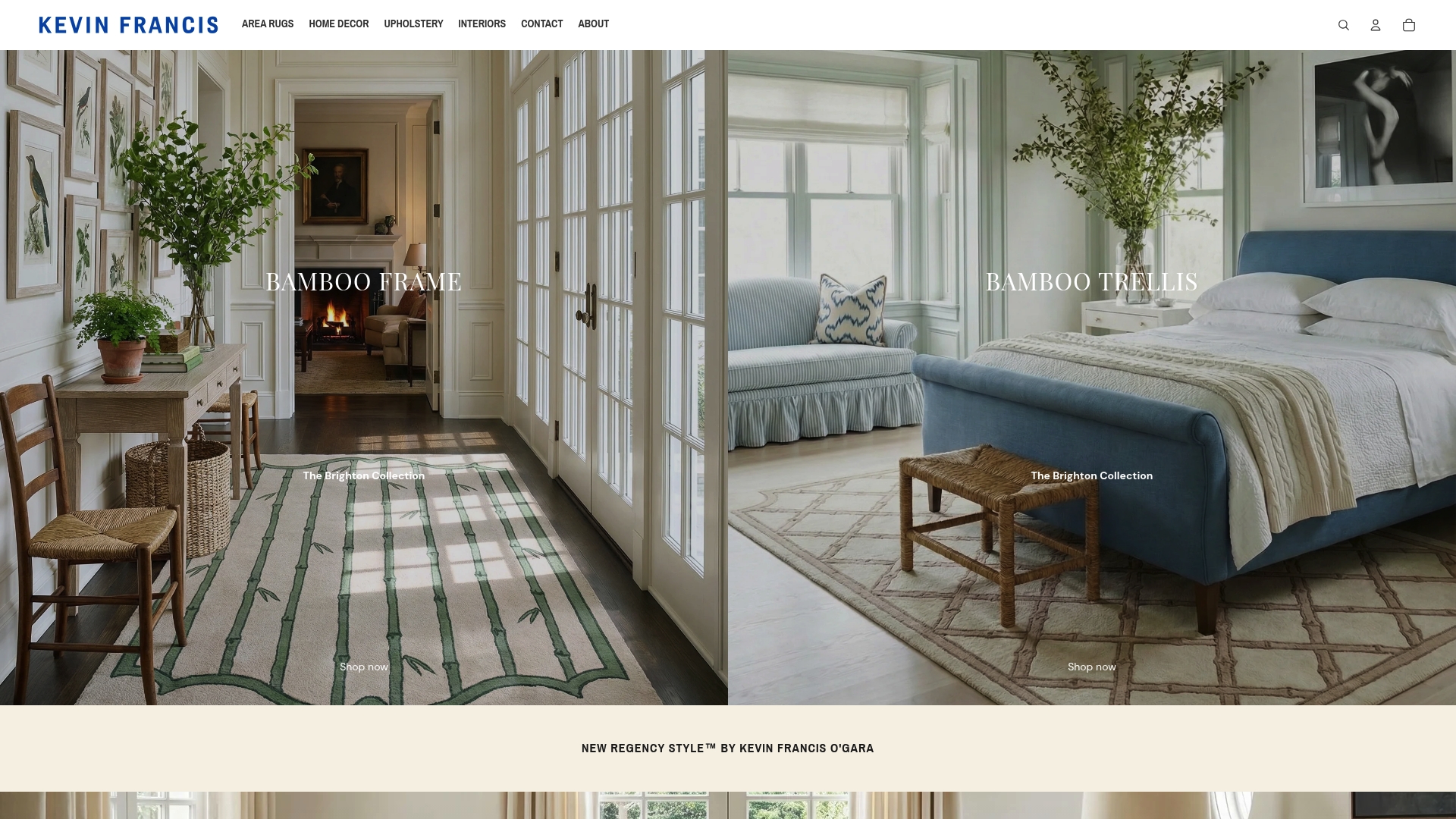
Kevin Francis Design creates handmade luxury rugs whose stories begin long before they reach your floor. Each piece in our collection draws on a specific creative vision, whether inspired by modernist art movements, architectural geometry, or the natural world, and is realized through handweaving, hand-tufting, or Tibetan knotting by skilled artisans. The result is a rug that carries genuine narrative weight, the kind of object that rewards years of living with it. We also offer custom design services for clients who want a piece built around their own story. Browse our full collection of handcrafted luxury rugs and discover the piece that belongs in your home.
FAQ
What makes a designer rug a storytelling object?
A designer rug tells a story through the combination of its motifs, materials, and weaving technique, each element chosen to convey a specific cultural, architectural, or emotional meaning. Unlike decorative prints, handmade rugs encode narrative through physical craft, making the story tactile as well as visual.
How do traditional rug motifs communicate cultural meaning?
Traditional motifs function as symbolic languages, with forms like diamonds, trees of life, and stylized birds encoding beliefs, environments, and collective memory rather than depicting the world literally. Semiotic research shows that the full meaning of these motifs emerges gradually as viewers engage with the pattern over time.
Can a rug tell a story without any pictorial imagery?
Yes. Technique-driven rugs like Doodle and the Gang’s Postcards collection use pile height variation, beveled edges, and fiber contrast to create emotional narratives without any representational motifs. The tactile and visual contrasts alone are sufficient to communicate feeling and memory.
How does material choice affect the story a rug tells?
Wool, silk, viscose, and cotton each carry distinct visual and tactile qualities that shape a rug’s emotional register. Wool reads as warmth and solidity, viscose introduces luminous sheen, and silk creates a jewel-like brilliance. Designers select fiber combinations the way painters select pigments, for their expressive as well as practical properties.
How do I find a rug whose story suits my home?
Research the creative inspiration behind any rug before purchasing, and match its design language to your room’s mood and architecture. Prioritize handmade pieces with documented artisan origins, as these carry the deepest narrative provenance and develop greater character with age.


